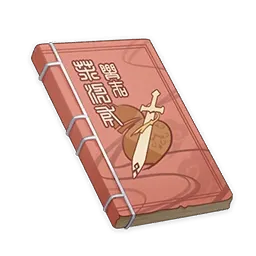
Records of the Gallant is a two-volume Liyue Book Collection released in Version 1.0, with Vol. 2 added in a later patch. Each volume opens with the same self-description: "a compilation of stories and legends of various knights-errant in Liyue. Some of them have been told for a long time but are still popular among the people." [1] Vol. 1 ("The Hermit") is a self-contained folktale of Jueyun Karst. The interesting one is Vol. 2 ("Dust"): its opening paragraph is one of canon's cleanest folk frames for the population shift out of the Guili Plains before Liyue Harbor rose. [2]
Vol. 1 - The Hermit
The volume opens by setting Jueyun Karst as "a mysterious place engulfed in mist all year around" where "myths and legends abound among the herb gatherers, telling of adepti and evil spirits." [1] The framing is explicit: this is herb-gatherer rumour, not roster.
The story follows a herb seller named Qiangu, robbed and bound by brigands at night. As he despairs, a deep voice cuts through the wind: "Arise!" loosens the ropes; "Ascend!" leads him to the summit at dawn, where he finds the brigands themselves bound and hanging from a twisted, withered pine, and an old man with hair and beard "as white as snow" sitting atop a curiously shaped rock as though it were a throne. The old man returns his possessions, refuses every offered courtesy, and accepts only a single Mora, to be repaid one day as a wedding gift to Qiangu's daughter, that he might attend the feast. [1]
The closing frame is the volume's built-in hedge. Qiangu prospers; rumour follows. Some say the old man was later spotted at Yaoguang Shoal disguised as a miner "darting around like the wind between the precipices"; others insist he is a fisherman saving those stranded at sea. "The stories are too many to count, and yet no one knows the old man's name." [1] The hermit is never named, and the text refuses to identify him with any Adeptus or god. [3]
Vol. 2 - Dust
Vol. 2 opens with its most important paragraph: [1]
"The area known as the Guili Plains was once an area lush with Glaze Lilies. But it was beset by troubles on every side, forcing its residents of old to flee, while the prosperity of Liyue Harbor would attract many of those who took their place. But even so, many tales of gallantry continue to circulate in these wilds."
The volume then narrates one such tale: in the dead of night, a maiden in "a long indigo robe" strides along the shallows of the Bishui River, seen only by those who get lost amid summer firefly-lights and can discern the scent of Glaze Lilies amid dancing lights and floating Seelie. Wangshu Inn guests' speculation is preserved as three readings on equal footing: "a lost illuminated beast," "a sole servant of some long-dead god, gently mourning her master only at night," or "simply a gallant hero, like those who spurn civilization, hiding their real names." A hunter eventually encounters her brandishing a sword against several perilous shadows under the moonlight; after an "elegant and sharp dance" the maiden vanishes, leaving behind a pile of bloodied dust. The next day, "the corpses of Millelith and land surveyors" are discovered by the river. The Ministry of Civil Affairs sends search parties; she is never seen again. The closing line is wistful: "the riverbank that maiden had used to roam remains filled with blooming Glaze Lilies to this day." [1]
The Guili Plains exodus, in folk legend
Vol. 2's opening paragraph is one of canon's cleanest folk witnesses to the same population shift before Liyue Harbor that Stone Tablet Compilations: Vol. I narrates from the official side. Zichang's Quest Item on Liyue's history is the primary text on the co-rulership of the Guili Plains era, the relocation south after catastrophe, and the founding of Liyue Harbor. [5] The two texts agree in direction (residents forced to leave; survivors moved south to the rising Harbor) without overlapping on any named principal. Records of the Gallant names no god, no adeptus, and no era, and gives no chronology. It stays folkloric rather than historical.
The Glaze Lily is the volume's one cosmological touch. The flower is associated with a partner Zhongli lost at the end of the Archon War, whose flower "he still tends" (a line from his character page, not a claim Records of the Gallant makes). [4] Vol. 2 names neither her nor any pre-Archon-War lesser deity, and the indigo-robed maiden stays unidentified. She could be a "sole servant of some long-dead god," but the volume holds all three speculative readings on equal footing and lets the legend fade with the countryside villages. Alignment with the era before Liyue Harbor is the strongest claim it sustains; pinning a named institution, god, or knight to her is reader inference. Vol. 1's "adepti and evil spirits" phrasing is the same herb-gatherer rumour and names no Adeptus either. [3] The compiler records the wilds and leaves whatever walked them unnamed.