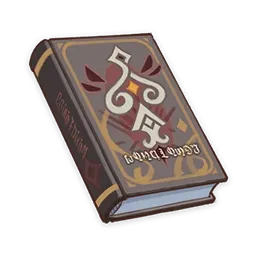
The Mondstadt Tower is a single-volume Mondstadt Book Collection, retrievable from the Grand Master's Office in the Knights of Favonius Headquarters or from Patchi the Curious at the Thousand Winds Temple. Its standing description frames it as "a historic romance novel," and the opening lines ("In the age of depression and tyranny, the outlander girl met the ominous orphan. Does this fateful encounter foretell a tragic ending?") set the tone: a tragedy declared as a tragedy from the first page, then broken off after a single volume on a balcony in the moonlight. The cover and spine read "Mond Tower" in the Teyvat Language. [1]
"In the time of the aristocrats" - the in-fiction setting
The narrative is set squarely in Mondstadt before Vennessa's rebellion: "in the time of the aristocrats, there stood a high tower in Mondstadt's plaza", a tower "built to honor Barbatos the Anemo Archon in name, yet in reality it was nothing more than a flamboyant display of wealth and power by the royal to gloat over the commoners." This is the age of depression and tyranny, and the text names three forces at work: "the tyranny of the nobles, the poverty of the commoners, and the ravage of the dragon," over which presides "the self-proclaimed 'orthodox' church - a mere figurehead, controlled by the ruling class," which "advocated abstinence from earthly pleasure to avert divine punishment" and had restricted even "the harp which symbolized the wind" to playing only "holy" songs. The omniscient frame says it plainly: "in the dark ages the Anemo Archon slept." [3]
The one yearly reprieve, says the text, was Ludi Harpastum, the festival at which the volume's events begin.
The triad - Inès, the Seneschal, Octave
A wandering singer arrives at one Ludi Harpastum; "the name of the lass was Inès, and everyone at the festival was enchanted by her stunning beauty," with people "of all ages and all walks of life" crowding to hear her foreign ballads and watch her throw the Harpastum. As she sings, she hands her festival earnings to "the poor and orphans in the city," preaching the verse the book quotes directly:
"The blessings of Barbatos are for everyone! You are only sinful if you are bitter at such a joyous occasion!"
In the crowd stands a frail figure, the Seneschal. He falls for her at first sight, and the text is careful with the specifically Hugoesque texture of the moment: "his religious piety filled him with a frustration at his inability to suppress the emotions he was experiencing, and her acts of charity, which violated the Church's right to aid the poor, irked him all the more." He decides ("To let her stay in the city is to bewitch all its inhabitants. What wickedness will this witch bring?") to abduct her under cover of the festival's traditional three-day royal protection, "to confine her to the Cathedral while awaiting further instructions."
He sends his adopted son. The book introduces him in a single paragraph that is the volume's strongest signal of its source material:
"Octave was an unwelcome child, abandoned by his superstitious parents at birth and later raised by the Seneschal. As a child, he was persecuted and abused by the citizens, seen as a bad omen of draconic disasters. The only person who protected Octave was the Seneschal, who treated him like his own son and thus won his utmost trust."
Octave climbs onto the balcony of the royal court at nightfall, sees Inès weeping in the moonlight, "and his pure heart was stirred, for he had never seen such a wondrous sight." He gazes; "the silence of the tranquil moment shared by Octave and the girl was interrupted by the servants…", and the volume ends.
The Notre-Dame de Paris parable
The book states its own source outright: "This book is based on the French novel The Hunchback of Notre-Dame, written by Victor Hugo." The triad maps cleanly. Frollo becomes the Seneschal, the pious cleric frustrated by his own infatuation, plotting through a deformed orphan ward. Quasimodo becomes Octave, the orphan from birth raised by the priest and persecuted by the citizens as an omen, where the book's "bad omen of draconic disasters" swaps in for Quasimodo's deformity. Esmeralda becomes Inès. The name carries the connection too: "the name 'Inès' has roots dating back to Agnes (Ancient Greek: ἁγνός hagnós, lit. 'pure, chaste'); 'Agnès' is its French equivalent and the real name of the fictional character Esmeralda." In Hugo's novel that Agnès is Esmeralda's baptismal birth-name, the name her mother gave her before she was taken in infancy and re-christened La Esmeralda by the wandering people who raised her. The Mondstadt text places that buried birth-name onto its singer at the surface, so the "outlander girl" arrives already carrying the Hugo-name the gypsies once erased. The cathedral-bell setting becomes the "high tower in Mondstadt's plaza"; Notre Dame's cathedral becomes "the Cathedral" to which the Seneschal plans to confine her. [1]
A parable, not a place
The volume is not a topographical text about a literal tower in present-day Mondstadt city. The tower is the story's stand-in for Frollo's cathedral, set in an era "when the Anemo Archon slept," and the city it describes is the aristocrats' city before the rebellion, not the knights' Mondstadt after Vennessa. Nor is it an official text of the Knights of Favonius. Vennessa founded the order centuries after the narrative's setting, and the Knights are absent from the story; the modern order merely shelves the book in the Grand Master's Office as part of Mondstadt's literary archive. It is a single-volume Notre-Dame de Paris parable: a romance on its cover, a tragedy in its frame, broken off at the very moment Hugo's plot would turn, with the Frollo, Quasimodo, and Esmeralda triad transposed to a Mondstadt under tyranny.