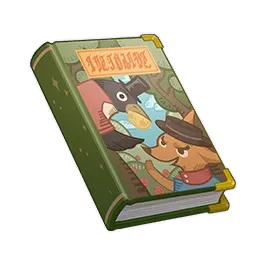
Fables de Fontaine is a 3-volume Fontaine Book Collection released in Version 4.0, the launch patch of Fontaine itself. Each volume opens with the same standing description, "A storybook containing various lore and tales authored by Marie Hericart de La Fontaine, most of which were not written by the author but are compiled from ancient poems which have since been lost," and contains one short prose fable closed by a one- or two-line moral. The collection is a play on the real-world Fables de La Fontaine by Jean de La Fontaine, a 17th-century French fabulist. The matching surname of the in-universe compiler Marie Hericart de La Fontaine is the pun the title rests on. [1]
Vol. 1 - The Maiden and the Sun
The first fable opens with a fox mother at the threshold of her own death ("My girl, little girl, I am standing in my grave. I may soon no longer be able to care for you as I once did"), asking her marriageable adopted daughter to choose a husband. The daughter answers that she will marry "the most powerful being in this world," and the mother runs the chain on her behalf. The Sun defers to the clouds (which block his radiance); the clouds to the wind (which blows them away); the wind to a mountain; the mountain to a mouse who can bore tunnels through it; the mouse to a cat; the cat to a dog; the dog to a wolf. By the time the chain is complete, the fox stands once more before the Sun, and "the young beauty marry the sun." The closing moral runs: "one should accept their destiny, instead of making excuses and trying to evade to the end. No matter how honest, or how cunning, one can never escape the duty one ought to shoulder." The volume is a pastiche of the real-world Aesopic-tradition fable The Mouse Turned into a Maid. [1]
Vol. 2 - The Crow and the Fox
The second fable opens with a crow "perched on a tree, a piece of stolen cheese in its beak," and a fox below the tree pretending concern for the crow's safety. Two opening pitches (that the cheese is "a source of misfortune that anyone sane would avoid like the plague" mismatched to the crow's throat, and that "this cheese is not some valuable delicacy" in the first place) fail to dislodge it. The third pitch is the trap: the fox concedes the crow may eat the cheese if it must, but warns it must not be "swallow[ed] willy-nilly," lest the "recipes I have spent time gleaning from the lands around the world" be wasted. "Suddenly curious, the crow could not help but open its mouth" to ask after the recipes, and the cheese falls. The fox snatches it and burrows back into its nest. The closing moral: "those who seek to discover mysteries that they should not know, shall lose all, even that which they already had." The volume is a pastiche of The Fox and the Crow, the Aesop fable familiar in Western tradition through La Fontaine's own Le Corbeau et le Renard. [1]
Vol. 3 - The Tale of the Donkey
The third fable opens with a framing aphorism ("Even when dressed to the nines, a Plain Jane will rarely be mistaken for a socialite … the only way forward is to know oneself and face one's own flaws") and turns to a donkey envious of the fox of Vol. 2. The donkey decides the fox is no genius, and resolves to copy her trick. He hides in the trees and waits; when the cheesemaker's daughter passes (note the in-universe continuity with Vol. 2's offstage cheesemakers), the donkey bounds out, raises a hoof, and demands she throw away her cheese for swift travel. The daughter is unimpressed: "Oh, you silly donkey! You dare to try to pull my leg? Get me my stick! I'm driving this beast back to the mill!" The closing moral: "trying to be someone else and smothering your own identity, is by no means beneficial. Indeed, it only leads to more suffering." Vol. 3 has no listed real-world Aesop-pastiche source. Its link to Vol. 2 is internal to the compilation rather than a nod to an outside fable. [1]
The compiler-vs-original framing
The volumes share a single standing description: the tales are "authored by Marie Hericart de La Fontaine, most of which were not written by the author but are compiled from ancient poems which have since been lost." That compiler clause was added after launch. The original Version 4.0 framing simply read "A storybook containing various lore and tales, most of which were not written by the author but are compiled from ancient poems which have since been lost": anonymous compilation, lost source-poems, no named compiler. The later update keeps that source-material framing word for word and only appends the named-compiler clause. So the "ancient poems which have since been lost" line is there from launch, while the "authored by Marie Hericart de La Fontaine" attribution is layered on afterward. [2]
What canon confirms, and what it won't name
What holds up is the three-volume Fontaine Version 4.0 structure, the Marie Hericart de La Fontaine compiler attribution from the later description update, the "ancient poems which have since been lost" source-material framing, the three fable texts and their morals as quoted above, and the note naming the Jean de La Fontaine real-world reference along with the two Aesop-pastiche sources for Vols 1 and 2. [1] [2]
What does not hold up, and is left as deliberate ambiguity, is any attempt to pin the source-poems to a specific pre-Fontaine tradition. The book names no in-world literary lineage as its source: not Remuria, not Egeria, not the Domus Aurea musical tradition, not the Narzissenkreuz Institute. The whole point of the framing is that the source-poems are lost and unattributed. It does not engage the post-Remuria partition of Fontaine, which canon attributes to Egeria rather than Focalors, and Marie Hericart de La Fontaine is tied to no other named Fontaine character. She appears as the in-universe compiler of this book, and nowhere else.