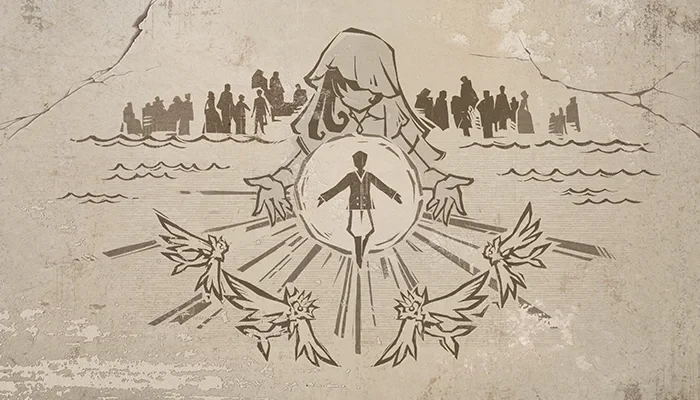
Created as the new heart of the Primordial Sea before Remuria; first Hydro Archon of Fontaine (after Remuria's fall); slain at Tunigi Hollow ~500 years ago during the Cataclysm, her body becoming the Amrita
Overview
Egeria was the original Hydro Archon of Fontaine and one of The Seven.
She gave rise to the Oceanids and shaped Fontaine's people from them.
Celestia condemned that act as Original Sin and sealed her away before her later ascension.
She founded lasting Fontaine institutions, including its rule of law and the Fortress of Meropide.
She died at Tunigi Hollow during the Cataclysm, and her body became the Amrita.
Egeria was the first Hydro Archon of Fontaine, created as a new heart for the Primordial Sea and worshipped under many water-titles including the Mistress of Many Waters and Lord of Amrita. She gave her Oceanid followers human form using water from the Primordial Sea, the act that created the people of Fontaine and the dissolution prophecy Celestia laid upon them. She founded Fontaine's rule of law and the Fortress of Meropide, and named Focalors her successor. She was slain at Tunigi Hollow during the Cataclysm, her body becoming the healing Amrita.
Spoiler-free overview. You hid spoilers under Settings → Reading; choose Show all there to read the full content.
Egeria was the original Hydro Archon of The Seven, also known as the Mistress of Many Waters, Sovereign of the Waters, Mother Goddess, Ruler of Rivers and Seas, Queen of All Waters, and Lord of Amrita, titles of rule over water rather than a seat among the dragon Sovereigns. She is the predecessor of Focalors and the maker of Fontaine's people. [1][4][3] She was the first of the two Hydro Archons; Focalors, the second and last, inherited the seat from her. [37]
In outline:
Naberius (the Shade of Life) created her as the new heart of the Primordial Sea after the original Hydro Dragon was removed. Per Hymns of the Far North Vol. 1, her substance and essence were formed entirely from material originating from Teyvat, and at the time of her creation no divine duty had been assigned to her. [2][29]
1.
Egeria - Genshin Impact Wiki (Fandom) · external ↗
2.
Hymns of the Far North - Genshin Impact Wiki (Fandom) · external ↗
3.
Wings of Merciful, Wrathful Waters - Genshin Impact Wiki (Fandom) · external ↗
4.
Splendor of Tranquil Waters - Genshin Impact Wiki (Fandom) · external ↗
5.
La Chanson d'Erinnyes - Genshin Impact Wiki (Fandom) · external ↗
6.
Fragment of Harmonic Whimsy - Genshin Impact Wiki (Fandom) · external ↗
7.
Vourukasha's Glow - Genshin Impact Wiki (Fandom) · external ↗
8.
Masquerade of the Guilty - Genshin Impact Wiki (Fandom) · external ↗
9.
Secret Keepers and Forbidden Zones - Genshin Impact Wiki (Fandom) · external ↗
10.
When All Return to the Waters - Genshin Impact Wiki (Fandom) · external ↗
11.
A New Star Approaches - wiki Archon Quest page · open page →
12.
Pale Fire - Genshin Impact Wiki (Fandom) · external ↗
13.
Nereides Chapter - Genshin Impact Wiki (Fandom) · external ↗
14.
Diluvies Chapter - Genshin Impact Wiki (Fandom) · external ↗
15.
Welkin Moon Act IX - wiki Archon Quest page · open page →
16.
Khvarena of Good and Evil - Genshin Impact Wiki (Fandom) · external ↗
17.
The Byakuyakoku Collection - Genshin Impact Wiki (Fandom) · external ↗
Canticles of Harmony - wiki World Quest page · open page →
33.
Egeria, Fontaine's True Origin - wiki deep-dive page · open page →
34.
Sovereign-Archon Transition - wiki deep-dive page · open page →
35.
Celestia and the Divine Thrones - wiki deep-dive page · open page →
36.
AQ IV Act V - wiki Archon Quest page · open page →
37.
Hydro Archon - Genshin Impact Wiki (Fandom) · external ↗
38.
Seven Sovereigns - Genshin Impact Wiki (Fandom) · external ↗
39.
A Divergence Leading to Oneself - Genshin Impact Wiki (Fandom) · external ↗
40.
Oceanid - Genshin Impact Wiki (Fandom) · external ↗
41.
Life Flows On (II) - Genshin Impact Wiki (Fandom) · external ↗
42.
The Last Day of Remuria - Genshin Impact Wiki (Fandom) · external ↗
43.
The Opera of Noirceur and Blancheur - Genshin Impact Wiki (Fandom) · external ↗
44.
Meeting Is Also Parting - Genshin Impact Wiki (Fandom) · external ↗
45.
The Truth of What Was - Genshin Impact Wiki (Fandom) · external ↗
46.
Melusine - Genshin Impact Wiki (Fandom) · external ↗
She, not Focalors, made Fontaine's people. In Masquerade of the Guilty Part 5, Opera of Noirceur and Blancheur, she took water from the Primordial Sea and put it into her Oceanid followers' blood vessels to give them human forms. Fontaine's humans are her Oceanids in human shape, carrying Primordial Sea water where ordinary people carry blood. [8][33]
Celestia named the act Original Sin and sealed her away. The dissolution prophecy, that the waters would one day rise and dissolve the people of Fontaine to wash their sins away, begins with that sealing, not with Focalors. [8][10][6]
She returned from her primeval prison at Celestia's command after Remuria's fall and the death of its god-king Remus. She gathered the surviving tribes, mediated their feuds, and instructed them to establish new cities around flowing springs. She was awarded a Gnosis and ascended as the first Hydro Archon of The Seven, commencing an era guided by law which has endured to the present day. [1][7][32]
She founded the Fortress of Meropide for criminals she had exiled and then granted redemption, with its main purpose to stop the path leading to the Primordial Sea, a purpose forgotten over time. [9]
Neuvillette now thinks it "more likely" that the ban on changing another species into a human was hers, "an insurance policy" to keep her people "insulated from the truth." The law stayed in force, unchanged, through Focalors's regime, and the only on-screen enforcement is the Sigewinne case. [13][25]
She died at Tunigi Hollow ~500 years ago during the Cataclysm, fighting the forces of the Abyss; her body transformed into the pure dew of the Amrita. [7]
Greater Lord Rukkhadevata anchored her consciousness, growing the Harvisptokhm from the Amrita to hold it in the Gaokerena lotus within. The Khvarena of Good and Evil WQ Series (Sumeru 3.6) reactivated her consciousness, which unleashed Amrita to extinguish the Sign of Apaosha. [7][16]
The Hydro Archon's authority she had held returned to Neuvillette, the Hydro Dragon, at AQ Chapter IV Act V Masquerade of the Guilty, not AQ Chapter V Act V (Natlan's When All Becomes a Monument). Apep's disclosure at the Heart of Oasis in Welkin Moon Act IX ("the Hydro Dragon has wrested his authority from the hands of the usurpers") is the first acknowledgment from another Sovereign. [8][15][39]
What stays open:
What "truth" the species-change ban kept Fontaine's people "insulated from," if Neuvillette is right that it served Egeria. The likeliest referent is the Oceanid-to-human act, though no line in the Nereides Chapter makes that link; whether anything deeper lies beneath it is not on screen.
Whether the Sustainer (Asmoday) was directly responsible for Egeria's death. Primary text names the forces of the Abyss per Vourukasha's Glow, so reading the Sustainer as her killer is a community interpretation, not grounded in the game's text. None of the three things the Loom of Fate can refer to is named as a factor in her death. [29][31]
What Egeria's last words actually were. The dissolution prophecy is rooted in them per Neuvillette's speculation, but their full text has not been disclosed. The voice-only line in Overture Teaser: The Final Feast is voiced by Egeria but is not identified as her last words in primary text. [10][1]
Whether the species-change prohibition operates symmetrically. Sigewinne is the only on-screen enforcement; whether human-to-melusine or human-to-Oceanid species change is similarly prohibited is not addressed.
Where Egeria came from: Naberius, the Hydro Dragon, and the Primordial Sea
Per Hymns of the Far North Vol. 1, after the unnamed Hydro Dragon was removed from his position as the heart of the Primordial Sea, Naberius (one of the Four Shades, the Shade of Life, now fused with Rhinedottir) created Egeria as the Primordial Sea's new heart. Despite the Heavenly Principles' alien origins, her substance was formed entirely from material originating from Teyvat, and at the time of her creation no divine duty had been assigned to her. The wind glider Wings of Merciful, Wrathful Waters says that heart "had like nobility unto a dragon, but lacked its outer form, and had the majesty of a god, yet was bereft any divine duty." [2][3][29] She was not a Sovereign: Fandom's Seven Sovereigns table does not list her and calls her creation "an exception." The Gnosis and her ascension as Hydro Archon came later. [38]
The Sovereigns are the dragon-kin at the apex of a lineage from the Light Realm. It runs from surface vishaps through the Bathysmal Vishaps up to the elementally pure stock from which a new Sovereign can be born. Egeria was not part of that line. She replaced the removed Hydro Dragon as the Primordial Sea's heart, while the next Hydro Sovereign was meant to be born from the pure Hydro stock of the Enkanomiyan Bathysmal Vishaps. [38] That line broke when they deliberately split into Rimebiter (Cryo) and Bolteater (Electro) strains, per the account of trait selection in the Byakuyakoku Collection Vol. 4, and the break forced the prophesied rebirth of the Sovereign in human form that Neuvillette embodies. [28][17][18][22]
How Egeria made the people of Fontaine
A legend preserved in the Ancient Natural History Excerpts at the Institute of Natural Philosophy says the first Oceanid was born after Egeria shed the "first tear," and all the others came from it. By that legend the Oceanids are her children by creation, not officials she appointed. [1][40] In Life Flows On (II), the last part of the Wishful Drops event quest, the Oceanid scout Endora says her kind "once spread far and wide to rivers, streams, and ponds all over the continent" and "largely served as Fontaine's spies," but that the previous Archon "had no plan to speak of. She merely wished to connect everyone in the world, in much the same way as all water is connected." Endora calls Rhodeia of Loch "the most renowned of us Lochfolk scouts, and also the strongest." [41]
Some of her Oceanid followers eventually desired to live on the surface, having envied human life. Per the Masquerade of the Guilty Part 5 Opera of Noirceur and Blancheur disclosure, Egeria took water from the Primordial Sea and inserted it into the Oceanids' blood vessels, creating humanoid forms for them to walk on land. [8]
This is the act that made Fontaine. Fontaine's humans are not an ordinary human population that Egeria later organised; they are her Oceanid followers in human shape, carrying Primordial Sea water in place of blood, made that way by her own hand. Under cosmological stress, present-day Fontainans dissolve back into water, a danger that held until the Authority was restored in Masquerade of the Guilty. That dissolving is exactly the origin reasserting itself. The common reading that Focalors made Fontaine is not supported by primary text. Focalors inherited the Archon role after Egeria's act, not the act itself. [8][33]
Fandom's Egeria page adds that Celestia "deemed it a sin and sentenced her to be sealed for her crimes, claiming that a prophecy would come to dissolve the people of Fontaine in order to wash their sins away"; no line in Masquerade of the Guilty says she was sentenced or sealed. [1] The prophecy that Fontaine's people will dissolve begins here, with Celestia's verdict on this sin, not with Focalors. In AQ Chapter IV Act II When All Return to the Waters it is still going around Fontaine. Neuvillette speculates that it is rooted in Egeria's last words and constitutes the conundrum she left behind for her successor. [10][8]
Did Egeria create Fontaine's Pneuma and Ousia system?
The Pneuma / Ousia / Arkhe dualism that runs through Fontaine pre-dates Egeria's work and does not follow from her act of giving the Oceanids human form. She gave them that form using Primordial seawater in place of blood, and that line produced Fontaine's humans; the Melusines, by contrast, were born from the wounds of Elynas, not from Egeria. Neither line creates the Arkhe dualism, which already existed before both. The Narzissenkreuz Ordo studied a precursor of the Pneuma-Ousia framework four centuries before the modern Court of Fontaine codified the mechanic, and the Hero's Blade passive of the Sword of Narzissenkreuz grants Arkhe attunement across forms to non-Fontainian wielders. So the idea of Egeria as the architect of the Pneuma-Ousia system is not supported by primary text, and it stays a hedge. What she did create is the Oceanid-to-human line behind Fontaine's people, a feat of species-making rather than the building of a cosmological dualism. [20]
Egeria's return and the institutions she founded
Per the artifact Fragment of Harmonic Whimsy - Ancient Sea's Nocturnal Musing, after Remuria was destroyed by conflicts and rebellions, Celestia commanded Egeria to return from her primeval prison to take over Remus's position. [6] She gathered the survivors of the Remurian collapse, mediated their feuds, and instructed them to establish new cities around flowing springs, commencing an era guided by law which has endured to the present day. A Gnosis followed, and Archon status as first of The Seven from the Hydro seat. Per AQ Chapter I Act III Solitary Fragrance, Ganyu recounts that the first iteration of The Seven would gather in Liyue and drink with Rex Lapis after the Archon War. That grounds Egeria's attendance at those gatherings in primary text. [1][7][11]
This post-Remuria timing is reinforced in the 4.6 Fontaine world quest Canticles of Harmony, whose Remuria record has Egeria appear after the fall to settle the survivors' conflicts and take over as Fontaine's god. Egeria, not Focalors and not Remus, took the Hydro Archon's throne in post-Remuria Fontaine. Remus ruled Remuria as its emperor; he was never a successor of Archon rank. [32] In the Second Movement The Last Day of Remuria, when Paimon mentions Neuvillette, Monsieur Os, the Remurian Harmost Cassiodor, says "A new Dragon of Water has already been born? Then again, it has been a long time since even the former Mistress of Many Waters passed..." He recognises Neuvillette as a new Hydro Dragon and speaks of Egeria as long dead; the line does not make Neuvillette her successor. [42]
Two institutions are tied to her making of Fontaine's people. The first is the ban on changing one's species into human form, which the Sigewinne Nereides Chapter brings into primary text, and it is Egeria's only by Neuvillette's present reading. "Long before I became Iudex, there was an ancient law in Fontaine that prohibited any attempt to transform another species into a human," he says, and "now, it seems more likely that the law was nothing more than an insurance policy," a way for Egeria to keep her people "insulated from the truth." On that reading, any further shift into human form risked exposing the Oceanid truth beneath them. [45] Its only on-screen enforcement is Sigewinne: her change from melusine to human by potion (Fandom calls her "an exception" among melusines), her sentence in the Fortress of Meropide, and her choice afterward to stay human as head nurse. [13][25][46]
The Fortress of Meropide works the same way. It is a present-day institution (Wriothesley's prison) whose everyday role has grown over its original purpose. Per AQ Chapter IV Act IV Part 3 Secret Keepers and Forbidden Zones, Egeria exiled criminals from her nation; some begged forgiveness; she granted them redemption by ordering them to guard her secret beneath the waves. The Fortress was built as their home. Its main purpose was to block the path down to the Primordial Sea, a purpose forgotten over time. The species-change law keeps the surface from learning the truth; Meropide keeps anyone from walking back down into it. Both predate Focalors's reign, and both still stand under the order Neuvillette inherited after Masquerade of the Guilty. [9][1]
What kind of successor Focalors really was
In Masquerade of the Guilty Part 5, Focalors says only, "I can only assume that's why Egeria chose me as her successor." [43] The motive is Fandom's reading: knowing she could not make an enemy of the divine, but not wanting harm to befall her followers because of the prophecy, Egeria "assigned Focalors, one of her Oceanid followers, to be her successor, hoping that she would be able to concoct a plan to deceive Celestia." [1]
This frames the whole 500-year story of Focalors and Furina. Focalors was not Egeria's peer; she was one of Egeria's Oceanid followers, installed as a stand-in Hydro Archon with a single job, which was to defuse Celestia's dissolution prophecy with an Archon's sleight of hand. The Oratrice, Furina as a mortal vessel, and the 500-year trial were the machinery she built for it. Splitting Furina and Focalors into a divine operator and a mortal performer was Focalors's own later invention, not something Egeria did to herself. The Oceanids who refused to recognise Focalors eventually made pilgrimage to the Harvisptokhm in search of their old god, per the world quest Pale Fire, then scattered back across Teyvat to carry on Egeria's command in exile. [24][33][12]
Death at Tunigi Hollow - and the Amrita anchor
Per Vourukasha's Glow - Vibrant Pinion, Egeria was among several gods who ventured to Tunigi Hollow five hundred years ago, during the Cataclysm, to combat the forces of the Abyss spewing forth from the rift there. She was slain in the conflict, and her body transformed into the pure dew of the Amrita. As Egeria had been stained by corruption and unable to be reborn in a purer plane, Greater Lord Rukkhadevata grew the Harvisptokhm from the Amrita to anchor her consciousness in the Gaokerena lotus within. The Khvarena bird Simurgh, given to Rukkhadevata long beforehand by the late Nabu Malikata, later sacrificed herself by drinking the Amrita and transmuting into the sentient Pari and other Khvarena lifeforms, who defend and worship the Harvisptokhm as their god. [7][27][1]
The Khvarena of Good and Evil WQ Series (Sumeru 3.6) reactivates Egeria's consciousness on-screen. Defilement that built up without being ritually cleansed by the Order of Skeptics caused the Sign of Apaosha to form over the Harvisptokhm. The Pari Sorush, the Traveler, and Paimon perform the Rite of Chinvat at Tunigi Hollow and the Rite of Ab-Zohr to bloom the Flower of Sanctity within the Gaokerena. That awakens Egeria's consciousness, which unleashes Amrita across the land to rid it of its defilement and allows the withered Harvisptokhm to regrow. [16]
Whether the Sustainer or the Heavenly Principles caused the death at Tunigi Hollow is not stated in primary text. Vourukasha's Glow names the forces of the Abyss as the immediate enemy; reading Asmoday, the Sustainer, as Egeria's killer is a community interpretation, not grounded in the game's text. None of the three things the Loom of Fate can refer to is named as a factor in her death, so any Loom connection here stays a hedge rather than a claim. [29][31]
The return of Egerian Authority through Neuvillette
Neuvillette is not Egeria's child; of her he says, "Egeria, then... I had never met her, but her appearance here does match the records." [44] He is the Hydro Dragon reborn in human form, and like any living Sovereign he could not use his full power while the Hydro Archon's throne stood. That ends in Masquerade of the Guilty (AQ Chapter IV Act V), not in Natlan's When All Becomes a Monument (AQ Chapter V Act V). When Focalors takes her own life on stage as her final act of authority, the throne is destroyed and, as Paimon tells Neuvillette, Focalors "restored your power to you, transforming you into a fully-fledged elemental dragon sovereign." [38] The curse of dissolving into water is lifted (he declares the Fontainians' sin absolved, turning their false-blood bodies into true human ones), and the authority of the Hydro Archon, which Egeria held first, returns to the Hydro Dragon. It is the only on-screen restoration of a full Authority after the Cataclysm. [8][36][23][35]
Welkin Moon Act IX A Divergence Leading to Oneself brings the first confirmation from another Sovereign. At the Heart of Oasis, Apep (the Dendro Sovereign) says, "I can already sense that far away from here, the Hydro Dragon has wrested his authority from the hands of the usurpers," and adds, "Though we have yet to meet, I know that we are both preparing for our revenge day and night." [39] Her words open the arc in which the Sovereigns reclaim their Authority. Across the Sovereigns, the Hydro seat is the only one that continues by rebirth rather than replacement. Neuvillette is the Hydro Sovereign reborn in human form per the Enkanomiyan prophecy, not Egeria reincarnated. The thread runs through the Hydro Dragon's line, which Egeria was never part of. [15][26][34][18]
Are the Melusines Egeria's creations?
No. The Melusines are not a side-branch of Egeria's Oceanid-to-human line, and they are not a Pneuma or Ousia product of any Arkhe split (which was not her doing either, as above). They were born from the wounds of the great beast Elynas during the battle between the Marechaussee Hunters and the Narzissenkreuz Ordo about 400 years ago (the Ancient Colors world quest, Act III), a chance origin that comes roughly a century after Egeria's death at Tunigi Hollow. The two lines run side by side in Fontaine rather than one after the other. The way Pahsiv shifts between vishap and melusine forms shows the continuum linking vishaps, Sovereigns, and melusines, but Egeria's species-making does not extend to creating the Melusine line. Neuvillette's part is as their discoverer and as patron of the Vautrin trial reforms. He supported them; he did not make them. [21][20][19]
Egeria and the Sovereigns, and the "lost vessel" question
Egeria was not a Sovereign, so she has no fellow Sovereigns. Apep is the Dendro Sovereign, and the Hydro Sovereign is Neuvillette; Fandom's Seven Sovereigns table does not list Egeria. The scene at the Heart of Oasis in Welkin Moon Act IX is one Sovereign, Apep, sensing another, the Hydro Dragon, across different elements. [26][28][38]
The idea of a lost vessel or lost Hydro Authority, sometimes applied to Egeria after death, needs a hedge of its own. Primary text shows her Authority passing to Focalors as a stand-in Archon and then returning to Neuvillette in Masquerade of the Guilty. The game never uses the term lost vessel, and the line runs continuously from Egeria through Focalors to Neuvillette rather than being lost and recovered. The awakening in the Khvarena quest shows that continuity still holds today. The lost Hydro Authority reading stays a hedge. [7][16]
See also
The Hydro authority Egeria held as Archon returned at Masquerade of the Guilty to Neuvillette, the Hydro Dragon reborn in human form and not her child, whose reclaimed authority the Dendro Sovereign Apep senses at Welkin Moon Act IX. The full argument lives in the Egeria deep-dive, with the Sovereign-to-Archon transition table showing the Hydro seat as the one exception that continues by rebirth. Furina covers the mortal performer in Focalors's deception of the prophecy, Greater Lord Rukkhadevata the Amrita anchor that keeps Egeria's consciousness alive at Tunigi Hollow, and Sigewinne the one on-screen breach of the species-change law Neuvillette ties to her. The Arkhe dualism pre-exists her work, and the Melusines were born from Elynas rather than derived from Egeria.