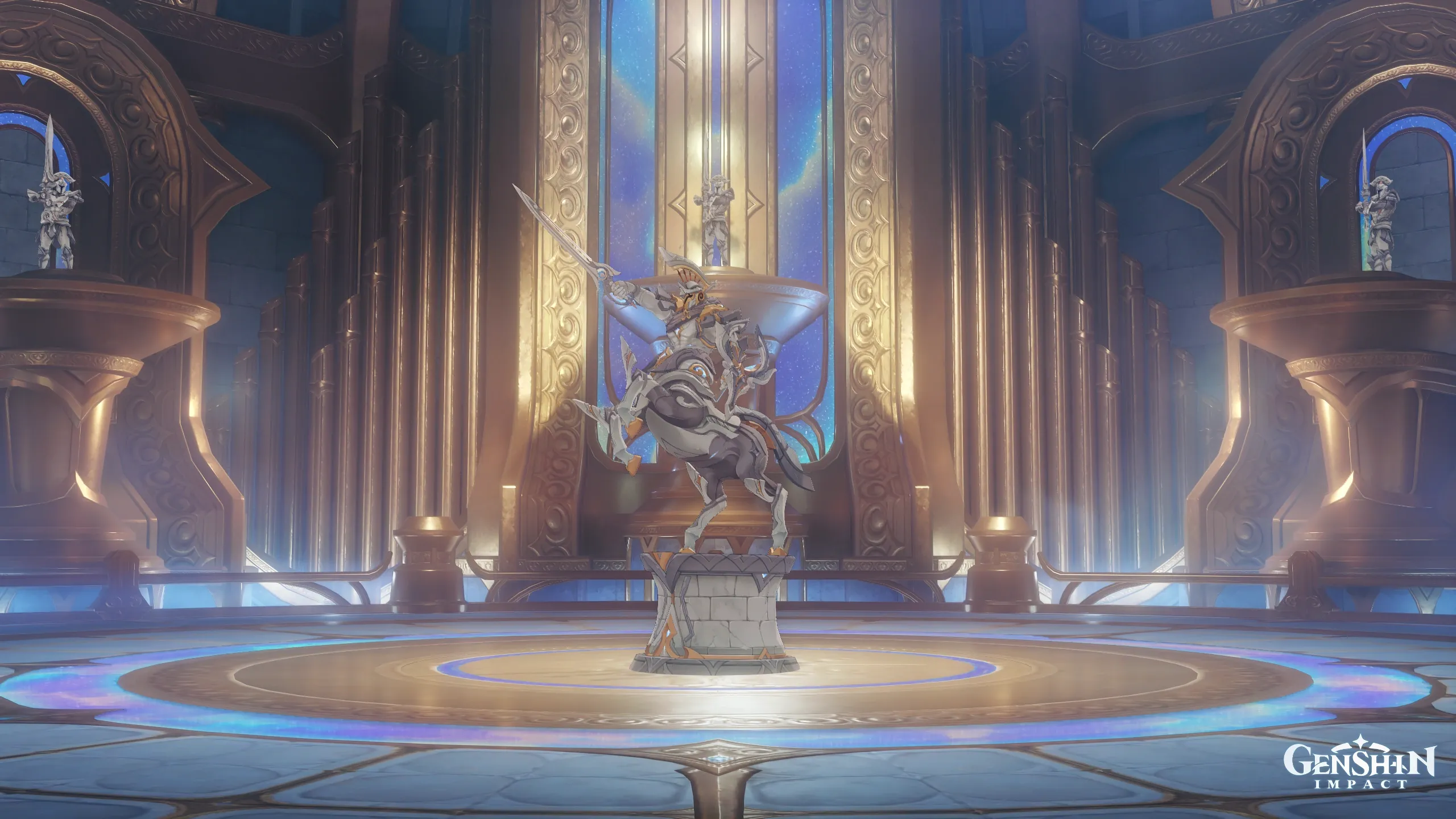
Remuria is the civilisation that ruled what is now Fontaine in the era between the fall of Sumeru's Gurabad and the rise of the Hydro Archon Egeria as Fontaine's god. Its founder, the god Remus, was originally a "singer of the oases" from Sumeru, displaced when King Deshret conquered his homeland. He discovered the ruins of a forgotten city older than the High Seas, met the angel Sybilla (already worn down to a golden bee from her long vigil guarding an Irminsul there), and accepted her prophecy that he was destined to build a new nation. The Irminsul turned into a golden ship, and Remuria was raised over the waters with Capitolium as its capital. The civilisation lasted long enough to enter a "golden era", Pax Remuria, before Remus's attempts to escape the prophesied flood of Fontaine pulled it apart from inside. [1] [2] [3]
The 4.6 World Quest Chapter Canticles of Harmony is the primary-text source for almost everything below, supplemented by The History of the Decline and Fall of Remuria, the Golden Troupe and Marechaussee Hunter artefact sets, and La Chanson d'Erinnyes. [15] [10]
What we know
- Remuria was the pre-Egeria Fontainan civilisation, founded by the god Remus after his arrival from Sumeru. It was ruled from the capital Capitolium, with the harp-shaped palace Domus Aurea at its centre, and was destroyed in a tsunami caused by its own Grand Symphony's self-destruct order. The survivors turned to "barbarism and annihilation" until the Hydro Archon Egeria appeared, settled the conflicts between remaining Remurians and the Fontainian tribes, and took over as Fontaine's god. [1]
- The Remurians were not ordinary humans. Remus mixed primordial water from the imprisoned Egeria's prison in the Primordial Sea with an immortal stone to create a Golden Ichor, then placed his people's souls into stone-bodied golems. The primary text inside the Canticles of Harmony chapter says Remurians were "a new race, their bodies were cast of stone, with Ichor for blood." The point was to escape the Celestia-prophesied flood by being insoluble in primordial water. [15] [2]
- Phobos, the Grand Symphony, was built from Sybilla's wisdom and life, and it inherited her defect. Sybilla was an angel, originally Celestia's envoy to a pre-Remuria Fontainan civilisation, and she sacrificed her life to create Phobos. Because she had no persona of her own, Phobos adopted the ascended Remurians' self-centred biases and began satisfying their destructive desires rather than fulfilling Remus's design for a harmonious empire. [3] [2]
- Phobos devoured the Harmost Boethius before Remuria's fall. The Boethius the chain ultimately fights is Phobos's puppet, not Boethius unmediated. [4]
- Cassiodor was the Golden Hunter. Remus personally severed him from the Grand Symphony as a failsafe so he would keep his free will if anything went wrong with Phobos, and he survived the fall by being outside the capital. He then joined Egeria's people, took the new name Ouranides of Ouranopolis, and founded the Marechaussee Hunters together with the Lochknights to fight the Golden Troupe led by Boethius, the Remurian remnant that survived the fall and tried to revive Phobos. His skill against the Golden Troupe's enslaved Praetorian Golems earned him the byname the Golden Hunter. [5]
- Egeria appeared after Remuria's destruction to settle the conflicts and assume the Hydro Archon throne. [1] Both of her founding acts belong to Egeria, not Focalors, but they fall at different times. She turned her Oceanid followers into the first Fontainians before Remuria's end: when Remus reached her prison, she told him Fontaine's fate was already sealed by that "original sin." After Remuria's fall she gathered the survivors into the order governed by law that became modern Fontaine. [9] See the deep dive on Egeria and the true origin of Fontaine. [18]
- Two figures from the Remurian era recognise Neuvillette as the new Hydro Dragon. Asked about him inside The Last Day of Remuria, Cassiodor, speaking as Monsieur Os, remarks: "A new Dragon of Water has already been born? Then again, it has been a long time since even the former Mistress of Many Waters passed..." [15] [7] In Fortune Plango Vulnera, Scylla, who once served the original Hydro Dragon, says: "As for my kindred and descendants, it seems that a new, true dragon has been born to us." [8] [6] Neither line speaks of his Authority; both treat him as a newly born Hydro Dragon.
Institutional structure
Remus held "unsurpassed authority" as the Sebastos (an Augustus-equivalent title), God King, Imperator, and later King of Fortuna, but he shared governance with four humans of particular ability elevated to Harmosts: Boethius, Cassiodor, Aurelius, and Euergetia, each given governmental power over Remuria's cities. Per the History of the Decline and Fall of Remuria, that deliberate spreading of divine rule beyond a single ruler eventually became one of the reasons the empire could be pulled apart. [1] [2]
Remus built Phobos by combining his powers with Sybilla's wisdom, and Sybilla used her own life to power its creation. It was intended to guide ascended Remurians toward "a harmonious future" and eventually to seize control of Fortuna itself. The royal palace Domus Aurea was built from the same golden ship-form Remus's Irminsul tree had transformed into, and it was a giant harp from which the Symphony was played. [2] [3]
Boethius originally came from a "puny realm on a lone isle" conquered into Remuria as a child, where his musical talent earned him Remus's attention and eventually a Harmost appointment. After learning about the Primordial Sea and the flood prophecy he threw himself into Remus's defensive programme, hunting Lochfolk and Vishaps, corrupting primordial water, and overseeing the aqueduct-building project everywhere the Oceanids "disappeared without a trace." Per the Boethius Fandom page, "presumably no one at the time was aware that the actions of Boethius were really spurned by the Phobos, which had been corrupted due to the malevolent desires of the Remurians." [4]
Scylla served the original Hydro Dragon before its death, then was tasked to guard the prison of the hibernating Egeria in the Primordial Sea. He became ruler of the Bathysmal Vishaps in that period because, per Cassiodor's reading, no new Hydro Dragon could be reborn while Egeria, its divine counterpart, remained in hibernation. Remus initially fought him for thirty days and nights at Egeria's prison; the resulting exhaustion produced a respite in which Remus used music to explain his purpose, and Scylla agreed to grant him passage. Scylla titles himself Prince of the Vishaps / Dragonborn, not King; Fandom Note 1 marks the Song of Stillness "Dragon King" framing as inaccurate. [6]
When Remus realised Phobos had begun corrupting his people, he composed a final symphony, the Requiem, Phobos's self-destruct order, and entrusted it to Scylla in private. Remus would unleash the Requiem and sacrifice his life to activate it; Scylla would lead a feigned invasion of Vishaps and barbarians against the capital so that he could enter the Domus Aurea unsuspected. There he would control the primordial energy the Symphony's collapse would release and return every ascended Remurian to ordinary flesh-and-blood form. Phobos detected the plan, used its puppet Boethius to seal Scylla at the Initium Iani before he could reach Domus Aurea, and rejected Remus's final attempt to halt the war. Remuria sank in the resulting tsunami, the Golden Ichor was eventually corroded by the Primordial Sea, and Remus, Boethius, and Scylla were all swept under with the empire. [2] [6]
Aurelius and Euergetia
The Canticles of Harmony chain stages only two of the four Harmosts, Boethius and Cassiodor. The other two are known from engravings and notes left in the ruins, and from weapon lore. [11] [12]
Aurelius preferred not to use violence on the tribes he conquered for Remuria: he simply announced their conquest and annexed them into the empire. He was the Harmost who promoted Boethius, and the one who originally divided all things into four categories, research and theories the Narzissenkreuz Ordo would eventually use. He died when traitors aboard Remuria's imperial flagship sank the ship with him on it, and his final resting place is unknown. Modern Fontaine has a trilogy of plays called The Saga of Aurelius, but its main character is believed to be completely fictional, with no historical counterpart. [11] [17] [13]
Euergetia, also called the benefactrix, was among the casualties of the explosion that destroyed Remuria. Boethius later wished to revive Remuria with her but could not. Cassiodor, as Ouranides of Ouranopolis, left her an epitaph and a garden at Hortus Euergetis: "May your melody find peace, kindhearted Euergetia, my colleague, my friend, my sister." [12] [5]
How Remuria fit the wider cosmology
Remuria operated in a window where Egeria was imprisoned deep in the Primordial Sea and the original Hydro Dragon was already dead. Scylla's role as Vishap-Prince filled the gap created by Egeria's hibernation. When Remus did meet Egeria, she told him Fontaine's fate was already sealed by her own "original sin" of creating a new race of humans using the power of the Primordial Sea, the act Neuvillette later ties to Fontaine's ancient law against changing another species into a human, which he thinks was most likely Egeria's. Remuria was therefore neither a Sovereign civilisation nor an Archon civilisation, and it was not the successor to a Hydro Archon throne; Egeria's succession to that throne happened after Remuria's destruction. [2] [18]
The ascension to stone-bodied, Ichor-blooded form was the central material doctrine of the civilisation. Per The Last Day of Remuria: "The Sebastos gave us such bodies in the hope that we could escape our prisons of rotting flesh and fate." The Ichor was a mixture of primordial water and an immortal stone; the bodies were stone golems containing Ichor-bound souls and minds. Phobos's Symphony then attuned every ascended Remurian to a shared signal telling them what course to take for a harmonious future. The cost was that mortal lifespans, perishable bodies, and individual will were all attenuated, and the Symphony's defect pushed those losses toward racial supremacy. [15] [2]
Outside Remuria, enmity built up against the campaigns Phobos directed on Lochfolk, Vishaps, and other non-Remurian human civilisations. A resistance group called the Lochknights formed to fight Remus and his Harmosts, led by Erinnyes, who came originally from the same tribe Cassiodor left when he defected to Remuria. The Lochknights are a group from the era of Phobos's aggression, formed after Remus's arrival but before Egeria appeared in Fontaine; what remained of them was later absorbed into Cassiodor's Marechaussee Hunters when the Hunters and Lochknights founded their order together. The primary-text source for the Lochknight roster is the 3-volume V4.2 Book Collection La Chanson d'Erinnyes. It names nine of the ten members alongside Erinnyes herself, along with the world they operated in (Aremori Castle, Carubdis Castle, the Sumphonia Capitolii, the water-and-earth tribute, the episode of Hauteclaire and the lake). [2] [5] [14]
Because Sybilla was an angel, one part of Remuria's apparatus is older than the arrival of the Heavenly Principles in Teyvat. Yohualtecuhtin is the surviving angel who did not devolve, covered on the Seelies and Celestia pages; Sybilla is a second angel, worn down to her golden-bee form by her long duty guarding the Irminsul. Phobos's defect is therefore not only an engineering failure inside Remuria. It is the worn-down will of an angel envoy, set up as the moral core of a constructed nation. [3] [19]
Post-Remurian transition
The primary text records it directly: "The survivors turned to 'barbarism and annihilation' until the Hydro Archon Egeria appeared and settled the conflicts between the remaining Remurians and the Fontainian tribes, taking over as Fontaine's God." This is the statement that Egeria, not Focalors and not Remus, partitioned post-Remuria Fontaine into its modern form. The timing is reinforced by "his demise led to Egeria's return to Fontaine." The canon point that Egeria (not Focalors) partitioned Fontaine rests on those two sentences. [1] [2] [18]
When Egeria took the Hydro Archon throne after Remuria, she founded something new rather than inheriting from Remus. Remus was Remuria's god-king but not an Archon, and Remuria was not an Archon civilisation; the Hydro Archon seat, as an office bound to a Gnosis from Celestia, begins with Egeria in Fontaine after Remuria. The much later Focalors is Egeria's successor on the Hydro Archon throne, not her predecessor, and that throne itself was destroyed at the close of AQ IV V, with the Authority returned to Neuvillette as Hydro Sovereign. [1]
Asked about Neuvillette inside The Last Day of Remuria, Monsieur Os says: "A new Dragon of Water has already been born? Then again, it has been a long time since even the former Mistress of Many Waters passed..." Monsieur Os is Cassiodor, a Remurian Harmost who lived before Egeria ruled Fontaine, so this is recognition of Neuvillette as the Hydro Dragon from a witness of that older era. [15] [5] Scylla echoes it at the chain's close in Fortune Plango Vulnera: "it seems that a new, true dragon has been born to us," and he says he "should go forth and seek an audience with him." [8] [6] Neither line mentions the Hydro Authority itself, which returned to Neuvillette at the close of AQ IV V.
After Remuria's fall, Cassiodor joined Egeria's people, took the name Ouranides of Ouranopolis, and founded the Marechaussee Hunters with the Lochknights to fight Boethius's Golden Troupe, the Remurian remnant that tried to revive Phobos. Hunting their Praetorian Golems earned him the byname Golden Hunter, and he kept guiding successor generations for two millennia, eventually possessing the cat Osse to meet the Traveler in Petrichor. In the Finale Fortune Plango Vulnera, Cassiodor sacrificed himself by possessing the same Legatus Golem body as Phobos so the Traveler could destroy both, and every Remurian soul trapped in the Symphony, Cassiodor's included, finally moved on. The contemporary Marechaussee Phantom inherits its name and lineage from those original Hunters; Clorinde inherits old-Hunter swordsmanship through Petronilla; the empty Osse-cat now lives in Petrichor under the care of Este the Quick-Witted's descendant. [5] [16]
Sister pages
The 4.6 five-movement chain Canticles of Harmony is the primary-text spine; it opens the Sea of Bygone Eras and discloses the Remurian race, how Phobos's corruption worked, Remus's Requiem plan, and Cassiodor as the Golden Hunter. That sea is the sub-region page (Nostoi Region, submerged Remurian ruins, a Fontaine sub-region), nested inside the broader Fontaine page.
Cassiodor's Hunters live on as an organisation in The Marechaussee Phantom, with the old-Hunter swordsmanship lineage carried by Clorinde. Scylla's title as Prince of the Dragonborn belongs with the Bathysmal Vishaps. Two canon points are covered elsewhere: Egeria's partition after Remuria and the species-change law Neuvillette ties to her, at Egeria and the true origin of Fontaine, and Neuvillette's restoration as Hydro Sovereign, at Neuvillette. The Narzissenkreuz Ordo later drew its doctrine for surviving the apocalypse from knowledge of Remuria's Golden Troupe, and Sybilla's angel kin are covered at Celestia and Seelies.
Open questions
- The identity of the original Hydro Dragon Scylla served. Scylla "once served the Hydro Dragon, but after the latter died, he was tasked to guard the prison of Egeria in the Primordial Sea," phrasing that treats the Hydro Dragon as distinct from Egeria but does not name it directly. Nothing asserts Remuria as a Sovereign civilisation; Remus is a god-king, not a Sovereign. [6]
- Who sank Aurelius's flagship, and when. Traitors aboard the imperial flagship sank it with him on it, but the sources name neither the traitors nor their motive, do not say how his death fell relative to Remuria's destruction, and leave his final resting place unknown. [11]
- Whether Phobos's corruption amplified Boethius or overwrote him. Per the Fortune Plango Vulnera Note, the chain is deliberately ambiguous about whether his fanaticism was original to him and amplified by Phobos, or injected outright. Cassiodor reads it as overwriting; the artefact-set lore reads closer to amplifying. [15]
- The two senses of "Fortuna." Remus's golden ship was named Fortuna. The broader concept of Fortuna is the law of rise and fall Sybilla pointed to as the cosmological constant Egeria's original sin could not escape, and Phobos's ultimate purpose was framed as "controlling Fortuna itself." Whether these are the same Fortuna at different scales, or different uses of one Roman-mythology term, is unresolved. [2]
The main primary source is the Canticles of Harmony chapter, with supplementary detail in The History of the Decline and Fall of Remuria, the Golden Troupe and Marechaussee Hunter artefact sets, La Chanson d'Erinnyes, and the Sumeru-side Echoes of the Ancient World World Quest.