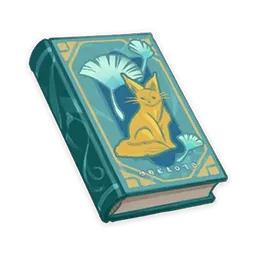
The Fox in the Dandelion Sea is an eleven-volume Mondstadt Book Collection, "an unforgettable Mondstadt fairytale about a hunter and a fox," found in various places throughout the region. The book's cover, in the Teyvat Language, reads "Foxtale." Vols. 1–3, 5–7, 10, and 11 were available at Version 1.0 release; Vols. 4, 8, and 9 were folded in later. [1]
The lake and the Mist Flower
Vol. 1 opens at a forest lake whose surface is "like the stained glass windows of Mondstadt Cathedral: crystal clear and shimmering in the sunlight." The hunter, distracted by water that reminds him of "a girl I loved a long time ago," nearly walks past a small white fox whose tail has been frozen into the lake by a Mist Flower, Mondstadt's frostbite-causing plant. He decides on stew, takes out his bow, and silently runs his grandfather's hunting mantra: "Be good and stay put." In Vol. 2 the fox lifts its head, meets his eyes - "like the lake, glittering as if harboring fragments of gemstone within" - and his arrow shatters the ice instead of the fox. He chases the fleeing white spot until the air fills with shimmering points of light he eventually realises are nothing more than dandelion seeds; the fox has vanished as foxes are said to do, "as if [running] into another world." That night something stirs outside his door. [1]
The bargain and the dandelion sea
In Vol. 3 the fox arrives at the threshold and grows, by approach, into "a tall and slender woman, with a swan-like neck and pearly skin," whose eyes are still the gemstone-lake - "You'd believe anything after you'd seen those eyes." In her own tongue, which he somehow understands, she announces the bargain that runs the rest of the series: "We foxes are grateful beings, so you must let me return the favour." Vol. 4 redeems it. After a few days of unaccountably abundant prey, she returns at midsummer in a blizzard of dandelion seeds and leads him out of the dark forest into "a sea of dandelions [that] lay before me, stretching as far as my eyes could see" - "the homeland of the dandelions," the place "where all the prey who disappeared had eventually gone to." Her terms: he will teach her child human speech; in return, "I will teach you the magic of foxes." [1]
The chant - "ride the wind to the Anemo Archon"
Vols. 5–9 spend the bargain. The hunter teaches the little fox not only language but "how to count, how to grow carrots, how to change window panes, and how to sharpen knives"; Vol. 6 supplies the cub's reason - he wants to befriend a "gray-clad lupine boy" who once saved him from monsters in a faraway wood. In Vol. 7 the cub picks a single dandelion and shows his teacher his own magic: "Dandelion, Dandelion, ride the wind to a faraway land," he chants, blowing the seeds away, and adds "May my teacher's wishes ride the wind and reach the Anemo Archon" - the book's first explicit invocation of Barbatos by his archon-title. The mother fox arrives quietly; her promise of transformation magic is reaffirmed in Vol. 8; Vol. 9 turns elegiac as the hunter realises the lessons are nearly spent and asks himself, without answering, whether he will see the dandelion sea again. [3]
The reversal
Vol. 10 stages the parting. The little fox waves himself into the distance until he is again a single white spot in the field; the mother fox walks circles around the hunter, growing with every pass - until, in Vol. 11, the dandelions are also growing, and he realises he has been turned into one. "Even if I wanted to protest, the dandelion had no mouth nor tongue for me to make a sound." The giant fox lifts him between thumb and forefinger and chants once more: "Dandelion, Dandelion, ride the wind to a faraway land." The closing line of her prayer, the second and final invocation of the Anemo Archon, turns the bargain inside out: "Oh, Anemo Archon, I beg you to turn us into humans! For only then can we be safe from their hunting bows and knives." The hunter wakes back at the gemstone lake with Vol. 1's standing description repeating around him "crystal clear and shimmering" and concludes: "I must have lost myself in thought that day, drifting off into sleep as I watched the sparkling lake." [1]
A fairytale, not doctrine
This is fairytale, not doctrine. The dandelion sea as "the place where all the prey who disappeared had eventually gone to" is a whimsical-faerie threshold, not a Liyue Wangsheng-style psychopomp or death-rite cosmology. The setting is Mondstadt, given Vol. 1's Mondstadt-Cathedral comparison, the region's dandelion-symbolism, and the explicit Anemo-Archon invocations, and that does not carry over to the cross-region "fox" naming overlap with Liyue's Tianqiu / Yaoguang Shoal fox-imagery. The fairytale itself is era-agnostic: nothing in canon places it in the Decarabian, Aristocrat, or post-Vennessa periods. The "girl I loved a long time ago" recurrence is the series's unstated emotional centre, left as memory rather than promoted to an in-universe historical claim. The two Anemo-Archon invocations are the only doctrinal anchors the book carries, and both address Barbatos as wish-bearer rather than narrating his actions.