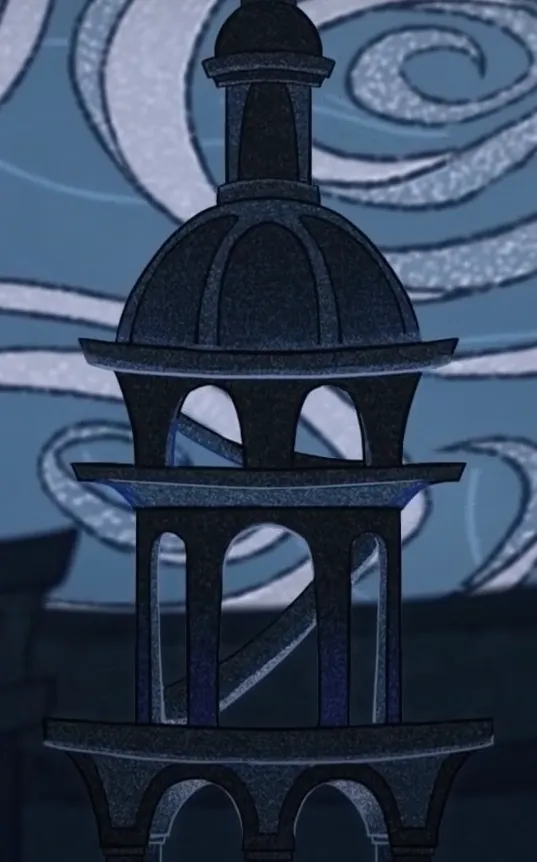
Pre-Barbatos God of Storms who ruled Old Mondstadt during the Age of Kings; slain by his own people in the rebellion ~2,600 years ago
Overview
Decarabian was the God of Storms who ruled Old Mondstadt during the Age of Kings.
He sealed his city behind an impenetrable storm wall against the rival god Boreas.
His tight control over his people drove them to rebel.
He was slain about 2,600 years ago, opening the seat Barbatos would fill.
His ruined tower is the place now known as Stormterror's Lair.
Decarabian, the God of Storms, the Lord of the Tower, the King of Gales, the Storm Lord, ruled Old Mondstadt, the city that today's Outlander knows as Stormterror's Lair. During the Archon War he raised an impenetrable storm wall around his capital to defend it from the blizzards of his rival Boreas. From inside that wall he micromanaged every life within reach and called the result protection. Two thousand six hundred years ago his own people disagreed. They killed him. [1][6]
He was the first of two gods of the Mondstadt region in his era to die. Boreas gave up his claim to rule when the tower fell and went back north to sleep. [30] Decarabian's death opened the seat that Barbatos, the wind spirit allied with the rebellion, rose to fill. The Anemo Archon title did not exist for Decarabian. He was a wind god in the Chinese and Japanese source text, not an Archon, and the Anemo Archon seat post-dates his death at the rebels' hands. [1][3]
The Age of Kings
Little of Decarabian's origin survives in primary text. What the game records is that at the height of his civilization his territory spread through the and , with a major settlement around , and that for at least four hundred years before his death he was at war with the wolf-king god .
1.
Decarabian - Genshin Impact Wiki (Fandom) · external ↗
2.
Decarabian's Mondstadt - Genshin Impact Wiki (Fandom) · external ↗
3.
Barbatos - Genshin Impact Wiki (Fandom) · external ↗
4.
History of Kings and Clans - Genshin Impact Wiki (Fandom) · external ↗
5.
Biography of Gunnhildr - Genshin Impact Wiki (Fandom) · external ↗
6.
Venti/Lore - Genshin Impact Wiki (Fandom) · external ↗
7.
Amos' Bow - Genshin Impact Wiki (Fandom) · external ↗
8.
Song of Broken Pines - Genshin Impact Wiki (Fandom) · external ↗
9.
Fragment of Decarabian's Epic - Genshin Impact Wiki (Fandom) · external ↗
10.
Scattered Piece of Decarabian's Dream - Genshin Impact Wiki (Fandom) · external ↗
The conflict was already underway 3,000 years ago and ended only with Decarabian's death 2,600 years ago. Mondstadt's history books came to call this era the Age of Kings, the Kings of Ice and Frost, and the Storm-lord of the Tower and the Kingwolf of Boreas chapter of History of Kings and Clans is its primary-text source. [4][5]
During this era the Land of the Wind was a giant frozen wasteland, a byproduct of Boreas's power rather than a deliberate act of weather. Decarabian's storm wall arose as a defensive response. Per Fragment of Decarabian's Epic, he built the impenetrable wall to protect his city and its inhabitants after Boreas declared war on him, and it was strong enough that not even Boreas and his immense power could land a scratch on it. [9][12][13]
The Storm Wall
The wall is Decarabian's signature act, and the foundation of his tyranny. In his own eyes, per Scattered Piece of Decarabian's Dream and Venti Character Story 4, he had given his subjects a city free from the bitter cold, and his people loved him as he loved them. [10][6]
In their eyes, he had locked them in. The wall barred both exit and entry, and his desire for control scaled to match. Per Scattered Piece of Decarabian's Dream and the Decarabian page, every resident's living quarters was determined for them, and Song of Broken Pines attests that he banned certain chords and tunes that might indicate any kind of resistance. Biography of Gunnhildr records that the Gunnhildr Clan left the city after growing disillusioned with his rule, and that the clan's prayers in the blizzards outside the wall gave a faint wind spirit, hovering at Mondstadt's edge, enough faith to gather a shelter for them. [10][8][5]
Decarabian did not seem to be malicious. He simply did not understand humanity. Per the Decarabian page and Character Story 3, when he looked down on his subjects he saw them bowing in adoration and respect, when in fact they were bowing because the harsh winds in the capital forced them to. [1][6]
He had at least one mortal lover, the human woman Amos, and did not love her the way she loved him. Amos' Bow attests her realization. She eventually joined the rebellion that killed him, and died in it. [7]
The rebellion
The rebellion coalesced around a five-member coalition. Per the Boy and the Whirlwind story teaser, Venti Character Story 4, and the Barbatos page: [19][6][3]
The Nameless Bard, a human boy from inside the storm wall who wished to see the world beyond Decarabian's closed-off capital.
The wind spirit who later became Barbatos, at this point "but a wisp among the thousand winds" with no human form, as Venti puts it in his Story Quest, the Carmen Dei Chapter. [29] Per Biography of Gunnhildr, the Gunnhildr Clan's faith outside the wall became "the source from which the wind spirit drew its power." [5]
Amos, Decarabian's former lover, disillusioned.
Gunnhildr, the knight whose clan's prayers had built the wind spirit's faith from the outside.
A wandering Red-Haired Warrior, per Freedom-Sworn and Windblume Ode.
Per Windblume Ode, the rebellion used the Windblume as its symbol of solidarity to evade Decarabian's watchful gaze. The storm wall still stood when the rebellion came to a head. [14][15]
Boreas outlived the tyrant. In Varka's Story Quest, Venti says that "even as the tower fell, he chose to abandon his claim," and that he "returned to the North and slumbered for a thousand years" before journeying back to Mondstadt with the first Knight of Boreas. [30] Per Boreal Wolf's Nostalgia, he thought himself "unworthy of becoming the Lord of the Winds of the world. Therefore, he chose to disappear." [11] Only in his final moments, per Spirit Locket of Boreas, did he let his powers "freely flow into the land to protect it and its inhabitants." [12]
The Boy and the Whirlwind teaser frames the final encounter. The rebels emerged victorious, Decarabian was finally slain, and his death detonated part of his tower. The storm barrier dispelled with him, revealing a clear blue sky as the rebels saw the world outside the city for the first time. Amos and the Nameless Bard died in the fight against the old god. [19][6]
With Decarabian dead and Boreas gone north, the wind spirit ascended to godhood as Barbatos, the first and only Anemo Archon. [30] He took the form of the Nameless Bard so he could play the lyre as the boy had, and may have taken up the bow in memory of Amos. Gunnhildr celebrated his ascension; the Red-Haired Warrior was less pleased and left. [6][14][3]
After the fall
Barbatos reshaped the land, blowing off the snow and ice with his winds, terraforming the cliffs and valleys, and scattering many of the eastern mountains into the ocean, then led his people to Cider Lake to build the new City of Mondstadt on an island. Decarabian's City was left abandoned. His architectural footprint survives across the contemporary map. Per the Decarabian's Mondstadt Point-of-Interest page, Decarabian-style ruins feature triangular decorative motifs, geometric margents, and an exaggerated cercelée, and appear around the Brightcrown Mountains, Cecilia Garden, and the southern Teleport Waypoint in Windwail Highland, but not around the Wolvendom part of Windwail Highland, which was Boreas's territory. [3][2]
What came after Decarabian has three chapters in primary text:
The Tyrant's Final Fury (a misattribution from the Khaenri'ahn era). Per AQ Chapter I Act IV We Will Be Reunited and the Field Tiller Point-of-Interest page, when the Kingdom of Khaenri'ah prepared for the war against the gods, they developed the Field Tiller, a prototype Ruin Guard with vast combat power. It engaged Boreas's spirit-form in Wolvendom, was heavily damaged, and escaped to Decarabian's City. There it took up residence in Decarabian's Tower, and for about a year afterwards it indiscriminately attacked anyone who approached with missile-fire. The Mondstadt people of the time misattributed the attacks to Decarabian's ghost and called the phenomenon the Tyrant's Final Fury. After the Field Tiller ran out of power and stopped, they concluded the fiery attacks could not have been the work of the God of Storms. [20][27]
Dvalin's 500-year retreat. Per the Dvalin page and Breeze Amidst the Forest Vol. 2, 500 years ago, after being badly injured and poisoned in his Cataclysm-era fight against the original (historical) Pyro/Abyssal Durin, Dvalin turned Decarabian's Tower into his lair to recuperate. The 500-year slumber ended in the arc of his corruption by the Abyss Order, the Stormterror crisis of AQ Prologue Acts I–III, and Decarabian's Tower came to be known as Stormterror's Lair in present-day Mondstadt. [22]
The AQ Prologue Acts I–III rescue destination. During the 1.0 Mondstadt opening arc, the Outlander, Paimon, Venti, Diluc, and Jean made their way to Stormterror's Lair and broke the Abyss Order's wind seals to free Dvalin, resolving an arc of Abyssal corruption on the very ground Decarabian once enclosed with his storm wall. The Tower holds three layers of Mondstadt history at once: Decarabian before the Archon War, Dvalin's recovery after the Cataclysm, and the present-day corruption of Stormterror by the Abyss Order. [22][21]
What canon has not surfaced
Decarabian's origin. The game attests little to nothing about his origins or his history before the war with Boreas. Whether he was a Sovereign survivor, a god created in the era of the Heavenly Messenger, an envoy on the level of the Shades, or something else is unrevealed. The Sovereign-to-Archon transition deep-dive reads the gods of Mondstadt before the Archon War (Decarabian and Boreas) as separate from any line of Anemo Sovereign dragon kin, but a positive identification of what Decarabian was remains open. [21]
Primary text does not support the speculation that the Skyfrost Nail struck Decarabian. Some readings conflate the Skyfrost Nail's destruction of Sal Vindagnyr at Dragonspine with Decarabian's death. These are distinct events. Sal Vindagnyr fled the Age of Kings war between Decarabian and Boreas to Dragonspine, seeking a land far from snow and strife per the Ancient Carvings, and was destroyed by the Skyfrost Nail thousands of years before the rebellion era. Decarabian died by rebellion, in his own tower in his own city. On the Heavenly Nail page's list of six known Nails, Decarabian is not among the civilizations struck. [25]
Decarabian and the Anemo Archon title. Per the Barbatos page, Decarabian was a wind god in the Chinese and Japanese source text; English-side material that calls him an Anemo Archon reflects a translation artifact rather than a true title. Barbatos is the first and only Anemo Archon. Decarabian held the territorial seat of Old Mondstadt but never the Anemo Archon seat, which post-dated his death. [3]
The Four Winds were founded roughly 1,600 years after Decarabian's fall. Per the Barbatos page, the Four Winds of Mondstadt"arose by the end of the Aristocracy era some 1,600 years after Old Mondstadt fell," established in the era after Vennessa's rebellion ~1,000 years ago, not in the era after Decarabian 2,600 years ago. Decarabian is not one of the Four Winds; the order arose entirely after his death. The seat of the Wolf of the North held by Boreas (as Andrius, his spirit form after death, at Wolvendom) was constituted after Vennessa's rebellion, not in Decarabian's lifetime. [23]
Etymology and the moon-city allusions
The name Decarabia belongs to the 69th demon of the Ars Goetia, a Marquis with thirty legions under his service. A frequently noted grouping links Decarabian with Boreas as linked to the story of the three moon sisters who lived in ancient times, and may also be linked to the Abyss. The grouping rests on these observations: his city's name, Mondstadt, is German for Moon City; the top of his tower resembles an observatory, used to observe celestial events; and the tower's bottommost aboveground floor stretches deep into the ground below the rest of Mondstadt's surface, triggering out-of-bounds dialogue from Paimon if approached. These observations do not amount to doctrine in primary text, but they anchor the open theory that Decarabian's domain may carry a pre-Cataclysm cosmological depth that primary text has not yet revealed. [1]
Deep dive
The arc of the wind spirit who became Anemo Archon and inherited the seat Decarabian's death opened runs through Venti and the Carmen Dei Chapter of his Story Quest. His rival Boreas survives as Andrius, the spirit form of the Wolf of the North and the Great Wolf King at Wolvendom, covered on the Four Winds page alongside the order founded after Vennessa's rebellion, roughly 1,600 years after Decarabian fell. The Cataclysm-era Anemo Dragon who retreated to his tower and became Stormterror is Dvalin; the region his tyranny sits inside is Mondstadt. For the Heavenly Nail and the Skyfrost Nail's destruction of Sal Vindagnyr, which is separate from his death by rebellion, see the Heavenly Nail page, and for the Khaenri'ahn Field Tiller behind the misattributed Tyrant's Final Fury at his tower, see the Ruin Machines page.