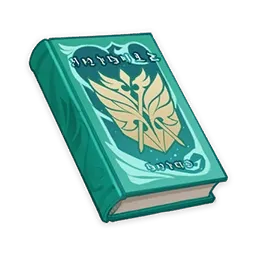
The Knights of Favonius Handbook - 5th Edition is a single-volume Quest Item, categorically distinct from the multi-volume Mondstadt Book Collections, released in Version 1.0 and obtained when the Honorary Knight Traveler completes the World Quest Question and Answer. The quest-giver, Swan, stops the Traveler near the entrance to Mondstadt, requisitions a copy from the order on the Traveler's behalf, then quizzes them on the contents. The three correct answers, "Stormterror's Lair," "Strange yet respectable traveler," and "Acting Grand Master," each trace to a specific item in the handbook itself. [1] [2]
The freedom-and-duty preamble
The handbook opens with the doctrine of the Knights of Favonius, stated as plainly as it ever is in primary text:
"As members of the Knights of Favonius, it is incumbent upon us to be the very embodiment of the three virtues of knighthood: modesty, honesty, and self-control. These are the three pillars of Mondstadt's freedom - remember, freedom cannot exist without the support of duty."
The three virtues (modesty, honesty, self-control) are framed in the closing Appendix as "mutually reinforcing and treated as a collective." The closing clause, "freedom cannot exist without the support of duty," is the clearest statement of the Knights' freedom-and-duty principle: that the order's job is to make Mondstadt's freedom possible by carrying its responsibilities, rather than to embody freedom directly the way Barbatos does. [3]
The Sections: language, conduct, and the Varka clause
Eleven numbered Sections then prescribe behavioral standards and explicit Approved Language / Prohibited Language lists for the situations a serving knight is most likely to encounter. §2 stipulates the term of address for outsiders, "strange yet respectable traveler(s)/wayfarer(s)/guest(s)," and prohibits the alternate cadence "Hey, you! Stop right there! State your identity, you rascal(s)/hooligan(s)/ruffian(s)/outlander(s)/trespasser(s)!" §3 forbids any visible lapse in knightly disposition even during rest; its example of prohibited off-duty speech is "Noeeeelle... Have you got a minute...", with a footnote that "the Acting Grand Master has instructed Noelle to immediately report any work-shy knights who attempt to delegate their existing duties to her." §4 restricts alcohol on duty and forbids knights of minor age from drinking at all. §9 classes "the fish and other aquatic life found in Mondstadt's lakes and rivers" as public property that no knight may destroy, a piece of the order's whimsy made into enforceable regulation. §11 authorises spot-checks on wind-glider users "even if the airborne offender is an off-duty member of the Knights of Favonius."
Two passages in the main body, §5 (New) and §6's closing clause, carry the (New) tag that identifies them as 5th-Edition additions (the Appendix also tags items 4 and 7). §5 forbids any disclosure of knights' operations or strategic deployment to outsiders while off duty, citing "a recent increase in Fatui activity in the city." §6's (New) clause scripts the public-facing reassurance during "the Grand Master's absence": "Please rest assured that even though Grand Master Varka is not currently in Mondstadt, the Knights of Favonius are quite well equipped to deal with this crisis in a swift and elegant manner." The mention of Varka's expedition is primary-text evidence that the 5th Edition is promulgated under Jean's acting tenure, not while Varka is in residence and in command. [4]
The Appendix: terminology, theology, and the Stormterror rename
The closing Appendix glosses seven terms; three of them carry doctrinal weight. Item 4, "The Anemo Archon (New)," identifies "Barbatos, the God of Wind and Song, the granter and guardian of Mondstadt's freedom," and concedes that "as an organization, the Knights of Favonius heeds the will of the Anemo Archon. This means that we must be prepared to go to war in the event that Mondstadt's freedom comes under threat." An unusually candid editorial note immediately follows: "Need to add additional material on this term. Several members of the Knights of Favonius and even the Church seem not to have any belief in the Anemo Archon at all." The handbook is the only official text of the order in which it admits, in its own pages, that a portion of its membership and of the Church does not believe in Barbatos at all. [6] Item 5 sets the Fatui delegation's diplomatic-immunity status in Mondstadt and warns that "their activities are shrouded in mystery and deceit." Item 7, "Stormterror's Lair (New)," christens the ruins northwest of Mondstadt ("once a city where a tyrant ruled from his tower," since occupied by Dvalin) under the official name the Knights issued, and Swan's first quiz answer turns on exactly this naming.
The order writing itself down
The handbook is the closest the Knights of Favonius come to writing themselves down. The 5th-Edition framing, with the (New) tags on §5, §6's Varka clause, and Appendix items 4 and 7, implies a long-running revision history (four prior editions) rather than a novelty of Jean's era, even though the surviving body is plainly her document as Acting Grand Master. The admission in Appendix item 4 that some in the order do not believe in the Anemo Archon is the root of the order's recurring friction between Knights and Church. The freedom-and-duty principle is what every Knights of Favonius character page, from Jean to Lisa to the on-duty cadets, ultimately traces back to.