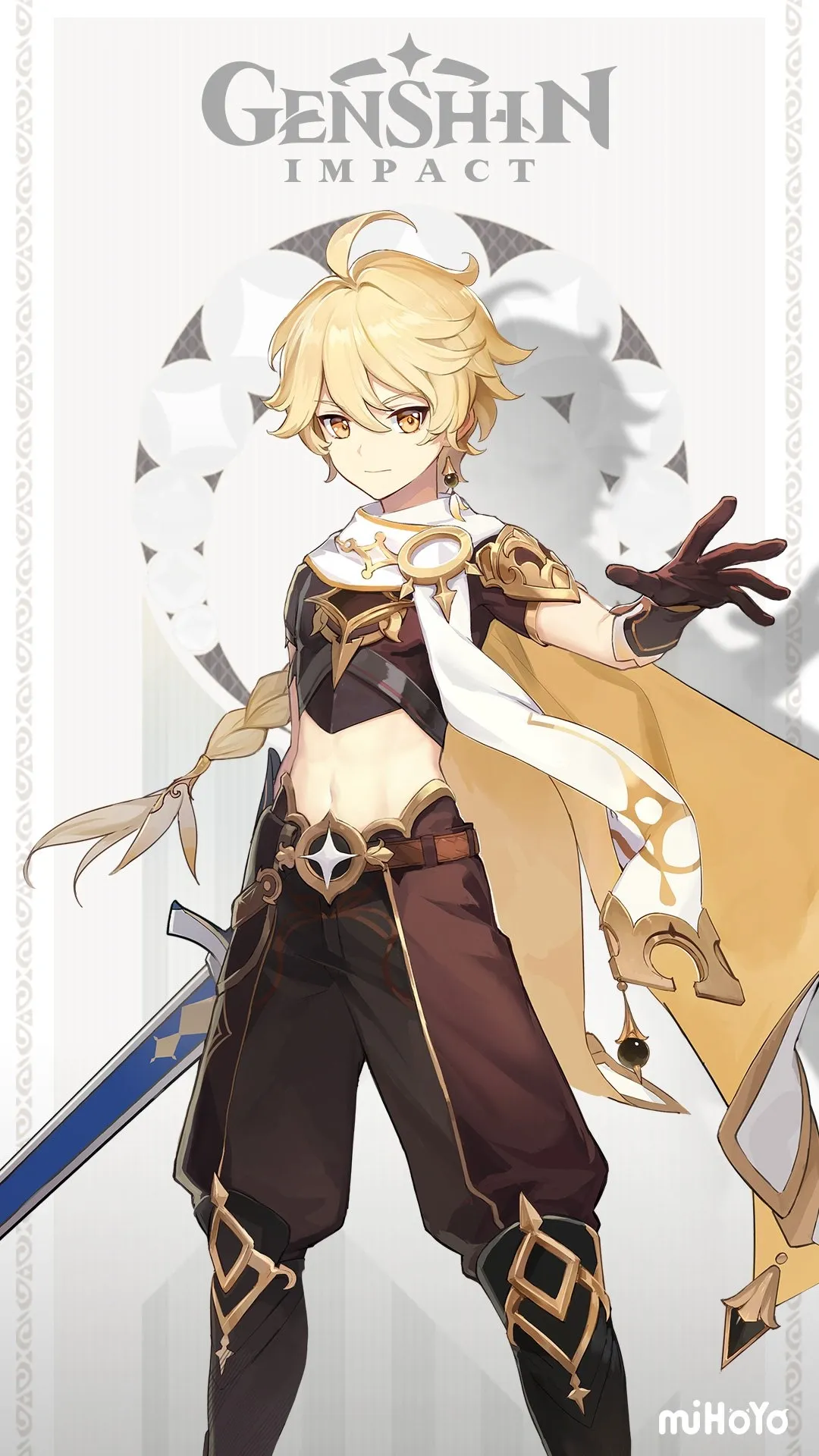
The Traveler is the protagonist, Aether if the player picked male, Lumine if female. The character pages Traveler and Traveler's Sibling carry the biographical material. This page collects the primary-text observations made about the player-character's status as the Fourth Descender. The Sibling came from beyond Teyvat too, but remains unclassified.
The single most important framing is Nahida's, in AQ III Act V: the player-character is the Fourth Descender. [4] Rene's research says not every outlander qualifies; a Descender is a will capable of rivaling an entire world and influencing its fate. See the Descenders page for that criterion, the numbered evidence, and Dainsleif's “four... perhaps more” hedge. This page focuses on what is observed for the Traveler in practice.
Five Traveler-specific observations
Five unusual interactions are grounded in named primary text. They describe the Traveler; primary text does not define them as what Descender universally means or require every Descender to reproduce them. [1]
Property | What fails | Primary-text grounding |
|---|---|---|
Vision-distribution-system immunity | Celestia does not issue the Outlander a Vision. The seven-element-licensing apparatus has no token to bind to them. The Outlander instead borrows elemental power by resonating with each region's Statue of the Seven, something no other character does. In Welkin Moon Act VIII, Columbina says, "I lifted some of the restrictions this world placed on you," and the Outlander finds, "I can use the elements more freely now...", an extension of this same property granted by a Trilune Goddess rather than by Celestia's licensing. | AQ Prologue Act I gameplay system (Anemo via the Mondstadt Statue); reinforced by every later region's Statue-resonance. [3] Welkin Moon Act VIII Welkin Moon's Homecoming Columbina-Outlander Frost-Moon gift. [16] [34] |
Irminsul-edit immunity | When Nahida uses Irminsul to delete Scaramouche's past in AQ III Act IV, every other character's memory shifts: the Wanderer is now somebody who never did the things Scaramouche did. The Outlander remembers Scaramouche. Their memory is not edited because their existence is not recorded in the world-tree. Welkin Moon Act IX extends this to a live anomaly: after Nahida connects herself directly to Irminsul and collapses, the Outlander scouts on past the point where Sekkura warns that "delusions will start afflicting your mind," reasoning, "Nahida once said that Irminsul doesn't contain any information about me... So theoretically, I shouldn't be affected by such anomalies." The same protection holds against a present-tense Irminsul anomaly, not just against later edits. | AQ III Act IV "The Morn a Thousand Roses Brings", Nahida's Irminsul edit and the Outlander's surviving memory. [5] Welkin Moon Act IX A Divergence Leading to Oneself, the Traveler scouting through the anomaly. [17] [29] |
Teyvat-astrology impenetrability | In Mona's Astrolabos Chapter, Mona sees through a bandit's ruse and says she can "read the gist of a situation at a glance." The Outlander is the exception: "Teyvat's stars can only display the fates and truths of 'this world.' Anything related to you becomes like a fog that even I cannot penetrate." Teyvat-astrology reads what belongs to this world, and the Outlander does not. | |
Sibling-residue recognition | At the pre-Dvalin Old Mondstadt cliff in WQ "Bough Keeper: Dainsleif," the Outlander touches a dandelion and reports they can feel the Sibling. Dainsleif's verbatim interpretive framing: "Perhaps that dandelion bears some sort of 'scent' that only you recognise. As for why... has it perhaps experienced something related to you?" The recognition is immediate, specific to the Sibling, and tied to objects the Sibling has physically touched. | WQ "Bough Keeper: Dainsleif" (Mondstadt 1.1). [8] |
Immunity to a time-freeze (new at Welkin Moon Act VI) | In Welkin Moon Act VI Return to the Moon, Dottore combines Hyperborean manipulation of memory with his false-moon construction and seizes the power of all three moons to freeze time. The Outlander puts it afterwards: "The Doctor froze time, which is why only I could move freely." The cutscene freezes everyone racing to the platform, Arlecchino among them; only the Outlander fights on, while the caged Columbina opens a Moon Gate. Time itself, even when held under the power of all three moons, does not bind the Outlander. | Welkin Moon Act VI Return to the Moon, the Dottore time-freeze ambush. [14] [32] [35] |
The first three observations and the time-freeze scene show unusual responses by the Traveler. The fourth is different: it is the Traveler recognising their Sibling's residue. It places the Sibling at Old Mondstadt earlier, but does not assign the Sibling a Descender number or establish a category-wide diagnostic. [11]
Saarelainen is the strongly implied candidate for the Third Descender because Hymns of the Far North says he was carved into seven pieces while Skirk separately says the seven Gnoses use the Third Descender's remains. No source explicitly joins those statements. Nahida names only the player-character as Fourth; the Sibling remains unclassified, and shared arrival does not create a shared Fourth assertion. The five observations above must not be generalized to the Sibling or other Descenders.
Chapter VII: the Ley-Line exception at death
In Chapter VII Act II, Ronova defines ordinary death as a two-stage process: the physical body dies, then the soul returns to the Ley Lines. Her authority can temporarily separate the Traveler's soul from their body, but she says that the Ley Lines of Teyvat would not accept the Traveler and that the Traveler's will firmly anchors soul to body. She concludes that this Descender can be killed only by directly destroying either body or soul. The scene tests the Traveler; it does not establish identical behavior for every Descender. [18] [19] [20]
The return from the theater's afterlife adds a memory consequence. Odette and the other recent victims initially forget what happened while dead; Mitya infers that an invisible mark was carved into his soul and preserved his memory, while the Traveler confirms that being a Descender is essentially why they remember. Treating this as related to the Irminsul-and-Ley-Line exception is an editorial synthesis, not a sixth mark or mechanism that the game defines. [18] [20]
The act also lets the Traveler describe that distance from inside. They say they used to feel like a spectator in this world, perhaps because they are a Descender, and that Paimon's presence gradually strengthened their connection to Teyvat; her authenticity made the world feel real. The Traveler still speaks of trying to overcome a sense of detachment. This is a subjective account of belonging, not a diagnostic property imposed on every Descender. [18] [19]
Chapter VII Acts V and VI: before Celestia's terminals
In Act V the Esoptron at the Temple of Space will not say how to stop the Holy Soil phenomenon until the inquirer gives "sufficient grounds." The Traveler's answer is personal. "I promised Lumine/Aether that we would meet again at the end of this journey... I don't want that to be in the ruins of a broken world." "Along the way, I've grown to love this world of Teyvat. I've made a lot of new friends here, and many precious memories." Then: "Speaking as a living witness to this world, I believe it has a right to a continued existence. I want to protect it... That is my wish." The terminal accepts it: "No further response detected. Sufficient grounds established." [37] [39]
Inside Sumeru's Nail of Retribution in Act VI, the Traveler and Paimon reach the inner chamber separately from Nahida, who is taking the trial alone. The Esoptron that runs the trials reports "Unexpected target entering processing area," fails to reach its core database, activates a "default protocol," and gets out only "Welcome... to the... world..." Paimon wonders whether the problem was "The fact that we weren't gods?", and the Traveler can only suggest "It's probably because the Heavenly Principles are asleep..." Nobody explains it, and since the reading covers Paimon too, it is not counted here as a sixth Traveler observation. [38]
At the Divine Throne, Nukvah claims the Temple of Space exchange as its own: "When we first came into contact at the Temple of Space, I asked why you wished to undertake these trials and save the world." Its reward, one allogene from each nation preserved while Teyvat is still to be destroyed, is not what the Traveler asked for. "What I told you was that I love this world because of all the friends I've made and the precious memories it's given me," the Traveler protests. "Teyvat is essential to me — it's like a second home. You've flagrantly misrepresented my terms!" Later comes a flat refusal: "The fate of the world should not be yours to decide." [38] [40]
The act's last spoken line belongs to the Traveler in Yatta's record and to the Traveler's Sibling in Fandom's transcription: "I have already traveled through this world once. Once you reach the end of your journey as I did, you will see for yourself the true nature of this world." The Traveler's thoughts follow: "(All of a sudden, Teyvat is to me what Khaenri'ah is to her/him...)" and "(I understand now, Lumine/Aether. What a lonely thing it would be if memories were all that was left of this world...)" None of these lines classifies the Sibling. [38] [41]
The Fourth Descender
The Outlander is the named Fourth Descender. The framework is named on-screen by Nahida in AQ III Act V; Dainsleif's language associates both twins with the wider question but does not assign the Sibling a numbered slot. [4] [11]
The ordering, as Dainsleif's voicelines lay it out:
- The Heavenly Principles, also called Phanes and the Primordial One, are the First.
- Nibelung is Second in Fandom's count. No released line numbers him, and the idea that leaving Teyvat and re-entering from the Sea of Stars earned him the number is a reading.
- The Third is unnamed explicitly; Saarelainen is the strongly implied candidate.
- The player-character Traveler is the named Fourth.
What is unambiguous is the named sequence above. The total is not closed: Dainsleif says “four... perhaps more,” and Chapter VII Acts I-VI do not resolve the Sibling's classification; Act IV's account of Hroptatyr summoning the Sibling does not call them a Descender. [27] See the Descenders page for the full evidence boundary.
What it means: the Traveler has a world-rivaling will under the Descender criterion and also displays several unusual interactions with Teyvat's systems. Those observations do not establish a universal checklist. The Traveler's recognition of their Sibling is an observed bond, not a formal classification of the Sibling.
The 500-year separation event: Asmoday at the cosmological border
The opening cinematic of the game is also the cosmological event that sets up the entire main plot. [3]
Later released material places the twins' Nod-Krai crash before the Sibling's Khaenri'ahn life. After the Cataclysm began, the Sibling returned to the crash site, woke the Traveler, and the reunited twins attempted to leave Teyvat. Only then did the gold-cloaked Unknown God intercept them. The earlier chronology is sourced to that later account, not inferred from the Prologue or The Final Judgment. [2]
Per the disclosure in The Final Judgment (Sumeru 6.5 Luna VI Apathic Interval capstone), the Unknown God is Asmoday, Ruler of Space among the Four Shades and Sustainer of Heavenly Principles. [6] Asmoday is the figure responsible for separating the Traveler from their sibling when the twins attempted to leave Teyvat; she trapped both twins in dark red cubes, and the Traveler later awoke with their powers sealed. That establishes the separation, not responsibility for the Nod-Krai crash.
Several features of the event become legible once the actor is named:
- The mechanism (spatial separation and cube seals) is consistent with Asmoday's title, Ruler of Space. The scene does not disclose whether she intended containment, execution, or some other outcome.
- The asymmetry (one sealed, one detained and then released) explains the 500-year gap. The Outlander's seal held until shortly before AQ Prologue Act I; the Sibling's containment broke or was released far earlier and they emerged into post-Cataclysm Teyvat.
- The interception targeted the twins' attempt to leave. Its authorization and motive are not stated.
The 500-year separation is downstream of one event by one actor on one day. The rest of the main story is built on its consequences.
The Final Judgment adds a later relationship clue. Melanta asks Asmoday why she chose her or him, with the pronoun changing to match the unchosen twin. Read beside Ronova's "new master" wording, this strongly implies the Traveler's Sibling is Asmoday's new master. The text does not define the relationship's terms or Asmoday's motive. [6]
The 500-year asymmetry between the twins
The mismatch between the Outlander's and the Sibling's experiences of Teyvat is the driver of the entire main plot. [2]
Twin | Time in Teyvat as of AQ Prologue | Trajectory |
|---|---|---|
The Outlander | Days. Recently awakened from the Asmoday-seal stasis with no memory of the intervening period. | Begins in Mondstadt, accumulates regional ally networks, learns the cosmology piece by piece across the Archon Quests. |
The Sibling | Years in Khaenri'ah before the departure interception, followed by most of the 500-year interval after waking or being released from Asmoday's seal; the exact release timing is unknown. | Met Chlothar Alberich at the Unknown Sanctuary; joined the Abyss Order; came to lead it as Prince of the Abyss / Princess of the Abyss; operates the Loom of Fate; is currently building New Khaenri'ah's Ley Lines inside the Night Kingdom. |
The Sibling has lived through Caribert's expiry, Chlothar's disappearance, developments with the Five Sinners on the board, the destruction of the Hydro Throne, and (per AQ V Act VI) a personal negotiation with Yohualtecuhtin in the Night Kingdom. [12] [13] The ancestry of Abyss Mages, Heralds, and Lectors remains unmapped. The Outlander has none of that history. Every reunion between the twins is shaped by centuries of different experience.
For the Sibling's stated worldview (the Heavenly Principles are the real enemy, Teyvat's gods are collaborators, the Cataclysm was Heaven's atrocity) and their place in the Order, see the Abyss Order page. For the Loom of Fate operation that defines their current activity, see the Loom of Fate page. This page handles what the Outlander and Sibling are; those handle what they do.
Chapter VII Act IV adds a thread to the Sibling's Khaenri'ahn years. Pierro reveals that when he summoned Paimon from Celestia, Hroptatyr summoned the Sibling at the same time, after being told that "a blond-haired crowned heir will answer his call." The act does not explain what the Sibling was doing in Celestia or how this fits the twins' earlier arrival in Teyvat. [27]
Prior arc at the Luna VII close (Version 6.6)
At the Luna VII close, the arc added several Traveler-specific observations: movement during Dottore's time-freeze, Dottore calling the player-character a Descender, Columbina loosening elemental restrictions, and passage through a live Irminsul anomaly without the ordinary reaction. None is promoted into a universal Descender diagnostic. [17]
What the Welkin Moon arc added (Acts VI–IX)
Song of the Welkin Moon (Versions 5.8 through 6.6, in scope here through Act IX) is the densest run of primary text on the Outlander's nature since Nahida named the Fourth Descender in AQ III Act V. Four moments in it engage that nature directly, each adding to the picture without rewriting it.
Act VI: immunity to a time-freeze (the fifth property)
Per Welkin Moon Act VI Return to the Moon (Version 6.2, Luna III): Dottore's stacked "variables" reach even Hyperborean phantoms "he never met"; he uses what they tell him "to truly create a 'false moon,'" and "had already amassed the power of all three moons" (Arlecchino's words) when he froze time. The Outlander concludes, "The Doctor froze time, which is why only I could move freely," and wonders, "Is it because I'm a Descender?" This is a fifth Traveler-specific observation. It does not establish time behavior as a universal Descender diagnostic. [14] [32]
Act VII: Dottore offers to restore the Outlander's status
Per Welkin Moon Act VII A Traveler on a Winter's Night (Version 6.3, Luna IV): Dottore captures the Outlander and slows their time: "A whole month passed before you opened your eyes again" (his time manipulation is still imperfect). He tells them, "I wonder if you don't understand humans all that well," says their "long life and unique origins make you fundamentally different from them," asks how long before people "treat you like the alien you are," and adds, "You have been treated most unfairly," before offering to "give you back the status you rightly deserve as a Descender." [33] Two things stand out.
- Dottore calls the Outlander a Descender. His offer treats their status as something he claims he could restore. The scene does not define the Traveler's Vision, Irminsul, astrology, residue, or time observations as imposed restrictions, and Dottore's claim does not create a universal diagnostic.
- Other Harbingers anticipate Dottore's strategy. Arlecchino says, "Traveler is Teyvat's Fourth Descender," adds that "all harbingers are aware of this," and judges that Dottore "is unlikely to kill him/her right away." That shows the Harbingers know the Traveler's number; it does not show that any of them can recognize a Descender on sight. [33]
When Dottore renews the offer in Act VIII Descending Moon, the Outlander answers with silence ("Not in the mood to talk? As you wish," he says) and never engages the pitch. [34] The chapter's villain tried to treat being a Descender as a status he could manipulate, and the primary text confirms a sufficiently resourced actor can attempt that, even though Dottore could not finish it before his Act VIII vaporisation. [15]
Act VIII: Columbina loosens the element restrictions
Per Welkin Moon Act VIII True Moon / Welkin Moon's Homecoming (Version 6.3, Luna IV): at the Frost Moon, after the chapter resolves and the Trilune Goddess descends, Columbina tells the Outlander, "But you and your friends taught me what a true home should look like," and lists her gifts: "I've given the Eternal Moon's marrow to Lauma, and the Iridescent Moon's Marrow to Arlecchino. And now, I shall return my kuuvahki to Nod-Krai again, that it may continue to protect my chosen home." Then she says, "I lifted some of the restrictions this world placed on you," and the Outlander feels it: "I can use the elements more freely now..."
Columbina's gift modifies the Traveler's elemental access on screen. The Traveler is not granted a Vision; they receive freer use of the elements they already access. The scene remains evidence about the Traveler and does not define how every Descender must interact with Visions. [16] [34]
Act VIII: the Frost Moon spaceship and the flight log
In the same Welkin Moon's Homecoming subquest, the Outlander reaches the Frost Moon spaceship, the crashed vessel the AQ Prologue cinematic implied existed but had never shown. Two disclosures land in sequence.
- The spaceship was hidden on the Frost Moon by the Heavenly Principles, by Columbina's account: it "has been hidden on the Frost Moon, which lay beyond the sky," by "the Heavenly Principles," and she can only guess why: "I don't know. Perhaps your ship contains something that is incompatible with Teyvat. Or something that cannot be known." If she is right, Heaven's restrictions reach the Outlander's physical belongings, not only Teyvat's own Vision, Irminsul, and astrology systems. The earlier reading, that Heaven's restrictions act only on Teyvat's systems, is extended rather than contradicted: from Act VIII on, the text has Heaven moving an Outlander's possession.
- The flight log gives the Outlander and Sibling's path before Teyvat. As the Outlander reads it, the ship "flew over the skies of Teyvat once before. A long, long time ago," and "barely came to a stop before flying on again." With some of the data corrupted, they suspect "it kept flying for thousands of years" before it "made a forced landing in Nod-Krai." This is the first time primary text grounds the twins' path before Teyvat; where they came from is still not said. The crash preceded the Sibling's Khaenri'ahn life and the twins' later Cataclysm-era departure attempt; Asmoday intercepted that later attempt rather than forcing the landing. If the Outlander's estimate holds, the first pass sits well before the 500-year Cataclysm.
After reading the log, the Outlander reflects, "I remember Lumine/Aether telling me that when she/he first arrived in Khaenri'ah, she/he could not recall the past... So this might be something that even she/he doesn't know..." That sits beside the motive given in Welkin Moon Act I by a figure in the Sibling's form: "What happened to us in the past, how we came to Teyvat, why our spaceship crashed here... There are things I want to know too." The figure was Rerir in disguise: in Act II Nefer says he "came in disguise to obtain the Moon Marrow," and Fandom lists him that way. The twins' shared past before Teyvat may be something neither already knows, and something both of them would have to discover. [16] [34] [30] [31] [36]
Act IX: Irminsul immunity in a live anomaly
Per Welkin Moon Act IX As All Falls to Emptiness, the Outlander scouts through the Irminsul anomaly without the ordinary reaction ("So theoretically, I shouldn't be affected by such anomalies") and then takes Nahida to Apep for restoration. This is another Traveler-specific observation. Apep's cooperation is contextual and does not establish peer recognition on sight as a universal Descender mechanism. [17]
Apep also says she sensed the Hydro Dragon reclaim his Authority. Focalors held the Hydro Archon office until she destroyed its Throne; Neuvillette remained Fontaine's Iudex and the Hydro Sovereign in human form, never a Hydro Archon. The Traveler witnesses this reclamation arc without receiving an Authority. [22] [21]
How this connects to the wider cosmology
The Welkin Moon disclosures sit alongside several deep dives. None turns the five Traveler observations into category-wide tests or changes the Asmoday separation.
- Egeria and the true origin of Fontaine. Reads the Hydro seat as the first on-screen restoration of full Sovereign Authority (the AQ IV V Hydro Throne destruction and the restoration of Neuvillette's power). Egeria's origin as Naberius's creation, her engineering of Oceanids into humanoids, and the prophecy of Fontaine's dissolution ground the kind of event Apep acknowledges from across regions at Welkin Moon Act IX. The Outlander witnesses that first Sovereign restoration in the chapter just before their own cooperation with Apep at the Heart of Oasis. [21]
- The Sovereign-to-Archon transition. Reads the long two-war arc (Heaven's forty-year war and the Archon War the wounded Heavenly Principles set in motion) whose reversal the Outlander witnesses opening at Welkin Moon Act IX, with the story of each seat region by region, Neuvillette's rebirth in human form, and the cooperation with Apep. The Outlander's standing with the dragons is one of being worth addressing, not of being eligible to receive an Authority. [22]
- The three things called the Loom of Fate. Keeps apart (a) the Abyss Order's constructed device and the Sibling's project, (b) the pre-Cataclysm Khaenri'ahn fate-engineering concept, and (c) the speculative "Teyvat operating-system" reading. The Outlander's recognition of the Sibling's residue (the fourth mark) is not the same as the Sibling operating the Abyss Order's Loom device. They are two different things about one pair of Descenders, and they are kept apart here as everywhere. [23]
- The Welkin Moon arc, as a story. A ten-beat read of the Prelude and Acts I-IX of Song of the Welkin Moon as three braided threads: the Wild Hunt's mastermind (Rerir), the recovery of the Three Moon Goddesses (Columbina, Aria, Sonnet, Canon), and the disclosure about the twins' past before Teyvat at the Frost Moon spaceship, with its flight log of two approaches. The Outlander's thread crosses the other two at the Acts VI-IX moments this page lists; the synthesis reads them as drama where this page reads them as cosmology. [24]
The character pages hold the biographical framing; this page records five Traveler-specific observations without assigning them to the Sibling.
What this is kept distinct from
Two deep dives bear on the framing here. Neither turns the five Traveler observations into universal diagnostics or changes the Asmoday separation.
- Saarelainen and the Third Descender. Hymns of the Far North Vol. 2 says Saarelainen was carved into seven pieces; Skirk separately says the seven Gnoses were crafted from the Third Descender's remains. The parallel makes Saarelainen the strongly implied candidate, not an explicitly named identity. The Gnosis system belongs after the War of Funerary Flame and before the Archon War. [25]
- Who the Sustainer is: Asmoday and the Four Shades. The Sustainer is not a rank of its own; it is a role Asmoday (Ruler of Space among the Four Shades, whose absence Fandom reads as a defection) holds. [42] Her intervention separated and sealed the twins, but the scene does not disclose her motive, establish recognition on sight as a Descender ability, or assign the Traveler's five observations to the Sibling. [26]
Both deep dives leave the five Traveler observations unchanged. Neither turns them into universal Descender diagnostics or assigns them to the Sibling. The Traveler's recognition of the Sibling's residue stays distinct from any Loom of Fate operation.
How the Outlander recognises the Sibling across the gap
Two named channels carry recognition across the 500-year gap and the separation Asmoday imposed. Both show a durable twin bond without classifying the Sibling.
The Suspensus Somnium Mechanism
The Suspensus Somnium Mechanism is a device for restoring memories, built with adeptal arts by Cloud Retainer, disclosed in Xianyun's Grus Serena Chapter (SQ Xianyun, Version 4.4). It produces a soft breeze and a gentle adeptal tune that ease a person into a half-hypnotic state, restoring lost or buried memories. [9] [10]
In the chapter the device restores Yuandai's memories of her former life as a crane. The same chapter shows it as the means by which the Outlander dreams of their Sibling, a rare source for the twins' shared past before Teyvat outside the Caribert sequence (Chapter III Act VI) and the Song of the Welkin Moon material. The Outlander's memory of the Sibling runs deep enough to be drawn back out under the right conditions, even after Asmoday's seal and separation.
Recognising the Sibling's residue
The second channel is direct recognition of something the Sibling has touched. In WQ "Bough Keeper: Dainsleif," at the pre-Dvalin Old Mondstadt cliff, the Outlander touches a dandelion and reports feeling the Sibling. Dainsleif supplies the word for it: "Perhaps that dandelion bears some sort of 'scent' that only you recognise." [8]
The recognition is immediate, with no investigation needed, and runs through the dandelion itself, not through anything the Outlander sees or hears. It is one of the five Traveler observations above. The scene itself does not classify the Sibling or define a Descender diagnostic.
The two channels complement each other: the Suspensus Somnium works on memory, in the dream; the dandelion works on physical contact. Both show that the twins recognise one another across Asmoday's seal without assigning the Sibling a numbered status.
What the Outlander does not have
The Outlander's nature does not include the following. Setting these out guards against the kind of inflated reading the wiki has had to correct elsewhere (Surtalogi as the Loom engineer, Skirk as the Cryo Sovereign, and so on).
- No on-screen demonstration that the Outlander can rewrite Irminsul. Edit-immunity is a property of being outside the system; the ability to write into the system has not been shown. Nahida and Greater-Lord Rukkhadevata have both rewritten Irminsul; the Outlander has not.
- No on-screen demonstration that the Outlander can operate the Loom of Fate. The Sibling operates it. The Outlander has interacted with Caribert (the original vessel of the Loom) and with the pipeline behind the Atlas of New Khaenri'ah, but not as an operator of the Loom.
- No declared Descender purpose. The Outlander's stated goal is to find the Sibling. Beyond that the Outlander has not announced a cosmological agenda. The Sibling has, but the Outlander has not. The nearest thing is the wish the Traveler gives the Esoptron in Chapter VII Act V, to protect a world that "has a right to a continued existence," and no line frames that as a Descender's purpose. [37]
- No name attached to the Outlander's pre-Teyvat origin. Aether and Lumine are the names the twins have used since the AQ Prologue cinematic. The earlier name, the home world, and the reason for coming are all unrevealed; Song of the Welkin Moon's pre-Teyvat material is the closest canon has come.
These are not gaps to fill with guesses; they are the limits of what canon says about the Outlander as of Version 7.2.
Connection to other frameworks
- The Descenders. The named sequence from First to Fourth. The Outlander is the named Fourth; Dainsleif's hedge and the Sibling's unresolved slot remain explicit there.
- The Heavenly Principles. The current order. The Outlander's nature is what makes them legible to it, and partly out of its reach.
- The Four Shades. Asmoday is the Sustainer who imposed the 500-year separation; Ronova laid the curse of immortality on the Khaenri'ahn survivors the Sibling lives among. Chapter VII Act II further shows Ronova's ordinary soul-return process failing to accept the Traveler, extending the Outlander's Irminsul-and-Ley-Line exception into death. [18] [20]
- The Abyss Order. The Sibling's home after the Cataclysm. The Outlander never joined; the opposition between the twins is also an opposition between the Outlander and the Order.
- The Loom of Fate and the three referents kept apart. The device the Sibling operates is one of three things the name covers. This page does not equate the Traveler's recognition of residue with the Sibling operating a constructed device that weaves Ley Lines, nor with the pre-Cataclysm Khaenri'ahn fate-engineering concept, nor with the speculative "Teyvat operating-system" reading. The player-character is the named Fourth; the Sibling remains unclassified. [23]
- The Cataclysm. The crisis of 500 years ago, underway when the twins attempted to leave. The Nod-Krai crash and the Sibling's Khaenri'ahn life came earlier; Asmoday's separation happened only during the later departure attempt. Released canon does not make the twins or Asmoday the cause of Heaven's separate responses across Khaenri'ah and the other regions.
- The Seven Archons. Archons have reacted to the Traveler in different ways across their regional stories. Cooperation or respect does not establish a universal ability to recognize Descenders on sight. Per Welkin Moon Act IX, Apep cooperates with the Traveler at the Heart of Oasis to restore Nahida; that is an alliance in context, not a taxonomy test.
- Columbina, the Trilune Goddess. Per Welkin Moon Act VIII Welkin Moon's Homecoming, Columbina (restored with the full Authority of all Three Moon Sisters) removes some of Teyvat's restrictions on the Outlander, letting them use the elements more freely. She is the first authority on Teyvat's own side, in primary text, to change one of the Outlander's marks rather than just observe it.
- Dottore (deceased at Welkin Moon Act VIII). Per Welkin Moon Act VII, Dottore offered to "give you back the status you rightly deserve as a Descender." He is the first Harbinger on screen to treat the Outlander's nature as a status that could be changed rather than as what they simply are, and in the same act Arlecchino says all Harbingers know the Outlander is the Fourth Descender. [33]
- Nod-Krai. The 8th-nation region of Luna I-VII, where the Sibling's Khaenri'ahn remnant forces operate (the Wild Hunt, the Frostmoon Scions, the Five Sinners' rescue origin at Welkin Moon Act IV). The Sibling's position crosses Nod-Krai's geography even where the Outlander has not yet engaged the region directly.
- Dainsleif and the Sibling. The Bough Keeper Dainsleif WQ shows the Sibling was physically present in Mondstadt at some earlier point and traveled with Dainsleif for part of the 500-year gap. So the Sibling's long residence in Teyvat includes a Khaenri'ahn knight's company for at least part of it, not pure isolation.
Deep dive
The biographical character pages sit at Traveler and Traveler's Sibling, with the four-Descenders framework as a whole on the Descenders page. The grounding that the Sustainer is Asmoday runs through The Final Judgment world quest and the Four Shades page. On the Sibling's side, their place in the Order and the Loom of Fate operation are at Abyss Order and Loom of Fate. The distinction between the three referents, which keeps the Outlander's recognition of the Sibling apart from operating the device, is at the deep-dive on the Loom of Fate's three referents.
The Cataclysm, which happens at the same time as the separation, is at the Cataclysm page; the background to the Hydro Throne destroyed in AQ IV V, from Naberius's creation of Egeria onward, is at the deep-dive on Egeria's true origin; and the Sovereign-to-Archon transition whose reversal Welkin Moon Act IX opens is at the Sovereign-to-Archon transition deep-dive. The essay reading Acts I-IX as a single ten-beat story braiding the Wild Hunt, the Three Moon Goddesses, and the twins' pre-Teyvat strands is the Welkin Moon arc synthesis. The individual marks are grounded in primary text at Mona's Astrolabos Chapter (the astrology mark), the Bough Keeper: Dainsleif dandelion scene (the recognition mark), and Xianyun's Grus Serena Chapter (the Suspensus Somnium dream channel).