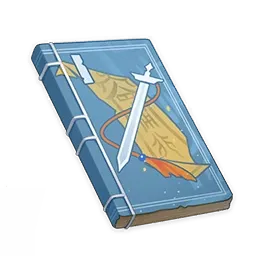
Legend of the Lone Sword is a 4-volume Liyue Book Collection released in Version 1.0. Each volume opens with the same standing description, "A popular martial arts novel in Liyue Harbor. In a world without elemental energy or alchemy, a tale unfolds of love and hate between friends and foes", and the four volumes together cover the opening arc of a revenge story that the book itself never closes. [1]
Jin the Seventy-Second
The protagonist is the last man left alive of a martial-arts school whose other 71 members were buried "in the merciless mountain snow" by a nameless rival swordsman three days before Vol. 1 opens. He takes the name Jin the Seventy-Second because the count is all he has left of his school. Vol. 1's opening road sequence establishes him as merciless rather than heroic: when a cart driver answers his request for a ride to Tupi Village with an aphorism ("For you are not I, nor I, you"), Jin draws his blade and kills the man without further reply, "for he had always hated pointlessly talkative people most of all," then rides the bloodstained cart on to the village.
The Tupi Village duel
Tupi Village sits at the foot of barren mountains, reached only by a single ancient path; in-universe etymology gives "Tupi" the gloss "to burn away vanity's dross to attain the gem of truth." Vol. 2 frames Jin's edge over the village's other would-be challengers: "Tupi Village was full of evil people, schools and sects had their rules, and so none would dare come knocking with rash provocations and talk of revenge. But Jin the Seventy-Second had no school or sect, and was thus unbound by any such rules. He was but a single starving ghost with a lone sharp blade." By the time he reaches the red-eyed chief's mansion he has killed "exactly three hundred and sixty-two. No more, no less" of the chief's men, "and one dog", the gatekeeper, whose bone he tosses onto the wind case after stewing it "almost to the marrow." Vol. 3 settles the duel itself by a feint: the chief never registers that Jin's left hand has been carrying a broken incense burner the whole time, and a single censer-strike to the forehead ends the fight. The chief dies pointing the way: "The person you're looking for is in the barren mountains beyond this village..."
The barren mountains and the meta-fictional frame
Vol. 4 sends Jin into those barren mountains wounded and limping, with two unnamed figures watching from a cliff: a "bone-thin old crone" with "icy death in her jade-blue eyes" and a "corpulent old man" who walks past without disturbing "a single withered tree or blade of dying grass." The volume ends with the swordsman collapsing on the gravel and catching, just as the darkness takes him, "a glimpse of the billowing hem of azure-blue skirts", a silhouette he half-recognises and the book deliberately leaves unidentified. [1]
The novel's no-element premise does not extend to its in-text mythology. Vol. 4's folk tales hold that the mountains were "brought into being by slices from the Celestial Emperor's blade" and had "soaked up the tears of the Earth Mother," borrowing the imagery of the Celestial Emperor and the Earth Mother as Liyue fiction inside a story that has already ruled out working elemental powers. The "world without elemental energy or alchemy" disclaimer is what marks the series as fiction within Liyue Harbor, popular reading material rather than testimony, which is why it sits where it does among Liyue's books.
Not the Inazuma "A Legend of Sword"
Legend of the Lone Sword (Liyue, 4 vols, anonymous in-universe author) is not the same Book Collection as the Inazuma series A Legend of Sword (6 vols, authored in-universe by Xingqiu under the pen name Zhenyu and illustrated by Albedo under the pen name Calx, with an Inazuman-script cover reading "DLDFSCH"). The two share "Legend" and "Sword" in their titles, and that is the whole of the overlap: different region, different volume count, different in-universe authorship. Xingqiu's well-known taste for chivalric novels makes him a plausible reader of Legend of the Lone Sword, but he is the in-universe author only of the Inazuma counterpart, and conflating the two erases the cross-region distinction. [3][2]