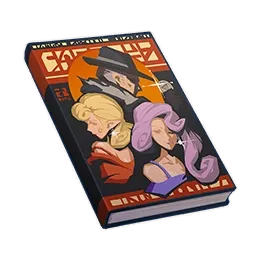
The Legends of Reed Miller, Thief Extraordinaire is a three-volume Nod-Krai Book Collection released in Version "Luna I" alongside East of the Moon, West of the Sun, the WQ Series built around the Reed Miller treasure hunt, and Polkka Beneath the Moon's Oracle, the WQ Series on Frostmoon Scion history. Each volume opens with the same standing description: "An anthology of pulp fiction stories based on the exploits of Reed Miller that is wildly popular throughout Nod-Krai. Collated from various works and authors, the veracity of the stories within is as dubious as the quality of the paper they are printed on." The book is the chain's pulp counterpart, folklore sold in Nasha Town before the real historical figure behind the Reed Miller persona is named at Bunker No. 0. [1] [2]
Vol. 1 - the Sampo Mill heist
Vol. 1 is an issue of Your Dime Eerie Mystery! The Master Thief Reed Miller and the Sampo Mill (Deluxe Quarterly Edition), a cheap serial sold in Nasha Town for 10 Mora an issue. It is presumably about Reed Miller's "attempt to steal the Frostmoon relic, the Sampo Mill, from the governor's palace," though it mostly follows the young women chasing his affections. The middle of the volume has been ripped out, so only two chapters survive. In Chapter IV, Miller meets the thief Wagtail at night on a tower. A few people, Miller among them, know her as "A", and she is the only femme fatale in Nod-Krai "whose skill and infamy rival those of the most legendary thieves." Chapter XVII is the payoff. A group of Snezhnayan detectives storms the governor's palace and puts him in irons. Their Detective Leonov is Miller in disguise, and the Oprichniki who tied the governor up are Miller's own people. Miller tells the governor that "the Frostmoon Scions' treasure has been safely returned to their holy lady." Wagtail, also disguised as a detective, then tells Shadow Weasel, whose adoptive father is the bound governor, that Miller did keep one thing: "What he has stolen for himself is the heart of the Frost Moon's daughter." The chapter does not say who that daughter is. [1] [6] [7]
Vol. 2 - the gender-swap
Vol. 2 carries an explicit disclaimer, "any resemblance to real persons, places, or events is purely coincidental," that the book's own trivia subsequently disowns. The volume stages Reed Miller's newspaper challenge to Lord Prokhor Trubetskoy and the heist at the birthday ball of Leonita Prokhorovna Trubetskaya, the governor's "adopted daughter," aided by a red-haired footman and a Fontainian jeweler (Treasure Hoarders embedded in the palace) who swear "We promise to steal all the misery from this world!" The key reveal is that Leonita's gifted gemstone triggers her "treatments," which "were not for healing - they were rituals, the key to making the Mill produce an endless stream of diamonds." Leonita herself, not the Mill, is the source of Trubetskoy's "near-limitless" wealth. Per the book's own trivia, "Vol. 2 is a gender-swapped version of the actual historical events, where Brahe, the human adoptive son of the fae governor Trubetskoy, fell in love with the second Reed Miller, Alia, as she looted the governor's palace." The fictional male Miller is Alia; the fictional female Leonita is Brahe; the fae governor of the foundational Sampo Mill legend that East of the Moon, West of the Sun leaves nameless is Trubetskoy. [1] [4] [5]
Vol. 3 - Zima's footnote
Vol. 3 leaves the heroic mode for a tragic interlude unanchored to any other primary source. Zima ("a Slavic surname meaning winter," per the book's trivia) is a Snezhnayan sailor raised on tales of Jack Frost and the "pale, melancholy Snegurochka who, when betrayed, froze the lovers they had once sought into lifelike statues." He joins Reed Miller's three-masted ship seeking "a unique fate," finds only the "grind of scrubbing decks, patching sails, and scurvy gums," and is at last sacrificed by Miller to a siren who refuses Mora and demands flesh. "His adventures did not pen a new story… They were merely unnoticed footnotes to an existing one." The volume reads as the book's own reflexive disclaimer (even pattern-defying lives are footnotes) and as the counterweight to the heroic tone of Vols. 1 and 2. [1]
What the trivia line establishes
The book's real contribution sits in the trivia line. It (a) names the fae governor of Reed Miller's foundational legend, Trubetskoy, which East of the Moon, West of the Sun refuses to do; (b) establishes Brahe as that fae governor's human adoptive son, a position from before the events at Bunker No. 0 that is otherwise undocumented; and (c) names Alia as the "second" bearer of the Reed Miller name. Per Polkka Beneath the Moon's Oracle, Alia is the older twin of Moonchanter Aila, and it was Alia who threw herself into the Sampo Mill at the Pillar of Embla to kill Rauthvangi. The book is therefore the primary-text source for reading the Reed Miller folk mantle as held by three bearers: first bearer (unnamed) → second bearer Alia → third bearer Brahe. Vol. 2 dramatises, in gender-swapped form, the events at Trubetskoy's palace during Alia's time as Reed Miller. The Treasure Hoarder oath the Vol. 2 accomplices swear, "We promise to steal all the misery from this world!", links to the cavern where the East of the Moon, West of the Sun capstone seeds the Treasure Hoarders' founding under Avrelian and Silvestr. [4] [5] [9]
Pulp fiction, not chronicle
The book is not a primary-text historical chronicle. Its volumes openly identify themselves as pulp fiction of "dubious" veracity, and Vol. 3 has no other source behind it. The in-fiction Reed Miller of Vols. 1 and 2 is a single male master thief; the historical Reed Miller is a folk mantle held by at least three known bearers, and the story of Vol. 2 refers to the second bearer, Alia, rather than the third, Brahe. The Sampo Mill the book stages as a wealth-mill, operated through Leonita's silvery-white "treatments," is in truth a world-ending device wielded by Professor Rotwang to destroy a previous Teyvat; the wealth-mill of the story is a much smaller thing derived from that, not the same thing. The book does not equate Leonita's silvery-white "flaw in her very being" with the silver blood of the Frostmoon Scions; the trait is narrative coloring, not a claim that Brahe was a Frostmoon Scion or a subject of the Sacred Heir Project. The Snezhnayan elements the book invokes (Oprichniki, the Tsar, Snezhnograd) are kept separate from the Nod-Krai setting in which the book is sold and read, with the same care over which region each element belongs to that A Brief History of the Pale Starborn shows. [8] [7]