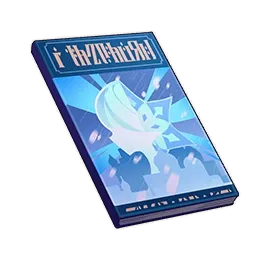
A Brief History of the Pale Starborn is a one-volume Snezhnaya Book Collection obtained in Nod-Krai, purchasable for 1,500 Mora from the NPC Dhabit at Mimisbrunnr Books in Nasha Town on Lempo Isle. It released in Luna IV (patch 6.3) alongside Tales Carried by the Northwind and Night Murmurs From the Far Border: Varcolac; collecting it together with Varcolac grants the achievement "The History of One City." Vol. 1's standing description sets the tone: "A book on fae history. Based on certain details within, it's believed to have been written by fae elders." The single recovered volume comes in two parts. A footnoted extract from the 428th Cycle Pale Star War, then a compressed annal from the 799th Cycle covering Tsaritsa Anastasya Feodorovna's first seven regnal years, sit about 371 Cycles apart on the in-universe Cycle calendar, which the book never converts into any Teyvat-wide reckoning. [1] [2]
The Pale Star War - 428th Cycle
The first part is the primary-text origin of the Belyi Tsar title. "In the third year of the 428th Cycle, that is, the 76th year after Emperor Monomakh Snezhnyi raised the imperial capital upon the frozen earth," the Emperor's envoys demand that the Vila stop paying tribute to King Miscislav of the Volkodlak, the Volkhov Chronicles' Gorynishche, "Son of the Mountain," the Blood-Devourer. Miscislav accuses "the Pale Star court of breaking the standing peace agreement"; the Emperor refuses; in the seventh year, Miscislav marches on Kitezh with the Miscislavli, Nyholmgarthir, Dalegrad, and Cirnareka clans. The armies clash three times. "The Emperor slew King Miscislav," slaying Grand Dukes Skoldyryt and Vodyanoy on the same spear "used as an arrow, launched with force unimaginable by common knowledge"; Grand Duke Seriviiki escapes and later joins the Pale Star court as a minister. The Emperor then declares himself "heir to the Pale Star, and protector of all fae," and from that day names himself the Belyi Tsar. [1]
The Anastasya annal - 799th Cycle
The second part is the record of the present-day Tsaritsa's accession. "The first year of the 799th Cycle. In the fourth month of this year, Anastasya Feodorovna was crowned Tsaritsa of all Snezhnaya." Many fae princes stayed away, and "the Dalegrad clan broke ties with Snezhnograd, for Emperor Monomakh had passed away." In the second year Port Belovodye rebels; Grand Duke Drevogorye fails to suppress it. In the third year the Tsaritsa establishes the Fatui, pointedly "unlike Emperor Monomakh, she did not muster the Druzhna," and the Fatui "conquered the lands of the fae princes"; Drevogorye dies accusing the Tsaritsa of treason. In the fourth year the Tsaritsa orders the Fatui to build the fortress Glupov, "meaning 'the city of fools,'" near Snezhnograd. In the sixth year "the Tsaritsa established the Snezhnograd Veche … The human, Ioanna Ivanovna, was appointed its first chairperson." In the seventh, the Imperial Order Reformation Edict publishes and "a great many princely fae … voluntarily forsook their noble titles and departed Snezhnaya." [1] [3]
The three readings it pins down
This single volume is the primary text behind three Snezhnaya readings. First, it says Emperor Monomakh Snezhnyi took the Belyi Tsar title. The book does not call Monomakh a Cryo Archon or equate him with the Cryo Sovereign, but other in-game text joins it to the later records. The Version 7.0 World Quest uses "Belyi Tsar" for a being who, by Aksinya's account, awoke from the dead Cryo Dragon Sovereign's remains after one thousand years. Its dialogue never names him Monomakh, yet The Alchemist's Notes (II), a readable in the ruins of his research organization Hvergelmir, says "His Majesty Monomakh has passed." In Chapter VII Act III the Tsaritsa calls the Belyi Tsar "my predecessor," and in a Traveler voice-over Paimon calls him "the previous Cryo Archon." [12] [16] [17] [18] [19] Second, the book names Anastasya Feodorovna as the Tsaritsa; whether that is a personal name, regnal title, or both is not spelled out. Third, it dates Ioanna Ivanovna's appointment as the Snezhnograd Veche's first chairperson.
Act IV's instigator
Version 7.1 adds a third record that uses the title. In Chapter VII Act IV, Rhinedottir tells the Tsaritsa: "On that fateful day, the Belyi Tsar incited you — a mere herald of the court at the time — to open the gate to the Abyss alongside the Third Descender." That act, she says, "triggered the numerous Abyssal disasters that have plagued the world over the past millennium," and "the true blame should lie with the Belyi Tsar as the instigator." The Heavenly Principles erased the Tsaritsa's existence as punishment, while the Belyi Tsar "escaped all consequences by fleeing to the Shadow Realm," the only one who kept some memory of the Third Descender. [13] [15]
The Tsaritsa says only that "the Belyi Tsar once told me about it," that "it sounded like someone else's story," and that "I never had much trust in the Belyi Tsar either." [13]
Act IV does not name Monomakh, does not say whose court she served as a herald, and does not call its Belyi Tsar a Cryo Archon or the Cryo Sovereign. Other texts carry the link. The Hvergelmir readable ties this book's emperor to the World Quest's Belyi Tsar. In Act III the Tsaritsa calls "the Belyi Tsar" her predecessor and says he told her about the Third Descender's seal, much as Act IV has him tell her the story she was forced to forget. That Act IV's instigator is the emperor of this book is implied by the shared title and the Tsaritsa's own words, but neither this book nor Act IV states it. [14] [16] [17]
The Belyi Tsar also connects to Flins's Aarnivalkea family-title fairy-fire, where the Long Night's Oath artifact set traces it to a Lightkeeper-warrior's prayer to the departed Belyi Tsar, the present-day Nod-Krai continuation of the imperial-fae folk-religion this book records the founding of. And the third-year founding of the Fatui sits upstream of the post-Cataclysm reorganisation of the Eleven Fatui Harbingers under the Tsaritsa and Pierro. [5] [7] [9] [10] [11]
The Version 7.2 supplements
Three readables added in Version 7.2, General History of Snezhnaya Supplement (I) to (III), revisit the same war. The first reaches back to Monomakh's youth. It makes him the "disciple" of Yalyane Morevna, the "Knyazhna of Blood," and draws one fact from a story it calls absurd: "after meeting with the young Monomakh, Yalyane's slaughter of the fae grew ever less." It also names Miscislav's father, the Arkudino chieftain Bodvar, whom Yalyane killed. [20] The second follows Miscislav's rise to found the Volkodlak Alliance and records that "the young Emperor Monomakh raised the city of Kitezhgrad beneath the Pale Star." [21]
The third bears on how Miscislav died. Its editor writes that "all contemporary sources state plainly that King Miscislav never met Emperor Monomakh upon the field at all, but was killed by a spear driven through his skull, and that his last words were merely 'What.'" This book's main text says only that "the Emperor slew King Miscislav." Its footnotes come closer to the supplement: the Emperor's spear was "used as an arrow," not wielded in a direct engagement, and Miscislav died "when the Emperor's spear pierced through his head." The supplement, though, does not say whose spear it was. The same volume also prints, as an appendix whose credibility it rates "the lowest order," the Tables and Lives of the Beast Lords, in which a cornered Miscislav curses "Monomakh Snezhnyi" to his face before he is killed. No text reconciles these accounts. [22] [1]
A Snezhnayan history, sold in Nod-Krai
The book is Snezhnayan, not Nod-Krai. The Nod-Krai tag it carries is only a "where you can buy it" label; the history it tells belongs to Snezhnaya. That sets it apart from its sibling Tales Carried by the Northwind, which is genuinely Nod-Krai material (Lightkeeper-Starshyna succession poetry) rather than Snezhnayan-imperial history. The book never touches the Wild Hunt, the Frostmoon Scions, Kuutar / Columbina, the Lightkeepers, Aila, Solovei, Nephilheim, the Three Moons, or the Moon Gate, none of the Nod-Krai pre-elemental cosmology the Nod-Krai page covers. The Volkodlak, Vila, and Snowland Fae of the 428th-Cycle narrative are a pre-imperial fae people of the Snezhnaya mainland, whom the Linnea cross-reference ("most cluster in Novokitezhgrad / Snezhnograd; warmer Nod-Krai climate is the reason so few remain") places upstream of the present-day Nod-Krai Snowland Fae rather than equal to them. The book is also just one recovered volume of an in-universe fragmentary chronicle: the ellipses "..." at the section breaks are part of the text, marking passages that existed but were not recovered, the same honest gaps its sibling Northwind keeps. [6] [8]