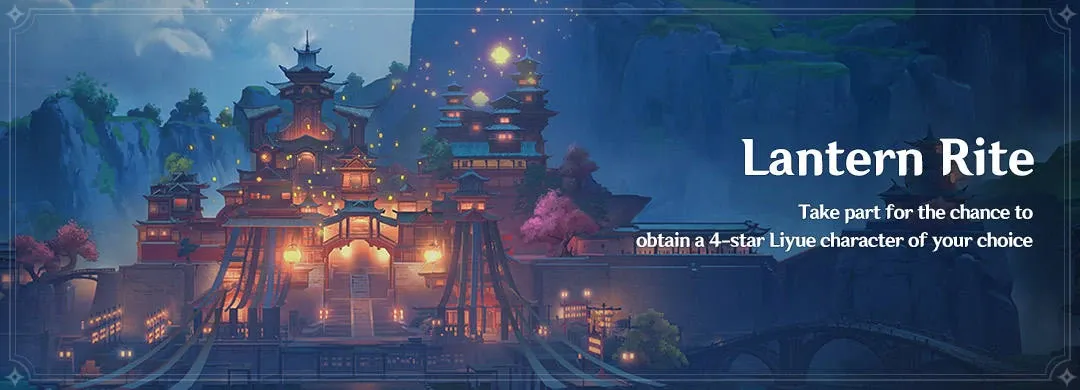
The Lantern Rite (海灯祭, Hǎidēng-jié, "Sea Lantern Festival") is Liyue's biggest annual festival, held on the first full moon of the year and lasting five days. It borrows its shape from the real-world Chinese New Year and Lantern Festival. Beneath the food and the markets, though, it is a festival of remembrance: Liyue's yearly reckoning with the protectors it lost in the Archon War. [1]
Origin and meaning
The rite did not begin as a celebration. People first "began releasing lanterns as a way to remind soldiers of the way home, and to never lose sight of themselves." After the Archon War ended, the practice "became a way to commemorate those who sacrificed their lives during the war, and eventually evolved into a full-blown festival of remembrance." At root the lanterns are a navigational aid for the dead, a light to guide the lost home. [1]
The lanterns
Two kinds of lantern define the festival. The Xiao Lanterns are the small ones every citizen releases. Each "contains a piece of Plaustrite that makes it float," and people hang wish sticks from them carrying their hearts' desires "in written or painted form," hoping the light "might guide the souls of Liyue's faithful protectors home, that they might return and be reunited with their people once more." That floating Plaustrite is the same material, in miniature, that keeps the Jade Chamber aloft. [2] [7]
The Mingxiao Lantern is the great one, built from materials donated by citizens and visitors alike. "Every year, one fallen hero from Liyue's history is selected as [its] subject," and its size depends on the largest chunk of Plaustrite found the previous year. Its design is "usually based on one of the adepti who died protecting Liyue." In Version 1.3 that was the late adeptus Skybracer, who saved Mt. Tianheng from collapse by sacrificing his antlers and battling on until his death. Canon does complicate the "adepti only" rule. The Version 5.3 lantern honoured the god Tao Dou, who was not affiliated with the adepti. Funds and materials for the lantern are raised through the annual Xiao Market. [1] [3] [5]
The danger beneath the festival
The Lantern Rite is shadowed by a recurring threat. It "coincides with one of the largest outbursts of power from gods who fell in the Archon War," which the Yaksha Xiao must battle for the festival's whole duration. The remembrance has teeth, then. The war the city commemorates reasserts itself every year, and one of Liyue's last Yakshas spends the celebration fighting the residue of the dead gods so the living can enjoy it in peace. [1] [4] [6]
Once it is over, certain members of the Millelith travel throughout Liyue collecting the spent lanterns so they do not become litter. [1]
What the rite is for
The Lantern Rite is Liyue's collective memory of its war dead. The Wangsheng Funeral Parlor tends to individual death; the rite tends to the city's shared grief, turning what Liyue owes the adepti and soldiers of the Archon War into a yearly ritual of light, wishes, and homecoming. It also lines up with a real resurgence of the war's danger, which Xiao fights off-stage, so the city keeps remembering the protectors whose enemy has never entirely left. [1]
What canon leaves open
- The full roster of Mingxiao Lantern subjects. Canon names Skybracer (V1.3) and Tao Dou (V5.3) as honoured subjects; the complete year-by-year list and the selection process are only partly surfaced. [1] [3]
- The mechanism of the annual fallen-god outburst. The festival coincides with a recurring outburst Xiao must battle, but how the dead gods' power resurges on the first full moon each year is never fully explained. [1] [4]