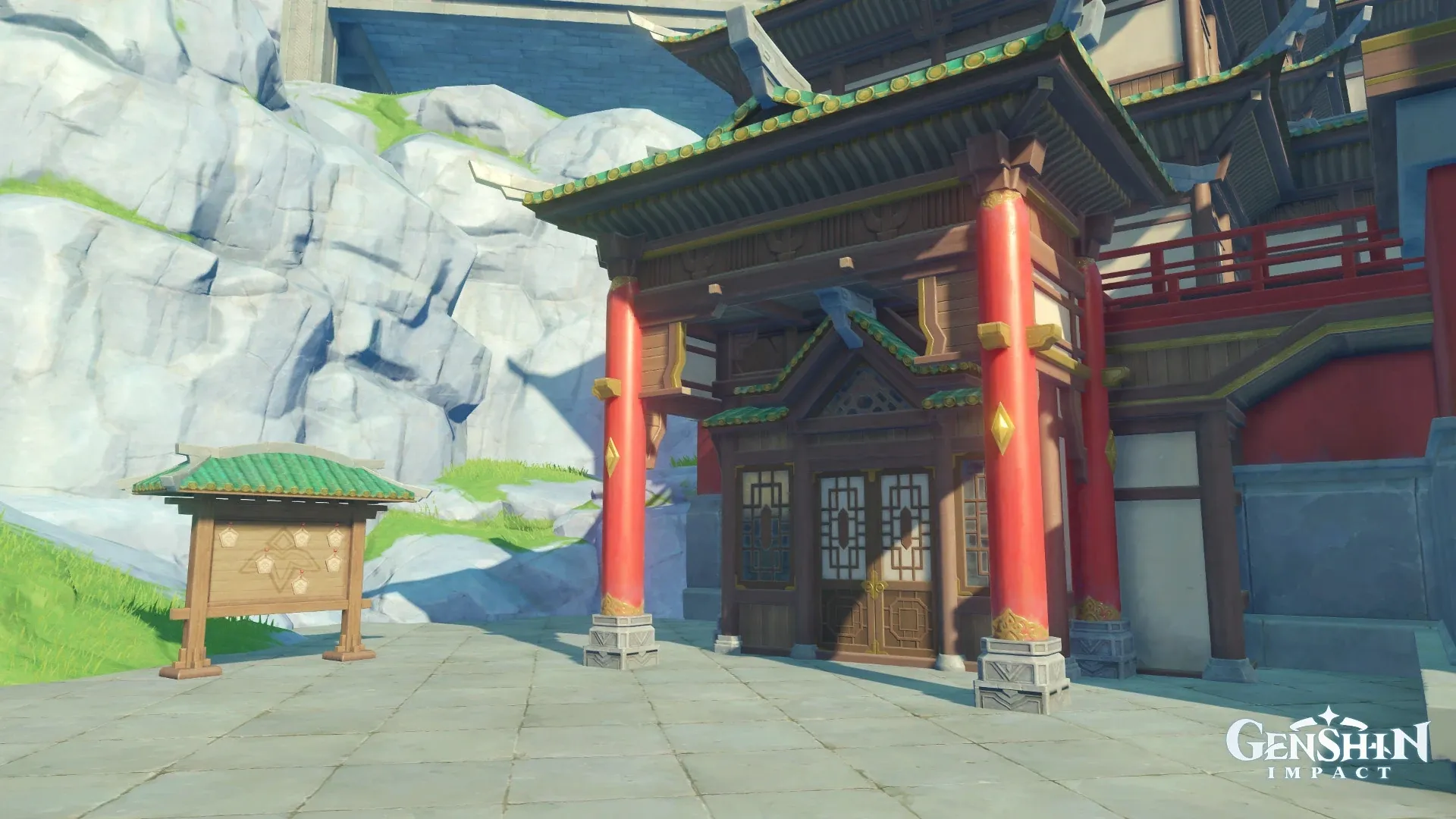
The Wangsheng Funeral Parlor (往生堂, Wǎngshēng-táng, "Hall of Rebirth") is the funeral parlor of Liyue Harbor, sited on Feiyun Slope, and the institution that handles Liyue's relationship with death. On the surface it is a family business, 77 generations old, that buries the harbor's dead. Underneath, it is responsible for the balance between life and death in all of Liyue. It is mundane and cosmological at once. [1]
What it does
The parlor's visible work is funerary. It buries Liyue Harbor's dead and, distinctively, performs the funeral rites of the adepti, the illuminated beasts of Liyue, a remit no ordinary undertaker could claim. Its deeper, less-advertised responsibility is to maintain the balance between life and death in Liyue: monitoring death's "border" so death does not spill out from it, and eliminating growths of fetor wherever they manifest. The parlor began "more of a doctor's office" and "gradually evolved to a funeral parlor over time," a lineage from healing the living to tending the dead that still shapes its dual mandate. [1] [5]
It also, per Childe, has acknowledged ties to the Fatui, though "ostensibly" it does not conduct shady backroom dealings like assassination. [1]
Origins: the Yaksha-plague
The parlor's founding is bound up with the cost of Liyue's protection. During or after the Archon War, when the fallen gods of the war manifested demons, Rex Lapis (Zhongli) sent the Yakshas to defend Liyue. Over the long centuries of that work the Yaksha "accumulated massive amounts of negative karma, some of which manifested into a plague that swept through Liyue, killing many in its path." Paranoid people read it as a curse from the gods, but a few realised the plague could be contained by purifying the air and burning infected corpses, and it was these pioneers who founded the parlor and, with their successors, took up the unending task of keeping life and death in balance. The parlor is therefore a direct result of the Yakshas' sacrifice, the mortal body that cleans up the karmic residue of Liyue's divine defenders. [1] [4]
Its purification arts have a named adeptal lineage. After the Archon War, when the Lone Butterfly of the Crimson Flame sacrificed herself to conduct the Seven-and-Eight-Gates Method to purify Tao Dou (another of the Eight Adepti), the Wuwang Kid took up her mantle and "taught the arts to the Wangsheng Funeral Parlor," the channel by which adeptal purification technique passed into a mortal institution. [1] [5]
The Hu Family and the 77 generations
The parlor "has existed for 77 generations," owned and operated throughout by the Hu Family. Its current (77th) director is Hu Tao; the former Geo Archon Zhongli is its consultant, and the undertakers Ferrylady and Meng round out the present-day staff. The directorship is hereditary and dangerous: the 75th director, Old Hu, and the 76th director, Hu Tao's father, are both dead, and the manner of their deaths is the parlor's most recent tragedy. [1] [2] [3]
The Wuwang Hill tragedy
Ten years before the Traveler's arrival in Teyvat, Old Hu and Hu Tao's father attempted to purge a fetor growth that had grown out of control on Wuwang Hill. At the last moment Hu Tao's father "slipped," causing devastation to the surrounding area and dying in the process. Old Hu managed to contain his son's mistake, but the sheer amount of fetor he absorbed doing so killed him soon afterward. With both directors dead in a single disaster, Hu Tao succeeded them as the current director. It shows how lethal the parlor's work of keeping life and death in balance is, a hazard real enough to kill two consecutive heads of the family. [1]
Who cleans up after the gods
Liyue's grandeur (Rex Lapis, the adepti, the Yakshas) came at a karmic cost that had to be borne by someone, and the parlor is the mortal institution that took it on, turning the management of death into a profession and a 77-generation duty. That its current consultant is Rex Lapis himself, retired into mortal life as Zhongli, closes a loop: the god who created the debt now advises the family that manages it. [1] [3]
Open questions
- The full content of the parlor's practice of keeping life and death in balance. The game establishes the remit (monitoring death's border, purging fetor) and its lethality, but how a mortal institution polices the boundary of death is only partly shown. [1]
- The depth of the Fatui ties. The parlor's Fatui connection is acknowledged but deliberately vague; how far it extends is not shown. [1]
The current director is Hu Tao, the consultant and the god behind the Yaksha is Zhongli, and the demon-hunters whose karma birthed the parlor are the Yakshas. The adepti whose funeral rites it performs have their own page, and the harbor it serves is Liyue Harbor.