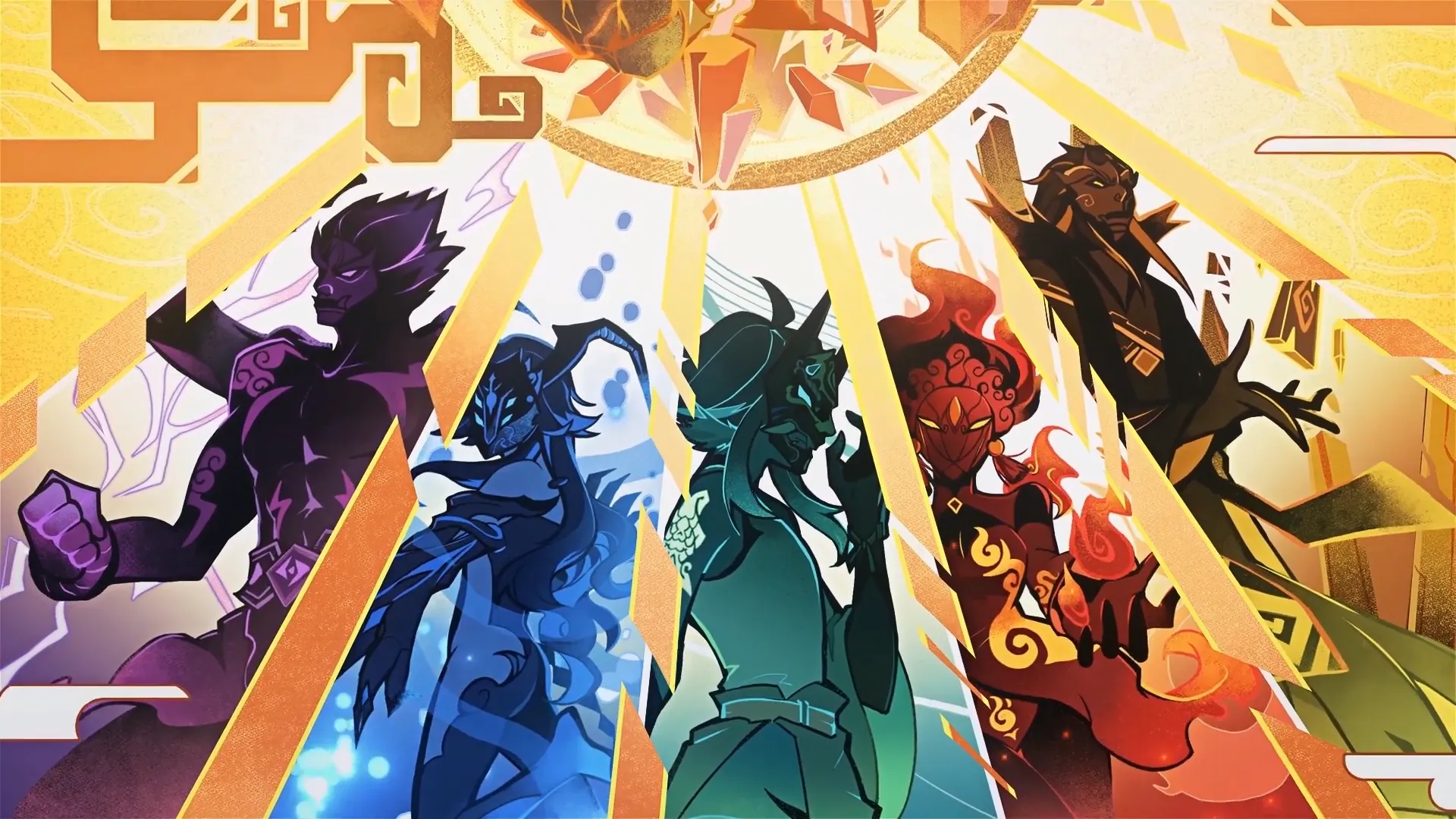
The yakshas were fierce illuminated-beast adepti of Liyue, called by Morax (Rex Lapis) to purge the monsters, plagues, miasmas, and demonic things born from the lingering hatred of gods defeated in the Archon War. [1] [9] They were a long-term cleanup force for divine resentment rather than an ordinary army, summoned as a fierce martial branch within the broader Mighty and Illuminated Adepti contract Morax anchored.
The in-game book Yakshas: The Guardian Adepti gives the core doctrine: defeated gods' bitter souls refused to pass on, took flesh as daemons, and ravaged Liyue. Rex Lapis summoned yakshas to purge them. Of the many, five were strongest: Bosacius, Indarias, Bonanus, Menogias, and Alatus. [2]
The five foremost Yakshas
Yaksha | Element | Titles | Status |
|---|---|---|---|
Alatus / Xiao | Anemo | Golden-Winged King; Conqueror of Demons; Vigilant Yaksha; General Alatus | Alive; sole surviving operational Yaksha. [6] |
Bosacius | Electro | Marshal Vritras; eldest Yaksha; leader of the Five | |
Indarias | Pyro | General Musatas | Deceased. [1] |
Bonanus | Hydro | General Chizapus | Deceased; implied to have killed / been killed by Menogias after karmic corruption. [4] |
Menogias | Geo | General Kapisas | Deceased; remembered also through Xianyun's comments on his tailoring. [1] |
This five-member roster should be kept distinct from the broader yaksha class. Many yakshas existed, but the Five were the foremost: the strongest and most heavily mythologized.
The broader yaksha class
Yakshas were illuminated beasts of dreadful appearance and warlike temperament. The ones shown so far take humanoid forms while retaining beastlike qualities through masks, attire, and animal associations. The Five wore masks in battle, drawing on the imagery of Nuo masks and of conquering evil. [1]
As adepti, yakshas could perform adeptal arts. Xiao uses Dream Trawler in Alatus Chapter, and Pervases uses Mortal Lingering to briefly manifest after death. [7] Bosacius used adeptal arts to seal his treasure in Minlin in The Yaksha's Wish. [3]
Where the Yakshas fit: adepti, not Sovereigns
The Yakshas sit inside the broader Liyue adepti, not beside them. Morax (Prime of Adepti, 岩王帝君 Yánwáng Dìjūn) is the progenitor of the modern adepti, and he summoned the Yakshas as a fierce martial branch tasked with cleansing the demonic residue of fallen gods. The Mighty and Illuminated Adepti contract that binds the broader adepti to Liyue is the same arrangement the Yaksha summoning worked under; the Yakshas did not sign a separate one. Their military titles (Marshal Vritras, General Musatas / Chizapus / Kapisas / Alatus) sit on top of the broader adeptus naming the Adepti page documents: most adepti carry the 真君 zhēnjūn "perfected lord" honorific (Cloud Retainer, Moon Carver, Mountain Shaper, Madame Ping, and the others), Morax alone uses the higher 帝君 dìjūn "sovereign lord", and Xiao alone forgoes it for 大圣 dàshèng "Great Sage". [9] [16]
By race the placement is just as clean. The broader adepti are illuminated beings, mostly 仙兽 (xiānshòu, illuminated beasts) and gods, the illuminated beings of the Human Realm in the era after the Heavenly Principles. Yakshas are illuminated beasts of dreadful appearance and warlike temperament; they belong to the same class as the adepti Cloud Retainer, Moon Carver and Mountain Shaper, who are illuminated beasts too. [14] The Yakshas are a specialisation within the adepti, not a separate race. [10]
Yakshas are not Sovereigns. Sovereigns are pre-Archon dragon-kin born from elementally-pure vishaps in the Light Realm, the older order the Heavenly Principles inherited and reorganised when they remade the world for humanity. Yakshas belong to the later world of illuminated beings, after the Heavenly Principles; Morax, an Archon who inherited redistributed Geo Authority, summoned them to clean up the resentment left by gods he had fought after that reorganisation was complete. Different kind, different era. The "divine resentment" the Yakshas were summoned to purge is the resentment of the defeated lesser gods of the Archon-War era, Osial, Havria, Marchosius (later revived as Guoba), Chi, Tao Dou (Bune), and the wider lesser deities from before Liyue Harbor, not the dormant Sovereigns themselves. [11]
The Sovereign-to-Archon transition was two great events with a gap of millennia between them: the Primordial One's forty-year defeat of the Seven Sovereigns, and the Archon War the wounded Heavenly Principles set in motion much later. The Liyue Archon War, Morax and Guizhong's Guili Assembly era through the founding of Liyue Harbor after it fell, sits inside the second. The Yaksha summoning comes out of that Archon-War aftermath: Morax called the yakshas to clean up the residue his own rise to Archon had created, not to fight the much older war between the Heavenly Principles and the Sovereigns, a war they did not exist for. Azhdaha is the only Sovereign-adjacent figure in Morax's story, a Geo-aligned draconic king who woke from long slumber beneath Nantianmen and befriended Morax. Erosion and mining in the Chasm later drove him mad, and after a battle that began in the Chasm and ran north to Nantianmen, Morax, Moon Carver, Mountain Shaper and a third unknown adeptus sealed him in the Dragon-Queller there. [13] The Yakshas are not part of that sealing in canon; the broader adepti are. [15]
Liyue is the worked example. Four kinds of being run through the nation: humans (the people the Heavenly Principles built the Human Realm to suit); adepti (where the Yakshas sit, as the Mighty and Illuminated Adepti's martial branch); Sovereigns (Azhdaha, a Geo draconic king whom Fandom lists as the Geo Sovereign; since Version 7.2 it cites Zibai's line in Chapter VII Act V about "the great Geo Dragon, Azhdaha," which calls him a Geo Dragon, not a Sovereign) [18]; and gods (the many lesser deities from before the Archon War, whose defeat left behind the divine resentment the Yakshas were summoned to clean up). [12] The Yakshas sit cleanly in one of these. The confused reading that places them at the Sovereign level mixes up groups from completely different eras: the Yakshas exist because of the fallout from the Sovereign-to-Archon transition, not as players in the transition itself. [17]
Karmic debt
The yakshas' work poisoned them. Their endless battle stained them with karmic debt, wearing away their souls and sanity. Some turned on each other, some succumbed to darkness, and others vanished. [1]
The in-game book frames the burden as an incalculable debt from violent deeds: a heart filled with darkness and hatred, no reward, no resolution, no escape from suffering. [2] Xiao's Alatus Chapter confirms this is not metaphor alone. His karma causes anomalies, can stain nearby people, and forms the reason he avoids mortal society. [7]
Karmic debt is therefore the hazard that exposure to combat poses for Liyue's long-lived divine cleaners. It is close to erosion but not identical. Erosion is the wear of time on long-lived beings; karmic debt builds up from contact with divine resentment and violence.
Bosacius + the Chasm
Bosacius is the Yaksha whose fate most directly ties the Yakshas to the Cataclysm. He was the eldest of all Yakshas, master of Electro, and leader of the Five. After centuries of duty and accumulated karmic debt, he grew weary, sealed his treasures in Minlin, disappeared, and later went mad. [3]
During the Cataclysm, monsters from Khaenri'ah invaded through the Chasm. Bosacius, drawn by the bloodshed despite shattered sanity, fought alongside Boyang, Rongzhao, and the Millelith. They used the Fantastic Compass to trap and seal the monsters, sacrificing themselves in the process. Bosacius died inside the sealed space and entered legend as the Nameless Yaksha. [3]
That event is an afterimage, in the Cataclysm, of the original Yaksha office. Even after his collapse, a Yaksha answered Liyue's crisis of containing monsters one last time.
Pervases + memory of the fallen
Pervases was not one of the Five foremost Yakshas. He was a junior Yaksha who died during the Archon War. In Xiao's Alatus Chapter, his spirit lingers in a crane statue near Mt. Tianheng through Mortal Lingering, timed to the anniversary of his death. [5]
Pervases shows the Yakshas were a larger, younger, and more socially textured group than the Five's mythic tragedy alone suggests. He remembers Xiao, senses Xiao's karmic burden on the Traveler, gives up ritual objects so Xiao can punish Starsnatcher non-violently, and asks only for Grilled Tiger Fish. [7]
Legacy in Liyue
Among adepti, yakshas are respected for strength and seniority. Xiao's title Conqueror of Demons is used by other adepti out of respect. Among mortals, yakshas were once protectors whose statues and rituals helped people remember their pain and duty. Over time, damaged statues, obscure books, and Sumeru-style scholarship pushed them into folklore. [1]
The memory is not gone. Wangshu Inn is maintained by Qixing secret agents as a front for assisting Xiao's duty, and lineages like Hu Tao's and Chongyun's retain more direct knowledge of Yaksha realities than ordinary civilians. [1]
Deep dive
Xiao's character context is at Xiao and the Alatus Chapter, and the broader Cataclysm event that drew Bosacius to the Chasm is at Cataclysm. Liyue's adepti context runs through Liyue, Zhongli, and Xianyun; the order the Yakshas belong to is the Adepti, covered both as an institution and as a race. The Sovereigns the Yakshas are sometimes confused with are covered at Seven Sovereigns, and the two-part Sovereign-to-Archon transition the Yaksha summoning follows from is at the Sovereign-to-Archon transition deep dive.