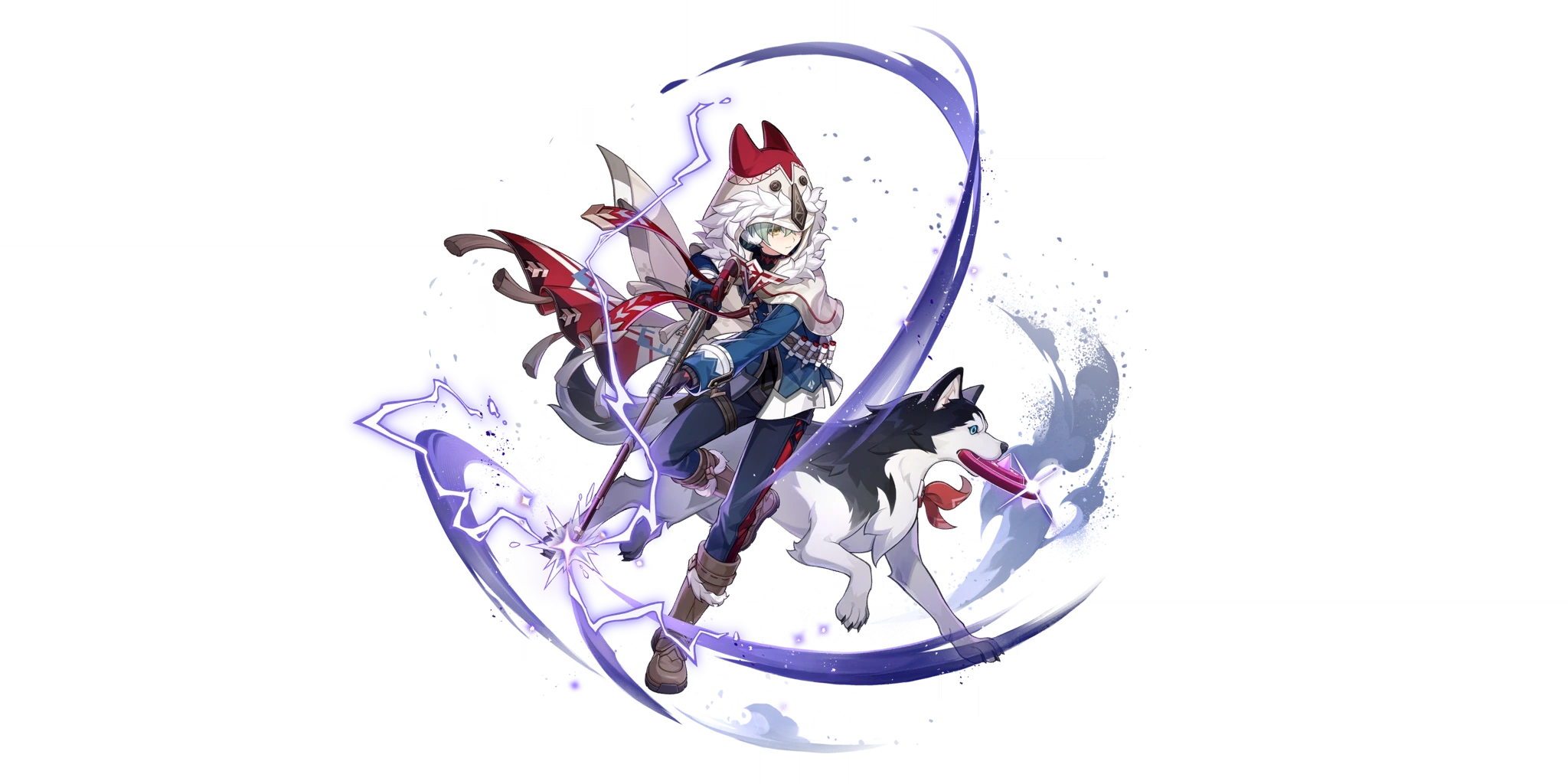


Alyosha, titled Swift-Striding Hound, is a professional hunter from Snezhnaya and a covert member of Rokot. HoYoverse released him in Version 7.0 as a 4-star Electro Polearm character; his story weapon is instead a heavily modified hunting rifle, a narrative tool rather than his gameplay weapon class. [1] [2]
Alatyr and the first hunt
Alyosha learned hunting from his father and expected to inherit the family's rifle when he came of age. An exceptionally brutal winter destroyed that simple plan. Bandits raided Alatyr, stole what little the villagers had, and badly injured Alyosha's parents when they resisted. [3]
He took the rifle early, tracked the attackers, and killed them. Alyosha does not excuse the act: his voice-over says their blood is on his hands and he does not regret making them pay. But discovering that the raiders were as poor as his own family changed the question. Recovering the stolen goods could not pay for months of medicine, and killing desperate criminals did nothing to change the conditions producing them. [3] [4]
Financial desperation pushed him into forming Alatyr's first highwayman group. He imposed a code: target armed gangs, never unarmed travelers, and do not kill. When Project Stuzha drove more desperate migrants through their territory, his companions broke that agreement and began preying on civilians. Alyosha became their leash, fighting the gang he had helped create and enforcing one surviving rule: never harm the "fowl," their code for ordinary people. [3]
Tugarin
Tugarin was an abandoned pup freezing in the snow when Alyosha gave him his last two sausages. The pup followed him into a dangerous bear hunt, distracted the animal, and refused to leave afterward. Alyosha named him Tugarin in the hope that he would grow into a true bear-hound, though the text never establishes his exact breed. [3]
By Chapter VII, Alyosha introduces Tugarin as his hunting partner. Their bond is practical and affectionate: Tugarin tracks, guards, and fights beside him, while Alyosha plans food and work around keeping both his family and his hound alive. [5] [4]
Rokot and a realistic ideal
An unidentified high-status visitor pushed Alyosha to ask what a true hunter should do when the dangerous beasts are inside his own territory. An anonymous recommendation later opened the way into Rokot. Intelligence about Project Stuzha confirmed Alyosha's growing belief that bandits, corrupt officials, and gangs were symptoms of a deeper national failure. [3]
He accepted membership without accepting obedience: "I can join you. But I don't promise to take orders from you." Rokot's reply, that what he did was his freedom, matched his own insistence on individual responsibility. Members hide their identities and choose their methods, but anonymity cannot be used as permission to do evil. [3] [6]
Alyosha's goal is deliberately material: a world where everyone can eat and no one needs to pour lead into another person. He also knows a successful movement can outlive its usefulness. His voice-over says Rokot's principles fit Snezhnaya now, but once the country changes, "the real test begins." [3] [4]
Chapter VII
In Act I, Alyosha shelters the ill Paimon in Sretomorozsk and investigates diverted Kresnik Kristall with the Traveler. Freight records, tracking, and simple arithmetic expose Shishkin and the mayor's smuggling operation. Alyosha then guides the group toward Snezhnograd, helps them survive the Shadow Realm, finds Paimon a doctor, and brings the Traveler into Rokot. [5] [6] [11]
In Act II, the real Alyosha works backstage at the Korolevskiy Theater and goes alone into the unnatural storm. He does not return. The figure who comes back in his appearance is Ronova, who later drops the disguise and admits the deception. Any instructions, deductions, or personality changes after that return belong to Ronova, not Alyosha. [7] [8] [12]
In Act VI, released in Version 7.2, he comes to Zapolyarny Palace with Odette and Vodyanitsa, bringing gifts for Mitya. They rarely see him, because "Accessing the Armory Palace is such a rigmarole," but for now "the Tsaritsa has generously opened up Zapolyarny Palace as an intel-sharing and strategy hub," so Mitya is easier to catch there. When Paimon mentions that a third rune has vanished from the beam of light, Alyosha already has the news: "The third one should be Snezhnaya's." He introduces himself to the fae lord Noy as modestly as ever ("I'm Alyosha. I do odd jobs around the theater."), and when Vodyanitsa compares trust between researchers to trust on stage, he speaks for the crew: "Our work designing the sets has meaning thanks to them." The revived Spirit Seeker is selling out, too. "So many people have begged me to try and get them a ticket, even just a standing ticket." [13] [14]
World-quest civic action
In Hunter on the Snowfields, Alyosha acts on a rumor that fae gangs with Energy Commission connections are smuggling Kresnik Kristall outside Project Stuzha's ledger. His plan is to steal that off-ledger supply and distribute it among freezing villagers, reasoning that the gang could not openly reclaim it from households under the Druzhna's attention. The Commission connection and hidden stock are his starting intelligence, not facts independently confirmed by the quest. [9]
The raid finds antiquities rather than the expected Kristall, including a prototype Kresnik's Torch. Alyosha observes that it produces more heat than the Kristall furnaces he knows and can warm the entire area, so he turns the ruin into a shelter and escorts villagers at risk of freezing there. The change of plan keeps the same redistributive goal while replacing handouts with a shared heat source. [9]
Alyosha deliberately stops short of pursuing the larger conspiracy around the access card, Shadow Realm relics, and gang excavation. He says following that trail might lead to something “monumental,” but would also mean pointing his gun at more people; he hands the deeper investigation to the Traveler and returns to bringing villagers to safety. This is a rejection of monumental action as his own priority, not ignorance that the wider scheme exists. [9]
A Thread of Dawn-Light contains a progress-dependent branch in which Alyosha works to restore an abandoned station. In that branch, he says the government is too occupied with a grander plan to notice the site, so citizens must step up; he explicitly describes the repair as a way to act for Rokot without reaching for his gun. The branch later uses a recovered Shadow Realm power core to restart the station's heater, but its political point is the peaceful civic work and the neglect Alyosha himself identifies, not a claim that every government service has ceased. [10]
Relationships and outlook
Odette is a theater acquaintance and fellow Rokot member rather than a confirmed intimate friend. Alyosha is surprised to learn that a Fatuus shares their principles, and the discovery makes him more optimistic that Snezhnaya can change. Vodyanitsa is a trusted Rokot intelligence source; Tugarin accidentally exposed their covert identities to each other during a disguised mission. [4] [6]
Mitya is a friendly technical acquaintance who has modified Alyosha's rifle. Valeriy is a useful contact at the Armory Palace, with a relationship based on explicit boundaries. Both men give their own side in text added with them in Version 7.2. Mitya's fourth character story has Vodyanitsa decide that the theater's oddest regular must be a Fatui spy and entrust the investigation to "Alyosha, her fellow Rokot member adept at hunting," who keeps his notes on Mitya in code names; the crate they take for a bomb holds Prime Ice cups, one of them "for the pup." Mitya calls Alyosha "my friend too." Valeriy, for his part, has "neither official grounds nor any personal desire to arrest him," and says of the Rokot, "For now, however, they are still working for the good of Snezhnaya. They are not my enemies." [15] [16] [17] The Tsaritsa is more distant: Alyosha compares her to the snow, an unavoidable bitter cold that also protects the country from worse dangers, while wondering whether she will ever allow the land to thaw. [4]
His Vision
The Vision story places an untainted Electro glimmer at the moment Alyosha commits to Rokot on his own terms, strongly linking the two events without explicitly saying his wish caused the Vision to appear. Alyosha himself is unsentimental about Visions; if his had not made him stronger, he says he might have sold it for Mora. [3] [4]
What remains open
- The identity of the visitor who recruited him toward Rokot.
- His exact age, full name, and his parents' current condition.
- What the real Alyosha experienced after Ronova replaced his afterlife manifestation.
- The exact causal mechanism of his Vision.
- Rokot's eventual political program after Project Stuzha.
- Tugarin's exact breed and Alyosha's life after Alatyr was abandoned.
Alyosha calls himself practical, but his politics are built around an ideal. The tension between those instincts is the point: he is willing to use violence, yet measures success by whether future people can live without it.