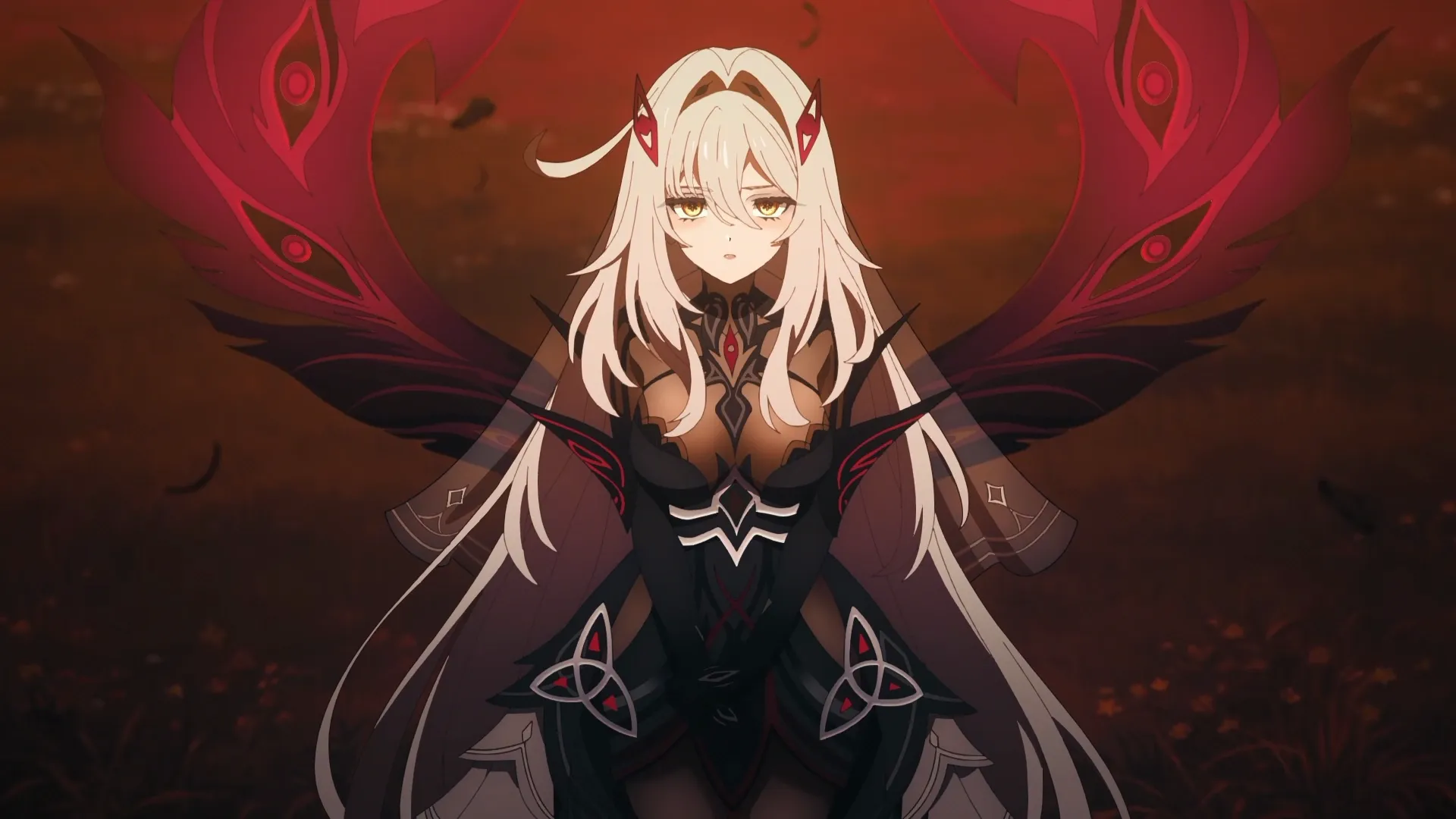
Created by the Heavenly Principles during their war against the Seven Sovereigns; held the Authority of Death until Celestia reclaimed it in Chapter VII Act IV
Overview
The Ruler of Death, one of the four Shades the Heavenly Principles left to govern Teyvat's laws.
She can define or deny how any being dies, and cast the Khaenri'ahn curse of immortality.
Helped rebuild Natlan's broken Ley Lines as the Night Kingdom, then was scolded for overstepping.
The most visible Shade in the recent story, from the Capitano bargain to the Celestia meetings.
In Version 7.1 Celestia stripped her of the Authority of Death, and she was defeated in battle.
Ronova is the Ruler of Death, one of the four Shades who govern Teyvat's laws on behalf of the Heavenly Principles. She seldom shows herself to mortals, yet her rulings on death sit behind Natlan's rules of resurrection and the long lives of Khaenri'ah's survivors.
Spoiler-free overview. You hid spoilers under Settings → Reading; choose Show all there to read the full content.
Ronova is the Ruler of Death among the Four Shades of the Heavenly Principles, alongside Naberius (Life), Istaroth (Time), and Asmoday (Space). HoYoverse's NPC archive puts it simply: "The Ruler of Death, one of the Heavenly Principles' Shades." Her authority over death is so elastic she can freely define the form any entity's death takes in Teyvat, or deny it altogether. That second power is how she cursed full-blooded Khaenri'ahns with immortality during the Cataclysm. [29][1]
She predates the Seven Archons and is an "extremely elusive figure"; records dating back thousands of years have nearly no mentions of her. [3] In the deep past she sang alongside the angels on high. At some point she came to prefer embracing the rotting bones of the mortal world, and expressed the desire to witness firsthand its creatures, their lives, and their deaths. [9]
She guided the Lord of the Night in rebuilding Natlan's ruined Ley Lines as the Night Kingdom. Before Chapter VII she was already the Shade seen most often: Capitano's curse-paradox sacrifice in AQ V Act V, Xbalanque's bet honoured in Mavuika's Story Quest, and the Gods' Limits meeting where she proposed that the Shades intervene. In Version 7.1 that intervention cost her. reclaimed her after caused her killings in to go unrevived, and she was defeated in battle. Whether she survived is uncertain. In Version 7.2 she is blamed for the phenomenon that follows, and 's view, as passes it on, is that she is "almost certainly dead"; no line confirms it.
1.
Ronova - Genshin Impact Wiki (Fandom) · external ↗
2.
When All Becomes a Monument - Genshin Impact Wiki (Fandom) · external ↗
3.
The Rainbow Destined to Burn - Genshin Impact Wiki (Fandom) · external ↗
4.
All Fires Fuel the Flame - Genshin Impact Wiki (Fandom) · external ↗
5.
The Gods' Limits - Genshin Impact Wiki (Fandom) · external ↗
6.
The Final Judgment - Genshin Impact Wiki (Fandom) · external ↗
7.
Truth Amongst the Pages of Purana - Genshin Impact Wiki (Fandom) · external ↗
8.
Echoes of Life - Genshin Impact Wiki (Fandom) · external ↗
9.
Lunar Arcanum XIII: Death - Genshin Impact Wiki (Fandom) · external ↗
10.
Hymns of the Far North - Genshin Impact Wiki (Fandom) · external ↗
11.
Wings of Fate's Course Intertwined - Genshin Impact Wiki (Fandom) · external ↗
12.
A Thousand Blazing Suns - Genshin Impact Wiki (Fandom) · external ↗
13.
Hearken, Ye Who Have Returned - Genshin Impact Wiki (Fandom) · external ↗
14.
Echoes of an Unfinished Past - Genshin Impact Wiki (Fandom) · external ↗
15.
The Byakuyakoku Collection - Genshin Impact Wiki (Fandom) · external ↗
Per the Frostmoon Scions' collection of ritual hymns, Hymns of the Far North, Ronova is venerated as Tuonetar (a name borrowed from the Queen of the Underworld in Finnish folk religion, who rules over the underworld Tuonela), along with the linked titles Mother of the Underworld, Mistress of the Dead, Lady of the Underworld, and Noble and Majestic Goddess. [10] Her official title, from the AQ V Act IV disclosure, is Ruler of Death. [3] The Weapon A Thousand Blazing Suns preserves the "God who Pronounced Death" and "Death" aliases. [12] The name derives from Ronove, a Marquis and Great Earl of Hell ranked 27th in the Ars Goetia. It follows the same pattern of Goetic demon names that Celestia uses for the Seven Archons. [1]
Chapter VII adds three more. In Act II, Mitya and the Traveler unmask her as the "Grim Reaper" wearing Alyosha's appearance in the Korolevskiy Theater. In the Act IV battle the game names her "Ronova — Arbiter of the Heavenly Principles," and, once her authority is gone, "Ronova — Paralogism's Outcast." [22][28]
Authority over death
Ronova's law is the most elastic of the Four Shades'. She can freely define the form of death for any entity in Teyvat, and she can deny death altogether. That second power is how she cast the curse of immortality on the pure-blooded Khaenri'ahns during the Cataclysm. [1] The same authority underwrites the Ode of Resurrection that governs Natlan's Ancient Name bearers. The ability to resurrect fallen bearers whose team prevails against the Abyss comes from Ronova's power, which Xbalanque borrowed when he established the Pilgrimage of the Return of the Sacred Flame. [17]
The Ruler of Death observes Teyvat through a crimson-red rift in the sky, a technique she uses to watch the world below from Celestia without descending. [1] From this rift she manifests six eyes (two to her right, three to her left, and a larger central eye). The crimson energy of the rift is a manifestation of her power. Her humanoid form, revealed at the Gods' Limits teaser, is a tall pale-skinned woman with long thick white hair, golden seven-petalled flower-shaped pupils, near-black arms marked with red eye-like patterns, and a pair of upwards-curved dark-red wings with eye-shaped holes. Her nails elongate when she focuses her power.
Origin and the Shade-tier do-not-be-named custom
Ronova was created by the Heavenly Principles in the forty years of war between the Primordial One's arrival from the sea of stars and the vanquishing of the Seven Sovereigns. The same campaign produced the other three Shades: Naberius, Istaroth, and Asmoday. [15] She predates any Archon and is more powerful than the Seven Archons. At the Gods' Limits meeting she referred to the Tsaritsa's "paltry powers." [16][5]
Like the other Shades, Ronova prefers not to be named by living beings, even by the Seven, and operates in shadow rather than direct address. [5] The custom explains why most primary text from before Phase 5 refers to the Ruler of Death only obliquely: as "Death" in A Thousand Blazing Suns, as Tuonetar, mother of the underworld, in Hymns of the Far North, and as the unnamed deity who prefers the rotting bones of the mortal world in Lunar Arcanum XIII: Death.
Natlan: Yohualtecuhtin and the Night Kingdom
Amid the devastation caused by the War of Funerary Flame, the ancient conflict between the Heavenly Principles and the dragons, the region that would later become Natlan suffered extensive ruin and its Ley Lines were severely damaged. In the aftermath, Ronova instructed Yohualtecuhtin, the Lord of the Night, to reconstruct them, which he did by establishing the Night Kingdom. [3] Per the AQ V IV "Beneath the Secret Source" disclosure, Yohualtecuhtin is a surviving non-devolved Angel, the same race Seelies devolved from, and his fellow Angels "rallied around me and offered their power to humanity to reconstruct the Ley Lines." [21]
The resulting Night Kingdom is Natlan's substitute for its Ley Lines, a liminal space between body and mind, life and death, rebuilt from fragments of the old Ley Lines under Ronova's patronage as Ruler of Death. It stores Natlanese souls as Nightsouls, supports Ancient Name recording, powers Nightsoul combat systems, and enables the Ode of Resurrection for Ancient Name bearers who fall in battle if their team defeats the Abyss. [17] The anchor is Ronova's. The Ode of Resurrection cannot operate without her authority, and Xbalanque could not have built the Pilgrimage framework on top of it without her pact.
Heavenly-Principles censure and self-pity
The Heavenly Principles censured Ronova for the rules she set up in Natlan, regarding them as an overreach of her authority as a Shade. After the censure she "succumbed to self-pity," and grew increasingly indifferent to the fate of the land. [3] Her motive for the overreach, as AQ V IV Part 1 frames it, was an expression of love and an act of reparation, not a power-grab. After the Cataclysm the Shades fractured (Naberius captive within Rhinedottir, Asmoday missing, Istaroth withdrawn, Ronova censured and then re-engaging), which is why three of the four Shades are now in irregular states relative to their original mandate. [16]
The Xbalanque pact
After Xbalanque ascended and became the first Pyro Archon, he used his divine throne to borrow Ronova's powers and set the rules by which Natlan's Pyro Archons succeed one another. Those rules are the Pilgrimage of the Return of the Sacred Flame, which lets ordinary humans become Pyro Archons by completing the pilgrimage. Those who ascend are then granted knowledge and memories of the land through the Sacred Flame. [8] The two agreed that those who used Ronova's powers would eventually die, and that if the Heavenly Principles found out, she would simply deny involvement and claim her powers were stolen. Xbalanque also asked for a chance to see Natlan's future should its people prevail over the Abyss, an additional bet she agreed to.
The pact reaches far. It sets the rules every Pyro Archon after Xbalanque follows, Mavuika included. Their authority is power borrowed from Ronova, with their deaths only deferred, Ronova as the silent guarantor, and her deniability built in. The arrangement also explains why Pyro Archons die more readily than other Archons (Xbalanque, Tenoch, Murata the second, and the later Pyro Archons whose names are absorbed by the Sacred Flame's collective memory): they work on borrowed authority over death, and that debt is eventually collected.
The Cataclysm curse of immortality
During the Cataclysm, the Ruler of Death cursed the full-blooded Khaenri'ahns with immortality. Per Capitano's disclosure in the AQ V Interlude Part 1 For the Same Land: Ronova made no distinction in whom she cursed despite the fact that the Five Sinners of Khaenri'ah and the Vinster King were the primary culprits responsible for the calamity.[4][1] The Wind Glider Wings of Fate's Course Intertwined also records that she cursed without distinction. [11]
The curse is the last known direct, large-scale intervention by the Heavenly Principles before their five hundred years of dormancy. [18] Eide separately says that people whose ancestry belonged to the domains of other gods received the curse of the wilderness and became monsters; Caribert is the named case who became a hilichurl. That primary text does not attribute the wilderness curse to Ronova, nor does it say that Abyss Mages, Heralds, Lectors, Shadowy Husks, and Black Serpents came from the people it struck. The curse of immortality is the one Khaenri'ahn curse securely attributed to Ronova.
The population the curse still binds lies behind the present-day Khaenri'ahn diaspora: Dainsleif, Pierro, Chlothar, and Capitano are documented long-lived cases with differing physical outcomes. The exact origin of the curse-pact mechanism remains obscure, since "records dating back thousands of years have nearly no mentions of her," even though the Cataclysm-era casting is attested. The Capitano arc, which ties the curse on full-blooded Khaenri'ahns to Ronova, narrows the event to the Cataclysm itself.
The Mavuika-Capitano curse paradox
After Mavuika used Ronova's powers to thwart Gosoythoth's Abyssal invasion of Natlan during AQ V, Ronova demanded Mavuika's life as payment to fulfil their pact, since the death-debt under the Xbalanque pact had come due. [2] But the Lord of the Night and The Captain had pre-agreed to have Il Capitano offer his life instead, meaning to exploit the curse of immortality Ronova had placed on him centuries earlier. The plan was to create a paradox that would let him take vengeance on Ronova for the suffering inflicted on innocent Khaenri'ahns, himself among them, by forcing her to break one of her own rules. If she accepted Capitano's life-payment, she would have to release the curse of immortality on a Khaenri'ahn; if she did not, the Mavuika pact would default. Either resolution would force a Shade to act against her own rules.
Ronova chose to keep upholding the curse of immortality, and Yohualtecuhtin gained eternal life as Capitano's life force transferred to the Lord of the Night. [2] Capitano died, the curse on full-blooded Khaenri'ahns held, and the paradox resolved because she chose to keep her rules rather than break them. The result reshaped Natlan's Ley Line system. The Night Kingdom was rewritten when Capitano's life force merged with the Lord of the Night, strengthening the realm and letting outsiders be accepted into it for the first time. [17]
Mavuika and Capitano turned Ronova's own curse against her. It is the first known case of mortal figures forcing a Shade to make a binding choice under pressure, and one of the direct Shade crises since Fontaine, alongside Rhinedottir devouring Naberius at the Paralogism Interlude and, in Chapter VII, the loss of Ronova's own Authority of Death. Neuvillette's battle in AQ IV Act V was against the All-Devouring Narwhal, not Asmoday, and belongs to the separate story of the Sovereigns' restoration. Ronova kept to her rules, but the outcome was in effect a win for the mortal side. [16]
Xbalanque's bet honoured
Because the Natlanese won the war against the Abyss, Ronova honoured her ancient bet with Xbalanque and let him see present-day Natlan. [13] Xbalanque chose to stay a single day in Mausau's body and offered Mavuika the rest of the life force Ronova had given him as payment for their duel, which would have let her bring her loved ones back temporarily in his place. Mavuika declined the offer.
The Aila-Lovia thread-severance
Per the Nod-Krai World Quest Polkka Beneath the Moon's Oracle: Echoes of an Unfinished Past, Ronova guided Aila's hand to "sever the thread" of the last Archpriestess, Lovia. [14] It is the only known Ronova intervention outside Natlan in the Phase 5 era, and it fits her power to define the form of death for any entity in Teyvat.
The Gods' Limits intervention-suggestion
Some time after AQ V Act V, Ronova attended a meeting with the other Shades in Celestia at which Asmoday was absent. Ronova wanted to find her: "Since the Heavenly Principles cast us as Shades / Not one of us has ever missed a meeting." When Istaroth suggested Asmoday might have "just switched sides," Ronova first called the idea unthinkable, then added, "Unless... ...She loves her new master more than her own self..." [5] Ronova does not name that master. The Final Judgment gives a stronger clue to who it is. Melanta asks Asmoday why she chose her or him, with the pronoun following the unchosen twin. Together the lines strongly imply the Traveler's Sibling is the new master, while leaving the relationship's terms and motive unstated. [6]
Later in the meeting, after Rhinedottir observed that the Heavenly Principles "have yet to awaken" and that in the Tsaritsa's place she would not pass on that opportunity either, Ronova proposed acting: "For lack of a direct order / I say it's time we intervened," then, "To the extent permitted by the 'rules.'" [5]
The suggestion was the clearest statement of where she stood before Chapter VII. She proposed intervention inside the rules, not rule-breaking, and Chapter VII shows what that meant in practice.
Welkin Moon Act X: the Three-Shades audience with Nahida
With the Pyro Gnosis in hand, Nahida faced three Shades in Act X of Song of the Welkin Moon, Truth Amongst the Pages of Purana (first titled "Of Myriad Paths, Flux, and Dissolution"), during Part 3, the quest of the same name. The game labels the speakers the Ruler of Death, the Ruler of Time and the Ruler of Life. The Ruler of Death is Ronova's title; Fandom names the other two Istaroth and Naberius. Ronova asked the Dendro Archon whether she was alright with burning Irminsul, since it "represents both your roots and your finest accomplishments" and is "the very thing you have always fought for." Nahida answered that Irminsul "has been corrupted beyond redemption." [7][31][32]
Ronova's question is about what Irminsul means to Nahida. The Ruler of Time adds that Irminsul "is the means by which the Heavenly Principles maintains fate itself," and the Ruler of Life asks why "the loss of another tree" should "be anything to fear," then parts with "Till we meet again, Lord of Dendro." No line grants permission in so many words. Fandom's summary reads the exchange as the Shades granting it, and the burning follows. Read that way, it is the weightiest permission the Shades have given in the post-Fontaine era, for an act as large as burning the world's foundational memory record. [31][32]
Chapter VII: the Curse of Death and the lost authority
In Chapter VII, Ronova casts a Curse of Death over Snezhnaya that triggers mass deaths whenever its energy research or Project Mistilteinn approaches a breakthrough, halting both in Act II. [22][25]
Act III shows how she stayed within the rules. In a memory recovered by prism, Rhinedottir warns her that "To punish humans with death without the Heavenly Principles' approval would be a grave sin in their eyes." Ronova answers that "during this period of slumber, Celestia only monitors our actions periodically," so a death and resurrection completed between two monitoring periods incurs no sin. Rhinedottir agrees to revive the victims. Mitya adds that repeated deaths at her hand damage memory and eventually erode the soul, and Pierro concludes that Ronova "has been studying how to circumvent the restrictions imposed upon her by the Heavenly Principles." [25]
In Act IV the Tsaritsa turns that arrangement against her. Ronova attacks at Rankova Zorya and kills everyone present, while Rhinedottir is at tea in a hall where the Tsaritsa has slowed time. The resurrection window passes, and Celestia reclaims the Authority of Death; Ronova's own words are "They stripped it from me, just like that." She declares that she can now kill without consequence and fights the Traveler, Pierro, and Dainsleif. Pierro afterwards judges that, unless she escaped undetected, she has sustained "fatal and irreversible damage." [26]
The Traveler draws a distinction from the outcome: the Curse of Immortality was laid under the Heavenly Principles' judgment and stays in force, while the Curse of Death was her own unsanctioned act and ended with her authority. That is the Traveler's inference, not a statement by Ronova or Celestia. The act's closing cinematic is not in the dialogue record. Fandom's transcript of it has Ronova emerge "at the point of death" before a Nail of Retribution above the Cryo Dragon's corpse. "So... This is what death feels like," she says, then infuses "Eitr" into the Nail as "my parting gift" and begins disintegrating as the Nail fractures. The scene does not show what becomes of her. [26][27][28]
Chapter VII Acts V and VI: blamed for the Hallowing
Act V opens on what the gift has done. A Nail of Retribution in Snezhnaya flares back to life, and the Fatui suspect her at once. Pantalone sees "Clear evidence of tampering" in its "sudden burst of activity after years of dormancy," and Pierro says, "It must be Ronova's doing... Then, we failed in our duty to destroy her completely." Once Vesna's report names the Holy Soil phenomenon, or Hallowing, Sandrone gives the council's view: "Our suspicion is that Ronova somehow put this in motion in her final moments. But we have no way of knowing how she did it." Pantalone adds, "The Jester's view is that Ronova, having been stripped of her authority, is almost certainly dead by this point — in which case, she took this secret to her grave." [33][34]
Alice treats it as settled. She calls the Hallowing "Her final act of revenge," and when Paimon asks whether it is Ronova's doing after all, she answers, "Why, yes... but I thought you already knew that?" Nicole thinks the order "cannot have come from the Heavenly Principles in their state of slumber. The most likely explanation is that Ronova went rogue." At the Temple of Space the Esoptron reports: "As witnessed by the Ruler of Death, the Holy Soil phenomenon is currently in effect, triggered by the Embryonic-Ichoric-Telluric-Rudiment." The in-game description of Act IV's closing cinematic, as Fandom records it, says she "fused the Embryonic-Ichoric-Telluric-Rudiment with Snezhnaya's Nail of Retribution," and in the same scene she names the "Eitr"; Fandom's Eitr page treats the two as one, giving Embryonic-Ichoric-Telluric-Rudiment as the Eitr's full name. At the leaders' meeting Nahida calls it war: had Ronova "truly wanted to take revenge on Snezhnaya, she could easily have activated only the Nail of Retribution located here," and instead "Her actions are a declaration of war against us all." [33][28][35]
Act VI does not name her in its main dialogue. In optional dialogue that Fandom records, Mavuika recalls that the Lord of the Night "created the Ode of Resurrection under the Ruler of Death's guidance," and suspects that Xbalanque, or someone close to him, learned the secret of the allogenes "given all their contact with Ronova." [36]
What canon has not surfaced
Whether Ronova survived Chapter VII Act IV, and who now holds the reclaimed Authority of Death. Pierro's view in Act V is that she is "almost certainly dead," but no line confirms it. Act V shows what her "parting gift" set off, the Holy Soil phenomenon, though Sandrone admits "we have no way of knowing how she did it." [33]
When the curse-pact mechanism first came into being. The Cataclysm-era casting is attested per Capitano's AQ V V disclosure, but whether the mechanism itself dates to a pre-Archon confrontation, a Cataclysm-era ruling, or something in between is obscure, since "records dating back thousands of years have nearly no mentions of her".
How deliberate her post-Natlan turn was. Chapter VII confirms that she intervened in Snezhnaya, but reading her trajectory as a planned policy shift (an open theory now kept on the Four Shades page) is still extrapolation, not something the text states.
How Celestia judged the intervention as a whole. Its monitoring caught the missed resurrection window, and the Traveler infers that the Curse of Death was never authorized. No source says whether Celestia knew of the loophole before Act IV.
The full scope of the pre-Cataclysm period when she "sang alongside the angels on high". Per Lunar Arcanum XIII: Death, her transition from singing among the angels to preferring the mortal world's rotting bones is narrated but not dated.
How her defeat changes the Tsaritsa's larger plan. Before losing her authority, Ronova threatened that she could kill the Traveler and their allies for good once Asmoday returned and the Four Shades acted jointly, or once the Heavenly Principles woke. In Act V Pantalone says that "without Ronova around to interfere, Project Mistilteinn can now resume." [33]
Deep dive
The Four Shades page covers the full system of Shades Ronova belongs to, and the Heavenly Principles page covers the dormant creator-god whose envoy she is. Her Natlan work runs through the Night Kingdom she guided into existence via Yohualtecuhtin. The curse she cast 500 years ago with her authority as Ruler of Death is covered at The Cataclysm and Khaenri'ah. The mortal-side conflict at the centre of her most on-screen role runs through Capitano, Mavuika, and the Pyro Archon succession the Xbalanque pact set up.