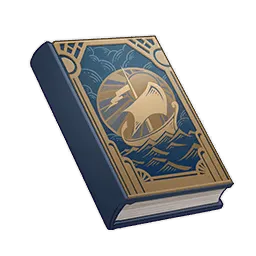
Anecdota Septentrionalis, Latin for "Northern Anecdotes" (CN 北境秘史 Běijìng Mìshǐ, "Hidden Stories of the Northern Land(s)"), is a three-volume Fontaine Book Collection released in Version 4.6. It is found inside the Faded Castle subarea of the Nostoi Region, the sunken Remurian palace that the same patch's World Quest Canticles of Harmony opens to playable view. Vol. 1 sits in the Lower Level main hallway, Vol. 2 floats in a Middle-Level corridor, and Vol. 3 waits at the top of the Middle-Level library, reached by a floating-platform lift activated at a blue crystal. Each volume opens with the same standing line: "An ancient Remurian scroll you accidentally discovered in the ruins. There is no way to verify the truth of the words within." [1] [2] [3]
The narrator's manifesto
The book is, in its own opening confession, a deliberate piece of self-declared fabrication. The unnamed Remurian narrator opens Vol. 1 with a manifesto against writers who "have loved to write that which is utterly absurd and have the temerity to call it their real experiences ... swearing that 'I saw it all with my own eyes! Not a word of it is false!'" He singles out one Xanthus Talassii filius for writing of "barbarians in the north" who "used glass and platinum to build their prosperous polis amongst the mountains, calling their king a 'knight,'" when "in reality, he has not in his life even set foot outside of Capitolium." The narrator then takes the opposite stance: "I will freely and honestly admit that everything I write is completely, utterly fabricated. After all, since I've admitted it up front like this, nobody can call me a fraud." Every place and person that follows is therefore invented as "pure nonsense" aimed at writers who lie while pretending not to. [1]
Vol. 1: sailing past the known archipelagos
The Remurian sailors weigh anchor "ever northward, passing through the territory of the barbarians," aiming "to see just what the edge of the ocean looks like." The narrator picks a fight with the writer Quinctilius, "according to [whom] the High Sea ends in impassable waterfalls in every direction," citing instead "the respected Iuvenalis" and his "faraway kingdom in the north." After seventy-nine empty days the ship is attacked on day eighty by "a group of bandits riding on the backs of giant birds [who] blocked our path and asked us for potatoes," each feather "as thick as the Ocean Pillars." The Remurians pray "to Sebastos to deliver us," using the title of the Remurian god-king Remus, and are saved by "warriors riding Blubberbeasts ... each Blubberbeast larger than fifty Sumpter Beasts, their entire bodies draped in armor made of crystals, the scales of dragons, and cabbages." The leader, "more like bipedal vishaps" with "eyes ... glowing with their strange light," addresses the sailors as "Dear guests, are you merchants from Serenum?" and, on hearing they are Remurians, invites them inland to the "Empire of Solaris." [1] [4]
Vol. 2: the Solarians' civil war and Lucilius's technology
The Solarian knight, "laughing so hard that even the sailfin on his back shook," tells the Remurians that "there's no such place as 'Remuria,' merely a fake history invented by the southern barbarians who, not having their own civilization, created a fictional empire that simply didn't exist." He jokes that "so long as we did not eat Sunsettias in public, we would still be honored guests in their Empire of Solaris," and from their clothing guesses they are "likely traveling traders from Hyperborea." The frame then turns confessional: "some decades ago, a philosopher named Lucilius invented a way for some people to obtain extraordinary abilities far exceeding those of ordinary mortals. But it came at a price. Their appearance would change to be unlike those of ordinary people. Some believed that this practice destroyed the purity of humanity, and those with special powers had but two options: to be slaves, or to be destroyed utterly." The Solaris Empire is fighting the resulting civil war when the Remurians arrive. The narrator's reply is the volume's central joke: he advises the Solarians to stop researching ways to alter humans and "instead focus their efforts on technology to alter Blubberbeasts, as Blubberbeasts are far more likable than humans." The Solarian arms thirteen legions of "a million soldiers" each with Blubberbeast cavalry, and the volume parodies The Iliad's opening line, "Sing, O musician, sing of the rage of the Blubberbeast which brought countless ills!," over a battle in which rebel one-eyed giants hurl Bulle Fruits whose bubbles carry victims "straight into the sun" ("That is why the sun and Bulle Fruit have a similar color"). The narrator skips the war's conclusion in mock homage to "respected playwrights" who "wish to leave enough space for future stories." [1]
Vol. 3: the wall of liars and the island of Amoria
Vol. 3 leaves Solaris behind for two unrelated oceanic episodes. After three hundred further days of empty sea the sailors reach "a tall wall in the middle of the sea, stretching out of sight, high up into the sky." On it, "countless densely packed human figures were suspended from the wall, and though they had neither bodies nor muscles, their forms could clearly be seen. All on this earth who speak lies, or pen falsehoods in their writings, will be hung from this wall to receive judgment after their death." The narrator, keeping his straight face, explains that "as everything in this travelogue is completely true, ... we had no way to get close to the wall," and they row away. They then make landfall on an island ringed by "twelve walls, each wall constructed of a different kind of precious gemstone" (amethyst, purple agate, jadeite, rubellite, jasper, topaz, ruby, cornelian, emerald, chrysoprase, sapphire, jade) with a "moat ... not water, but fresh milk" swimming with pre-cured pickled fish. The elegant hostesses name the place Amoria ("it means love") and lure the sailors home. The narrator, alone in suspicion, smuggles in a Bulle Fruit; finding "human bones all around" the hostess's home, he confronts her, "but she only laughed uproariously, turning into a pool of water and disappearing in the blink of an eye." The ship flees, and the island vanishes behind them. The volume closes on an explicit cliffhanger, "As for how the story will unfold, pay close attention, for all will be revealed in the next chapter ...," that has no Vol. 4 in primary text. [1]
What the book is and is not
The book is a Remurian-era satirical pseudo-travelogue, Fontaine's in-universe answer to real-world Lucian of Samosata's True History (a 2nd-century-CE Greek satirical fake-travelogue) and Procopius of Caesarea's Anekdota / Secret History (a 6th-century-CE Byzantine scandal-history), the latter being the parallel for the Latin title. Its classical references run thick. The Blubberbeast-rage opening echoes The Iliad; Pacuvius is named for the Roman poet Marcus Pacuvius; Ennius draws on "a Roman writer, poet, and the uncle and teacher of Pacuvius"; and Xanthus "may be a reference to the river god Scamander," with "thalassi" (Greek, "the sea") and "filius" (Latin for a male descendant) rendering "Xanthus, descendant of the sea." [1]
It is not a historical chronicle of any real nation. The Empire of Solaris, the philosopher Lucilius, Serenum, Amoria, and the wall of liars in the sea are self-declared fabrications: the Vol. 1 manifesto ("everything I write is completely, utterly fabricated") frames them that way, and the Vol. 3 wall set-piece is the narrator's own joke against his own conceit. There is a tempting echo between Lucilius's appearance-changing, ability-granting technology in Vol. 2 and the real Remurian ascension via Phobos that the narrator's own civilisation in fact runs on ("Remurians were not ordinary humans ... their bodies were cast of stone, with Ichor for blood," per the World Quest Canticles of Harmony). That stays a reader's inference, not a claim the book makes. The narrator never draws the link, and the Solaris story is satirical invention rather than a disguised Remurian self-portrait. The mid-Vol.-1 "Lochknights" mention, offered as an example of obviously untrue writing, sits beside the real Lochknights, the Erinnyes-led anti-Remurian resistance, without being equated to them; in the fiction the narrator simply treats them as legend. The book is also not part of the Mortal Travails achievement series, since completing Vols 1-3 grants no such achievement, and it is not written by any of the in-fiction authors the narrator cites (Xanthus, Quinctilius, Iuvenalis, Pacuvius, Ennius, Pisculentum's Terentius, Lucilius). Those belong to the parody's frame, not to the actual unnamed author of Anecdota Septentrionalis. [4] [5] [7]
So a Remurian sailor admits up front that he is going to lie, then sails north past the edge of the known world. He meets cavalry-Blubberbeast vishap-knights of a Solaris Empire fighting over a philosopher's ability-granting technology that changes your appearance, parodies the opening of the Iliad, passes a sea-wall where liars are hung in judgment, and barely escapes an island of shapeshifting hostesses by waving a Bulle Fruit. There is no Vol. 4.