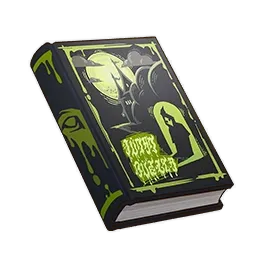
The Fall of the Faded Castle is a 3-volume Fontaine Book Collection released in Version 4.2. Each volume is introduced with the same standing description: "A poem penned by an author unknown. The writing style seems to give off a strange and ominous aura." Together the three volumes form a single narrative arc: a dream of a black ship, a glittering lakeside castle whose master cannot sleep, and the castle's destruction by the same dark-robed figure the dream foretold. [1]
Vol. 1: the black ship and the dark-robed figure
The first poem stages a recurring dream of "a black ship … sailed through dark night and bleak fog," its hull rotten, its mast shattered, "each broken piece … placed in some twisted way, entwined together by the algae and seaweed that enveloped the vessel," shambling through moonlight in a form "that none could glimpse and not panic." Upon the deck stands "a tall and slim figure … wrapped in dark robes, its face barely seen, only its eyes, those two cold eyes, which can pierce your soul with a glance." The volume closes on three competing readings of what the figure might be ("a monster that arose from the depths of the sea? A lord returned from some ancient world? Or perhaps the nightmare itself?") and refuses to settle the question. [1]
Vol. 2: the castle by the purest lake
Vol. 2 turns to a "glistening castle" by "the banks of the world's purest lake" whose walls of gold leaf and gems "shone blinding in the post-noon sun," with pretty banners, soaring towers, colored windows, and, most marvellous of all, "the many statues, odd in form but as real as life." At its centre is a "golden stage, where musicians played day and night for the castle's master," with wine "flowed never-ending to sate the thirst for revelry" and guests of every class and homeland dancing in time. Yet "none of this could ease the master's fears". At every midnight chime he was "possessed by an uncontrollable panic, trapped by his fears and his gloom," knowing that "the dark-robed figure would surely collect on debts owed, and all before his eyes would be turned into dust, the souls of his guests, and his own, included, as tribute to that dark, ancient world." [1]
Vol. 3: the collapse
The closing poem opens in stillness ("the curtains in the breeze, and the faint sounds of animals chewing"), then breaks: a rasping laugh from an empty room, thunder and storm, "a glowing red fog-cloud … embraced the castle just like a shroud." On the central stage "a tall thin figure did appear, a dark spirit in black robes, arriving at last." The guests "fell to the floor one by one, bereft of time even to scream," the master sat shivering on his throne with "his soul also snatched by the dark," and "amid the roar of brick and tile hitting the ground, the castle's glory faded into the past, swallowed by glimmering waves." The blood moon "the towers once blocked reappeared in the sky," sweeping the land with its baleful glow, and the volume closes with the present-tense epilogue: "today, by the banks of the world's purest lake, the water reflects the long-fallen, faded castle … there is nothing there now, bar darkness, death, and loss." [1]
The title match and the Remurian collapse
The book's title directly matches the name of the Faded Castle (褪色古堡, Tuìsè Gǔbǎo), the subarea of sunken ruins in the Nostoi Region of Fontaine introduced in Version 4.6. The location is described there as "a sunken ruin that was once part of the kingdom of Remuria. The Harmosts and scholars of Remuria once lived there, maintaining the archives and researching music theory and fate. The castle contains the entrance to the Sea of Bygone Eras." In Remuria's golden age the former Harmost Cassiodor called it the "golden castellum," and the Version 4.6 World Quest Canticles of Harmony is what opens the location and reveals the Remurian people behind it. [2] [4]
The book's Version 4.2 release pre-dates the Version 4.6 location reveal by one major patch, and the three poems line up point for point with Remuria's collapse. A golden palace by water becomes the Domus Aurea, the harp-shaped palace from which the Grand Symphony was played. Musicians playing day and night for a master become Phobos, the Symphony that steered every ascended Remurian's fate. Statues odd in form but as real as life become the Ichor-bound, stone-bodied Remurians, "cast of stone, with Ichor for blood." A master who feared a foretold reckoning becomes the flood Celestia prophesied, which Remus's whole ascension programme was built to escape. And a castle finally "swallowed by glimmering waves" becomes the tsunami that sank Remuria when the Symphony's self-destruct order, Remus's Requiem, was triggered. [3]
What holds up, and what stays unnamed
The match between the title and the Faded Castle subarea holds up, as does the order of release, with the book in V4.2 and the location reveal in V4.6. Identifying any specific named entity inside the poems does not hold up, and the page keeps it as poetic ambiguity, in line with the book's own "an author unknown" framing. The book names no Remuria, Remus, Phobos, Domus Aurea, Capitolium, or any of the Four Harmosts; the master, the castle's location, and the dark-robed figure all stay unnamed in primary text. Reading the poems as Remuria's collapse is an inference grounded in the title match and the Version 4.6 location reveal, not something the book itself states. [1] [2]
The book is a Fontaine three-poem cycle about a golden lakeside castle, its anxious master, and a dark-robed figure who finally arrives to collect. It released one patch before the game reveals that the Faded Castle is the sunken palace of the kingdom of Remuria, and that all three of the poem's marvels (the gold, the day-and-night music, the strangely living statues) had Remurian originals.