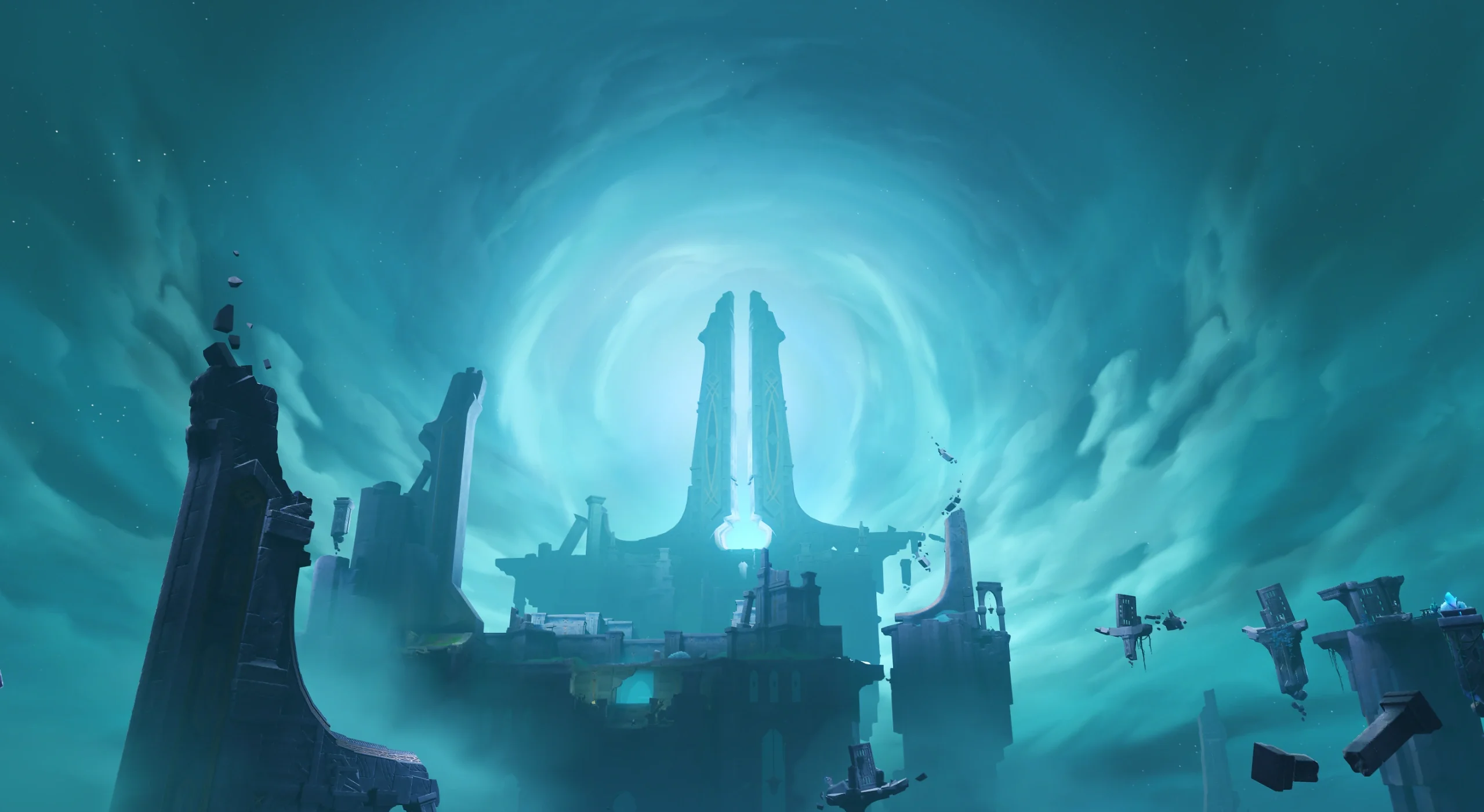
Hyperborea is the lost civilization the Frostmoon Scions of Nod-Krai claim as their origin. [30] "We Frostmoon Scions are the last descendants of the ancient golden realm of Hyperborea," Lauma tells the Traveler. [2] Other texts call it the Golden City. It stood in the far north, in what is now Snezhnaya: had its great experiment not gone wrong, Aksinya says, "the Golden City would still be standing tall upon this land today... and we would not be standing atop this frozen expanse instead." [10] Nefer reckons that phantoms claiming to be Hyperboreans "must be from 6,000 years ago." [3]
A human city taught by angels
Nicole, an angel herself, puts it simply: "The Hyperboreans were humans I once aided. They accepted the civilization and creations bestowed upon them by the angels." Yet "many among them still held onto their faith in the moons," [4] the three whose goddesses once "blessed them greatly and protected them from harm." [5] Lauma's character story says they "learned to use the lunar tides to power their magics," and that some grew "horned crowns akin to deer antlers." [23]
The city's own voice survives in a letter buried in a time capsule on Nod-Krai's Wing of Keres. Dated to "the tenth year since Hyperborea initiated the 'Elysium Project'," it looks down on ancestors "prostrating at the feet of the Heavenly Emissaries" and boasts: "All the clans have united as one to shape the world into an Elysium for humankind alone." Its writers were raising "a tower that reaches the heavens," and their work on "the Seeds of Life" meant that "new humans born after such 'adjustments' can wield elemental forces at will." [13]
Who led it
A weapon appearance says that "the first divine envoy bestowed her sacred sigil upon the high priest of Hyperborea, granting them the right to lead the resplendent city of gold." [14] The time-capsule letter describes the city as "Guided by Dawn's Navigator and the Exalted Saint." [13] In the city's records, say notes at Pale Crown Palace that Fandom attributes to the Belyi Tsar, "an individual known as 'The Saint' appears time and again": "His true name, it would seem, was Anacharsis, and it was he who instigated the rebellion that courted eventual destruction." [12]
Fandom reads the envoy, Dawn's Navigator and the "first angel" of the Finale of the Deep Galleries artifacts as Koitar, ruling for thirty years with Anacharsis, the voyager from the stars who in those artifacts takes the body of a youth in the "city of gold" and swears to be the first angel's "unpardonable conspirator in rebellion." [1] [25] [15] [16] The game never sets Koitar's name beside Hyperborea's. Her hymn, which calls her "first, fairest daughter of the creator god," does not mention the city. [26]
What it made
Hyperborea's artisans made the fae. Deep Gallery's Moment of Oblivion recalls how, "Turning to forbidden methods, artisans forged countless fae spirits upon the bones of giant beasts," spinning "fallen frostmoon light into flawless flesh and blood." That power to create had been "the lord of the firmament's divine prerogative," handed to mortals "by the rebellious envoy." [17] Aksinya partly agrees: "A number of the fae were originally servants created by the Hyperboreans." [11] The Belyi Tsar's notes reject the servant story and record the fae's earliest name: "Filii Adamici Evoluti, or 'the evolved children of humanity.'" [12]
The Version 7.2 World Quest series An Ancient Song of Flowing Crystal and Stone Chests puts broader claims in characters' mouths. Reading old fae script, the Volkodlak Glinin says that "fae are artificial lifeforms, originally created by the Hyperboreans," and when Paimon asks whether that means all of them, he answers, "Nobody now knows the exact circumstances, but there are a multitude of surviving records that attest to it." Thrud accepts the making and rejects the purpose: "It is true we fae were created, but we were not originally meant to be 'tools.' We were meant to be remade into a 'more superior form of life.'" The Shimmering One, who wants humanity "cast out," says "The ancient Hyperboreans created us in their pursuit of transcendence..." [33] [34] [35]
Its boldest project was a new ruler. Aksinya calls the Belyi Tsar "the culmination of Hyperborea's most advanced technologies," and says "The Hyperboreans even attempted to forge his body from the flesh and blood of the Primordial Cryo Dragon, just to give him authority equal to The One," whom she names as Nibelung. [10] A later note says neither The Saint "nor the people of the golden realm knew that the will which once ruled the ancient universe had not yet been extinguished, and thus none could ascend the throne they had prepared." [12]
The fall
"Hyperborea's fate had been sealed long before The Saint arrived," the notes conclude. The decree "to annihilate the golden realm" was one "that even the eldest daughter of the angels could not alter," and the faithful could only "stave off the execution of that judgment for a mere thirty years." [12] Aksinya names the trigger: the experiment on the Cryo Dragon "went out of control"; "the corpse of the Cryo Dragon Sovereign and their unchecked authority turned the whole of Snezhnaya into the Holy Soil of primordial ice," until a being she does not name "sent their heavenly nail crashing down." [10]
The Celestial Gift artifacts, one of which calls the city's end "the final verdict," describe a people who met the nail in open revolt. [20] "The arrows of defiance were ready to fly, their aim fixed upon the heavenly city; even the newborn fae were now armed for war." [18] More angels gathered than at any time "since creation," and "the most ancient masters of the earth" answered the call; Fandom reads those masters as dragons. [19] [1]
"From the holy citadel to the ancient capital, dark blue crystal nails annihilated every last city with even the most minuscule sign of life," and "The once-praised apostle and the gods' first messenger both vanished in the catastrophe." [21] The fae "turned into icy silver mist," and "in the space of a single night, the splendor of the golden city was ruined by frost-laden winds." [17] What remained sank: "by that time, Hyperborea had already sunk into the Shadow Realm, and the only ones seen in the land of ice and snow were the fae..." [10]
Survivors
"Those who survived by grace of being nowhere near the cities at the time could only cling to life amidst the freezing wind and snow." Only "one celestial ruler shed tears for the mortals' pain": "the mistress of the Frost Moon," who "spun gleaming threads from the silver glow to lead the displaced across the frozen plains." "The proud descendants of Hyperborea call themselves the 'Frostmoon Scions' for this reason." [21] Fandom identifies that mistress as Canon. [1] In Act VIII of the Song of the Welkin Moon, Canon tells Columbina that the Heavenly Principles "would even cast down celestial nails as manifestations of their power, to punish the civilizations of the world below," and that she "did everything in my power to help the punished escape catastrophe." Columbina silently counts "The ancestors of the Frostmoon Scions" among them. [6]
Nicole's character story has her hurry the people of a "satellite city" to safety as "The giant spike of judgment hammered the ground"; Fandom places that city in Hyperborea. [24] [1] A Disenchantment in Deep Shadow artifact has the king of the north find, in the Shadow Realm ruins of "the shattered golden homeland," a structure "filled with life-sustaining devices from ages past," and inside one a silver-haired infant, "unconscious, yet still alive." Fandom identifies the child as Aksinya, and HoYoverse's NPC archive lists her region as Hyperborea. [22] [28]
The 7.2 World Quest series finds one refuge. In a buried grotto reached from Teplo Oasis, inscriptions in the fae script, as Glinin reads them, record that "the golden capital withdrew into shadow unseen, awaiting the day of return..." and that "We, the survivors, found this sanctuary of pure earth amid the pitch-black crystalline shadow that engulfed all..." Glinin thinks the golden capital "is likely related to Hyperborea," and Thrud reckons the writers "must have lived much longer than 500 years ago." A journal from the grotto is plainer: "We are the people of Hyperborea, the Golden City! Even if our once-glorious capital has sunk into the drifting shadows, and shifting ley lines have unleashed a black Kristall-Blight that swallows everything... we must still find a way to rebuild our civilization!" It adds that "The fae once stood as citizens of Hyperborea just like humankind." In Glinin's reconstruction, which he offers with a "Perhaps," survivors and still-enslaved fae fell out over the crystal tree that protected them, and in the end "both the humans and fae who lived here were all swallowed by the spreading Blightkristall." [33] [36] [35]
Hyperboreans after the war
Nicole's Act V account adds a later chapter: "It began with the Hyperboreans who lived after the war of funerary flame." They "sought to contact the moon goddesses beyond the sky," building "titanic structures that consumed vast amounts of kuuvahki" until "at last they glimpsed the moons and heard their voices" and learned that "the three moon goddesses were dead." [4] At one such site in Act VI, Nicole remarks, "This is where the people of Hyperborea communicated with the moons." [5] An earlier phantom, Razmaspes, calls Hyperborea the place "where my ancestors once lived." [4]
In Chapter VII
In the Shadow Realm, the Eye of Graeae gives the Traveler a weapon whose activation code ends, "This is what remains of the Golden City, Hyperborea." [7] Pierro warns that unless the Heavenly Principles are overthrown, "the fate of the people of Khaenri'ah and Hyperborea is a cycle doomed to repeat itself." [8] In Act III the Tsaritsa traces Vesna's power back to it: "During the Hyperborean era, the former Archangel stole a small portion of the Ruler of Life's power." [9]
In Act V Nicole asks the Tsaritsa to protect Snezhnaya, because "since the days of Hyperborea, countless people have placed their hopes and dreams in this land we now know as Snezhnaya." [31]
In Act VI the fae lord Noy speaks of the "golden realm" as his former home. "I may not have experienced the destruction of the golden realm directly, but I am better acquainted than anyone with the rubble and ruins of that era," he tells the Tsaritsa, and "before it all came crumbling down, it was the land I called home." His escape was luck: "I was lucky enough to be beyond the starry sky when catastrophe struck. But then I was pulled back by a gravitational force that could not be fought against..." He never says the word Hyperborea in the act; golden realm is Lauma's name for it, and his introduction card calls him a fae "from Hyperborean times." He first guesses that a plague in Snezhnaya "may be caused by the remnants of the golden realm," then traces it to the fury of fae who died in "the great war that preceded the Belyi Tsar unifying Snezhnaya." [32] [37] [2]
Unsettled
- Where the fall sits against the war of funerary flame. Fandom puts it first, and Crystal Tear of the Wanderer sets it while the Frost Moon was "a silver mirror unbroken," yet Nicole speaks of Hyperboreans who lived after the war. [27] [21] [4]
- Why the decree was issued (the notes give no reason, and Fandom calls the reasons unclear), and what became of the apostle and the first messenger, who simply "vanished." [12] [1] [21]
- Whether Koitar led the city. HoYoverse's NPC archive describes her without mentioning Hyperborea. [29]
- When the grotto's survivors lived, and how Noy escaped the city's end. The inscriptions give no date, and Noy's card says only "for reasons unknown." [33] [37]