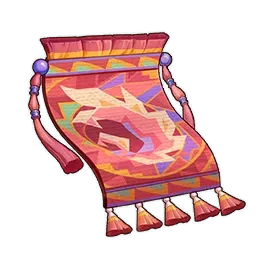
Fires of Autumn Twilight is a three-volume Natlan Book Collection released in Version 5.2 and sold by Amazolli at Idukan's Trove (a bookstore on the Masters of the Night-Wind tribe's Tezcatepetonco Range) at 1,500 Mora per volume. Each volume opens with the same standing description: "A woven scroll from the Flower-Feather Clan. It seems like it consists of what were originally two separate stories from different eras that were then merged together at some unknown time." [1] [2]
The two stories woven into one
The interleaved narrative is a single protagonist's diptych. Lianca's "soft-hearted second daughter," never named, is both the archer in a narrow cave and the bride at a warehouse altar. The trick is the same in both, and the volumes alternate between the two strands paragraph by paragraph.
In the dragon strand, she spends years hunting the beast her mother once pierced ("the archer by whose arrow had pierced its throat decades past, the woman who had driven it into the depths of the dark forest like an alpaca"). She lures it into a narrow cave salted with liquid phlogiston ("Containers of liquid phlogiston were shattered by its frantic movements, its flesh consumed by the fire that rained down"), waits motionless at the entrance with her drawn longbow, lets it commit, and looses the arrow only after the fire has done most of the work. The closing image of Vol. 3 is the dragon's skull "high above them" in the warehouse: "a relic of the beast that she, singlehandedly, had slain some years past." The dragon-kill is therefore historically prior; the warehouse scene is the present-day frame the dragon-trophy hangs inside.
In the wedding strand, the same daughter, now of marriageable age and the last viable heir of the Flower-Feather Clan after "Lianca and her chosen successor were both now dead", receives back her childhood companion as a Recording Officer of the Grand Alliance sent to "receive the banner of the Flower-Feather Clan in the name of the Holy Sovereign" and to escort her to "Cinder City and meet with His Majesty." She has buried oil beneath the warehouse. She lets him hold her hand. She drops a single spark. She seals the exits. "Not even death can part us," she whispers, turning his vow against him verbatim. Both die. Elder Nyamgondho, a Flower-Feather Clan elder who had been complicit in the takeover plan because "he too was a child of the Flower-Feather Clan", leads the investigation after the fire, finds no clue, and rules the deaths accidental.
What the book anchors
The dragon is CL-06 - Aj Tininik Oyowal Waak - He Who Shakes the Earth Like Thunder in His Wrath, one of the Thirteen Sovereign Lords Xiuhcoatl created and one of the few who survived the siege of Tollan. Fires of Autumn Twilight is the primary text for CL-06's final fate: slain by Lianca's second daughter during Och-Kan's reign, decades after Lianca's own pre-siege bowshot wounded but did not kill him. The book is therefore the closing chapter of CL-06's individual arc. [4]
The book is also the primary-text witness to Flower-Feather Clan resistance under Och-Kan. The "Holy Sovereign" the Recording Officer serves is Och-Kan, the Sacred Lord and Python King of Ochkanatlan, per the in-game interactable Holy Sovereign's Notes (VII) and the Scroll of the Hero of Cinder City artifact set. "Cinder City" is Ochkanatlan itself: "Ochkanatlan, also known as the Cinder City." The "Grand Alliance" is Och-Kan's political institution after Xbalanque, the same one Lost Traveler in the Ashen Realm names as the era during which Och-Kan ruled before the Scarlet-Eyed Youth deposed him. The protagonist's assassination is therefore a Flower-Feather Clan act of resistance against Och-Kan's absorption of Natlan's tribes, clan by clan. In a single fire it takes out his Recording Officer, his plan to secure the succession through a puppet marriage, and the last living heir of Lianca's line. [3] [6]
Cross-text grounding
Lianca herself is the Flower-Feather Clan's founder, raised by CL-08, the Eighth Lord, *Priestess of Floral Candles and Skyborne Feathers as a dragon princess and named by AQ Welkin Moon Prelude as the uncrowned queen of her people and the original bearer of the ancient name *"Vuka" later inherited by Chasca. The book's archer-mother ("the woman who had earned [the dragon's] hate") is therefore Lianca herself, and the daughter is a second-generation Flower-Feather Clan member operating one generation downstream of the clan's founding. [5] [7] [8]
The Flower-Feather Clan's modern role as the tribe whose "flying squads" monitor cursed Ochkanatlan runs straight downstream of this same resistance. The clan that once burned Och-Kan's Recording Officer in their own warehouse remains, two thousand years later, the watch on Och-Kan's abandoned capital. [3]
Reading the seam, and what not to conflate
The book is not a historical record. The standing description's "two separate stories from different eras... merged together at some unknown time" is an in-text disclaimer: the dragon-kill and the warehouse-burning happened in different eras and were stitched into a single woven scroll afterwards, and the narrative voice keeps inviting the reader to notice the seam. The dragon is not a Saurian or a Pyro Vishap; it is one of the Thirteen Sovereign Lords, close to the Sovereigns rather than a devolved dragon. The "Holy Sovereign" is not Xiuhcoatl the Pyro Sovereign (slain by Xbalanque at the Great Volcano of Tollan generations before Och-Kan's reign) and not Xbalanque (the Scarlet-Eyed Youth and first Pyro Archon, whose followers built Ochkanatlan in the first place); the appellation is reserved in primary text for Och-Kan alone, the tyrant after Xbalanque who proclaimed himself Sacred Lord. The Elder Nyamgondho of the Flower-Feather Clan is a discrete character within this book and is not to be conflated with Sumeru's separate Nyamgondho the Fisherman parable.
A note on the title
The title Fires of Autumn Twilight references Margaret Weis and Tracy Hickman's Dragons of Autumn Twilight, the first novel of the Dragonlance fantasy universe, and the Dragonbolt Chronicles achievement for collecting all three volumes is a parallel Dragonlance nod. The in-Teyvat story is unchanged by the homage; the Dragonlance allusion is authorial framing, not in-universe quotation. [1]