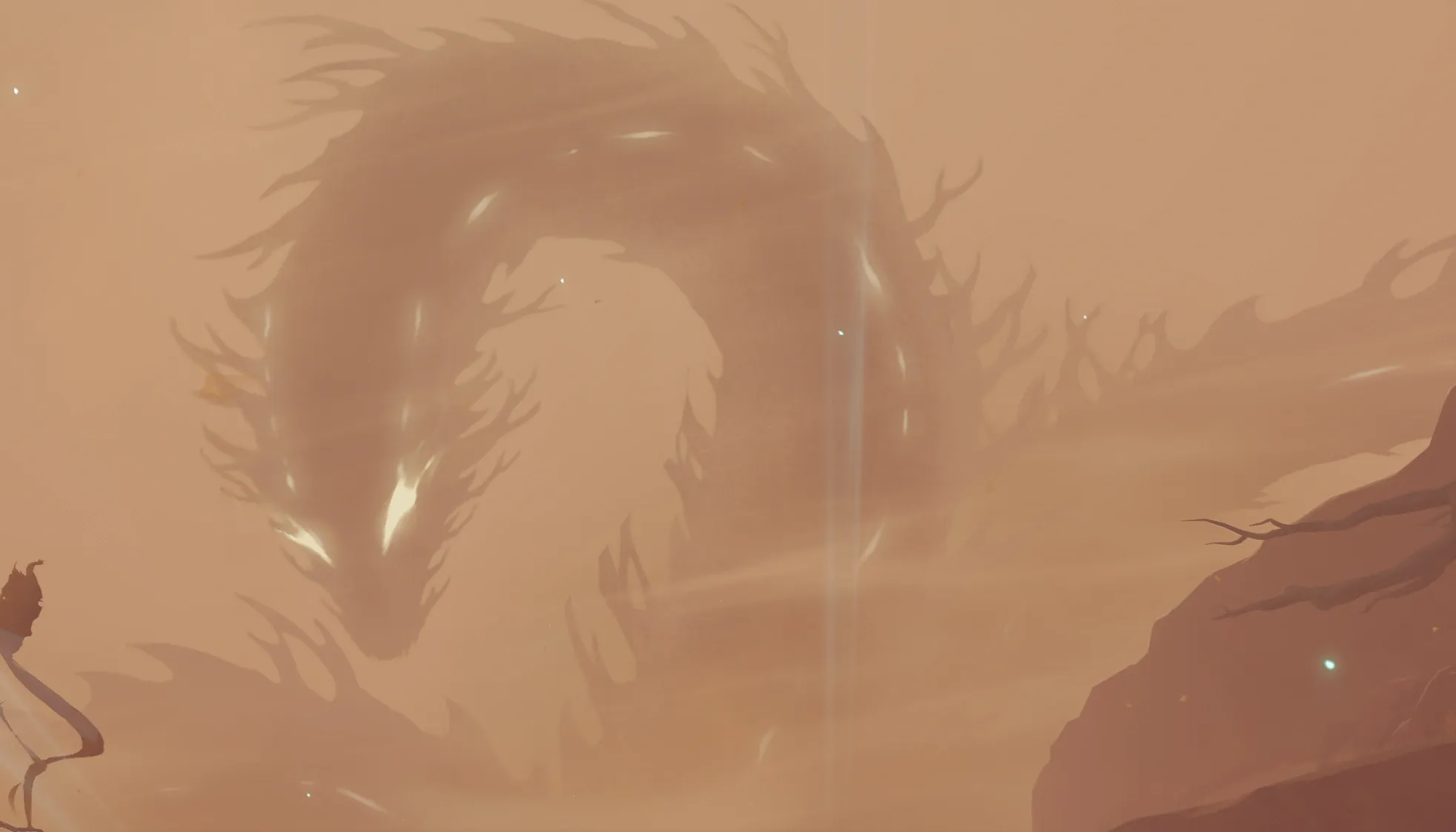
A Sovereign is one of the original draconic rulers of Teyvat's seven elements, the rulers who existed before the Primordial One arrived from outside the world. Each element had one. The Primordial One defeated them, redistributed most of their authority via the Archon War, and installed mortal Archons in their place. Most of the Sovereigns are dormant, sealed, or in hiding; a few are still active, and the Tsaritsa's Gnosis collection appears to involve them directly. [8]
The current shape of Teyvat, with elements that behave the way they do, Archons that look like people, and ley lines tied to Irminsul, is what remains after the Sovereign-to-Archon transition. The Sovereigns ruled the world that came before.
What a Sovereign is
Like all vishaps, the Sovereigns are creatures of the Light Realm, and each harnesses one of the primordial elements. They were the mightiest among dragon-kind and ruled the old world and its seven nations. [8] [15]
They come from the vishaps, which once followed each Sovereign with the matching element and were the dominant race of the world. Over time vishaps evolve into true dragons, and "from each vishap species, the Seven Sovereigns will be born anew, so long as they remain biologically pure." [13] [16] Purity is the condition: Sovereigns "can only be born from dragons who are elementally pure." The Bathysmal Vishaps strayed from their pure Hydro form into impure Cryo and Electro variants, so the next Hydro Sovereign was not born from them and was reborn in human form as Neuvillette instead. [8] [15] Liyue's Geovishaps belong to Azhdaha's line: they are attuned to Geo, and adults can also take on Cryo, Electro, Pyro, or Hydro in combat, one element at a time, with Azhdaha the exception. [13] In Fontaine's Erinnyes Forest, Pahsiv is a vishap who can take melusine form; her true form is a Primordial Bathysmal Vishap, and as a melusine she keeps dark blue skin and hair and pink eyes with vertical pupils. [14]
A Sovereign's dragonhood is bound up with its elemental Authority. The Heavenly Principles stole part of those Authorities, which went to the Archons' divine thrones, so none of the living Sovereigns can access their full abilities or memories of the old world until the matching divine seat is destroyed and the Authority returns. [8] The one case shown so far is Neuvillette's, at the end of AQ IV Act V (below).
Nibelung and the dragons' war
Nibelung, the Dragon King, was born alongside Teyvat, and since the "dawn of time" the world belonged to the dragons. It "was led by Nibelung and the Seven Sovereigns, who each possessed one of the Seven Authorities and a portion of the world," and each Sovereign's land was attuned to its element. [8] [1] [17] In the distant past the voyager Anacharsis told him that Teyvat would be destroyed and that he should leave with her. He refused to abandon his people and tried to lead the dragons to the stars instead; in the end he left Teyvat and created the Three Moons from the planet crust to govern the cycle in his stead. [8]
When the Heavenly Principles arrived, the Sovereigns were defeated and fell into a deep slumber. Nibelung's return in the Funerary Year, bringing Abyssal power, woke them, and unable to resist its call they joined him in a "great war of vengeance" against the Heavenly Principles. Apep and other dragons fought at his side, and they lost. [8] [29] Fandom's account continues that the Heavenly Principles, no longer able to hold the old world down alone, worked with "the one who came after" to make the seven Gnoses from the Third Descender's remains and part of the Sovereigns' Authorities, which set off the Archon War. [8]
The seven, by element
At a glance, the seven seats and where each stands today. The names follow Fandom's Known Sovereigns table, which lists three of them, Azhdaha, Dvalin and Kapatcir, without a line that calls them Sovereigns. [8]
Element | Sovereign(s) | Status (one line) |
|---|---|---|
Dendro | Apep | Lives in the Sumeru desert; restored in Nahida's Homecoming, helps Nahida in Welkin Moon Act IX. |
Hydro | Original Hydro Dragon (unnamed) → Neuvillette | Fandom lists the original as unknown and deceased, succeeded by Neuvillette, who reclaimed the Authority in AQ IV Act V. Egeria is not on Fandom's roster. |
Cryo | Original Sovereign unnamed and dead; successor unknown | Version 7.0 establishes the original corpse; no current occupant appears through 7.2. |
Geo | Azhdaha (Fandom's listing) | Fandom lists him as the original Geo Dragon, "Incapacitated" since his resealing; its reference is Zibai's Act V line calling him "the great Geo Dragon," not a line naming him Sovereign. |
Anemo | Unnamed original → Dvalin (Fandom's listing) | Fandom lists Dvalin as the current Anemo Sovereign on an inference note; no released line calls him one. |
Electro | Kapatcir (Fandom's listing) | Fandom now lists the Thunderbird Ei slew as the original Electro Dragon; in Act VI its power waits inside the Raiden Shogun. No line calls it a Sovereign. |
Pyro | Xiuhcoatl (slain) | Slain by Xbalanque about 2,000 years ago; Xbalanque became the first Pyro Archon. |
Dendro: Apep
Apep lives in the Sumeru desert, where Nahida says she "had been slumbering," and helps Nahida at the Heart of Oasis in Welkin Moon Act IX. A Celestial Nail, "the giant spike that fell from the sky," turned much of her rainforest into sand, and she says she "was stopped by the giant spike" as she gathered more forbidden knowledge. That knowledge, which Nahida calls "the root cause of The Withering," tormented her for millennia; after Nahida restored her Heart of Oasis in Homecoming, Apep says in Act IX that "it was Buer who saved me from agony." [9] Her own account of the old war comes in Nahida's Story Quest Homecoming: "We all once believed in the distant past that only forbidden knowledge could give us enough power to defeat the Heavenly Principles," and "The Dragon King acquired the power of darkness from outside of this world and led us in a fight against the order established by the outsiders." She never says "Primordial One," and she speaks of the Dragon King, whom Fandom's transcript marks as Nibelung, as the leader she still follows ("the scales and will of the Dragon King still shine bright in my heart even to this day"), not as an ancestor. [1] Her disclosure to the Outlander in Welkin Moon Act IX, in the quest A Divergence Leading to Oneself, is dense: "Irminsul existed before they ever arrived in Teyvat"; the Ley Lines then "flowed with an abundance of a familiar, primitive form of elemental energy... You may know it as the power of the Light Realm"; the Heavenly Principles "usurped and refashioned Irminsul, made it serve humanity, and used it to anchor the fate of the world"; "there will come a day when we reclaim this world for ourselves"; she can sense that "the Hydro Dragon has wrested his authority from the hands of the usurpers"; and "Though we have yet to meet, I know that we are both preparing for our revenge day and night." She names only "the Hydro Dragon," never Neuvillette. [9] [27]
Hydro: original Hydro Dragon → Neuvillette
Besides the Hydro Authority, the original Hydro Dragon presided over the Primordial Sea and could be considered the original "God of Life." All life on the planet traces back to that sea, which is sometimes called "birthing waters" or "amniotic fluid," and life within it was a collective rather than made up of individuals. [8] [29]
Fandom's table lists the original Hydro Dragon as unknown and deceased, "Succeeded by Neuvillette," and does not count Egeria as a Sovereign. Its history calls her creation "an exception": she "was created as a replacement "heart" for the Primordial Sea," and Fandom's Egeria page says Naberius made her the Sea's new heart after the Hydro Dragon "was removed from its position." [8] [26] Egeria was the first Hydro Archon. She died at Tunigi Hollow during the Cataclysm fighting the Abyss per the Vourukasha's Glow artifact text; her body became the Amrita from which Greater Lord Rukkhadevata grew the Harvisptokhm, and her consciousness was anchored in the Gaokerena tree. That death site is Tunigi Hollow, not the Oratrice; the Oratrice Mecanique d'Analyse Cardinale is Focalors's later construction built to execute the Prophecy of Fontaine across five centuries, per the Egeria deep-dive. The Archon's authority then passed laterally to Focalors, Egeria's Oceanid follower, who was appointed as a substitute Archon under the arrangement to deceive Celestia over the prophecy and was never a Sovereign at any point. [11]
Neuvillette is the Hydro Dragon's successor, currently Iudex of Fontaine. At the end of AQ IV Act V, as Paimon tells him, Focalors "destroyed the divine throne of the Hydro Archon and restored your power to you, transforming you into a fully-fledged elemental dragon sovereign." [4] [8] Sovereigns can be reborn in human form when elementally pure draconic stock is unavailable. That is the fallback the Enkanomiyan prophecy anticipated after the Bathysmal Vishaps diversified into Cryo and Electro forms and broke the pure-Hydro line of rebirth, and Neuvillette is the case shown on screen. [8] [15] He did not make the melusines. They were born from the wounds of the great beast Elynas about 400 years ago, and he regards them as his dependents and successors, "a new sort of Hydro Vishap species." [28] [29] In Welkin Moon Act IX, Apep says she can sense that "the Hydro Dragon has wrested his authority from the hands of the usurpers," and adds, "Though we have yet to meet, I know that we are both preparing for our revenge day and night." She never names Neuvillette, and the Traveler privately decides not to tell her "that we're on such good terms with the Hydro Dragon." That makes him the first Sovereign another Sovereign describes as having reclaimed his Authority, which opens the arc of the Sovereigns reclaiming their Authority. [9] Osial, the Overlord of the Vortex, is not a Sovereign and is absent from the roster of known Sovereigns: he is "an ancient god and sea monster that was defeated by Rex Lapis during the Archon War two thousand years ago." [6] [8]
Neuvillette attends the leaders' meeting in Snezhnaya in Act V of Chapter VII, where Nahida greets him as "the Hydro Dragon, with his full authority restored." He does not hide the old grudge. "I may not be a first-generation dragon, but even so... as I sit here, I feel a rancor stirring within me," he says, and "The rift between dragons and gods goes deeper than any 'conflict' or 'friction.'" Pierro observes that letting the Hallowing run its course would mean "turning elemental energy back to Light Realm energy once more. In the eyes of dragonkind, this is no disaster." Neuvillette joins the effort anyway, on his own terms: "No matter how many eons go by, the Dragons will never forgive the gods for their usurpation. Yet I doubt that the Heavenly Principles ever envisaged the gods of this world rising up in rebellion against them. In this moment, at least, we share a common goal." [34] [36] In Act VI he stays away from Celestia; Furina explains that "being a dragon, he had his misgivings about showing up in person." [35]
Cryo: formally unnamed
The released Version 7.0 World Quest gives the first trace of the seat in primary text. Hyperborea used the unnamed original Cryo Dragon Sovereign's flesh and blood in an unfinished Primordial-Human experiment. The dead dragon's unchecked authority froze Snezhnaya and crystallized its Ley Lines; a heavenly nail was sent; the Belyi Tsar awoke from the remains one thousand years later. The quest does not identify Belyi as the Sovereign, Nibelung, Monomakh, or a Cryo Archon, and it names no successor. [20]
Version 7.1 returns to the corpse without settling the seat. In the closing cinematic of Chapter VII Act IV, a gravely wounded Ronova, stripped of the Authority of Death, fuses "Eitr" into the Nail of Retribution hovering over the corpse, and the Nail fractures and begins to crumble. The scene's in-game description says she hoped "to make all of Teyvat experience that same sensation as the Holy Soil spread across the land." No successor appears, and Version 7.1 does not show what the crumbling Nail releases. [25] [24]
Version 7.2 does. In Act V the Nails of Retribution flare across Teyvat and set off the Holy Soil phenomenon, or Hallowing; the Esoptron reports it "currently in effect, triggered by the Embryonic-Ichoric-Telluric-Rudiment," the substance the Act IV cutscene says Ronova fused with the Nail. Pierro cites records that describe it as "the final punishment Celestia imposes upon a transgressing civilization," a reset to "Teyvat's original state — that is to say, the Light Realm." [34] [25] [38] The Cryo seat stays empty through Act VI.
The 7.2 World Quest series An Ancient Song of Flowing Crystal and Stone Chests returns to the dragon's remains inside a wing-shaped mountain. A crystal being that calls itself the Shimmering One boasts, "Our flesh descends from one of the Seven Sovereigns of old. The divine blood flowing through His Majesty Monomakh is no different from our own," and wants "all the power within the Cryo Dragon's remains." The fae Sadunova says of the dead dragon, "That accursed usurper erased even its name." In black-screen text that Fandom transcribes from the finale, a voice demands to be addressed "as the Lord of Frost and Snow, one of the seven pillars that stood beneath the primeval..." None of this names the Sovereign or a successor. [40] [39] [41] [42]
Skirk does not fill that gap. Her master Surtalogi is a Khaenri'ahn Sinner, and her Cryo presentation is the Seven-Shifting Serpent disguise over Abyssal power. She is neither proxy, deputy, carrier, nor heir of the Cryo Sovereign in released text. [5] [18]
Geo: Azhdaha, per Fandom
Fandom's table lists Azhdaha as the original Geo Dragon and a current Sovereign, "Incapacitated as of Amidst Chaos, the Rock Is Unmoved." Its reference for the entry is now Zibai's line at the leaders' meeting in Chapter VII Act V: "Zijiao bore witness when Rex Lapis fought side by side with the great Geo Dragon, Azhdaha, at whose slightest touch the very mountains quake." That calls him a Geo Dragon, not a Sovereign. [34] An earlier revision rested on a note on terms, not a line naming him Sovereign: the English "Dragon Sovereign" renders the same 龙王 ("dragon king") used for Azhdaha's title, and his Chinese boss title (被封印的岩龙之王, "Sealed King of Geo Dragons") matches Xiuhcoatl's as Pyro Dragon Sovereign. [8] Azhdaha is described as an Ancient Geovishap Ancestor who "holds command over the Ley Lines." He had signed a contract with Morax never to harm humanity or Liyue, but erosion made him forget Morax and his love for humanity. When miners damaged the Ley Lines in the Chasm he lashed out at the humans he had sworn to protect, and Morax sealed him with Mountain Shaper, Moon Carver, and a third, unknown adeptus. [7]
Anemo: Dvalin, per Fandom
Fandom's table lists an unknown original Anemo Dragon, deceased and "Succeeded by Dvalin," and Dvalin, the Anemo dragon of Mondstadt, as the current Anemo Sovereign. That listing rests on an inference note rather than a released line: Breeze Amidst the Forest calls him an elemental dragon, several quests group him with Apep, and his title 风龙 ("Wind Dragon") matches the short titles of other Dragon Sovereigns. No released line calls Dvalin a Sovereign. [8]
Electro: the Thunderbird, per Fandom
Fandom's table long had no Electro entry. The Bathysmal Vishaps did evolve Electro variants, straying from their "pure" Hydro forms into "impure" Cryo and Electro ones, but tying them to an Electro Sovereign is speculation. [8]
Chapter VII Act VI brings an Electro dragon into the story. Ei recalls that she "once slew a great Thunderbird on the island of Seirai which posed a threat to Inazuma's safety," and explains why killing it was not enough: "The dragons were the original form of life in Teyvat. Though they may perish, their elemental energy surges on incessantly, eventually giving rise to a new dragon." So she "sealed the primordial Electro element away." The Hallowing, which "has the power to reset everything it touches," undoes the seal, and Ei makes the released power her proof for Inazuma's trial, holding it in the Raiden Shogun's body until, after "a long incubation period," it can "take shape as a conscious lifeform." Paimon and the Traveler call it the Electro Dragon. Neuvillette, who helps upgrade the Shogun, calls the project "beneficial for dragonkind" and plans to return "to pay my respects to the new Electro Dragon." [35] [37] No line in the act names the Thunderbird or calls it a Sovereign. Fandom's table now lists it as Kapatcir, the original Electro Dragon, alive as of Act VI with its essence held in the Shogun and its consciousness in the Plane of Euthymia. [8]
Pyro: Xiuhcoatl (slain by Xbalanque)
The Natlan WQ "A Finale Emberforged" Part 1 An Omen of Annihilation and the Final Entreaty names Xiuhcoatl. He was the Pyro Sovereign who presided over light, heat, and wisdom, manipulated Phlogiston (the atomic form of Light Realm energy), and created the dragon Kukulkan at the moment of his own birth, naming him brother. Xbalanque, who seized on his weak point, slew him about 2,000 years ago and died in the same fight; Xbalanque was reborn and became the first Pyro Archon, with Pyro Authority transferred into the new Archon system. Kukulkan wonders whether the rebirth was "part of the deal he had made with a certain entity all along," an entity Fandom identifies as Ronova. Xiuhcoatl's residual power occasionally manifests in Saurians directly descended from him. [10] [31] [11] That fight fell in the Archon War period, which ran from 6,000 to 2,000 years ago, but Natlan was never part of the Archon War itself. In Smokeless War Acatl explains: "The in-fighting between the dragons pretty much took over everything, so there was no room for the gods to join in." [32] [33]
Kukulkan is not a Sovereign. He is Xiuhcoatl's younger brother (named brother at his own birth per the same WQ), the Regent of Natlantea appointed after Xiuhcoatl's incapacitation by the Heavenly Principles, and per the Thirteen Sovereign Lords page not one of the Thirteen either. Regent and Sovereign Lord are distinct roles per the Chamber of Deliberation B-CL-11053 Impeachment Inquiry into Regent Kukulkan record, which lists every Lord CL-01 through CL-13 as attendees and lists Kukulkan separately as the Regent under inquiry. The Thirteen Sovereign Lords are a regional group in Natlantea: Dragonlords, artificial intelligences Xiuhcoatl created from the primal flame to rule under the Pyro Sovereign's throne, alongside the elemental thrones this page catalogues but distinct from them. See the Thirteen Sovereign Lords page for the full roster from CL-01 through CL-13 and the rundown of the three survivors (CL-03; CL-10, who is Ajaw; and the benevolent half of CL-11, who is Ineffa). Several on-screen appearances come close to the Pyro Sovereign without being him: Flamelord's Blessing inheritances, Huitzilopochtli manifestations, and the Tonatiuh memory cutscene in Act III of Lost Traveler in the Ashen Realm, where Kukulkan, as Sage of the Stolen Flame / Waxaklahun Ubah Kan, addresses Little One as Chosen of Dragons and is revealed as the true architect of the legend of the Jade of Return. The only on-screen depiction of the Pyro Sovereign remains Xiuhcoatl's slaying by Xbalanque. [19] [21]
The Sovereigns are not a unified faction. Apep is hostile to humans; Neuvillette is sympathetic; Nibelung is dead. The original Cryo Sovereign is also dead, and no present successor is named. Surtalogi and Skirk belong to a separate chain of Khaenri'ahn and Abyssal power, so no Cryo Sovereign is established as operating through a student in the Abyss. [20]
What we know
- The Sovereigns are far older than the Archons, though no source gives the gap in years. Since the "dawn of time" the world belonged to the dragons, led by Nibelung and the Seven Sovereigns, who each held one of the seven Authorities and a portion of the world before the Heavenly Principles came. [8] Apep speaks as though the current Sovereigns are a remnant of that older order. Whether the elements were ever shared out among the Sovereigns in some other way is not stated.
- The Archon War established the seven seats. In Fontaine, Furina performed the public role while Focalors held the Hydro Archon office. Neuvillette served as Iudex and Hydro Sovereign in human form; he was never Hydro Archon.
- Some Sovereigns can still act. Apep still speaks and acts from the Sumeru desert. Neuvillette's Vision story says that after regaining his complete form he "set aside parts of himself, as like unto the dragon-treasure hoards of old, awaiting valiant humans to come and claim them." [29] Fandom's Vision page takes this to mean that Hydro Visions now come from Neuvillette, since Visions come from whoever holds the elemental Authority; the passage itself does not call these parts Visions. [30] Whether a present Cryo successor exists or acts is unknown; Skirk and Surtalogi are not evidence of one.
- The Gnoses were created from the Third Descender's remains after the War of Funerary Flame and before the Archon War. Saarelainen is the strongly implied candidate, not an explicitly named identity; in Version 7.1 Rhinedottir tells the bargain behind the Gnoses without naming him. [23] Focalors held the Hydro Archon office until destroying its Throne; Neuvillette regained Sovereign Authority without becoming an Archon. [12] [11]
What we don't know
- Whether Dvalin (Anemo) and Azhdaha (Geo) truly hold their seats, since Fandom lists both without a line calling either a Sovereign; whether the Thunderbird whose power Ei now carries in the Shogun is the Electro Sovereign, as Fandom's listing implies but no line says; and who, if anyone, succeeded the dead Pyro and Cryo Sovereigns. The gaps may represent death, hiding, succession, or records not yet surfaced.
- Whether any Sovereign took part in the Cataclysm 500 years ago. No source describes a Sovereign uprising then. The only dragon fight Fandom's Seven Sovereigns page records from it is Barbatos and Dvalin killing Durin, the artificial dragon the Khaenri'ahn alchemist Rhinedottir sent to the surface. [8]
- Which Sovereigns joined Nibelung's war, and what each did. Apep and "other dragons" fought beside him, and Fandom gives no full roster. [8]
- Whether the vishap line runs only one way. Sovereigns are born anew from pure vishaps, and Pahsiv shows a vishap taking melusine form, but no Sovereign is shown returning to vishap form, and Neuvillette is the only Sovereign shown reborn as a human. [13] [14]
- The mechanism of the Sovereign-to-Archon "carving." The Saarelainen / Third-Descender parallel is itself inferential and cannot prove the Sovereigns were physically carved.
- What the Tsaritsa finally plans to do with the Gnoses. In Version 7.1 she names two purposes, amplifying her power to face the Heavenly Principles and opening a seal the Third Descender left, and she does not mention the Sovereigns. Her Version 7.2 account of how the Fatui collected the Gnoses, given to the leaders of the nations, leaves them out too. The Sovereign-restoration reading remains a theory she has not confirmed. See the Open Theories below. [22] [34]
The casual version: the Sovereigns are the dragon-rulers who ran Teyvat before the gods we know took over. Most are gone or hiding; a few are still out there; and the story has been quietly setting up their return.
Welkin Moon Act IX - the Sovereign-Authority-reclamation arc opens
Apep's disclosure to the Outlander at the Heart of Oasis (Welkin Moon Act IX A Divergence Leading to Oneself) sets out where the Sovereigns have been heading since the Cataclysm. She makes four claims in a single exchange: [9]
- Irminsul existed before the Heavenly Principles even arrived on Teyvat. The Sovereign-era world already had it, though "Its appearance and function then differed greatly from today," and the Heavenly Principles refashioned it rather than building it. Apep speaks as a witness to the pre-HP arrangement, which places her higher in the cosmos than the Archon War's redistribution suggested.
- The Ley Lines once flowed with Light Realm power: "The Ley Lines flowed with an abundance of a familiar, primitive form of elemental energy... You may know it as the power of the Light Realm." The Heavenly Principles then repurposed Irminsul to anchor fate; they "usurped and refashioned Irminsul, made it serve humanity, and used it to anchor the fate of the world." The fate-anchoring function is a retrofit the Heavenly Principles gave Irminsul, not an original property.
- One day, the dragons will reclaim control of Teyvat. Apep states this as fact, not aspiration: "The opportunity will arise, no matter how long we must wait." The Tsaritsa's project of collecting the Gnoses runs in the same direction as this prediction, though Apep does not (yet) count her as an ally.
- The Hydro Dragon has already reclaimed his Authority, and Apep counts him in her own plans. She says "the Hydro Dragon has wrested his authority from the hands of the usurpers" and "Though we have yet to meet, I know that we are both preparing for our revenge day and night"; she never names him, but the Hydro Dragon is Neuvillette, whose Authority returned in AQ IV Act V. That return was legible to at least one other Sovereign as a cosmological event of the same kind as Apep's own ambitions, not merely the settling of the Hydro Archon succession inside Fontaine. The arc of the Sovereigns reclaiming their Authority opens with Neuvillette as the first reclaimant another Sovereign describes.
What is new is one Sovereign acknowledging another. Apep tracks Neuvillette accurately enough to identify his reclaimed Authority. Whether that awareness extends to any present Cryo successor, to Azhdaha and Dvalin, whom Fandom lists for Geo and Anemo, or to an Electro Sovereign, is not on-screen. Surtalogi is not part of the Cryo succession question.
This adds to the picture of the Heavenly Principles. Their prohibitions operate on top of a world from before them that Apep remembers, and the fate-anchoring function they gave Irminsul is a repurposing that came after them. See Heavenly Principles for the parallel.
Deep dive
Three sister essays cover the background on the thrones that this page draws on:
- The Sovereign-to-Archon transition, the essay on two cosmological events: the Primordial One's forty-year When the Doves Held Branches war that seized the Sovereigns' Authorities, and the Archon War the wounded Heavenly Principles set in motion four millennia later, after the war of funerary flame. It has the full region-by-region substitution table (Xiuhcoatl for Pyro, Egeria's dual role for Hydro, the missing Anemo, Geo, Electro, and Cryo seats, and the peaceful sharing arrangement for Dendro), the exception of Neuvillette's rebirth as Hydro Sovereign in human form, and Apep's Welkin Moon Act IX disclosure about a fellow Sovereign that opens the arc of the Sovereigns reclaiming their Authority. [11]
- Celestia, the Heavenly Principles, and the Divine Thrones, on the split between Throne and Gnosis and how far the Saarelainen candidacy goes. [12]
- Skirk, Surtalogi, and the Cryo Sovereign question, which separates Skirk's chain of Khaenri'ahn and Abyssal power from the dead original Cryo Sovereign and the unknown current successor. [18]
For the Descender framework that displaced the Sovereigns, and the in-game evidence for each Descender's identification (including the context of Nibelung as Dragon King in the pre-Sovereign era), see The four Descenders, by the evidence.