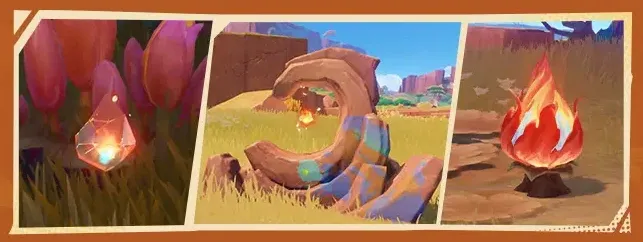
Phlogiston is Natlan's pre-elemental energy, Teyvat's primordial "primal flame" that pre-dates the present seven elements. Almost everything on the Natlan side of the game runs on top of it: the Nightsoul abilities of Natlan's playable cast, the ancient dragons' Iridescent Inscription technology, the Ancient-Name carvings, and the rituals at the Stadium of the Sacred Flame. In play it is described as "a mechanic unique to Natlan that can be used in combat, in exploration, and as an energy source," an "advanced form of Pyro" with several manifestations: Liquid, Solid, and Gaseous Phlogiston, plus Spiritways. [1]
Phlogiston is older than the elements
The key disclosure comes in Archon Quest Chapter V Act IV "The Rainbow Destined to Burn," Part 1 "Beneath the Secret Source," in Yohualtecuhtin's words to the Outlander, Paimon, Mavuika, Xilonen, "The Captain" (Capitano), and the awakened Ororon. The original Chinese, cited for clarity against the English wording, runs: 燃素是提瓦特原初的力量,而元素力则是由天理在燃素的基础上改造而成,此番改造本就是为了应对深渊威胁, which Fandom translates as "Phlogiston is Teyvat's primordial form of energy. The Heavenly Principles transformed (alternatively, modified) Elemental energy using phlogiston as a basis, so as to better combat the Abyss." [1] [2]
Two points follow. Phlogiston is primordial: it pre-dates the elemental energy the Heavenly Principles made from it. And because, in Yohualtecuhtin's account, the Principles built elemental energy using phlogiston as a basis, elemental energy is the later, derived form, while the original survives in regional reservoirs. Natlan holds phlogiston; Nod-Krai holds its sibling, Kuuvahki. The English line reads, "The Heavenly Principles used phlogiston as a basis for the creation of Elemental energy." [16] How much of the seven elements is the Principles' work is still uncertain. Fandom notes that the Chinese has them modify elemental energy rather than create it, and its Seven Sovereigns page has the Sovereigns already holding "the seven elemental Authorities" before the Heavenly Principles came. [1] [17]
The lore record puts it directly: "Alongside Kuuvahki, Phlogiston is one of Teyvat's two ancient and primordial forms of elemental energy, which flows out from the Light Realm, and was used by the ancient dragon civilization to store information. Various Phlogiston recordings can be found in Natlan's ruins from the dragon civilization." [1] [5]
Phlogiston and the Nail of Retribution
Mavuika ties phlogiston to the Nails at the leaders' meeting in Chapter VII Act V: "once upon a time, Natlan's terrain was rich in Phlogiston and Light Realm energy, until a Nail of Retribution was sent to change that..." She calls it "a temperamental nail": "First, it doesn't allow Light Realm energy to spread unchecked, then, it starts turning elemental energy back into Light Realm energy to punish civilization." That second step is how Pierro describes the Hallowing at the same meeting, "turning elemental energy back to Light Realm energy once more." [18] [19]
Act VI adds two passing remarks. Ei, explaining how she came to ask Mavuika for a craftsperson, says, "I understand that Phlogiston is a widely used energy source in Natlan whose origin is primordial Pyro energy." And Natlanese who have left the country, Kachina says, "forget how to use Phlogiston" once the Wayob fall silent. [20]
The four forms of phlogiston
Phlogiston manifests in four forms. [1]
- Liquid Phlogiston, the swimmable variety Saurian-Indwelling abilities engage. It is the source of Phlogiston Particles, each one restoring 20 points of the shared 100-point Phlogiston Meter, refined from Pyrophosphorite per the Records of Hanan Pacha Vol. 1 origin story ("a crystal refined of the primal fire in the depths of the great volcano... its color was that of an ever-shifting rainbow"). [9]
- Solid Phlogiston, appearing as Crystals, Spikes, Volcanic Boulders, Everflame Seeds, Flaming Seeds of Phlogiston, and the giant solid-phlogiston nails of the Cataclysm-era Abyss-sealing apparatus described in the Beneath the Crystal Rock world quest. The Solid form converts under an Iridescent Inscription's control; when Abyss pressure surges, the Inscription's power scatters and the apparatus "shifts" into Unstable Phlogiston Crystals. [8] [3]
- Gaseous Phlogiston, the aerosol form found in strong-phlogiston puzzle areas, which gates Saurian-Indwelling abilities across the Natlan map.
- Spiritways, the dragons' phlogiston-based transport network, introduced in the Version 5.5 A Finale Emberforged chain ("An Omen of Annihilation and the Final Entreaty"). Creating Spiritways was one of the things the dragons could do with their Inscriptions. [6]
Mechanically, the Phlogiston Meter is a 100-point shared party pool above the HP bar. While indwelling a Saurian the player gains an extra 50-point buffer, and each Phlogiston Particle restores 20 points. Phlogiston is consumed by Saurian-Indwelling abilities (swimming in Liquid Phlogiston included) and during a sustained Nightsoul's Blessing state once Nightsoul points run out. It is not available in Domains. The Sage of the Stolen Flame story frames it as carrying "deep spiritual significance to the people of Natlan, symbolizing their indomitable spirit." [1]
How the dragons used phlogiston to store information
Phlogiston is a form of computronium: programmable matter, considered the most efficient way to store information, which the ancient dragon civilisation of Natlantea used to record knowledge. Their control language for it was the Iridescent Inscription, "essentially a programming language that allowed the dragons to manipulate matter at an atomic level." [3] [7]
That language was general-purpose, not built only for sealing the Abyss. The dragons used Inscriptions to record information, control all kinds of Secret Source Mechanisms, perform calculations, convert phlogiston between its forms, change their own appearance, create Spiritways, and fight the Abyss, among other things. Phlogiston is the substance; the Inscription is the language; the dragons built both as one integrated toolset. Recordings still survive in Natlan's ruins, the Inscriptions themselves are now "scattered across Natlan," and modern researchers (per the Saurian Relics Association's research bounty) have made "very little progress on deciphering them." [3] [7]
How phlogiston reached humans: the Kukulkan gift
Phlogiston reached humans through the Dragon Sage Kukulkan, the Sage of the Stolen Flame, who "stole a seed of Phlogiston and taught its use to humans through his disciple Chaac and the rite of the Hanan Pacha." The Thirteen Sovereign Lords and Three Princes voted to impeach Kukulkan after this gift, recorded in the Chamber of Deliberation's B-CL-11053 Impeachment Inquiry into Regent Kukulkan; proceedings halted when Xiuhcoatl appeared at the trial. [4] [11]
The folk version of that event is told in Records of Hanan Pacha, a three-volume Natlan book collection. Vol. 1 narrates Waxaklahun Ubah Kan's theft of Pyrophosphorite from a vain winged-dragon hoarder; Vol. 2 his raising of Hanan Pacha ("the Upper Sanctum of which people today now speak") and his teaching of its use to humans through Chaac; Vol. 3 the Lord of the Night's alcohol-trick expulsion of the people, and the scattering: "The scattered people brought phlogiston with them to every corner of Natlan." The book disclaims itself as folk tradition ("this tale has nothing to do with historical fact") and is careful to say the winged-dragon hoarder is not Xiuhcoatl himself. Read it as an origin story, not a biography. [9]
Kukulkan is not a Sovereign, and not one of the Thirteen Sovereign Lords. He served as Regent of Natlantea after his older brother Xiuhcoatl, the Pyro Sovereign, was incapacitated by his defeat by the Heavenly Principles and frozen in lava in a false-death: "In the past, he served as the Regent of Natlantea after his older brother Xiuhcoatl was incapacitated upon the latter's defeat by the Heavenly Principles." Regent and Sovereign Lord are separate roles; the B-CL-11053 record lists all thirteen Lords as attendees and lists Kukulkan separately as the Regent under inquiry, so he could not be both at once. [4] [11]
Phlogiston Engraving: the human imitation
After humans received phlogiston from Kukulkan, they "attempted to control it by imitating the art of Iridescent Inscriptions. They ultimately succeeded in creating their own language, called Phlogiston Engravings, but there is a considerable gap in complexity between the two technologies." [3]
Phlogiston Engravings today reach beyond manipulating phlogiston. They can also interface with the Sacred Flame at the Stadium of the Sacred Flame, where Natlan holds the Pilgrimage tournament that selects its Pyro Archon. Two uses dominate. Name Engravers of the Children of Echoes, one of Natlan's tribes, forge Ancient Names by carving them into obsidian, where a slip or deviation can cause cognitive side effects. Masters of the Night-Wind make Nightspirit Graffiti and Nightspirit Sigils from a mix of Phlogiston Engraving and oil-painted graffiti, which they activate with a Spiritspeaking skill unique to their tribe. [3] [15]
The body paint Natlan's playable characters wear is "another form of phlogiston engraving": the markings light up while a character is in the Nightsoul's Blessing state, "suggesting that they use Phlogiston or elemental energy to channel the power of the Night Kingdom." Some Sauroform Tribal Warriors among the Masters of the Night-Wind enhance their physical abilities through special body-paint Engravings. [3]
The Cataclysm-era seal at the Sulfurous Veins
The clearest Cataclysm-era use of Solid Phlogiston is the sealing pillar at the Children of Echoes' Sulfurous Veins, in Tequemecan Valley, told in the Version 5.0 Shadows of the Mountains world-quest series (Beneath the Crystal Rock and Peace to the Slumbering). Under Elder Traore, the Children of Echoes and their Saurians "fashioned giant stone nails out of solid phlogiston" through the Iridescent Inscriptions to seal an Abyss incursion, with two Khaenri'ahn soldiers, Zephaniah and Irizar, alongside them. [8]
The knowledge persists. Even today, the Children of Echoes, who mine phlogiston and gems, know that "the phlogiston around the sealing stone nails must remain untouched." They operated inherited dragon technology rather than inventing it. The Inscription itself was written by dragons; the Children of Echoes deployed it during the Cataclysm; and the human Phlogiston-Engraving imitation came later still. [7] [14]
What Phlogiston is not
- Not one of the seven elements. Per Yohualtecuhtin's AQ V Act IV disclosure, phlogiston is pre-elemental, the primordial energy the Heavenly Principles used as a basis when they built elemental energy. The Vision system does not issue Visions for it, and the Phlogiston Meter is a separate resource from the elemental-energy bar. The "advanced form of Pyro" description refers to its Pyro-adjacent behaviour in combat, not to its place within the seven-element framework. [1]
- Not Kuuvahki. The two are sibling primordial Light-realm energies. Phlogiston is tied to Natlan through its volcanic Pyrophosphorite, Kuuvahki to Nod-Krai through its proximity to the frozen moon. Both pre-date the seven elements; how they might interact is not anchored in primary text. [5]
- Not the Iridescent Inscription. Phlogiston is the substance; the Inscription is the dragons' programming language for controlling it. The Inscription operates on phlogiston the way code operates on a computer. [7]
- Not the Sumeru-side Khvarena framework. Per An Ode to Khvarena, Khvarena was created by Nabu Malikata "for the sole purpose of opposing the Cataclysm", a Sumeru-specific arrangement built to soften that disaster, separate from primordial phlogiston (which pre-dates both the seven elements and the Cataclysm). The two are anti-Abyss measures from different eras: phlogiston the primordial energy the Principles drew elemental energy from; Khvarena the gift Nabu Malikata built once she foresaw the disaster. The Order of Skeptics' Khvarena liturgy and the Children of Echoes' Phlogiston-Engraving tradition resist the Abyss by different means. [10]
- Not Khaenri'ahn Abyssal power. The stolen Abyssal power from the Welkin Moon Act IV Vedrfolnir rescue (see The Cataclysm) is Khaenri'ahn Abyssal power, separate from both the primordial energies (phlogiston and Kuuvahki) and the Sumeru-side Khvarena framework. [14]
- Not Sovereign authority itself. Xiuhcoatl holds the Pyro Sovereign throne, and Apep holds the Dendro Sovereign seat; phlogiston is the medium the Pyro Sovereign worked within, not the authority. It outlasted the Sovereign change-over, when Xiuhcoatl was slain by Xbalanque (the Sovereign-to-Archon transition deep dive covers this), and the Pyro Archon line inherited the medium through the Stadium of the Sacred Flame's Contending-Fire ritual without inheriting Sovereign authority. [13]
Open questions
- Whether anyone alive today still reads the dragon-language Iridescent Inscriptions fluently, or whether the whole post-Cataclysm world works only in the human Phlogiston-Engraving imitation. Modern researchers, per the Saurian Relics Association's decipherment bounty, have made "very little progress," and whether any progress has been made beyond what the Version 5.x patches show is not on the page.
- When Kukulkan's gift happened relative to the Cataclysm-era sealing at the Sulfurous Veins. Per Records of Hanan Pacha the scattering pre-dates the Tequemecan Valley sealing (the Hanan Pacha rite took place before the Pyro Archons), but the timeline of when Phlogiston Engraving matured, against the Cataclysm-era Inscription deployment, is less clear.
- Whether the Light-realm origin is stated in the game itself or is a community reading. The sibling framing for phlogiston and Kuuvahki rests on the wiki's Lore sections rather than on direct in-game text; the strongest in-game anchor for phlogiston's primordial status is Yohualtecuhtin's AQ V Act IV disclosure. The question stays open.
The dragons' language for controlling phlogiston is covered at Iridescent Inscription. The Natlantea dragonlords among whom the Kukulkan impeachment plays out are the Thirteen Sovereign Lords. The Night Kingdom that the Nightsoul and Ancient-Name systems operate inside has its own page, as does Nod-Krai's sibling energy, Kuuvahki. On the primary-text side, the folklore of Kukulkan's gift is told in Records of Hanan Pacha, and the Cataclysm-era sealing runs through the Beneath the Crystal Rock and Peace to the Slumbering world quests. The Sumeru-side Khvarena framework, which is distinct from phlogiston, is laid out in An Ode to Khvarena. Broader Natlan context is at the region page, and the Heavenly Principles' modification of elemental energy, which lies behind the Yohualtecuhtin disclosure, is at Heavenly Principles.