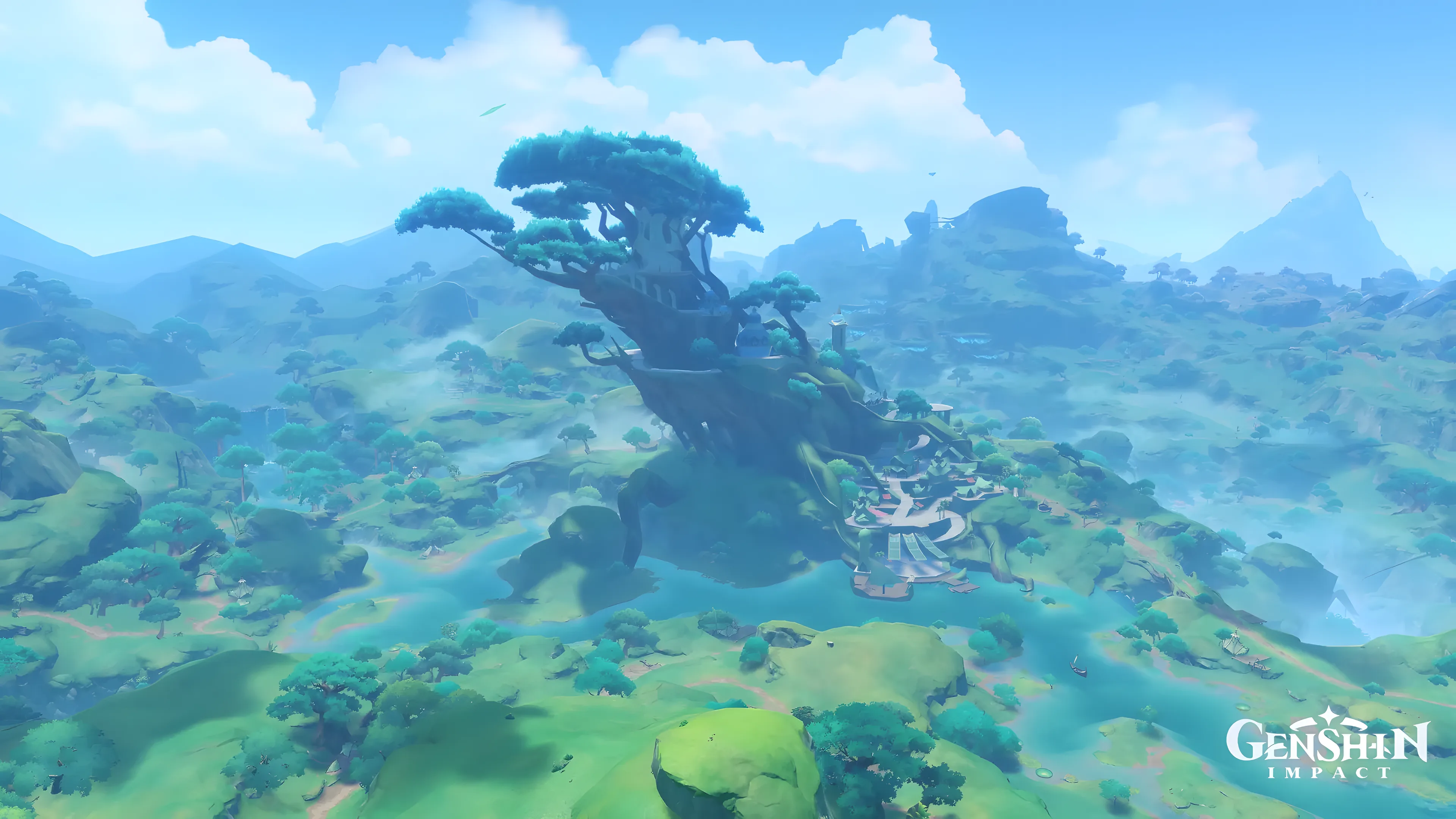
A scholar-state ringed by rainforest in the south and desert in the west, watched over by the Dendro Archon Nahida. Sumeru's Archon Quest is a three-act story about who gets to think, whether the Akademiya scholars, the desert peoples, or the god they almost imprisoned.
History
Sumeru's history splits at the desert's edge.
In the rainforest, the Dendro Archon Greater Lord Rukkhadevata governed for thousands of years through the Irminsul tree, a literal tree that is also the world's memory-storage system. She befriended scholars, raised the Aranara forest spirits, and after her death during the Cataclysm 500 years ago was succeeded by a smaller god created from her own consciousness: Nahida.
In the desert, the original god was King Deshret, a separate god (NOT one of the Seven Sovereigns; Apep holds the Dendro Sovereign seat, per the Sovereign-to-Archon transition deep-dive) who ruled the desert as one of the three gods anchoring pre-Cataclysm Sumeru, alongside Greater Lord Rukkhadevata (Dendro Archon) and Nabu Malikata (the Goddess of Flowers). His city of Gurabad rose and fell under his ambition. Deshret wanted to grant his people knowledge equal to a god's, and his attempt to siphon authority from the heavens broke his civilization. The desert peoples have not forgiven the rainforest scholars for narrating that history backwards.
In the present, the Akademiya, a scholar-government of six "darshans" (faculties), had locked Nahida away on the orders of corrupt Sages. They were running an experiment to extract her authority and pour it into a fabricated god of their own making. The Sumeru Archon Quest is the story of breaking that experiment.
Culture
Sumeru's rainforest is scholar-coded. The Akademiya's six darshans (Amurta, Haravatat, Kshahrewar, Spantamad, Vahumana, Rtawahist) compete openly for prestige, students publish, and the Akasha terminal lets every citizen tap into a shared knowledge-pool. The desert is survival-coded. The Eremites are mercenary nomads who organize into corps, the Tanit preserve oral lore the rainforest scholars dismiss, and the Sabzeruz Festival turns desert ruins into a celebration of King Deshret's reign rather than the Akademiya's verdict on it.
Religion
The rainforest worships through the Tree of Dreams at Vanarana (an Aranara settlement) and the Sumeru tree itself, and the Akasha terminal's voice is, at least in theory, Nahida's. The desert still worships King Deshret, though quietly; the Sabzeruz Festival is the most public form. After Nahida is freed, the Akasha system is dismantled, since it was being weaponized against her, and the Akademiya is reformed under her direct supervision. The desert remains its own religious universe.
Welkin Moon Act IX - the Sumeru-extension arc (Luna VII / 6.6)
In a first for the Archon Quest, Song of the Welkin Moon Act IX "As All Falls to Emptiness" (Luna VII, patch 6.6) moves the Luna arc back to Sumeru after eight acts of the Nod-Krai cosmology arc. The earlier acts (Prelude and Acts I-VIII) ran in Nod-Krai; Act IX is the chapter's pivot back to Sumeru. Act X, Truth Amongst the Pages of Purana, first appears in the quest log as Of Myriad Paths, Flux, and Dissolution and has its own page. [17] Act IX shipped at the wiki as Welkin Moon Act IX.
The arc adds five supplements to existing Sumeru canon, each grounded in primary text.
Akademiya Six Darshans - 6/6 named, Azar-successor slate
The post-AQ-III placeholder, with four new Sages still to be selected (per AQ III Act V A Toast to Victory), resolves at Welkin Moon Act IX A Divergence Leading to Oneself, in the Caravan-Ribat introduction scene. Per Naphis:
- Naphis (Amurta) and Baladhuri (Vahumana) are the old guard preserved; the Vahumana Sage's previously unrevealed name is resolved here as Baladhuri.
- Alkindi (Spantamad), Firnas (Kshahrewar), Shakir (Rtawahist), and Rushd (Harvatat) make up the slate of four new Sages who succeed Azar's.
The Six Darshans close 6/6 named at Act IX. See the Akademiya page for the Akademiya's record and how the framework closed.
Seven Pillars of King Deshret - 7/7 named and coordinated
The Seven Pillars of King Deshret's pre-Cataclysm era close 7/7 named and coordinated at Welkin Moon Act IX Ancient Shadows Re-Emerge. Per the scene at the Mausoleum of King Deshret and the sequence in which Heryshaf calls Shesepankh and Bennu:
- Thoth, the "Ibis King," seeded before the arc at Act IV through the setup in which Nefer returns home to the temple of Thoth, is resolved in the encounter at the Mausoleum of King Deshret in Welkin Moon Act IX.
- Heryshaf, the Goat King, and Sobek, the Crocodile King, whom Thoth calls Goatie and Croco. Heryshaf is the coordinator who calls Shesepankh and Bennu at Act IX.
- Shesepankh and Bennu, the two who agree to open Aaru.
- Hermanubis, through his representative. Heryshaf counts him in: "Hermanubis's representative and the Dendro Dragon Apep made their choice ahead of time." [15]
- Apep, the 7th Pillar, helping Nahida at the Heart of Oasis at Act IX, in its position as Dendro Sovereign from pre-Cataclysm Sumeru. See the Seven Sovereigns page for the Sovereign cross-reference.
The 7/7 coordination opens Aaru, allowing Jebrael (one of the souls released from Aaru) to meet his daughter Jeht and return to the Ley Lines. That resolution is what the Dirge of Bilqis WQ set up through its earlier thread about Jeht and Jebrael.
Apep's cosmological disclosure
The Outlander takes the comatose Nahida to Apep at the Heart of Oasis (Welkin Moon Act IX A Divergence Leading to Oneself). Apep agrees to assist, since "to receive aid without repaying it would likewise tarnish a dragon's dignity," and has the Heart of Oasis supply Nahida with life force, then delivers the chapter's central cosmological disclosure: [15]
- "That tree was not planted by the Heavenly Principles. Irminsul existed before they ever arrived in Teyvat."
- Back then, "The Ley Lines flowed with an abundance of a familiar, primitive form of elemental energy... You may know it as the power of the Light Realm."
- "The Heavenly Principles usurped and refashioned Irminsul, made it serve humanity, and used it to anchor the fate of the world."
- "But there will come a day when we reclaim this world for ourselves."
- Of the Hydro Dragon (Neuvillette): "I can already sense that far away from here, the Hydro Dragon has wrested his authority from the hands of the usurpers. Though we have yet to meet, I know that we are both preparing for our revenge day and night."
See the Heavenly Principles page for the cosmology that predates them, and the Seven Sovereigns page for the opening of the arc in which Sovereigns reclaim their Authority.
What changes in Sumeru: Caravan Ribat, Aaru Village, Akasha
Act IX reorganises the state Sumeru had settled into after AQ III.
- Caravan Ribat mass-evacuation. Per Welkin Moon Act IX Where Flowers Awaken, Nahida ordered everyone in the rainforest to move to Caravan Ribat after Collei reported her prophetic dream. On waking from it, Collei had heard Nicole's voice warn, "Time is short... A storm is coming from beyond the bounds of fate." Sumpter Beasts were mobilised and Dori's park contributed. The official reason given was "a large-scale renovation of the rainforest's ecosystem," since, as Tighnari puts it, "We don't want to cause widespread panic." [15]
- Aaru Village mass-relocation. In the briefing at Caravan Ribat in A Divergence Leading to Oneself, before the visit to Apep, Tighnari sets out the move into the desert: "The scholars and sages will head to the Temple of Silence, while the civilian population seeks refuge in Aaru Village." This covers the defense of Aaru Village against the Jinn and Jeht and Benben freeing the Traveler and Paimon from the ruins at Gurabad. Aaru opens after the Seven Pillars coordinate, resolving the thread of Jebrael and Jeht. [15]
- Akasha infrastructure still in place. In the same briefing Kaveh says that "although the system isn't currently operational, the technological infrastructure is all still there," and Tighnari adds that "The Akasha relies on the Gnosis as a power source, and in its absence, we'll need to find an alternative," which sends the scholars to the Temple of Silence; the power source they settle on is Aaru. Apep's power comes up separately, to help Nahida recover: "as long as Apep is willing, she should be able to convert her own power into a form that the Archon can use," Tighnari says, and Alhaitham answers, "The only problem is convincing her to help." The Akasha's shutdown after AQ III now reads as a shutdown with the infrastructure intact. [15]
- A barrier around Sumeru. In Ancient Shadows Re-Emerge, Nicole reports that "An invisible barrier has appeared around Sumeru's borders, cutting off all travel in and out," and suspects "it's a defense mechanism within Irminsul itself." [15]
The Fatui commander in Gurabad
Dottore dies at Welkin Moon Act VIII Descending Moon, vaporised by Columbina's massive lunar beam (the defeat of the chapter's villain). In Act IX a Fatui commander whom the game shows only as "???" traps the Outlander and Paimon in Gurabad. He says, "Our commander, Dottore, died in Nod-Krai," and of Dottore: "Neither he nor I are tolerated by the rules of this world." [15] Act X reveals him as the Harbinger Pantalone. Dottore is surprised that he chose "to present yourself as my former subordinate and not as the banker, Pantalone," and Fandom's summary identifies Pantalone as "the mysterious man that appeared at Gurabad". [16] [17]
Other Act IX disclosures
- Collei carries a fragment of Nabu Malikata. In the Ancient Shadows Re-Emerge secluded-spot scene, Nicole asks Collei, "are you aware that there are god remains inside your body?" and tells her, "Those were the remains of Nabu Malikata... the Goddess of Flowers." Cyno reassures Collei that "you are simply you." In Act X Nahida says she had sensed this long ago and kept it secret, and Liloupar takes the remains from Collei. See the Nicole Reeyn page for the scene. [15] [16]
- The Outlander's immunity to Irminsul edits. In A Divergence Leading to Oneself, Sekkura warns that "if you continue forward, delusions will start afflicting your mind," and the Traveler scouts ahead anyway, reasoning: "Nahida once said that Irminsul doesn't contain any information about me... So theoretically, I shouldn't be affected by such anomalies." This is the Fourth Descender's trait, confirmed in primary text. [15]
- A retrospective link to Gosoythoth. In the same act, Liloupar recounts, "I fought against it for a long, long time — until one day, I sensed a change in a foreign land to the west. Suddenly, the pitch-black Abyss fell silent." The Traveler wonders, "Did the Abyssal presence beneath this city fall silent when we defeated Gosoythoth?" The link between the two events is the Traveler's guess; the act does not confirm it. [15]
- Collei's prophetic-dream role-swap. In Where Flowers Awaken, the Sumeru cast appears in a dreamscape with reversed roles: Sethos as Master, Tighnari as General Mahamatra, Cyno as Temple-of-Silence leader, Kaveh as wealthy merchant, Layla as architect, Rahman replacing Barmak, Dehya as dancer, Nilou as Flame-Mane, and Siraj advocating mechanical life. Nicole later tells Collei the dream was a warning from the Goddess of Flowers: "She must have had a premonition. That is why she gave that dream to you." [15]
After Act IX, Sumeru stands as follows: Nahida still being healed by Apep at the Heart of Oasis; the six Sages at work with the seat of Acting Grand Sage vacant; the Akasha shut down but its infrastructure still there; Apep, the 7th Pillar, helping Nahida at the Heart of Oasis; Aaru opened after the Seven Pillars coordinated; the technical staff Naphis has already contacted on their way ("They'll be here soon") as Act X sets up; and the Fatui commander from Gurabad, revealed in Act X as Pantalone, still at large. What Act X, Truth Amongst the Pages of Purana, does to that baseline is covered on its own page. [15] [16]
The Hallowing in Sumeru (Chapter VII, 7.2)
Chapter VII's crisis reaches Sumeru in Version 7.2. In Act V, Hour of Ruin, with the Holy Soil phenomenon, or Hallowing, spreading from the Nails of Retribution, Nahida goes to the leaders' meeting at Zapolyarny Palace with Tighnari and Cyno. Naphis, who has taken "the role of Grand Sage," "had too much going on" to come. Having moved the rainforest's people to the desert during the Irminsul disaster, he now has to move the desert population to the rainforest "with what's happening at the Eternal Oasis." Tighnari passes on what the Dendro Archon learned from the Ibis King: "since King Deshret's Eternal Oasis draws power from the Nail of Retribution, Aaru holds some information on the topic." At the meeting Nahida offers Sumeru as the nation to attempt a Trial of Usurpation first, because "There was once a god of the desert who researched the Nail of Retribution, and we still have the records of what he had learned." Liyue's trial is passed before a test nation is needed. [18] [20]
In Act VI, A Yesterday Sent From Beyond, Sumeru's Nail stands far out in the desert behind huge tornados, but the Hallowing's path "has been erratic and unpredictable," so Sumeru City prepares anyway. Zubayr Theater becomes a shelter run by Nilou, and the Amurta Darshan moves plant specimens out of Pardis Dhyai to make room. In the desert, Dehya's mercenaries and the Corps of Thirty are fighting the monsters the Hallowing has brought and sending people to the city. "The sages have been helping, and the gods from the desert have provided their insights as well, so the response has been well-organized so far," Tighnari says. Collei, ill with a cold during Act V, has recovered and holds Avidya Forest while he works at the Akademiya. [19] [18]
The trial falls to Nahida. She alone hears a signal from the Nail, and once she has drawn it, Thoth credits that Nail with King Deshret's greatest works: "without studying that nail, he never would have been able to come up with a creation as exquisite as Aaru, nor conceive of the Golden Slumber." Aaru, which in Paimon's words "replaced Irminsul as the new center of wisdom," decodes the signal as "A single word: 'dreams.'" The dreamscape, which revisits Sumeru's past crises, opens a way into the Nail, and there Nahida faces its subject, "Wisdom," alone: "There is no single answer to the question of wisdom, because the very foundation of wisdom is disagreement and divergence." Sumeru's trial is passed. Nahida's page follows the dream in detail. [19] [21]
The World Quest From Trees to a Forest shows the rest of the effort. In the quest's own description, "Within the House of Daena, research, logistics, rescue missions, and combat operations are underway all at once." Cyno coordinates "While the Dendro Archon and Grand Sage Naphis are occupied," dividing the operation into "battlefield coordination, research data integration, forest search and rescue, and monster eradication." A team goes to support Natlan (the Wanderer and Sethos are the ones leaving), and researchers stay at the House of Daena, their findings to be "shared with the other nations as soon as possible." Kaveh sets up the Akasha Terminals, and Cyno announces, "The Akasha system will remain active for the duration of the operation. Supported by the power of the Three Kings, the Pari, and the Aranara, our communications network will cover Sumeru in its entirety." He does not name the Three Kings; in Act IX the awakened Pillars greeted Heryshaf, Thoth and Sobek with "Three Kings detected." In Act VI, by contrast, Nahida runs her dreamscape from outside because "The Akasha Terminals have been turned off." [22] [15] [19]
How Sumeru fits the Sovereign-to-Archon story
Three deep-dive pages frame Sumeru's place in Teyvat's broader shift from the Sovereigns to the Archons.
- The Sovereign-to-Archon transition. Sumeru is the peaceful sharing exception. In the Archon War record, King Deshret, Greater Lord Rukkhadevata, and Nabu Malikata held the pre-Cataclysm positions together. After Nabu Malikata and King Deshret died thousands of years ago, Rukkhadevata "presumably ascended as the Dendro Archon," in Fandom's words. [14] Apep, the Dendro Sovereign, endured millennia of suffering from the forbidden knowledge she had gathered, until Nahida and the Traveler restored the Heart of Oasis. [13] How the Dendro Authority reached Rukkhadevata is unconfirmed; Fandom says only that the Authorities the Heavenly Principles partly stole from the Sovereigns "were eventually given to the Archons' divine thrones." [12] So in Sumeru rule passed by peaceful sharing rather than by killing, unlike Natlan, where Xbalanque slew Xiuhcoatl. The deep-dive also reads Apep's Act IX line, "I can already sense that far away from here, the Hydro Dragon has wrested his authority from the hands of the usurpers," as the first acknowledgement in primary text, from one Sovereign to another, of an Authority being reclaimed. That opens the arc and casts Apep and Neuvillette, reborn as Hydro Sovereign after AQ IV V, as peers. [8]
- Egeria and the true origin of Fontaine, a cross-reference between Sumeru and Fontaine through the first Hydro Archon's death. Per the Vourukasha's Glow - Vibrant Pinion artifact text, Greater Lord Rukkhadevata grew the Harvisptokhm from Egeria's Amrita (Egeria's body after her death at Tunigi Hollow during the Cataclysm) to anchor her consciousness, a cooperation between the two regions' Archons during the Cataclysm. The deep-dive also sets Egeria's origin as Naberius's creation beside Apep's disclosure at the Heart of Oasis about the Light Realm before the Heavenly Principles, though Egeria herself was not a Sovereign. [9] [11] [12]
- The Nahida cascade, Nahida's state after Act IX (the successor grown from a fragment of Greater Lord Rukkhadevata's consciousness). Her Irminsul investigation drops her into a coma. She had connected herself directly to Irminsul to take over its recording and processing, a task Cyrus calls "almost impossible": "All that information flooding in at once would instantly fry any human mind." Apep restores her at the Heart of Oasis, warning, "Unless the issues plaguing it are resolved, she will never completely recover her former strength." She wakes and hands the Outlander a key and information to keep secret. [10] In the Ancient Shadows Re-Emerge scene, Nicole Reeyn identifies the god remains inside Collei as Nabu Malikata's. [15]
Notable figures
World Quests
- Aranyaka · Patch 3.0
- Varuna Gatha · Patch 3.0
- Golden Slumber · Patch 3.1
- Old Notes and New Friends · Patch 3.1
- Apocalypse Lost · Patch 3.4
- The Dirge of Bilqis · Patch 3.4
- The Eternal Dream, Ever Lush · Patch 3.4
- Khvarena of Good and Evil · Patch 3.6
- Pale Fire · Patch 3.6