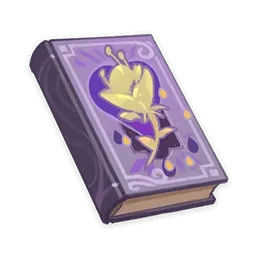
The Legend of Vennessa is a 2-volume Mondstadt Book Collection released in Version 1.0, found in the Grand Master's Office in the Knights of Favonius Headquarters and also obtainable from Dr. Edith at Windrise and Sayid at the Anemo Archon Statue. [1] Both volumes carry the same in-universe framing: "A popular song since the reconstruction of Mondstadt." The book is therefore a ballad compiled from oral tradition after the events it commemorates, not biography or testimony, and that frame shapes what it does and does not claim.
Vol. 1 - slavery under the royals
Vol. 1 opens with an apostrophe to the tavern, "Friends of Mondstadt, let us revel! Drink to your hearts' content! To freedom! To the Anemo Archon! To Vennessa, the first Knight to grace this world!", and immediately reframes the gift of Barbatos, the Anemo Archon, as "not freedom, but just defiance." The historical setting is bluntly stated: "Chained by royals, Mondstadt could barely suspire, And festivities were but vanity games of the rich, Beyond the grasp of the ordinary people. A withering dungeon, Mondstadt was." This is the primary text's statement that Mondstadt before Vennessa was ruled by the Aristocracy, a regime the book itself only ever calls "royals" or "the Aristocrats," never naming the Lawrence Clan that the Knights of Favonius page and the Songs of the Wind manga supply elsewhere. [1]
Vol. 1 also fixes Vennessa's own backstory in song: "A fiery-headed dame confined to a cell, From the southern plains she did hail. Born free but now bound by chains." "Southern plains" almost certainly does not mean Natlan ("scorching plains"), since Natlan lies southwest of Mondstadt. That leaves the geographical anchor uncertain, an honest gap the song does not close.
Vol. 2 - Barbatos descends
Vol. 2 narrates the meeting to which the Four Winds tradition would later trace its charter: "The day came when Barbatos answered her devotion. The Anemo Archon sought her fiery hair and descended to her position. 'Every being deserves a name,' the spirit grinned. 'To weave your fair name into a song I yearn,' 'I seek nothing but your friendship in return.'" The volume is careful to keep the Anemo Archon's role auxiliary: he sings to her march, not in front of it. "And so, to the battlefield she marched to Barbatos' singing voice, The demonic dragon fled from her might and the people did rejoice." The drake to whom slaves were sacrificed is Vennessa's arena trial; the book renders it in fairy-tale style ("the demonic dragon fled") rather than in combat detail.
The fall of the Aristocracy is then told explicitly as a joint effort with the winds: "Lonely forest breezes converged, jointly they overthrew the tyrant's tower from the sky. Broken free from shackles at last, the young lioness stood firm in the winds with her head held high." The doctrinal line that closes the volume is the song's most-quoted couplet, with Barbatos crediting Vennessa, not himself: "You first conducted what now transpires in your song. You have entrusted me with your friendship and your name. To praise your freedom, my songs came."
What the book does not say
The book ends with Vennessa standing "in the winds with her head held high," and stops. It does not state her later ascension to Celestia, it does not name her Falcon of the West, and it does not narrate the founding of the Knights of Favonius as an institution. The reading of Vennessa as the Falcon of the West is sourced from the Aquila Favonia weapon description and the Songs of the Wind manga, and her overthrow of the Aristocracy is "Mondstadt's second liberation from tyranny," that is, after Decarabian, not in Decarabian's era. [2] The song's silence on these later beats fits its nature as a popular ballad compiled by the freed city about its own founder. It stops where the historical record stops being party music.
What the ballad anchors
The Legend of Vennessa, compiled after the reconstruction, is the source for two readings. One is that the Knights of Favonius's doctrine of freedom traces, through Vennessa, to a deliberate framing of defiance rather than to a freedom handed down by Barbatos. The other is that the Anemo Archon's part in Mondstadt's second liberation was, in the words the ballad gives him, to support a human revolution rather than to author it. The book and Mondstadt's understanding of its own institutions feed each other: the city sings the song, the Knights administer the freedom, and the song credits the singer's friend rather than the singer.