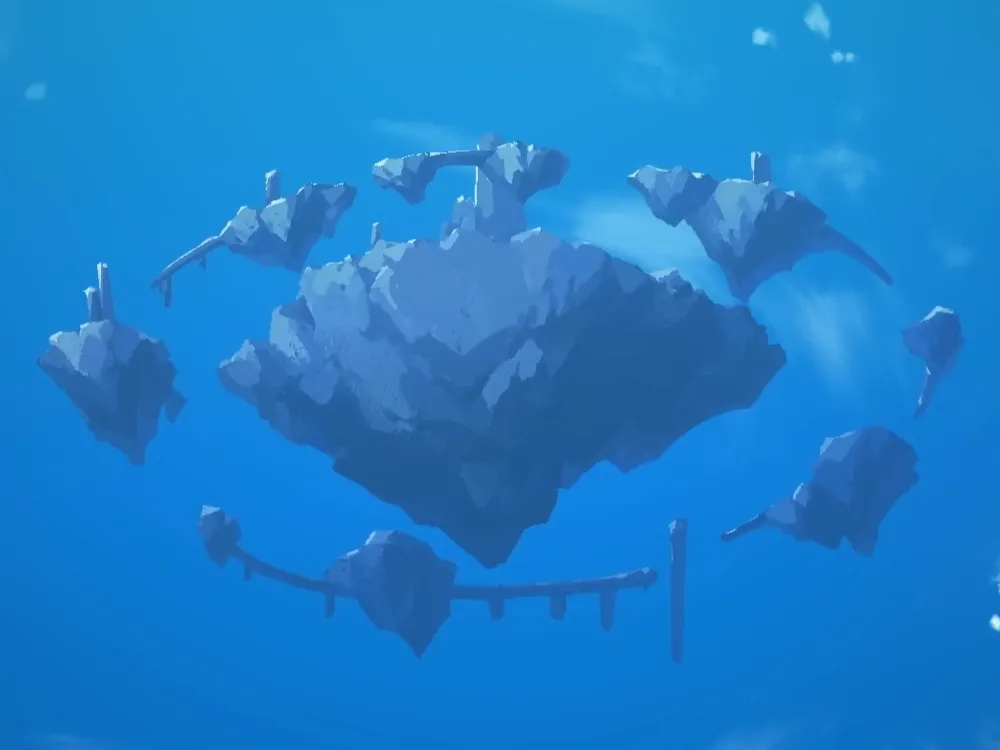
Celestia is the floating cluster of islands hanging above Teyvat, visible from any open-world high point and perpetually wreathed in cloud. Its master has not answered anyone for the last five hundred years. It is the seat of the Heavenly Principles and the source from which Visions and Gnoses descend. It also houses the Heavenly Principles' Four Shades: Naberius (Ruler of Life), Ronova (Ruler of Death), Istaroth (Ruler of Time), and Asmoday (Ruler of Space). Asmoday is the Sustainer of Heavenly Principles as well, and she is the one being mortals have actually seen descend in living memory.
The defining fact about Celestia today is that nobody on the ground is entirely sure who is still home.
What we know
- The Heavenly Principles have been silent since the Cataclysm, five hundred years ago.[1] Celestia has not gone quiet with them; Chapter VII shows it still monitoring the Four Shades (see below). Asmoday, the Shade most visible to mortals, is absent from the Shades' meeting in the post-Natlan "Gods' Limits" teaser, although Ronova says that "Not one of us has ever missed a meeting." Istaroth suggests she may have "just switched sides," and Ronova guesses at a "new master," though to whom is unknown.[5] The remaining three still gather in Celestia from time to time: Naberius (Ruler of Life, currently fused with the alchemist Rhinedottir), Ronova (Ruler of Death, until Celestia reclaimed her Authority of Death in Chapter VII Act IV), and Istaroth (Ruler of Time).
- Mortals can, in principle, reach Celestia. The classic path is ascension. Become the strongest mortal of an era and watch over Teyvat from above as a constellation. Vennessa, founder of Mondstadt's Knights of Favonius, is the documented case. She ascended after her revolt and became the Falcon of the West, one of Mondstadt's named constellations.[3] Dainsleif notes, politely, that even ascended mortals "hover under the light of the gods": Celestial citizens, never Celestial equals.[4] That is the belief. Chapter VII Act VI shows what her ascension came to (see the Divine Throne, below).
- Visions are Celestia's notice, not only a power-source. Anyone who receives one is, in the Sumeru Akademiya's word, an Allogene, a human Celestia has flagged as eligible for the ascension path.
- Archons can resonate directly with Celestia through their Gnoses. A Gnosis is not just a crown. It is a leash and a phone line at once.[2]
- Celestia or the Heavenly Principles intervened in Khaenri'ah's destruction, but released canon does not assign that destruction, the Heavenly Nails, or either curse personally to Asmoday. The opening cinematic depicts her separating the twins during their attempted departure; later released material, not the cinematic, places the Nod-Krai crash earlier. [6] [7]
- The Tsaritsa's accusation against Celestia is the foundation of the Fatui's whole project. She claims the gods of Teyvat have failed their mortals because Celestia stopped answering. The Travail story trailer closes on Celestia's god-statues visibly turning to stone, the same idea in one image.
Celestia's watch while the Heavenly Principles sleep
Why they sleep at all is weighed in The Heavenly Principles' slumber and the Third Descender's curse. Chapter VII shows that the silence runs only one way. In a prism memory from Act III, Rhinedottir warns Ronova that "To punish humans with death without the Heavenly Principles' approval would be a grave sin in their eyes." Ronova has found the gap: "during this period of slumber, Celestia only monitors our actions periodically," and "As long as we complete the death and resurrection process in the interval between two monitoring periods, no sin will be incurred." [14]
In Act IV the Tsaritsa exploits the same gap from the other side. She slows time around Rhinedottir until the interval passes, and Rhinedottir realizes the Tsaritsa has "uncovered the Heavenly Principles' 'monitoring cycle' as well." Celestia reacts at once. "Celestia has detected this incident, and thus, a directive has been provided," Rhinedottir says, a directive "echoing in my mind" that she resurrect Ronova's victims. Naberius judges that "The Authority of Death has most likely been reclaimed," and Ronova confirms it: "They stripped it from me, just like that." [15]
The system has thresholds. Naberius says the Tsaritsa's move "cannot be judged by Celestia, and falls far short of the threshold for casting down a nail of retribution," and a beast the Tsaritsa killed in Snezhnaya "certainly wasn't on Celestia's radar." Rhinedottir spares the Tsaritsa partly because Celestia is "keeping a close eye" on her and Naberius as possible accomplices, and she would "rather not have the Authority of Life reclaimed as well." [15]
Celestia also keeps records erased everywhere else. Rhinedottir says she "once reviewed the records in Celestia concerning the Third Descender incident," after the Heavenly Principles had used Irminsul "to erase all traces of the Third Descender's existence from the world." [15] [16]
Inside the Divine Throne
Version 7.2 takes mortals through the door. In Act V Celestia still does not answer: the Esoptron at the Temple of Space, a terminal "Built by the Heavenly Principles," tries "Connecting to Celestia..." and reports "...Could not connect. Activating default module." Nicole is sure that the order behind the Hallowing "cannot have come from the Heavenly Principles in their state of slumber." [21] [23]
Once the last Trial of Usurpation is passed in Act VI, the beams of the Nails lead the nations' representatives, the Traveler and Paimon to a door in Chenyu Vale. The Tsaritsa expects "a procedural announcement," since "The Heavenly Principles still slumbers — direct communication would be impossible." What meets them inside is a voice. "Invitees detected. Attempting to connect to the central database." "No response. Activating default mode." "Welcome to the 'Divine Throne,' Celestia's integrated computational array." Paimon can hardly believe it: "Celestia... We actually made it to Celestia..." [22] [24]
The voice belongs to Nukvah, and it speaks for a program rather than a master. "The default program requires Teyvat to be reset," it says. "Life, civilization, and administrators are to be restored to their initial states to maintain the stability of Teyvat." Passing the trials has earned a suspension of the Holy Soil phenomenon and nothing more. Each representative may choose one allogene to "ascend to Celestia as the final record of this civilization," and when Venti asks after Vennessa, Nukvah shows "where Vennessa is stored." After "Only 42 days," it says, "true annihilation shall descend." [22]
The representatives come away with Celestia's measure. "In the past, Celestia never would've wanted the civilizations of the world below to find out what happens up there," Nahida says. "But this time, it told us the truth..." The Tsaritsa is harsher: "In Celestia's eyes, we are but fuel... samples... test subjects in a sandbox." The game's Guiding Notes describe the Divine Throne as "The central hub from which Celestia controls fate and stores allogenes." [22] [25]
No Shade appears there. Nothing in the act says that Nukvah is the Heavenly Principles, the Sustainer or any of the Four Shades, or what its silent "central database" is. Its "Divine Throne" also shares a name with the divine thrones the Archons hold, and the act never connects the two. [22] [26]
Who actually lives in Celestia?
Celestia is the realm and residence of the gods. [10] Two facts about gods bear directly on the place.
The first is that gods cannot be completely destroyed. Even if a god's physical form is destroyed and their consciousness worn away, so that they are considered "dead," their emotions and power remain. When a god dies, that power flows out of the body and into the surrounding environment, and what determines the outcome is unclear and varies from case to case. The same principle runs under a whole family of cases: the Yaksha karmic-debt mechanism, the Tatarigami and the Inazuman wards built to suppress it, the path by which wildlife that consumes a god's remains becomes a Consecrated Beast, Marchosius revived as Guoba, Havria's salt-relics, and Remus's will protecting the ruins of Capitolium. Even the Travail trailer's closing image of god-statues turning to stone does not signal a complete death. Power and emotion remain where physical form does not. [10]
The second is that Angels are a separate kind of being from gods, and at least one is still alive. In AQ Chapter V Act IV "Beneath the Secret Source," the Lord of the Night disclosed as much to the Traveler, Paimon, Mavuika, Xilonen, "The Captain," and the awakened Ororon. Yohualtecuhtin is a surviving Angel who never devolved, of the same race the Seelies came from, and the Angels predate the Heavenly Principles' arrival. The Lord of the Night built Natlan's Night Kingdom from fragments of the old Ley Lines under Ronova's guidance, after the war between the Descender and the dragons known as the War of Funerary Flame. The Natlan ancestral spirits who live inside that realm are the Wayob. Angels rank alongside the Sovereigns; the Seelies are what they devolved into. [11] [12]
Sybilla is a second Angel alongside Yohualtecuhtin, though she died long before the present day, giving her life to create Remus's Grand Symphony, Phobos. Sybilla, the Golden Bee, began as an envoy from Celestia tasked with guarding the Irminsul tree of Meropis, an ancient nation in the area now known as the Sea of Bygone Eras. The long duty wore her form and mind down to golden-bee shape before Remus found her in the ruins, and she left with him to establish Remuria. [17] [18] That keeper's role makes her a guardian of an Irminsul tree, part of the memory-recording system Celestia administers, and her worn-down state aligns her with the same Angel race the Seelies came from, the one Yohualtecuhtin belongs to. So the count of Angels seen on screen now reads three of an unknown total: Yohualtecuhtin, Sybilla, and Nicole, who in Song of the Welkin Moon Act V introduces herself as "one of a very few angels who have retained both their preferred form and their power." [13] [19] [20]
What this means for Celestia is that the Angels predate the citadel entirely. Yohualtecuhtin operating outside Celestia today, as Sybilla did before her death, is not an anomaly. It continues an older order Celestia never fully contained. [10]
What we still don't know
- Whether the Heavenly Principles will wake up, and what happens if they do. Their dormancy is what every faction's plan rests on right now: the Fatui, the Abyss Order, the Archons themselves. The Traveler's sibling has said, on record, that the awakening will come. In Chapter VII Act IV the Tsaritsa asks Rhinedottir outright "when they will awaken" and gets no answer. From Rhinedottir's account of the Third Descender she concludes that the Cataclysm "must have triggered the Third Descender's curse," which is why they sleep; Rhinedottir calls the account "just a story." [15] In Act VI the Tsaritsa says they still sleep, and that had they awakened, "I doubt we would be afforded this opportunity at all." [22]
- What answers at the Divine Throne. Nukvah runs a "default mode" because its "central database" gives "No response," and no line says whether that database is the Heavenly Principles. Who the "administrators" in its reset are is not explained either. [22]
- Who now holds the Authority of Death that Celestia reclaimed from Ronova, and whether its monitoring has any answer for Asmoday's absence.
- What Asmoday's implied choice of the Traveler's Sibling means. Melanta's gender-variable line strongly points to the Sibling as the "new master" Ronova mentions, but no source defines the relationship or motive. Her absence, which Fandom reads as a defection, also does not establish a regency, impersonation of Heaven, or lack of authorization. [27]
- Whether ascension is the same thing for everyone. The path Vennessa took may differ from the one the Liyue adepti believe in, where some adepti reportedly descended from Celestia in the first place. The accounts contradict each other in small ways the wiki does not yet have a clean resolution for. Act VI shows only one ascended allogene, Vennessa, and says nothing of the adepti.
Celestia is the heaven Teyvat's gods report to, mostly empty, largely silent, running on muscle memory. When mortals finally walk in, in Version 7.2, what greets them is a terminal running its default program. More and more of Genshin's story turns on whether anyone is going to do something about that, and on what happens to the world if the master of the house finally wakes.