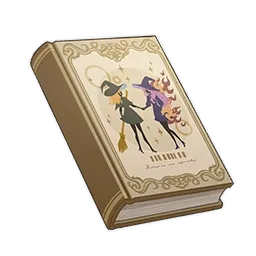
The Little Witch and the Undying Fire is a seven-volume Mondstadt Book Collection released in Version 4.7. Vol. 1 names the project outright: "This is the story of a little witch who journeyed far and wide to find the 'undying fire'." The note on every volume's first page says less than it lets on, though. "The binding and layout are exquisitely made, but the actual content is all handwritten. Judging from the handwriting, there is more than one author." Seven different members of the Hexenzirkel wrote the seven volumes, and the last of them is the witches' elegy for the member who died while the book was still being written. [1] [2]
The frame story
A young witch in "the westernmost part of the magic continent" is set the impossible exam task of finding "the undying fire" - drawn randomly from the lots, with her teacher's "hehe, I'll be rooting for you!" the only encouragement. She travels under a "blood-green moon" with a fortune-teller who delivers the volume's astrology lecture; falls in with a demon-king-hunting party; allows herself to be turned into mold to interview the mimic demon king; survives the chipmunk and great demon kings; is told via the crystal ball that "the trial is over. You were unable to obtain your witch license"; rushes home to find that her witch-traveller friend Octavia has returned with news that "the entire cosmos is going to die soon" and that the witch trials have been suspended because "in such a world, all things lose meaning"; and walks the last stretch to find the old witch dying - "actually the Star of Scorpio, that which burned still, even at the end of all things" - to take the flame and "bring the old witch's fire across the universe, to light every last corner of time."
The seven witches, one volume each
Each volume is the work of a different Hexenzirkel member, and the in-text tells are what give each one away. [1]
- Vol. 1, Alice (A, Merry-Witch). The Murphy's-Law misspelling, the philosopher's stone, the "parallel universe" grimoire, and the "baleen from a titanic universe-roaming whale" are all Alice's signature out-of-Teyvat references. The teacher who brazenly admits she made up the exam question and then triples the time limit is Alice writing herself.
- Vol. 2, Astromancer Barbeloth (B, Seer-Witch). The in-text fortune-teller is modelled on Barbeloth, and the long lecture on "the heavenly strings," the "sky-shroud," and the seven "archons" / "virtuals" / "dark sun" of other worlds is her astrology turned up to full volume.
- Vol. 3, Rhinedottir (R, Sage-Witch). The handwritten headnote "It's so rare for R to be in her right mind for a spell" names her by codename. The volume's preoccupation with biology, alchemy, and the little witch ingesting and then becoming the mimic-demon-king mold is the Art of Khemia rendered as procedural farce.
- Vol. 4, I. Ivanovna N. (J, Tricksy-Witch). The in-text mayor, a "loose confederacy" magistrate with no hereditary nobility, is modelled on Ivanovna. The narrator-aside "sorry, I don't know magic or mysticism" is true to her standing as the one witch with no magic of her own.
- Vol. 5, Nicole (N, Memory-Witch). "The writing here is practically a messy scrawl. Perhaps the author doesn't really write much, or perhaps something happened." It is the latter. Andersdotter died sometime during Vol. 5's composition, and the volume breaks off after a single sentence from the crystal ball. [3]
- Vol. 6, Octavia (O, Wander-Witch). Octavia uses her own name for the returning friend who reports that "many stars across the cosmos have gone out." The witch-chair line is the volume's emotional centre: "to each person a chair. That way, even if they are not present, their memories will be seated still."
- Vol. 7, Andersdotter and Alice (M + A). "I have already found the meaning of writing - that is to tell you: I do so wish you were here, too." Andersdotter is dead; Alice finishes the book she began. The cover pays homage to Pink Floyd's Wish You Were Here, and the album's title sits verbatim in the volume's standing description.
Who is the old witch?
The book never names who the old witch is. The bridge runs through the parallels. The old witch "often told the others that she was not their equal," echoing Andersdotter as the only ordinary human among the witches, and "she left behind stories that held countless worlds," echoing Andersdotter's own body of work. [1] [3] A witch travels the cosmos seeking the undying fire while the witches write the book in honour of the one whose own flame is going out. The in-story trial folds onto the real act of composition exactly.
Another world, not Teyvat
It is not a cosmology text about Teyvat. The planet the little witch travels is explicitly "the magic continent," a world apart, and the Vol. 2 astrologer's lecture about "the seven archons" and "virtuals" and "the dark sun" is about "other planets." The conceit of the passage is that Teyvat's own "sky-shroud" is so heavy the other-world terminology would not normally apply there. So the Seven Archons of Teyvat are not what the volume enumerates. The terminology is the in-fiction astrologer's exposition, not a roll-call of Teyvat's actual Archons. [8]
The translation notes on Vol. 2 do flag a Khaenri'ah Eclipse-Dynasty resonance on "dark sun." The Chinese 余 ("surplus, remainder") was localised as "virtual" in English, and the translator argues that "in Teyvat, the term is closely related to Khaenri'ah's Eclipse Dynasty, which was the kingdom's final dynasty before the cataclysm." That is commentary on the translation, not in-book primary text. The book itself does not name Khaenri'ah, the Eclipse Dynasty, or any Five Sinner. [7]
Despite the Alice and Rhinedottir authorship, the book is not really about Klee or Albedo; that Mondstadt family sits beside the volume rather than inside it. The only family on the page is the Hexenzirkel itself, seven witches at a tea party with one chair now empty.