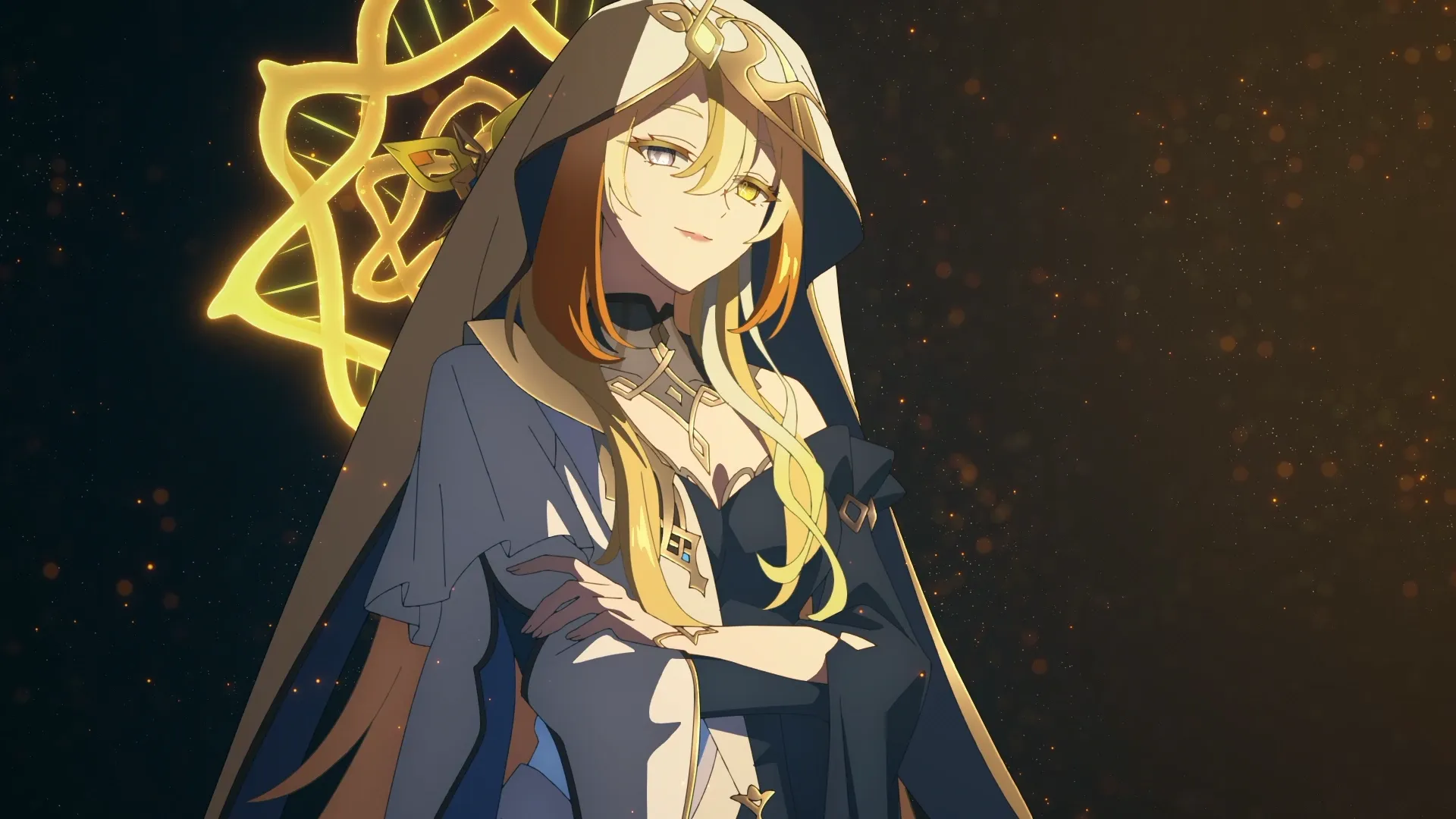
Pre-Cataclysm Khaenri'ahn alchemist; Eclipse-era practitioner of the Art of Khemia; participant in the raid to rescue Vedrfolnir; architect of the Cataclysm-era monster army; Ruler of Life fused with Naberius, in Snezhnaya in person in Version 7.1
Overview
The Khaenri'ahn alchemist 'Gold,' master of the forbidden Art of Khemia (life-creation).
Created both Durin and Albedo, and built the monster army that besieged Teyvat at the Cataclysm.
One of the Five Sinners of Khaenri'ah and the Hexenzirkel's Sage-Witch 'R'.
After devouring the Heart of Naberius, she now holds the Ruler of Life's power among the Four Shades.
In Version 7.1 she visits Snezhnaya as the Ruler of Life, reclaims Vesna's share of her power, and meets the Tsaritsa.
The Khaenri'ahn alchemist 'Gold': practitioner of the Art of Khemia, architect of the Cataclysm-era monster army, and creator of Durin and Albedo. She is one of the Five Sinners of Khaenri'ah, the Hexenzirkel's Sage-Witch 'R,' and, after devouring the Heart of Naberius, the holder of the Ruler of Life role among the Four Shades. She is alive, and in Version 7.1 she comes to Snezhnaya in person as the Ruler of Life.
Spoiler-free overview. You hid spoilers under Settings → Reading; choose Show all there to read the full content.
Rhinedottir, known as "Gold" for the alchemical heights she reached and as Sage-Witch "R" in the Hexenzirkel, is the Khaenri'ahn alchemist who built the monster army that besieged Teyvat 500 years ago and created Albedo as her final and most successful work. After the Cataclysm she devoured the Heart of Naberius to take over the Ruler-of-Life functions among the Four Shades. She is one of the Five Sinners of Khaenri'ah and a longtime friend of Alice (the Hexenzirkel's founder and Klee's mother). She lived as a human in Khaenri'ah before the Cataclysm, and she now acts as one of the Four Shades. [1][4]
She is still alive, and the Hexenzirkel still holds her seat. Until Version 7.1 she was not seen in Teyvat in person; in Chapter VII Acts III-IV she appears in Snezhnaya as the Ruler of Life, in the Northland Bank vault and over tea at Zapolyarny Palace. [24][25]
Three names, one being
She carries three main names, each belonging to a different layer of Teyvat's cosmology. [1]
Rhinedottir, her personal name, is Icelandic and Old Norse for "daughter of Rhine," a nod to the Wagnerian Rhinemaidens of who guard the Rhinegold. Alice uses the affectionate "Rhine" for her in private.
1.
Rhinedottir - Genshin Impact Wiki (Fandom) · external ↗
2.
Breeze Amidst the Forest - Genshin Impact Wiki (Fandom) · external ↗
3.
An Elegy for Faded Moonlight - Genshin Impact Wiki (Fandom) · external ↗
4.
The Gardener - Genshin Impact Wiki (Fandom) · external ↗
5.
The Gods' Limits - Genshin Impact Wiki (Fandom) · external ↗
Gold is her alchemical title, earned for attaining "the pinnacle of both knowledge and alchemical prowess." She is called Gold in earlier material such as Breeze Amidst the Forest; the title works like Surtalogi's "The Foul," an epithet won for achievement rather than a mark of Sinner rank. [2]Dainsleif's prophetic line, "Chalk pursues gold, in this time inopportune, the eclipse is swallowed by the crimson moon," links her Gold identity to Albedo's Chalk Prince title, and is one of the few passages that frames Albedo's arc as a deliberate pursuit of Rhinedottir. [16]
Sage-Witch "R" is her Hexenzirkel codename and epithet. The Hexenzirkel's other founding seats use the same one-letter pattern: Alice "A" (Merry-Witch), Barbeloth "B" (Seer-Witch), Ivanovna "J" (Tricksy-Witch), Andersdotter "M" (Story-Witch), Nicole "N" (Memory-Witch), Octavia "O" (Wander-Witch). The Hexenzirkel describes her as "A flower that is not of this world." The phrase suits someone who is Khaenri'ahn by origin and now holds a Shade's Authority of Life. [18]
She is a Khaenri'ahn human, barred like all Khaenri'ahns from receiving a Vision and, before she took her one-sixth share of Abyssal power, an ordinary mortal. Her transcendence comes from theft, not divine favour. The Sinners' authority as a class rests on what the five raiders took from Irmin's containment, not on anything granted to them. (See the Five Sinners of Khaenri'ah page for what the Five Sinners are.)
Pre-Cataclysm: the Art of Khemia and the Primordial Human Project
Rhinedottir was active as a researcher and alchemist during the Eclipse Dynasty under King Irmin, when she was especially skilled in the forbidden Art of Khemia, the Khaenri'ahn alchemy of creating life. The Art of Khemia is a Crimson Moon Dynasty tradition that had "fallen behind" by the late Eclipse era, when mechanical engineering and forbidden-knowledge research had taken over as the kingdom's mainstay. Her practice is the last great flowering of the Crimson Moon tradition to survive into the Eclipse era. (See the Khaenri'ah page on its two dynasties.) [21][1]
She sorted her creations under a soil-themed naming scheme, with categories that seem to reflect the material a creation was made from. Three are known:
Name
Etymology
Creations
Notes
Alfisol
Alfisol, a clay-rich, base-rich soil order
Riftwolves (Rifthounds)
Per the Golden Wolflord archive, the Riftwolves invaded Teyvat of their own volition during the Cataclysm. [11][12]
Humus
Humus, decomposed organic matter
The original (historical) Durin
The Cataclysm-era Pyro/Abyssal dragon slain by Dvalin and Barbatos; his corpse fell on Vindagnyr to become Dragonspine. [1]
Cretaceus
Cretaceous / chalk
Albedo
The Primordial Human Project's successful product, and the highest-quality of her categories. [22]
Many of her creations had a will of their own, which mattered once the Cataclysm-era army's spread slipped from her control. The list is incomplete; Bakunawa, Sebas, Subject Two, Fellflower, and others fall outside the three named categories. [1]
Her largest documented pre-Paralogism research was the Primordial Human Project, "an ambitious experiment which aimed at creating a human being through alchemy." It produced multiple iterations; Albedo was the successful Cretaceus result. [8][1]
She also created the Bakunawa at some point before Paralogism. She could not control it; it attacked her and swallowed a part of her body. She survived, but Bakunawa's later rampage in the Mare Jivari off Natlan, including the devouring of the entire Tenochzitoc tribe at the Cataclysm, follows from her creating it and losing control of it. Bakunawa's flesh later became one of the reagents Albedo would request for the playable Durin's synthetic body. [7][23]
The Vedrfolnir-rescue raid: entry into the Five Sinners
Per AQ Welkin Moon Act IV "An Elegy for Faded Moonlight" Part 1 "All Is Foretold," Rhinedottir was one of the four colleagues Dainsleif convened, alongside Surtalogi, Hroptatyr, and Rerir, to storm the Royal Palace and free his older brother Vedrfolnir from Irmin's prison. (See the Five Sinners of Khaenri'ah page for the full raid sequence.) [3][17]
She was surprised to hear that Vedrfolnir had been imprisoned, given his place as one of Irmin's most trusted council members, and suspected Dainsleif had been planning the attack for a while, seeing how resolved he was. The roles are now spelled out in the text: Dainsleif and Surtalogi fought the royal guards, Rhinedottir and Hroptatyr disabled the palace's security systems, and Rerir broke Vedrfolnir out of his cell. [3]
The raid succeeded, but in breaching the palace the five gained access to the world-shattering Abyssal power King Irmin had induced the Traveler's Sibling to absorb in the deepest depths of Khaenri'ah. Each of the five took a one-sixth share; Dainsleif declined his and is the one organizer who never became a Sinner. With her share, Rhinedottir became a transcendent being carrying "earth-shattering" Abyssal power, and the Sinners' authority class came into being. [17]
The Cataclysm: the monster army
Per the Chunk of Aerosiderite weapon material, the army of Abyssal monsters that besieged Khaenri'ah and the Seven Nations of Teyvat at the Cataclysm was created by Rhinedottir. [1][13] The Riftwolves were part of the vanguard sent to make way for the other monsters. Durin terrorised the skies of Mondstadt until the people's fervent prayers awoke Barbatos, who asked Dvalin to kill him. Bakunawa emerged in Natlan and devoured the Tenochzitoc tribe, stopping only after Tenoch and Sanhaj's great sacrifice blew it apart. [7]
Not every monster acted on her direct command. Durin's line in the Festering Desire weapon material, that Rhinedottir had sent him from Khaenri'ah to "display [his] beauty," leaves any darker motive on her part ambiguous; the Riftwolves invaded of their own volition; and both Durin and Elynas come across as innocent, almost childlike in their own self-understanding. [10][11] The army's eruption is not in doubt. How far each creation stayed under Rhinedottir's control during the Cataclysm itself is uncertain, a question the Bakunawa incident keeps alive.
She did not return to defend Khaenri'ah when the Heavenly Principles intervened. Per AQ IV Act VI Part 2 "Memories That Should Not Exist," none of the five Sinners did. Per Capitano in AQ V Act V "When All Becomes a Monument," it was the Sinners' exploitation of Abyssal power that triggered Ronova's curse on full-blooded Khaenri'ahns. Rhinedottir herself did not suffer that curse; she stood above the ordinary Khaenri'ahn humanity it targeted. (See the Cataclysm page on the Ronova curse.) [20]
Post-Cataclysm: Albedo, the Heart of Naberius, the disappearance
Rhinedottir emerged from the Cataclysm relatively unscathed. Her Primordial Human Project continued afterward; the breakthrough that produced Albedo, the "perfect" Cretaceus product, landed at some point in this window, and she taught him the Art of Khemia as they traveled in and out of domains together. Albedo's voicelines frame this period as his earliest memories of life, and her as someone the words "family" and "master" cannot fully express. [1][6]
At an unspecified point in their joint research, Albedo and Rhinedottir stumbled upon the Heart of Naberius. Shortly afterwards, Rhinedottir devoured the heart and disappeared. She left Albedo with a note, a recommendation letter, and a piece of classical text, tasking him with finding the "truth and meaning of this world" as his final assignment and sending him to seek out Alice in Mondstadt. (See the Albedo page for the Mondstadt side of the handoff.) [6][22]
How she became a Shade: the Naberius fusion
The disclosure that Rhinedottir devoured Naberius and is now fused with it comes in AQ Interlude Chapter Act IV "Paralogism" Part 3 "The Gardener" (patch 5.6). Albedo's words: "Naberius is not gone. Instead, because of Master's actions, she and Naberius are now one." The fusion gave Rhinedottir working control of the Ruler of Life's functions among the Four Shades; Naberius's consciousness lives on inside their shared mind, voicing disapproval of her words and actions but stripped of any power to act. [4][19]
Per the Gods' Limits teaser, when the other Shades met in Celestia to discuss the whereabouts of Asmoday, Rhinedottir attended in Naberius's place. Her appearance (the gold-and-DNA halo, the mismatched gray-and-yellow eyes, the dress patterned after Naberius's own outfit) is her post-Paralogism form. Parts of the design (halo, headpiece, the DNA-shaped strand of hair) glow blue when Naberius is the one speaking through her. [5][1]
A Sinner's share of Abyssal power together with a Shade's Life authority sets Rhinedottir apart among the Five Sinners. No other Sinner is shown holding both; nothing on-screen gives Vedrfolnir, Surtalogi, Hroptatyr, or Rerir a Shade's authority. Albedo's note that she "didn't always have a penchant for madness, you know" is the only on-screen hint that the fusion has cost her something. [4]
She is not part of the Abyss Order in any documented sense. The Sibling-led Abyss Order, the Tsaritsa's Fatui-and-Gnosis project, and Rhinedottir's own deep-Abyss research are three separate post-Cataclysm Khaenri'ahn ventures, and nothing on-screen shows them coordinating. (See the Five Sinners of Khaenri'ah page on how the Sinners dispersed.)
In Act X of Song of the Welkin Moon, Truth Amongst the Pages of Purana (first titled "Of Myriad Paths, Flux, and Dissolution"), three figures question Nahida before she burns Irminsul. The game labels the third speaker only "Ruler of Life"; Fandom names that speaker Naberius. Fandom's naming sits in tension with the Paralogism fusion, since Rhinedottir now holds the Ruler of Life's functions, but the dialogue does not say who speaks. The more cautious readings (an ordering before the fusion, or loose wording) are documented on the Four Shades page; this page follows the Paralogism account. [26][27]
The Hexenzirkel seat
Rhinedottir holds the Sage-Witch "R" seat in the Hexenzirkel, the seven-member Circle of Witches Alice founded "while still young enough for Nicole to remember her as the 'little merry-witch.'" The circle's descriptor for her is "A flower that is not of this world." [18]
Her part in the circle rests on two on-screen events. The first is the joint working of the rite that let Andersdotter's Durin "reject the fate of Rhinedottir's Durin" and become his own person, with Alice supplying the magic, Barbeloth Trismegistus the astrology, and Rhinedottir the alchemy. [18] The rite closed at the Durin Story Quest Draco Rubedo Chapter Act I - The Magic Known as Storytelling in patch 6.2. The second is her bridge through Alice, which placed Albedo in Mondstadt's alchemy corps under the Knights of Favonius, and the Paralogism request for a portion of her embryo as a reagent for the playable Durin's body. [4]
She is the only Hexenzirkel member whose outside obligations run on the scale of the Five Sinners and the Four Shades. Andersdotter's Boar-Princess authorship, Ivanovna's Snezhnograd mayoralty, Octavia's Miliastra Wonderland, even Alice's stewardship of the world's borders sit well below that. The Hexenzirkel's tea-party tone and Rhinedottir's deep-Abyss work share the same orbit, a tension the circle's own line, "Alice's criterion for new members was being 'interesting,' not moral virtue," quietly acknowledges.
Ongoing correspondence: Sebas, Albedo, the playable Durin
Between Paralogism and Version 7.1, Rhinedottir did not return to Teyvat in person; she worked from the deep Abyss through a few channels. Albedo's letters are the most-cited example; her courier into Mondstadt is a cat-shaped creature of corruption named Sebas, which Albedo counts as one of her creations through the mutation of her other creations rather than direct making. [1]
Per the Durin Story Quest Draco Rubedo Chapter Act I - The Magic Known as Storytelling (patch 6.2), Sebas also carried a message to the playable Durin in his new Mondstadt home. Rhinedottir sent monsters to test his strength, aware of the original Durin's shortcomings, and was pleased with his progress. She then offered him a way to control the Abyssal energies within him at the cost of his connection to Teyvat, an offer he declined. She closed by hoping that, next time, he would continue to surprise her. [9]
She observes, tests, and offers, and she takes a refusal for an answer rather than forcing it. Her dealings with Albedo and with the playable Durin read the same way.
Skirk knows her only by reputation, from Surtalogi. In The Opera of Noirceur and Blancheur she pairs the two: "My Master is likely a similar sort to Rhinedottir — they are both 'pursuing some form of perfection.'"[15]
Chapter VII: the Ruler of Life in Snezhnaya
Rhinedottir's first in-person role in the Archon Quest comes in Version 7.1. In a memory recovered by prism in Act III, she agrees to help Ronova's Curse of Death by reviving its victims between Celestia's monitoring periods. She asks to stay out of sight, telling Ronova, "unlike you, I still have many acquaintances in Snezhnaya." Naberius speaks through her as a separate voice, urging her toward the Four Shades' responsibilities. [24]
When Snezhnaya collects Seals of Life using the small share of her power that Vesna inherited, Rhinedottir releases "my failed experiment to destroy that which should not exist" and is drawn out at the Northland Bank anyway. The Tsaritsa greets her: "We meet at last, Ruler of Life. Or should I say, Rhinedottir." She refuses outright to help against Ronova, reclaims her power, returns the Seals of Life to their owners, and accepts an invitation to Zapolyarny Palace in exchange for information on Asmoday. In that exchange the Tsaritsa is also called "the God Vassaga." [24]
At the palace in Act IV, she wonders whether the hooded figure seen with Asmoday could be Asmoday's "new master," a theory Naberius dismisses. She refuses to say when the Heavenly Principles will wake, but, citing Celestia's records of the Third Descender incident, tells the Tsaritsa her own erased history and calls her "Mother of Khaenri'ah." She recognizes too late that the Tsaritsa has slowed time so that Ronova's victims go unrevived. Ordered by Celestia to resurrect them, she does so and declines Naberius's demand to punish the Tsaritsa, citing Celestia's close watch on her and not wanting "the Authority of Life reclaimed as well." She leaves speaking "as Mage R, 'Gold,' descendant of Khaenri'ah." [25]
Neither act of Version 7.2 puts her on screen. In Act V, Alice tells the Tsaritsa that "Rhine had already filled me in on the backstory by that point," and that Snezhnaya's defeat of Ronova "came as a big surprise." The act never says who Rhine is. Alice uses the same name for Albedo's master in his Character Story 2 ("So, Rhine said that you'll need a laboratory..."), and Fandom's quest page links it to Rhinedottir, so it is presumably her. Where she is now goes unsaid. [28][6][29]
Open questions
What Rhinedottir does next. Before Version 7.1 her letters from the deep Abyss were affectionate but cryptic; in Snezhnaya she acts as the Ruler of Life, yet her own agenda beyond that office is still unstated. Her Shade's Life authority, her Sinner's Abyssal power, and her ongoing Art of Khemia would in principle let her keep creating life at heights no one has reached, but nothing on-screen confirms a current project.
Whether the Heart of Naberius was found by chance. Albedo's Character Story 4 frames the encounter as a stumble, and the primary text does not present the eating of it as premeditated. Whether her earlier research was aimed at the Heart all along is left open (and is the subject of the first open theory above).
What Naberius can still do. In Chapter VII Naberius advises, objects, and argues with Rhinedottir in her own voice, but is never shown acting independently. The "voicing disapproval but stripped of agency" wording leaves open whether Naberius can act in any non-vocal way, and whether Fandom's naming of the Act X "Ruler of Life" as Naberius, if correct, implies it could separate again under the right conditions.
The Pyro Gnosis. Act X places the meeting about burning Irminsul just before the Pyro Gnosis goes missing. Whether the "Ruler of Life" who speaks there, Rhinedottir or Naberius, has any bearing on the Pyro disposition is not addressed.
Hroptatyr. Pierro says in Chapter VII Act IV that, after the Cataclysm, Hroptatyr left Teyvat to merge with the Abyss in the depths of the universe; where he is now is not shown. [25] Rhinedottir's pairing with him on the palace-security job is the closest coordination between any two Sinners shown on-screen; whether they have had contact since is unknown.
The "flower that is not of this world." That descriptor, chosen for a Khaenri'ahn alchemist, invites a reading that her own nature may not be straightforwardly Khaenri'ahn-human. In-game text does not currently support that reading, and the line may be aesthetic rather than literal. Released Chapter VII Acts I-VI leave the question untouched; any answer remains for later acts, if it comes at all.
Deep dive
The group that defines her post-Cataclysm identity is the Five Sinners of Khaenri'ah, and her witch-circle seat belongs to the Hexenzirkel, where the rite for Andersdotter's Durin was worked. Her Naberius fusion places her among the Four Shades; her finest creation lives on in Albedo; and the original Cataclysm-era dragon she built is kept separate from the playable Durin. For the event itself and her place in it, see the Cataclysm and the wider Khaenri'ah, the Cataclysm, and 500 years after.