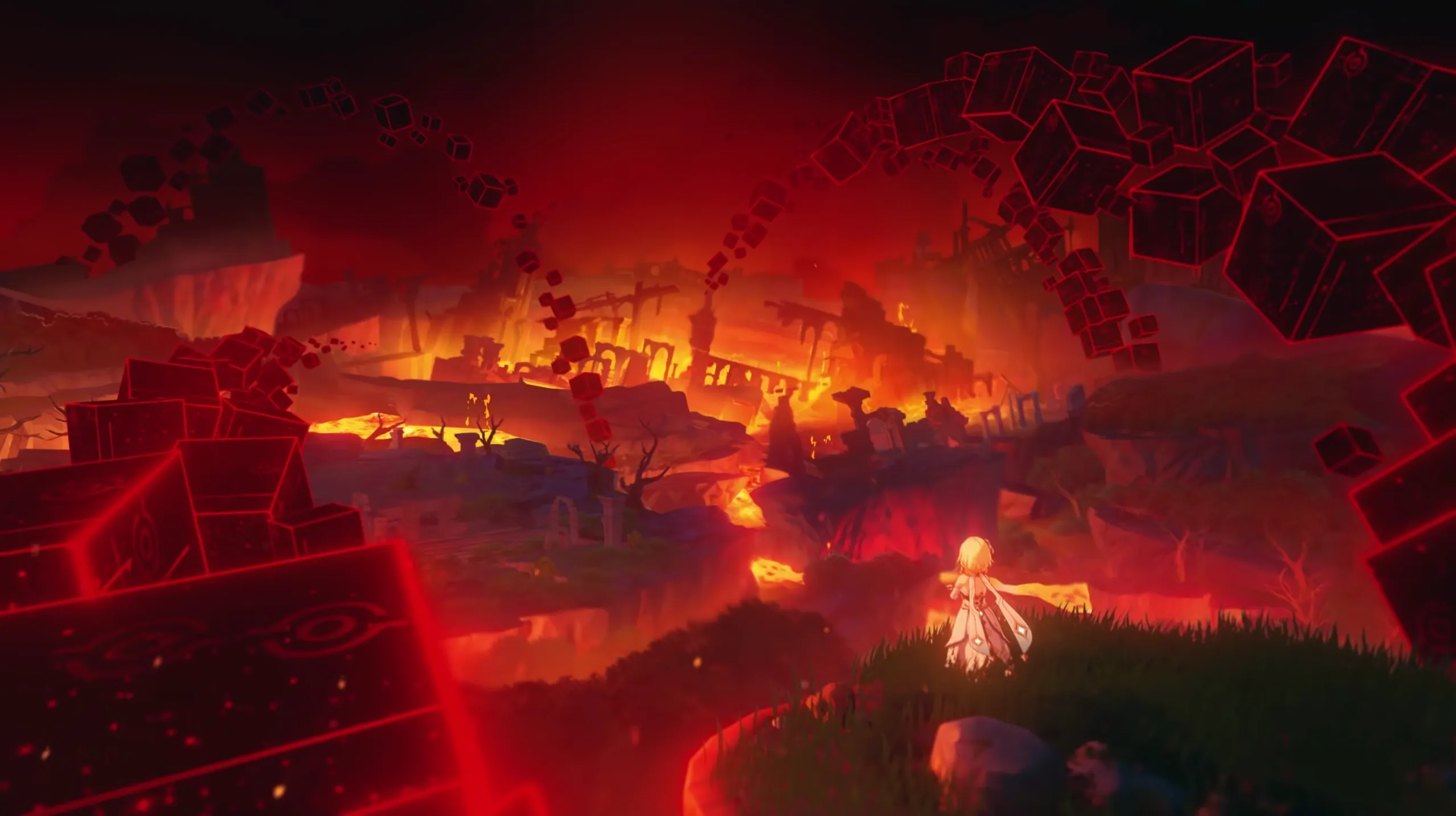
Khaenri'ah (also the Kingdom of Khaenri'ah, or Dahri) was the subterranean civilization destroyed during the Cataclysm 500 years ago. It sat deep underground near Sumeru, entered through a sealed stone gate beneath the Hangeh Afrasiyab workshop, and it was godless in the plain sense of the word. It never had a god to begin with; this was not a nation whose god had died or abandoned them. In Dainsleif's words in Travail, it was "the pride of humankind," a powerful nation built purely by humans that flourished on an unprecedented scale without divine sponsorship. [1]
Khaenri'ah's national flower is the Inteyvat; its motto is "The land is not to be tilled with farming tools, but rather to be fought for with steel and blood" (echoing Bismarck's Blood and Iron). Its astrologers used the Sea of Stars reflections in the subterranean lakes to read the true cosmological future, and predicted the arrival of the Traveler and their Sibling in Teyvat well before the AQ Prologue. [1]
HoYoverse's official Version 7.0 Special Program adds a direct lineage statement: "all Khaenri'ahns are descendants of the Tsaritsa." The source does not explain whether this is ordinary genealogy, a founding act, a supernatural lineage, or another relationship, so it should not be used to invent a mechanism or collapse Khaenri'ah's two dynasties into one family tree. [19]
Chapter VII Act IV (Version 7.1) supplies the in-game version. Rhinedottir greets the Tsaritsa as "Mother of Khaenri'ah" and says all Khaenri'ahns descend from "a bloodline that began with you and the Third Descender." She adds that the Third Descender bargained for the Heavenly Principles never to harm his descendants. The Tsaritsa says she has no memory of this. The account still gives no genealogy and does not relate the bloodline to the two dynasties. [20]
The civilization fell at the Cataclysm. The Five Sinners' theft of Abyssal power triggered Ronova's curse on full-blooded Khaenri'ahns. The Heavenly Principles then intervened directly, summoning the Seven Archons (except Rukkhadevata) to Khaenri'ah. Egeria was slain at Tunigi Hollow, Ei witnessed Mavuika's Pyro-scorched battlefield on the level of Musoujin Gorge, and the civilization was destroyed. Four lineages came out of it (the Alberich regents, the Fatui, the Abyss Order, and the scattered cursed survivors), and each carries a different response to that destruction. By Version 6.6 all four are on-screen at once for the first time.
For the full narrative of the Cataclysm, the cosmological reasons behind it, and the four lineages that came after, see Khaenri'ah, the Cataclysm, and 500 years after.
The two dynasties
Dynasty | Era | Tradition | Pupil evidence |
|---|---|---|---|
Older; the original Khaenri'ahn ruling line | Art of Khemia (life-creation alchemy) + Beastmaster Knights | Red X-shaped pupils within black irises | |
Eclipse Dynasty | Later; supplanted Crimson Moon; ended at the Cataclysm | Mechanical engineering + forbidden-knowledge research | No exclusive pupil marker is securely established; four-pointed-star pupils mark a strong Khaenri'ahn bloodline generally, not Eclipse descent by themselves |
The transition from Crimson Moon to Eclipse was a cultural shift. The Art of Khemia and the Beastmaster Knights, mainstays of the earlier dynasty, were eclipsed (so to speak) by the Eclipse Dynasty's interest in mechanical engineering. The Art of Khemia "fell behind" but did not disappear; Rhinedottir's practice late in the Eclipse era is the last great expression of the Crimson Moon tradition to survive into the Eclipse era. [11]
Irmin, the last Vinster King of the Eclipse Dynasty, viewed the Crimson Moon Dynasty's lineage as a threat to his rule and ordered all surviving Crimson Moon descendants killed, including young and distant relatives. Tholindis was on his hit-list because of her Crimson Moon lineage. Her fiancé Rerir was originally tasked with eliminating her; this turned him against Irmin's directives and became one of the immediate triggers for the rescue raid that made the Sinners. [2]
The Crimson Moon era is also when the original House of the Hearth was founded. Per Perinheri Vol. 1 and Arlecchino's Character Story 5, a sage of that era suggested to the then-ruler that an organisation be established to house children who came from beyond this world, in the hope that one such child might have the power to transcend the gods. The ruler gave implicit permission, and the organisation took in Khaenri'ahn orphans from all walks of life. Perinheri (an outlander) and the alleged Liyue-born Angelica are among its named pre-Cataclysm members. Pierro implies, in Arlecchino's Character Story 5, that this organisation is the original form of the modern House of the Hearth, its line of descent running from the Crimson Moon Dynasty through the Eclipse Dynasty and the Cataclysm into the present-day Fatui-aligned House he now oversees. [11] Arlecchino, the current Knave, is herself a Crimson Moon Dynasty descendant, and her Balemoon Bloodfire curse is the named combat power that runs in that bloodline, drawing on Abyssal energy.
Four-pointed-star pupils appear in the designs of several characters with strong Khaenri'ahn blood, including Dainsleif, Kaeya, Halfdan, Chlothar Alberich, and Pierro. They establish Khaenri'ahn heritage but do not, by themselves, prove descent from the Eclipse Dynasty. Red X-shaped pupils within black irises remain the specific visual marker associated with Crimson Moon descent.
Institutional structure
Institution | Role |
|---|---|
Court of Khaenri'ah | Royal court; where Irmin resided; the political-administrative seat of the Eclipse Dynasty |
Research institute; pre-Cataclysm hub for Khaenri'ahn alchemy + forbidden-knowledge research; the Seven-Shifting Serpent technique (used by Skirk to disguise Abyssal power so it presents as Cryo; per Surtalogi) originated here | |
The Schwanenritter | Military order led by a Knight Marshal ("swan knights"); Anfortas was the Knight Marshal who declared himself Regent when Irmin was left "indisposed" after the rescue raid |
The Black Serpents | Royal guards; the most-elite Khaenri'ahn military formation. Black Serpents and Shadowy Husks are both tied to Khaenri'ahn guard history, but released primary text does not map the whole corps, one to one, onto forms they took after the Cataclysm. |
The Alberich Clan | Pre-Cataclysm aristocratic family; became Regents of Khaenri'ah after the Cataclysm; Kaeya is descended from this clan (unclear why he is unaffected by the curse). Per the Alberich Clan teachings Kaeya secretly keeps: "it was the Alberich Clan, who did not have royal blood, who stepped in as regents when the strength of the one-eyed king Irmin failed" |
The Four Pillars of Khaenri'ah
Under Irmin's reign, four individuals were known as the Four Pillars of Khaenri'ah, presumably for their status and contributions to the kingdom. The Four Pillars are distinct from the Five Sinners (Rerir was not a Pillar; he was the fifth figure who joined the rescue raid). Only Hroptatyr is confirmed on-screen by his Pillar title; the other three are most likely Rhinedottir, Surtalogi, and Vedrfolnir, his associates in the Sinner era. [1]
Pillar | Title | Eclipse-era role |
|---|---|---|
Hroptatyr | "The Wise" | Confirmed Pillar; trusted by Irmin (per Irmin Fandom Story section); a pre-Cataclysm political and administrative figure. Per Pierro in Chapter VII Act IV, Universitas Magistrorum research "under Hroptatyr's leadership" focused on the Crimson Moon, and he left Teyvat after the Cataclysm to "merge with the Abyss" [20] |
Rhinedottir | "Gold" | Alchemist; sole pre-Cataclysm practitioner of the Art of Khemia after the Crimson Moon era's succession; Albedo's creator |
Surtalogi | "The Foul" | Knight of the Black Serpent Bladework; later Skirk's master; trained by Haden alongside Dainsleif |
Vedrfolnir | "The Visionary" | Prophet whose warning to Irmin led Irmin to imprison him as punishment (eyes gouged out; thrown into a decrepit cell); Dainsleif's elder brother |
The fifth figure who became one of the Five Sinners at the rescue raid was Rerir ("Rächer of Solnari"), Tholindis's former fiancé, originally tasked with her assassination and later a Wild Hunt commander in Nod-Krai. The five Sinners are the Four Pillars plus Rerir. The Pillars were the kingdom's administrative class before the raid; the Sinners are the same people after it, now holding stolen Abyssal authority.
Dainsleif (Vedrfolnir's younger brother; Royal Guard Captain at the time of the raid) convened the rescue operation but was not himself a Sinner; he was the only participant who declined a share of the Abyssal power. He is now the Bough Keeper, a cursed Khaenri'ahn who investigates across present-day Teyvat. After the raid came Irmin's death, Anfortas's regency and then the Cataclysm, in rapid succession.
Cultural traits
Obsession with mimesis. Khaenri'ah's defining cultural trait was the ambition to replicate and modify natural forms in ways that surpassed the originals, even for powerful elemental beings like dragons and Hypostases. This extended from alchemical creation (Rhinedottir's Durin, modeled on a dragon; Albedo, modeled on a young Mondstadt boy; Subject Two, a failed Primordial Human Project iteration) to mechanical replication (Ruin Machines as "Field Tillers," automated weapons of war). [1]
Art of Khemia. Advanced alchemy specialising in the creation of life itself. It developed during the Crimson Moon Dynasty as a replacement for Khaenri'ah's near-absent natural fauna, then persisted at lower priority through the Eclipse Dynasty. The only known practitioners are Rhinedottir and Albedo, her successful synthetic-human creation. Its link to Naberius's authority as Ruler of Life among the Four Shades (per the Paralogism disclosure that Rhinedottir devoured the Heart of Naberius) hints that the Art may always have brushed up against a Shade's power. Rhinedottir's discovery and consumption of the Heart reads as the logical end point of an art built around mimicking life itself.
Black Serpent Bladework. The traditional martial form of Khaenri'ah, taught by Haden to both Dainsleif and Surtalogi. The Seven-Shifting Serpent technique (Universitas Magistrorum) is the Khaenri'ahn method for using Abyssal power to mimic Teyvat's elemental energy. It is how Skirk's Abyssal authority presents as Cryo on the surface of Teyvat (per the Surtalogi page).
Ruin Machines. Khaenri'ahn automatons, built as weapons of war. Ruin Guards are the most common type (codenamed "Field Tillers" per the Khaenri'ahn military motto). After the Cataclysm they migrated across Teyvat, and they now gravitate to ancient ruins (Mondstadt's Dragonspine, Liyue's Guili Plains, Sumeru's desert, Nod-Krai's frostmoon regions). They are still dangerous but no longer serve a planned purpose.
Subterranean astrology. Khaenri'ahn astrologers used the Sea of Stars reflections in the subterranean lakes (through the Sign of Apaosha ritual) to read the true stars rather than the stars of the false sky. The spatial fabric in those areas was "comparatively unstable," which made non-physical attempts to break through the firmament more likely to succeed. The Crimson Moon Dynasty's astrologists "glimpsed in the inverted image of the false sky the origin of all the world's fate," which (per the Crimson Moon's Semblance weapon description) is implicated in the fall of the Crimson Moon Dynasty itself. [1]
Khaenri'ah's machines and the urge to outdo nature
Khaenri'ah's engineering ran on an obsession with mimesis. Per the Chaos Bolt material text, the Khaenri'ahns were "obsessed with the idea of mimesis," biomimesis in particular, building machines on the belief that any natural form could be copied in a way that surpassed the original, making superior beings that could "replace the continuously decaying and shattering order." [14] That belief drove the mechanical engineering of the Eclipse era, including the Ruin Machines below. It also sat right beside the Crimson Moon era's Art of Khemia, in which Rhinedottir's Durin and Albedo are the alchemical version of the same idea. The "continuously decaying and shattering order" the phrase names is the Teyvat that the Heavenly Principles had forbidden Khaenri'ah's godless civilisation from rising above. Some of that engineering outlived the kingdom: in Chapter VII Act VI Ei says of the Raiden Shogun puppet she designed, "There was a limit to how much Khaenri'ah'n technology I could uncover, so there are areas where I had to resort to bespoke solutions." [22]
The Ruin Machines. For the full taxonomy and how they operate after the Cataclysm, see Ruin Machines. They split into three elite sub-groups, a set of bosses, and the Ruin Golems: [13]
- Humanoid Ruin Machines: Ruin Guard (Field Tiller production unit; homing missiles and powerful arms), Ruin Hunter (propellers in place of legs; ranged missile barrages and a Pyro beam, the only elementally aligned attack among the Humanoids), Ruin Grader (giant variant; silent in combat, where the other two speak an untranslated Khaenri'ahn machine language).
- Ruin Sentinels: Cruiser (honeybee-themed), Destroyer (Regisvine-themed), Defender (insect-themed), Scout (jellyfish-themed); found almost exclusively in Inazuma and brought into Enkanomiya by the people of Khaenri'ah.
- Ruin Drakes: Earthguard (armless and bipedal, mimicking a Vishap) and Skywatch (airborne winged variant). They have a greater elemental "counteract" capacity than the Vishaps they mimic, which makes them the clearest on-screen example of Khaenri'ahn biomimesis exceeding the natural original.
- Bosses: Perpetual Mechanical Array (a unit of four Sentinels that mimics a Hypostasis), Ruin Serpent (mimics Setekh Wenut; resides in the Chasm), Aeonblight Drake (Earthguard and Skywatch functions combined).
- Ruin Golems / Mechanical Wardens: massive Khaenri'ahn constructs, known in the local Khaenri'ahn lexicon as Mechanical Wardens. Unlike the self-directed machines, these were crewed military vehicles manned by the Schwanenritter. Four units are known: Devantaka Mountain (Sumeru), Valley of Dahri and Desert of Hadramaveth (Great Red Sand), plus an incomplete prototype within Madinat al-Nuhas.
"Field Tiller" is the original Khaenri'ahn designation for Ruin Guards. Per Dainsleif in A Herald Without Adherents: "The land is not to be tilled with farming tools, but rather to be fought for with steel and blood. - This is how the 'Field Tiller' came about." [13] The motto sets down the Khaenri'ahn ethos as anti-agricultural. The "tiller" image keeps the irony intact by naming a war machine after the farming tool that ethos rejected, so "Field Tiller" reads as a philosophical statement rather than a functional designation. The first Field Tiller at Stormterror's Lair is the prototype that all later Ruin Guards replicate at reduced combat capability (per Dainsleif in A Soul Set Apart: "All of the Ruin Guards today are just replicas of this machine. As the prototype, its combat capability was unrestricted."). After the Cataclysm the Field Tillers wandered Teyvat for centuries and, per the Chaos Oculus material text, were renamed "Ruin Machines" through mistaken identity; the modern name is the wrong one, and "Field Tiller" is the Khaenri'ahn original.
Primal Constructs are not Khaenri'ahn. Per the in-game Tutorial card: "These ancient machines, which come from the desert, are quite distinct from the Ruin Machines." Primal Constructs are King Deshret's technology from before the Archon War, engineering of the Sumeru desert aimed at "rebirthing the paradise the foolish desert ruler dreamed of" (per the Repulsor description), not Khaenri'ahn biomimesis. The two share the in-game Automatons super-family tag but come from entirely different civilizations and engineering traditions. Fontaine's Clockwork Meka (Arkhe-powered Fontainan engineering after Egeria) and ancient Natlan's Secret Source Automatons (Phlogiston-powered work of ancient Natlan) are likewise separate members of that super-family. Khaenri'ah's Ruin Machines are one of four distinct families the in-game taxonomy collapses into a single gameplay tag. [13]
The Hyperborean era came long before Khaenri'ah
Khaenri'ah's two dynasties are not the oldest history preserved by the far north. The Voyager-apostle Seutervoinen is associated with Hyperborea's Mekhaneikos constructs and Light Realm Energy, while Hymns of the Far North separately preserves Saarelainen's seven-piece fate. Sharing a compiled hymn corpus does not give Saarelainen an exact date or prove contemporaneity. [15]
Hymns says Saarelainen was carved into seven pieces; Skirk separately says the Gnoses use the Third Descender's remains. The parallel makes Saarelainen the strongly implied candidate, but no primary line explicitly identifies him, calls him a god, or dates him. The Gnoses were created after the War of Funerary Flame and before the Archon War. Only the player-character Traveler is named Fourth; the Sibling remains unclassified. [15]
Two things follow.
- The hymn's subjects are not automatically Khaenri'ahn, contemporaneous, or members of one category. Saarelainen's exact era and status remain unstated.
- Khaenri'ah's forbidden-knowledge programme came long after the Gnoses and Archon system, which predate the Archon War rather than the Cataclysm. [15]
A similar distinction holds for the Sovereigns. Per the deep dive on Apep and the Dendro Sovereign lineage, Apep is both the Dendro Sovereign and the 7th Pillar of King Deshret, the two roles agreeing at the Heart of Oasis. That is a different order of being from the Khaenri'ahn humans the mimesis programme served. Khaenri'ah set out to copy natural forms (dragons, Hypostases, Vishaps) and surpass them, not to become a Sovereign itself. This is a side note to Khaenri'ah's story, but it supports the reading that the kingdom's "transcendence" worked at the human level, not at the Sovereign level described in the lore of the Heart of Oasis. [16]
The Cataclysm - what happened to Khaenri'ah
The Cataclysm proceeded in three rapid stages:
- The Sinners' rescue raid and Irmin's fall. Dainsleif convened Rhinedottir, Rerir, Surtalogi, and Hroptatyr to free his imprisoned brother Vedrfolnir. They breached the palace and the operation succeeded, but the five took a one-sixth share each of the "world-shattering" Abyssal power Irmin had induced the Sibling to absorb. Each became a "transcendent being." The text implies Irmin was killed during the raid. Anfortas declared himself Regent. [3]
- Ronova's curse and the Heavenly Principles' intervention. Per Capitano (AQ V Act V "When All Becomes a Monument"), the Sinners' particular exploitation of Abyssal power is what caused Ronova to curse full-blooded Khaenri'ahns with immortality. Ronova made no distinction, and the curse applied to all full-bloods regardless of involvement. The Heavenly Principles then intervened directly. The Seven Archons (except Rukkhadevata) were summoned to Khaenri'ah; Egeria was slain at Tunigi Hollow in an effort to suppress the defilement seeping from Khaenri'ah; Mavuika scorched Khaenri'ah on the level of Musoujin Gorge (per Ei's "About Haborym" voiceover); the kingdom was destroyed. [5] [8] [9] Five hundred years later, the Tsaritsa opens the leaders' meeting in Chapter VII Act V with "The last gathering of The Seven was in Khaenri'ah, during the cataclysm." [21]
- The curse of the wilderness for people whose ancestry belonged to the domains of other gods. Per Eide's disclosure in AQ III V "Caribert," the curse turned them into monsters as they fled. Caribert, who became a hilichurl, is the case named in primary text. The text does not assign every Abyss Mage, Herald, Lector, Shadowy Husk, or Black Serpent form to people of this ancestry, nor does it establish a blood-based hierarchy among those enemy classes. [4] In Chapter VII Act VI, when hilichurls on Dragonspine build fortifications in response to voices the Hallowing has stirred up, the Traveler asks whether it is "Because of... Khaenri'ah?" Venti answers, "Exactly. It was a different era, a different civilization, but the fact remains... They were once human, too." He does not say what ancestry those hilichurls had. [22]
Khaenri'ahn soldiers who fought the Abyss abroad
Not every Khaenri'ahn soldier was an instigator of the Abyss. One case surfaces in Natlan's Shadows of the Mountains series, in the resolution chain Peace to the Slumbering. Two named Khaenri'ahn soldiers, Zephaniah ("Warrior Who Cleaved the Dark Tide") and Irizar, worked with the Natlan Children of Echoes tribe under Elder Traore to seal an Abyss outpouring at the Sulfurous Veins / Tequemecan Valley site. They used a sealing pillar made of an Iridescent Inscription on a Solid Phlogiston Nail, and were themselves sealed alongside the Abyss through centuries of torment until the Outlander's intervention let them rest in the Night Kingdom. [18] The pair cut against the usual picture of Khaenri'ahn survivors as uniformly instigators of the Abyss. They are Khaenri'ahn soldiers who fought the Abyss far from the siege of their home nation. Traore's Boundary Marker Inscription restores their name as "brother-kin of the Children of Echoes" against the slander of the tribe's ghost stories, which the soldiers themselves had preferred as a way of keeping the tribe wary. [17]
The quest is careful here. It does not extend this to all Khaenri'ahn soldiers, nor does it touch the wider question of Khaenri'ah and the Abyss Order. Irizar's line, "your orders have been carried out... you won't be disappointed...," implies a Khaenri'ahn military superior the chain never names. Zephaniah and Irizar are distinct from the Five Sinners and from the Four Pillars described above; they are rank-and-file soldiers whose pre-Cataclysm posting (Eclipse-era Black Serpents, Schwanenritter, or some separate field unit) is left unspecified. The chain leaves the Crimson Moon and Eclipse Dynasty naming untouched and does not place either soldier in either dynasty's line.
The four lineages that survived
Four lineages came through the Cataclysm, each on a different path:
Lineage | Founder / leader | What they do now |
|---|---|---|
The Alberich Clan as Regents | Chlothar Alberich (pre-Cataclysm) + Kaeya (present-day descendant) | Inherited the regency after Irmin; Chlothar founded the Abyss Order at some point after the Cataclysm; Kaeya serves as a Mondstadt Knights of Favonius officer with cursed-Khaenri'ahn heritage. The Clan holds the regent authority, but the old apparatus has fragmented. |
The Fatui | Pierro (Khaenri'ahn royal mage and immortality-cursed survivor; founding member and unnumbered Director) | The Tsaritsa's machine for recruiting Khaenri'ahn survivors and collecting all seven Gnoses, carrying forward the Belyi Tsar's Rauthvangi-influenced plan to rebel against Celestia and build "Elysium." Commander Thrain (Capitano) remains First by rank but cannot participate after Natlan. [10] [6] [7] |
The Abyss Order | Chlothar Alberich (founder); the Traveler's Sibling (operational leader) | A Khaenri'ah-rooted coalition that also fields Abyssal beings and hilichurls. Per Dainsleif and the Sibling, its goal is to revive Khaenri'ah and destroy the nations under the Seven. The pre-transformation ancestry of its Mage, Herald, Lector, Husk, and Black Serpent classes is not securely mapped in primary text. |
Cursed individuals | Dainsleif (Bough Keeper; pure-blooded; the only one in the rescue raid who declined an Abyssal-power share); various unnamed cursed survivors | Stand outside any faction. Dainsleif investigates Cataclysm-related mysteries across present-day Teyvat, and is the clearest counter-evidence to "all Khaenri'ahns are Abyss Order": some pure-bloods stay unaligned. |
What canon has not surfaced
- The cause of the Crimson Moon Dynasty's fall. The Eclipse Dynasty supplanted it under circumstances that involved the Crimson Moon astrologists' "glimpse" into the cosmology of the inverted false sky, but the mechanism is held back.
- Why Kaeya is unaffected by the curse of immortality. Per Caribert and the Iaculum Pulchrae Chapter, Kaeya is a pure-blooded Khaenri'ahn and yet ages normally. His four-pointed-star pupils mark strong Khaenri'ahn blood but do not prove descent from the Eclipse Dynasty; how he escapes the curse remains unrevealed.
- The Sibling's specific project as leader of the Abyss Order. "Revive Khaenri'ah" is the surface goal. Chapter VII Acts I-VI add only a piece of the Sibling's past (Pierro says Hroptatyr summoned them at the same moment Pierro summoned Paimon from Celestia) and, at the end of Act VI, one line that Fandom's transcription gives to the Traveler's sibling, though the dialogue record labels it "Traveler": "I have already traveled through this world once. Once you reach the end of your journey as I did, you will see for yourself the true nature of this world." The Traveler then thinks, "All of a sudden, Teyvat is to me what Khaenri'ah is to her/him..." None of this discloses the operational steps, what the Sibling believes that "true nature" to be, or what they intend the post-revival state to look like; those questions remain for later Chapter VII acts or beyond. [20] [22] [23]
- The relationship between the Crimson Moon Dynasty and the Three Moons cosmology. The "Crimson Moon" name, the divination tradition of the inverted false sky, and the circumstances of the Eclipse Dynasty's rise all point toward a Nibelung-era cosmology underneath, but the link is not confirmed on-screen.
- What Anfortas's regency produced. Bulletin-style disclosures and the Schwanenritter material exist, but the period after Irmin and before the Cataclysm is mostly off-screen.
- Whether the four Pillars knew Vedrfolnir's prophecy. Surtalogi treated Vedrfolnir's prophecies as binding (per the account that he took Skirk as his disciple because of a prophecy). In Chapter VII Act IV a prism memory of the young Hroptatyr repeats a prediction that "a blond-haired crowned heir will answer his call," which Pierro attributes to Vedrfolnir; beyond that, what the Pillars knew and shared before the rescue is held back. [20]
Put casually, Khaenri'ah was the underground kingdom of humans who tried to build civilization without gods. They almost did it. Then one of their kings got greedy with Abyssal power, four of his lieutenants stole it for themselves, the gods destroyed the whole nation and cursed the survivors, and the descendants are still working out what to do about it 500 years later. Chapter VII begins to explain the Fatui's side through Pierro, and Act IV traces Khaenri'ah's bloodline to the Tsaritsa and the Third Descender, but the four-lineage aftermath is still unresolved.
Deep dive
Khaenri'ah, the Cataclysm, and 500 years after is the deep-dive essay on how the Cataclysm worked, the cosmological reasons behind it, the four lineages after it, the Caribert disclosure, and how it all converges in the present. The Five Sinners, how the Abyssal power was shared out after the raid, and the connection between Skirk, Surtalogi and the Sinners sit on Surtalogi; the Heart of Naberius and the Naberius-Rhinedottir fusion on Paralogism Interlude; and the Four Shades' post-Khaenri'ah trajectories (Naberius captive within Rhinedottir, Ronova as curse-deployer, Asmoday absent and read by Fandom as defected, Istaroth withdrawn) on Four Shades. [24] The Tsaritsa's inherited plan to rebel against Celestia and the Fatui's apparatus for collecting Gnoses are covered under Seven Archons, Celestia's place under Celestia, and the broader cosmology Khaenri'ah stood against under Heavenly Principles and The Abyss.