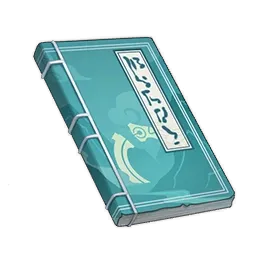
Springs of Hidden Jade is a 2-volume Liyue Book Collection released in Version 5.2, sold at the Wanwen Bookhouse in Liyue Harbor. Its two volumes share a single epigraph ("What kind of passerby will the young man, lost in a secluded bamboo grove, meet along his way?") and stage the encounter of an unnamed young cultivator with a slender, platinum-haired adeptal woman. Her amber-gold eyes are the only part of her appearance that stays the same however else the book frames her. The frame is folk legend, and it is among the more allusive cosmological hints in the Liyue Book corpus. [1]
Vol. 1: the bamboo-grove encounter
The young man, "come to this valley of hidden jade to cultivate his arts," wakes at dawn to "a pair of eyes, sparkling like amber gold" leaning over him: "a slender, golden-eyed woman… her long platinum hair flowing over her shoulder," white cotton robe, pearly raincoat and hat, voice "like jade that falls into a clear spring." She has wandered through the same bamboo wood by night and "unexpectedly encountered" him, an adeptus passing through. Her telling carries him past the moon's rise and fall: she takes him "on a tour of secluded abodes where adepti dwelled… to watch an unfinished game of chess; to the bottom of a clear river, exploring the court of deceased deities; up steep cliffs that overlooked the desolated cities left behind by the mountain tribes," and, when "silver butterflies glittered in the moonlight," together they "danced like the ancestral mages who revered the serpent, accompanying the demons and gods of the mountain in falling into deep slumber only when the cicadas had fallen silent." When he wonders aloud that mortals bind themselves to "individual points in the past and forever seek their echoes," she answers with a sly slit-eyed smile: "You do think highly of yourself. Alas, I may forget you in but a moment… We adepti really are heartless like that. But since you'd like to know, I'll tell you." [1]
Vol. 2: the story she gives him
Vol. 2 is the cosmologically dense volume. Mortals see time "as an eternal river of blood… rushing along its fixed paths… toward distant, silent death," but in her eyes time is "a barren wasteland with neither beginning nor end, blanketed in spider-silk threads… even the mighty mountains, so fixed in mortal sight, may dissipate like rolling clouds in hers." She is given three names in three peoples' mouths, none of them her own. "The mountain people once viewed her as time's daughter, like a white horse leaping from a pure spring." "The shepherds of the plains once pursued her steps," and her flying golden-white mane "blazed the trail for all herds in the land." "The kingdom of the ocean depths once saw her as an emissary, and based on their imagination, they granted her scales and tail plumage, falling down in worship of the light brought by one who was both mother and daughter." All three peoples and the kingdom are left unnamed in primary text. [1]
Then "the moon palace collapsed, the chariot fell, and the three sisters were slain", and "these legends became lost alongside disaster's descent and the downfall of bygone peoples. The heavens rained down cruel order, and from that day, the stars stilled their orbits, and the earth ceased to turn." She is "trapped within the shell of the starry sky, forced to tarry within this stagnant, foreign land, awaiting her mother's thousand threads, awaiting the erosion of hardy stone, awaiting the next encounter from beyond…" The fragment sits close to the Three Moons material found in Records of Jueyun Vol. 4 ("the three sisters of the Lunar Palace" seelie oath) and Moonlit Bamboo Forest Vol. 3 ("the world was smashed against the tides of great calamity"). But the volume itself names neither the moon palace as the Lunar Palace nor the three sisters as Sonnet / Canon / Aria, and the "heavens" that "rained down cruel order" go unnamed. The parallel with the intervention of the Heavenly Principles is drawn by the reader, not the book. [4]
The parting and the closing image
She wakes him gently and says only that she has answered his question. He asks for her name and where she comes from, and she "only laughed, saying nothing more. Sighing, the young man nodded to her, bidding her farewell." The closing image is hint and refusal at once: "Many years later, the young man, now old and grey, recalled this moment by chance. By then, he had honed his swordplay to flow like water, founded his own sect, and became a teacher - and still, he never could comprehend the final story she told him. And as for her, she sprints still along the threads of fate, concealing her trail beneath the forests and springs, far from the gaze of the gods, guarding the ancient stories that slip away from even her." The young man's sect and the gods from whose gaze she conceals herself are both unnamed.
A mirror of Moonlit Bamboo Forest
Springs of Hidden Jade pairs with Moonlit Bamboo Forest. In both Liyue bamboo-grove books an unnamed adeptal woman recounts a fragment of cosmology from before the adepti to an unnamed young man and parts from him at dawn. The two take different routes that reinforce each other. Moonlit Bamboo Forest names the Geo Archon and the "white horses that would leap from clear springs to become adepti to assist the campaigns of the Lord of Geo". Springs of Hidden Jade never mentions Rex Lapis once. It puts the "white horse leaping from a pure spring" into the mountain people's mouth as a description of "time's daughter", rather than as the path by which adeptal form is bestowed. And it replaces the frame of the Geo Archon and his companions with three peoples (mountain / plains / ocean depths) and three slain sisters (the parallel Three Moon Goddesses, never identified). The book hedges at every level, as the bamboo-grove books do: the adeptus is unnamed; her mother is unnamed; the three peoples are unnamed; the kingdom of the ocean depths is unnamed; the ancestral mages who revered the serpent are unnamed; the heavens that "rained down cruel order" are unnamed; and the young man, who lives a long life and founds a sect and "never could comprehend the final story she told him," is unnamed too. The point of the volume is to keep that silence, not to break it. [1]