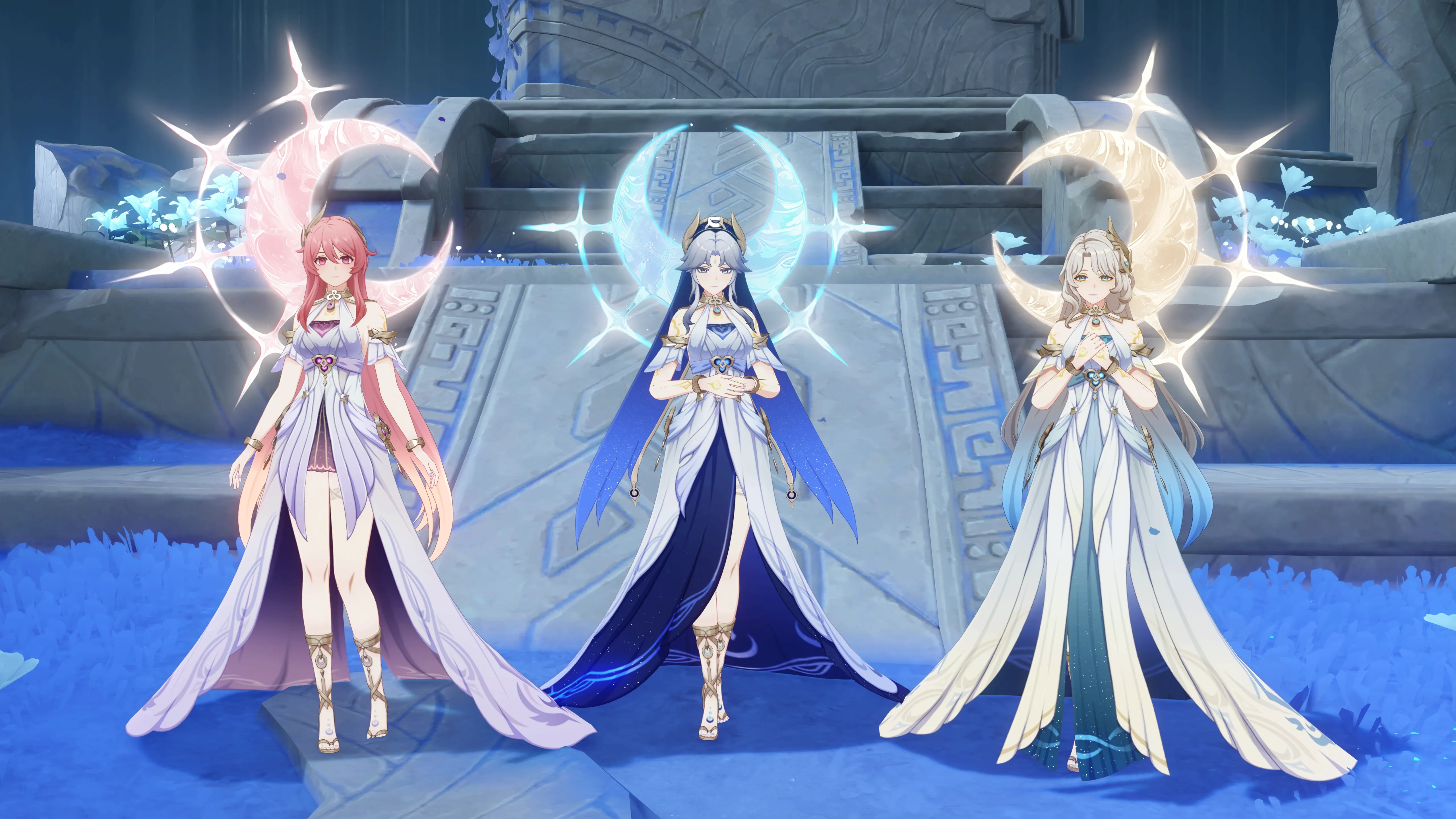
Pre-Cataclysm Teyvat had three moons in its sky, and three goddesses raised over it to keep them. Sonnet's Iridescent Moon and Aria's Eternal Moon were lost. Canon's Frost Moon survived beyond the false sky, was drawn back inside it during Welkin Moon Act VIII, and became permanently explorable in Luna VIII. [2] The old cosmology is no longer only a ruin or memory, since one of its surviving worlds can now be physically reached.
Where the Three Moons came from
Nibelung created them. In the artifact text Deep Gallery's Distant Pact, a voyager from beyond the stars urges the Dragon King, Teyvat's pre-Primordial One ruler, to "Forsake this world, fated for ruin, and journey with me beyond the stars." The text never names her; Fandom identifies her as Anacharsis, whom the Frostmoon Scions call Seutervoinen. He refused to abandon his people and promised to "lead my people onward to the stars." [38] [39] In the words of the weapon Fractured Halo, "The king who sought the world beyond set the moons aloft, to govern the cycles in their stead." [40] [5] The moons are Nibelung's gift, and they governed for some indeterminate era after his departure and before the Primordial One arrived.
He built them with ancient draconic engineering. The Welkin Moon arc establishes that Nibelung raised the moons from Teyvat's planetary crust at modern-day Nod-Krai, using Secret Source technology, the same line of craft behind the Field Tillers and the wider legacy of ruin machines. [26] [29] The moons' geological origin is therefore Nod-Krai itself, the site they were lifted from, long before the layers of cosmology that settled over the region in the post-Cataclysm centuries.
The Moons were powered by kuuvahki, a pre-elemental energy older than the seven elements that organise current Teyvat. [32] Where those seven elements came from is uncertain. Fandom's Seven Sovereigns page has the Sovereigns already holding "the seven elemental Authorities" before the Heavenly Principles came and "partially stole the Authorities." Its Heavenly Principles page instead has the Heavenly Principles repurposing the Light Realm and "diluting its primordial energy into the modern system of seven distinct Elements," and in Natlan Yohualtecuhtin says, "The Heavenly Principles used phlogiston as a basis for the creation of Elemental energy." [44] [45] [46]
Then Nibelung, whom Fandom counts as the Second Descender, came back from the Sea of Stars, bringing the Abyss with him, and weaponised the moons in the war of funerary flame. [33] The Primordial One was wounded, the Sovereigns awakened, and in the collateral damage the moons were shattered or cast away. Sonnet's Iridescent Moon and Aria's Eternal Moon remain absent. Canon's Frost Moon was cast beyond the false sky until Act VIII drew it back inside Teyvat's sky. [24]
The sisters' earlier relationship with the Heavenly Principles' order was more cooperative. When humans began settling the surface, Canon judged that answering them could fulfil Nibelung's mission; Aria tied that judgment to his maxim that life across the sea of stars were allies against the darkness. [21] The Moon Goddesses also had friendly relations with the angels. The Heavenly Principles sent servants to share the sisters' work, and Zibai served as a Lunar Envoy whose help the sisters accepted. [23] [22]
The three goddesses: Sonnet, Canon, Aria
The three moons were three goddesses. The murals in the Hyperborean ruins in Welkin Moon Act VI staged their creation, weaponisation, and deaths, and Act VIII "True Moon" named all three on-screen inside the Lunar Palace before gathering their authority into Columbina. [25] [24]
Sister | Moon | What remains today |
|---|---|---|
Sonnet | Iridescent (smallest; faint halo-producing light); the youngest | Fused with Abyssal power into the Crimson Moon; anchors the Crimson Moon Dynasty Khaenri'ah inherited, the line that traces to Arlecchino. Iridescent Moon Marrow returned to Arlecchino at Act VIII. |
Canon | Frost (brightest); the only moon to survive the shattering intact | Survived beyond the false sky; returned inside it during Act VIII and became explorable in Luna VIII. Canon guided the Hyperborean survivors south before dying. Fandom identifies her with Huurrekuutar, the Frostmoon Scions' Frost Moon goddess; Columbina, their Kuutar, has "the same power as Canon." |
Aria | Eternal (largest); its moonlight formed Teyvat's tides | Its fall threw heaven and earth into chaos; remains rained down as the Moon Marrow kept at Silvermoon Hall. Eternal Moon Marrow returned to Lauma at Act VIII. |
Their authority spanned Life, Death, Time, and Space, the same Trilunar Authority the Four Shades now carry, divided differently. It was near all-powerful, with one telling exception. It does not affect Descenders, which is why Dottore's attempt in Act VI to freeze time with the moons' power failed to lock down the Outlander. [26] Their stance was protective rather than sovereign. They split their power so no one sister grew too strong, and the night sky passed between them, each riding a silver chariot and switching places three times a month.
Chapter VII Act IV puts the split in Arlecchino's words and gives the first allocation. "Long ago, the authorities of Life, Death, Time, and Space all belonged to the moons. Of the three, the Iridescent Moon received the greatest share of the authority of Death." After the moons' demise, she says, the Heavenly Principles reclaimed those authorities and "redistributed them between the Four Shades under a new system of rules." The broken Crimson Moon, though, "merged with the Abyss, which simulated its former authority," so the authority of Death "resides within the Crimson Moon and its people's bloodline." The Fatui build a new Delusion on that inheritance. [36] [37]
Sonnet, the Iridescent Moon, was the youngest, her small moon's faint light producing the fleeting halos that became the iconography of the pre-Cataclysm sky. When the Iridescent Moon shattered, her agony drove her to fuse her soul with Abyssal power to prolong her life. The mix of Light Realm and Abyssal power turned her into the baleful Crimson Moon, origin of the Crimson Moon Dynasty and the bloodline that runs forward into Arlecchino. [26]
Canon, the Frost Moon, is the identity behind Columbina's restored status as Trilune Goddess; the line in the Lunar Palace in Act VIII, "You have the same power as Canon", makes Columbina, as Kuutar, the heir of Canon's line. [24] [27] The Frost Moon is the great exception. Unlike her sisters' moons, it was not destroyed outright. It remained beyond the false sky until the Act VIII world-formula drew it back within Teyvat's sky. [2] Canon survived long enough to guide the survivors of Hyperborea south to Hiisi Island before dying from Teyvat's rejection. The bloodline traits of the Frostmoon Scions (kuuvahki sensitivity, animal communication, silver blood, white antlers) are her hereditary gift to those survivors, who took the name Frostmoon Scions in her honour. [31]
Aria, the Eternal Moon, was the largest, and its immense moonlight formed Teyvat's ocean tides. When it fell, some of its remains rained down like stardust and gathered into the Moon Marrow the Frostmoon Scions have kept at Silvermoon Hall as a sacred relic ever since. The distribution in Act VIII's Welkin Moon's Homecoming confirms that the Marrow Columbina recovers from Dottore and returns to Lauma is the Eternal Moon Marrow. [24]
The deeper, scene-by-scene treatment of the three deaths and the war of funerary flame lives in the deep dive on the moons and the failed fourth.
The Frost Moon as a place
Version 6.7 turns the surviving moon into a permanent region reached through Moon Gazing. [1] Its mapped areas are Lunar Highlands, Moontide Sea, and Dark Side of the Moon. The Traveler's old spaceship, previously visited during Welkin Moon's Homecoming, can be reached again at Traveler's Crater. [2] [4]
The ruins show that dragons used the moon as a research settlement before the Heavenly Principles arrived. Near-side facilities studied life, signals, and the moon's creation power. The far hemisphere was later converted into a weapon complex by a figure the Traveler cautiously identifies as probably Nibelung after his return. The qualifier matters. The records use "Dragon Lord of Darkness," and the identification with Nibelung is the Traveler's inference. [4]
Two Ancient Moon's Remnants organize Luna VIII exploration. The Nuur Stone Circle node covers Dunanna Pit and Lunar Highlands; the Curtain-Form Blackbody Containment Lab node covers Moontide Sea and Dark Side of the Moon. Origin of the Sequence and Beneath the Lunar Sea unlock them for Luna Sigil upgrades. They are research and reputation nodes, not confirmed literal fragments of a moon. [1]
Kuutar - the Moon Goddess who became a Harbinger, then the Trilune Goddess
Kuutar is the Frostmoon Scions' name for Columbina, the former Third Fatui Harbinger and, since the Welkin Moon arc, the Trilune Goddess. [9] Five hundred years ago she was born from the residual Frost Moon matter on Hiisi Island. Huurrekuutar is not a link between her and Canon. The prayer to "Huurrekuutar, Goddess of the Frost Moon" in Hymns of the Far North Vol. 3 addresses the goddess Fandom identifies as Canon herself. [41] The Frostmoon Scions had been worshipping her as a moon goddess for centuries before the Fatui existed, so the being embedded in the Tsaritsa's apparatus pre-dates that apparatus by an order of magnitude. [26]
Act VIII "True Moon" settles the category question. After Dottore captured her and she entered a Moon Gate to deny him the moons' powers, Columbina was transported to the Lunar Palace, where time flows backwards and where the three sisters had been confined since the war of funerary flame. The transfer cost the sisters their authority and their immortality, and it required Columbina to split her being three ways (soul, body, and Trilunar Authority), with her body spread across Nod-Krai in the past as the kuuvahki that saturates the region today. [24] [32] The restored Columbina is now the single embodiment of the authorities of all three Moon Sisters.
The spreading of her body gives a second reason why Nod-Krai is strange. It is both the site the moons were lifted from and the site into which the Trilune Goddess's body was later poured back. Her hold over the other Harbingers, every named one of whom refused to fight her during her tenure, fits a being who is not really a mortal Harbinger. She had already left the Fatui when the Traveler met her in Act I. After the arc's capstone the Tsaritsa revoked the Palestar Edict issued to recover her, and she now resides at Silvermoon Hall on Hiisi Island, back with the Frostmoon Scions on her own terms. [42] [24]
The identification of Kuutar with Columbina also appears in the Selenic Chronicles Reputation system at Silvermoon Hall. In The Artist By the Moon's Side (I) (Part I, Luna I 6.0), the kuuhenki painter Maalaus's historical canvases are glossed by Paimon as "the Frostmoon Scions worshipping Columbina as their goddess," and Lauma's record-keeping is cited in the same scene: "Lauma said your birth was recorded by the Frostmoon Scions." The system spans both the time before Act V in the Damselette's parlour (Parts I-II) and the time after Act VIII, when she is the Trilune Goddess (Part III). The parlour's audience is the kuuhenki, not the Frostmoon Scions; Maalaus's canvases are records made by the kuuhenki about the Frostmoon Scions' devotion. [18] [34]
Nod-Krai and the failed fourth moon
The simplest account of why Nod-Krai is different is the one above about the planetary crust. It is the ground the moons were lifted from, and the ground into which Columbina's body was poured back as kuuvahki. That alone explains the region's strangeness. [26]
Alongside it runs the wiki's most distinctive interpretive reading, that Nephilheim is the remnant of a failed fourth moon. On this reading, after the three moons fell, someone attempted a fourth moon; the attempt failed, and the crater of that failure persists in northern Teyvat as the region called Nephilheim, now Nod-Krai. [7] The primary citations the Nephilheim page leans on (Ineffa's "Moon Wheel" character story and NPC Kofitse dialogue) establish only that Nephilheim is the pre-Snezhnayan name of the region, and that groups aligned with Natlan's Sovereign call the Three Moons "the traitors" and the Heavenly Principles "the usurper." They do not state that a fourth moon was attempted or that Nod-Krai is its crater. [30] Treat the failed-fourth idea as a community reading, not primary-text doctrine.
Either way, the region behaves like a remnant:
- It has access to kuuvahki the rest of Teyvat doesn't, a pocket of the pre-elemental energy preserved where the moons were raised.
- Lunar Reactions entered the story alongside the Luna arc, but current sources do not establish that the whole family is simply kuuvahki converted into the seven elements. Their relation to the old moon system remains incomplete. [11]
- The Wild Hunt, an Abyssal phenomenon, began at a moon gate: Rerir tried to enter one to find his lost lover Tholindis and was torn into pieces scattered all over Nod-Krai, and "these pieces are what brought the monsters of the Wild Hunt into existence." Kipumaki Cliff in the north is a separate hotspot, where the Scourge of Endless Decay was sealed 500 years ago and where the Hunt "was caused by Rotwang and his disciples." [10] [43] The failed-fourth reading is also what gives Nephilheim's double etymology (Norse Niflheim and Biblical Nephilim) its fallen, anomalous feel.
- The Frostmoon Scions worship Kuutar, the Moon Goddess. [8]
Lunar Reactions and Moonsign
The Nod-Krai chapter brought a family of reactions named for the moon. Lunar-Charged appeared first, in Version 5.8, before Nod-Krai opened; Lunar-Bloom followed in Luna I and Lunar-Crystallize in Luna IV. [12] [13] [14] Meeting elements alone does not trigger them. The party needs a character whose Moonsign Benediction passive converts the matching Hydro reaction, so Electro-Charged becomes Lunar-Charged, Bloom becomes Lunar-Bloom, and Hydro Crystallize becomes Lunar-Crystallize, which leaves Moondrifts instead of a shield shard. [11] [14] Columbina is one of the characters whose passive enables them, per Fandom. [16]
Moonsign itself is a party level set by how many Moonsign characters are present. At Nascent Gleam every party member gains a shared effect, and Ascendant Gleam enhances certain Talents of the Moonsign characters on top of it. [15] It is a character classification, not an eighth element, and not something every person from Nod-Krai has.
The lunar names invite a link to the old moons that the sources stop short of making. The released reactions do not depend on standing inside a Kuuvahki Field, and nothing checked says every Lunar Reaction is kuuvahki converted into one of the seven elements. A second converted family, Stellar Glimmer, was brought to ancient Snezhnaya by the Third Descender and has no stated tie to kuuvahki or the Three Moons. [17] It is covered alongside the Stellar Linchpins on Project Mistilteinn.
The Wild Hunt - the Abyss leaking through
The Wild Hunt is a centuries-old phenomenon native to Nod-Krai: waves of Abyssal cavalry that attack the Frostmoon Scions, the Lightkeepers, and any settlement they can reach. Per Fandom, its monsters came from the pieces of Rerir, who was torn apart when he tried to enter a moon gate to find his lost lover Tholindis. [10] [28]
Its original commander was Rerir, one of the Five Sinners of Khaenri'ah. Before taking Abyssal power he was an ordinary intelligence officer under King Irmin, not an aristocrat. His fragmented body and his later history with the Moon Gate followed from Abyssal power and events in that space; they were not special curse sentences issued by Heaven for a “sin.” After his banishment, the Abyss made an imitation of Roland to lead the Hunt. The Hunt in northern Nod-Krai was Rotwang's work, not Rerir's. [10]
The Wild Hunt is not the Abyss Order. It is an older Abyssal manifestation that predates the Order as a political body; Rerir was Khaenri'ahn but operated independently.
What we know
- Three Moons existed in some pre-Primordial-One era, raised by Nibelung from Nod-Krai's planetary crust. The Iridescent and Eternal Moons were lost; the Frost Moon survived, returned inside the false sky during Act VIII, and is permanently traversable in Luna VIII.
- During the Heavenly Principles' early order, the sisters could see humanity's settlement as fulfilling Nibelung's mission, maintained friendly relations with angels, and accepted Zibai's help as a Lunar Envoy. [21] [22] [23]
- They were three goddesses - Sonnet (Iridescent), Canon (Frost), Aria (Eternal) - holding authority over Life, Death, Time, and Space.
- The Iridescent Moon received the greatest share of the authority of Death. After the moons' demise the Heavenly Principles reclaimed the four authorities and redistributed them among the Four Shades, while Death survives in the Crimson Moon's bloodline. [36]
- Kuuvahki is the energy they ran on, and it predates the seven-element system.
- Nibelung returned from the Sea of Stars, weaponised the moons, and sparked the war that wounded the Heavenly Principles. Fandom counts him as the Second Descender, though no released line gives him that number.
- Three Lunar Reactions are currently confirmed. Their common origin with kuuvahki or the Three Moon Goddesses has not been reduced to one explicit rule.
- Kuutar is Columbina, the Trilune Goddess and formerly the Third Fatui Harbinger, restored once the three sisters in the Lunar Palace transferred their full Trilunar Authority to her.
What we don't know
- What, exactly, ended the moons era beyond the war of funerary flame, and whether the Primordial One's arrival was a separate erasure of the prior cosmology.
- Whether a fourth moon was ever attempted. The planetary-crust origin is the cleaner account in the game itself; the failed-fourth/Nephilheim reading remains a community interpretation.
- What cosmological rank the Trilune Goddess holds. Welkin Moon resolves Columbina's origin but leaves her classification open; she has no named place yet among the Archons, Sovereigns, Shades and Descenders.
- Which share of the Life/Death/Time/Space tetrad each sister held. Act IV gives only one allocation, the Iridescent Moon's greater share of Death; the rest is unstated.
- How Arlecchino's account of authorities reclaimed after the moons' demise fits the sisters' transfer of their Trilunar Authority to Columbina in Act VIII. Act IV does not address it.
- Whether the Iridescent and Eternal Moons can be restored. The Frost Moon has already been revitalized and returned; Luna VIII does not establish a route for restoring the other two.
Put casually, Teyvat used to have three moons and three goddesses. Two moons were lost. The Frost Moon survived, returned inside the false sky, and is now a place the Traveler can explore. The former Fatui Harbinger Columbina carries the three goddesses' consolidated authority.
Connected pages
- The three goddesses' deaths and the failed fourth - the war of funerary flame, the three deaths, and the question of the in-game origin versus the interpretive one, in full.
- Nephilheim - the pre-Snezhnayan name of Nod-Krai and the traitors / usurper language of groups aligned with Natlan's Sovereign.
- Columbina and Kuuvahki - the Trilune Goddess and the energy her body became.
- Wild Hunt and Crimson Moon Dynasty - the Moon Gate and Sonnet's downstream bloodline.
- Moon Gazing - the Luna VIII expedition through Dunanna Pit to the permanently explorable Frost Moon and Project Moongazer.
- The four Descenders, by the evidence - Fandom's count of Nibelung as Second Descender and how the moons' creation fits the broader Descender timeline.