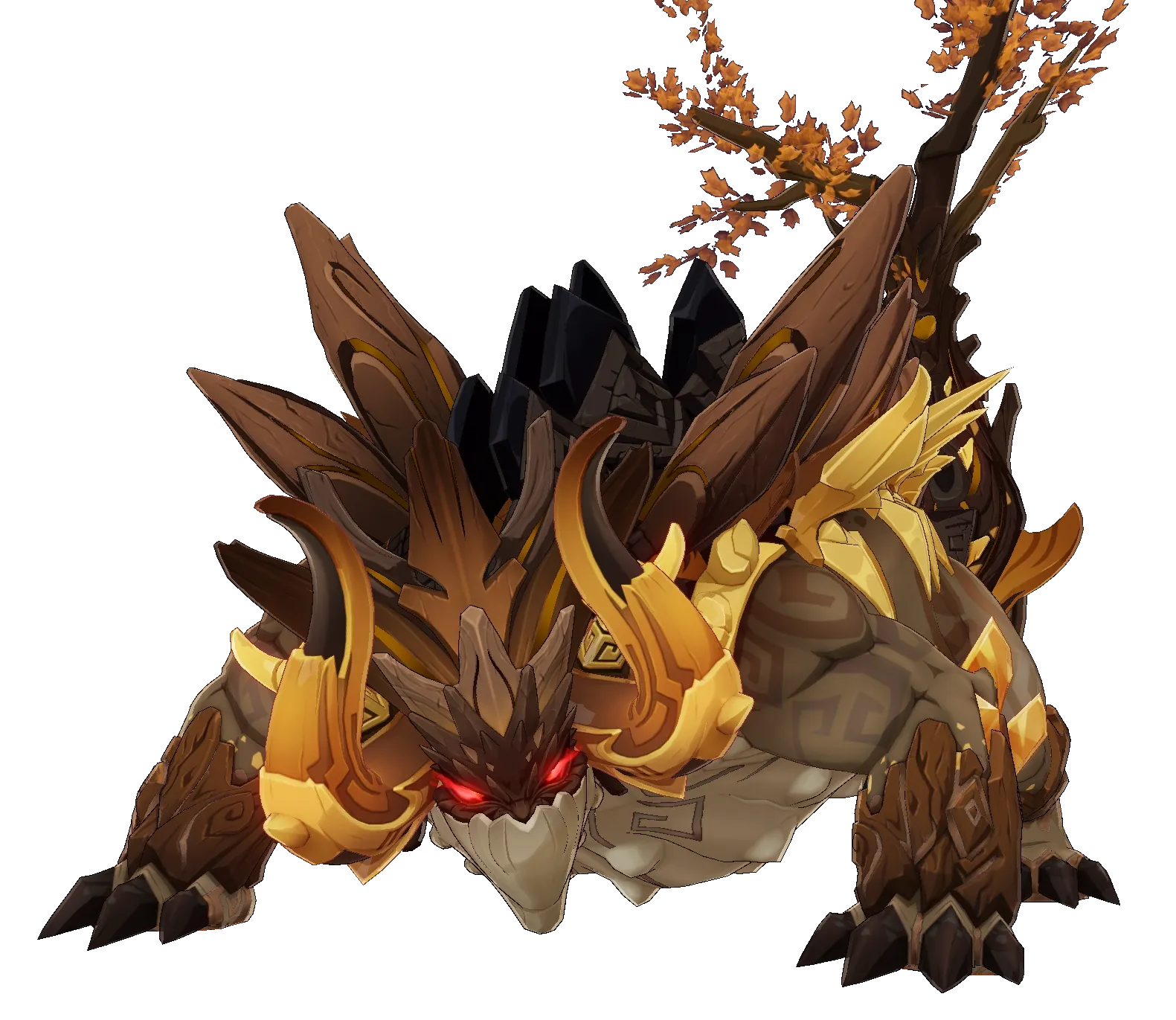
Erosion is the long, slow wear that damages beings over time, also called the curse of time. It often shows up as mental deterioration, but its reach is broader: erosion can affect memory, body, will, spirit, and the continuity of self. [1]
Weak beings are not the only ones who suffer it. Gods, dragons, Archons, and other long-lived entities are susceptible. It appears tied to the natural order imposed by the Heavenly Principles, the constant flow of Ley Lines, and likely Irminsul, with some hints pointing toward Istaroth, Ruler of Time. [1]
Forms of erosion
Form | What degrades | Example in the game |
|---|---|---|
Mental erosion | Memory, consciousness, recognition of bonds and past decisions | Azhdaha forgetting Morax, Liyue, humanity, and his own acceptance of sealing. [2] |
Physical erosion | Body / form / material stability | Ei abandoning her original body and using the Shogun puppet to withstand deterioration. [1] |
Erosion of will | Purpose, decisions, ideals, commitments | Azhdaha losing the reason he accepted sealing; Ei explicitly trying to preserve will. [1] |
Erosion of spirit | Selfhood / soul / sanity | Azhdaha's rage and loss of control; Ei's fear that even spirit can be eroded. [1] |
The forms can overlap. Azhdaha's case includes memory loss, spiritual collapse, rage, and bodily deformation. Ei's case is a strategy to prevent erosion of body, spirit, and will rather than a complete failure.
Azhdaha: the complete case
As the Geo Dragon Sovereign, Azhdaha is an Ancient Geovishap Ancestor and holds command over the Ley Lines. [2] He is the clearest complete case of erosion. He was once Morax's ally, coexisted with humanity, and agreed to a contract Morax stated explicitly at the moment Azhdaha was first granted sight: if Azhdaha ever endangered the order of Liyue, Morax would not hesitate to seal him back underground. [2]
Over time, erosion made him forget Morax's face, their contract, Liyue Harbor, and his bond with humans. Mining in The Chasm damaged Ley Lines and caused him suffering. Already worn down by erosion, he attacked the humans he had sworn to protect. Morax tried to delay the process by sharing his power, but it failed. Azhdaha's remaining benevolent consciousness accepted sealing, while the eroded self later forgot that choice and interpreted Morax as a tyrant. [2] [3]
Erosion can turn an ancient guardian into a threat without making the original bond false.
The containment built around the eroded Azhdaha is a standing arrangement, not a one-shot fix. The Dragon-Queller seal under Nantianmen holds the eroded self, and the Beneath the Dragon-Queller Trounce Domain, set beneath that same tree, is the replayable version of that seal-fight. The story encounter Beneath the Ancient Tree plays out the erosion failure on screen, set in that same domain space during Act II of Zhongli's Amidst Chaos, the Rock Is Unmoved arc. There, Kun Jun, the benevolent half of Azhdaha's split consciousness, narrates how erosion works, word for word. [2] [3]
Zhongli: retirement as anti-erosion reasoning
Zhongli indirectly confirms that erosion was one of the reasons he stepped down as Geo Archon. [1] The more powerful a being is, the more dangerous they become if erosion strips away memory, will, or selfhood.
Morax watched Azhdaha fall to erosion and could not stop it. His retirement is a containment choice as much as a political test for Liyue. If even stone can erode, Liyue needs institutions that can survive without a single ancient will holding everything together.
Ei: puppet + Plane of Euthymia
Raiden Ei's anti-erosion strategy is engineering. After the Cataclysm and Makoto's death, Ei created the Shogun puppet, an autonomous body designed to resist erosion, and secluded her consciousness within the Plane of Euthymia / Musou Isshin structure. [1] [4]
The strategy worked in one sense: Ei preserved herself. It failed in another: the puppet, designed to resist change, pushed "eternity" so far that the nation's institutions froze, producing the Sakoku and Vision Hunt Decrees until Ei returned to active judgment. Imperatrix Umbrosa Act II resolves the problem through a duel and settlement between Ei and the puppet, not by pretending the anti-erosion system had been harmless. [4]
Khaenri'ahn immortality
Dainsleif adds a different kind of erosion case. The curse of immortality denies death, but it does not freeze body and soul in perfect condition. Over time, both can continue eroding until the person becomes nearly nonexistent, even if "death" is not the form the erosion takes. [1]
This makes the Khaenri'ahn curse especially cruel. It grants persistence under continuing wear, not the rest of death.
Karmic debt, the adjacent mechanism
Yaksha karmic debt looks similar to erosion because it also damages long-lived beings' minds and souls, but its cause is different. Yaksha debt accumulates through contact with divine resentment, demonic remains, and violent purification work. [5]
Erosion is wear from time, the Ley Lines, and the natural order. Karmic debt is wear from exposure to what combat leaves behind. Xiao's suffering and Azhdaha's collapse belong near each other on the map, but they should not be flattened into one mechanism.
Deep dive
Azhdaha's main story is in the Historia Antiqua Chapter, and Ei's anti-erosion system in the Imperatrix Umbrosa Chapter. Yakshas covers karmic debt, the adjacent Liyue mechanism, and the Heavenly Principles are the world-order that imposes erosion in the first place.