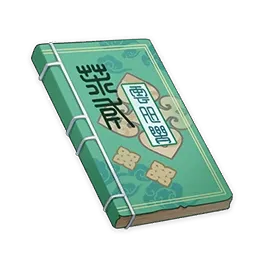
Records of Jueyun is a six-volume Liyue folklore anthology - "a collection of folk stories, myths, and legends from Liyue," per each volume's own self-description. Found at various locations throughout Liyue; released in Version 1.0; no compiler is named in-universe. [1] Five volumes are regional folktales; Vol. 4 carries the cosmologically dense fragment that ties Liyue's pre-Adepti past to the Three Moon Sisters framework closed in the Welkin Moon arc.
Vol. 1 - Stone Beasts
Vol. 1 narrates the stone animal statues scattered across Liyue. The elders of Qingce Village hold that some are illuminated beasts who once fought alongside Rex Lapis in the Archon War; knowing their flesh bodies would one day die, those who still pined for their guardian role "beseeched Rex Lapis to turn their ephemeral flesh bodies into everlasting stone," and the merciful Geo Archon granted their request. [3]
Vol. 2 - Palace Beneath the Sea
Vol. 2 is a fable about a benevolent Sea God who collects an annual bride from a fishing village in exchange for a year free from tempests. The young woman is given a snail-shell horn before being returned to land; years later, when the elders come to claim her own daughter, she blows the horn, and the Sea God's tidal embrace engulfs the village in their sleep. The fable echoes two real-world parallels: Ximen Bao and Hebo's Bride, and the Japanese Urashima Tarō. [1]
Vol. 3 - Wuwang Hill
Vol. 3 is the account of Wuwang Hill, the ominous slope north of Mt. Qingce. It narrates Wuwang's young people, enchanted by "the whale-like song of a faraway sea monster," throwing themselves into the Bishui River until the village fell silent; the present-day apparitions are not ghosts but ley-line dream-recreation, because "the ever-flowing ley lines remember all." Translation Note 1 glosses the "faraway sea monster" as the Oceanid Rhodeia of Loch, who took refuge in the waters between Qingce Village and Wuwang Hill after her self-imposed exile from Fontaine. [1]
Vol. 4 - Mountain Spirits - Three Sisters of the Lunar Palace
Vol. 4 is the volume Records of Jueyun is remembered for. It catalogues the lone seelie that float in Liyue's mountain forests, surveys the common folk-readings (departed adepti, unnamed benevolent gods, lonely kinless souls), and then reproduces an old mountain-village legend: in an era "before the adepti had come into being," the seelie had beautiful physical forms and possessed great wisdom, walking through the grand halls of cities of old in a time "said to date back even further than the days when Rex Lapis fought bitterly against countless rival gods." In that far-flung past, "the ancestor of the seelie met a traveller from afar, with whom they swore an oath of union witnessed by the three sisters of the Lunar Palace." Thirty days later, a sudden disaster struck; the seelie and their lover fled into exile as the world collapsed around them, and the calamity's punishment was to separate them eternally and wipe their memories. The heartbroken seelie and the sisters then withered until their wondrous forms collapsed into the tiny mountain spirits that now guide travellers through long-abandoned ruins. [1]
This Vol. 4 fragment is the only Liyue primary text naming "the three sisters of the Lunar Palace" - the trio closed in the Welkin Moon arc as Sonnet (Iridescent Moon, the youngest), Canon (Frost Moon), and Aria (Eternal Moon), in the Act VIII Lunar Palace authority-transfer that consolidated the Trilunar Authority in Columbina. [2] Read against the Three Moons page, the fragment is a Liyue-side witness that the Three Moon Sisters were present in Liyue's pre-Adepti era too, not solely a Nod-Krai figure. [2]
The in-universe author hedges the fragment hard. Vol. 4 closes: "Of course, these are nothing but clumsy, incoherent folk tales, wild and fantastical conjecture about what Liyue may have been like in the distant past before the time of Rex Lapis. Needless to say, such tales have no credibility whatsoever." [1] The hedge is preserved: the compiler is a folklorist, not a cosmologist, and the posture is interpretive, not primary-text doctrine. The Welkin Moon Act VIII Lunar Palace audience is the primary-text anchor; the Vol. 4 Liyue fragment is the supporting witness.
Vol. 5 - Qilin
Vol. 5 frames the qilin as a noble class of illuminated beast. Post-Archon-War, some illuminated beasts who had cultivated friendships with humans "left behind unique bloodlines in Liyue Harbor." The volume tells of a young qilin who, finding a herb gatherer bathing in a mountain pool, transformed into human form under the full moon and walked with him through the bamboo groves - either leaving a child in a basket at his door or living with him as his wife, depending on which ending the listener prefers. This is the primary-text grounding for the qilin / human hybridisation behind Ganyu's half-qilin lineage. [4]
Vol. 6 - Hidden Jade - Dunyu Ruins
Vol. 6 narrates the Dunyu Ruins northwest of Liyue Harbor - ruins that "already existed even before the time of the Archon Wars." Per Translation Note 2, Dunyu is 遁玉 (Dùnyù), "Fleeing Jade." The legend: a nameless star fell into the plains west of Liyue "in a past beyond memory, when even Rex Lapis would still have been young," opening the chasm from which jade emerged as the foundation of Liyue's mining industry. The Dunyu redoubts built in the resulting pit kept prosperous relations with Liyue Harbor "up till 500 years ago," when "the coming of the black calamity and the rise of the Abyss" drove the residents to seal the city and depart - even the millennia-old adepti and yaksha are silent on why. [5]
What each volume anchors
Records of Jueyun is Liyue's witness-anthology. Vol. 1 anchors the petrified-illuminated-beasts primary text, Vol. 5 grounds the qilin / half-qilin lineage behind Ganyu, and Vol. 6 anchors the Dunyu Ruins and the city-sealing roughly 500 years ago that doubles as a Cataclysm-era Liyue witness. Vol. 4 is the one that matters most: the single Liyue fragment naming the "three sisters of the Lunar Palace" (the trio the Welkin Moon arc resolved as Sonnet, Canon, and Aria), and the only Liyue text framing the seelie as a pre-Adepti, physically-formed people whose oath of union was witnessed by Moon-Sister authority before a sudden disaster cut it short. The compiler's "no credibility whatsoever" hedge is preserved alongside the Welkin Moon arc's primary-text anchor, kept uncertain rather than asserted.