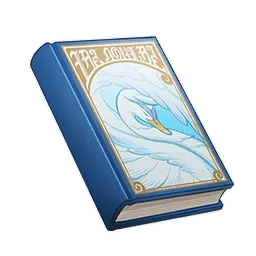
Tales of a Snow-Winged Goose (CN 雪翅雁童话集 Xuě Chì Yàn Tónghuà Jí, "Snow-Winged Goose Fairytale Collection"; French Conte d'une oie aux ailes enneigées) is a three-volume Fontaine Book Collection introduced in Version 4.0 and released in Version 4.2. Each volume opens with the same standing description: "A short fairy tale that is quite popular in Fontaine. Many children saw the exquisitely drawn cover and thought it was really written by the kind Madam Snow-Winged Goose of legend." The cover "reads LES CONTES (French: les contes 'the tales') in the Fontaine Script." The in-universe attribution runs on the same kind of surname-pun as its sister Version 4.0 collection Fables de Fontaine, which plays Marie Hericart de La Fontaine against the real Jean de La Fontaine. Here, Madam Snow-Winged Goose refracts the real-world Mother Goose of Charles Perrault's Histoires ou contes du temps passé. [1] [2] [4]
Vol. 1 - Pers the Penguin
The first tale opens with a child's-encyclopaedia voice on penguins ("chubby little ladies and gentlemen, with tuxedos of black feathers pulled tight over their cute white bellies") and pivots, after the familiar "throw themselves onto those bellies and slide as if snowboarding" beat, into the premise: "Every penguin in the world comes from outer space, far beyond the skies. Great flocks of penguins once flew across the universe, their flippers steering them between the stars, their sleek feathers reflecting what little starlight there was out there in the void. From red giants to white dwarfs, from the shoulder of Orion to the glimmering Tannhauser Gate ... The penguins explored it all. The penguins remember it all." This "red giants … white dwarfs … shoulder of Orion … Tannhauser Gate" line is a reference to the Tears in rain monologue from the 1982 film Blade Runner, Roy Batty's death speech, transposed into the voice of a children's fairy-tale origin myth. [1]
Several penguin clans, the narrator continues, "split off from that galaxy-roaming flock and landed in the icy waters to the south of Teyvat," but the atmosphere is too thick to fly in and the water unfamiliar: "those new arrivals found our atmosphere too thick to fly in, and their lack of prior experience with water left them unable to swim as well." The tale within the tale is the origin of swimming, the moment the penguins' descendants stop trying to recover flight and instead discover underwater motion through Pers the Penguin, "the first penguin to learn to swim." The fable runs through three teachers in sequence:
- The frigatebird, "the biggest bird he could find," who demands thirty fish in payment for the secret of flight. Pers spends "50 nights on a moonlit beach, collecting 300 shells," trades the shells to a shell-loving whale for the thirty fish, and the frigatebird swallows them all in one gulp before flying away and calling down its only "advice": "The secret to flying is to be light! Why not try losing some weight?" This is the volume's little etymology joke: "the frigatebird got a new nickname after all this for its greed and unreasonable nature: the piratebird."
- The seagulls, who "only … squawk and croak" unhelpfully and end up in such a fierce argument among themselves that "some of them became so angry that they refused to fly ever again, becoming auks." The seagulls turning into auks is the second in-fiction folk etymology.
- The petrel, who "would only teach him some impractical tricks, and not the basics that he needed most", being a noble seabird who thought it "better to learn how to soar through a stormy sky than to worry about trivial matters like taking off and landing."
Pers, "a very disappointed penguin," waddles back to the beach at night and notices "for the first time ever that the stars of his celestial homeland were reflected in the ocean. And he found them so beautiful that he simply ... jumped in." After "a brief moment of panicked sinking," Pers discovers underwater flight: "he could whizz speedily along, or twist and turn. It was, after all, what those strong wings and that smooth round body had been made for!" Other penguins follow. "Once Pers had shown them the way, the penguins took to life in the water and forgot their spacefaring past. Not even in their dreams did they remember that limitless void. The penguins live here now, between sea and land." The outer-space origin is forgotten by the penguins themselves at the close. The story turns away from inherited cosmic memory and toward the present life between sea and land. [1]
Vol. 2 - Princess Marcotte
The second tale runs a fairy tale with personified flora: "In the not-too-distant past, every type of plant and every type of beast had its own kingdom. And in the Marcotte Kingdom, there lived a princess with long pink hair. Legend has it that she was born in a crab claw and never put down roots - she always was, and always would be, a tough little seed." The princess refuses her father's request that she settle and grow flowers: "Father, father, please do not fret or rage. I was born in a crab claw, and that claw will be my ship. Your daughter's fate is not to take root in the mundane earth and grow pretty flowers. It is to conquer the seas and explore a new and wonderful world!" The king's reply is the volume's self-aware joke at the floral king's expense: "But he only felt this way because he was ashamed of not being as pretty as he wanted to be." [1]
The king's solution is layered confinement: "he had the princess and the crab claw locked up in a golden box. Then he hid the golden box in a mirror made of purest water. And then he threw the mirror into the sapphire lake of the Pluie Lotus Kingdom. There was only one way to reverse all those layers of confinement and free the princess (and the crab claw) - to make the Mother Lotus laugh. And as everyone knows, Pluie Lotuses are all too used to weeping." The princess works through three escalating kinds of comedy: written jokes (the crab claw chortles, the golden box guffaws, the Mother Lotus nothing); a rehearsed comic play (the crab claw bursts into laughter and "hop[s] around - despite having no feet!"; the interior of the box is converted into a theater; the Mother Lotus, still nothing); and finally situational comedy, in which "the princess tried to find comedy in the circumstances of her imprisonment ... Soon the crab claw was, like the princess, laughing until it cried and then crying until it laughed. And eventually, the Pluie Lotus - keen criers, as we know - found themselves giggling." The Mother Lotus is summoned by curiosity, and "the princess didn't even need to tell a single joke. The Mother Lotus burst out laughing as soon as the princess entered the room. Her laughter grew louder and louder, shaking the palace walls and sending ripples across the sapphire lake." [1]
The princess wins her freedom; the moral is "the ability to laugh, and to make others laugh, even in the saddest of circumstances." She sails out "in her crab claw ship ... on her voyage to the new world of her dreams," and the close is an in-fiction folk etymology of a real-world image: "ever since, sailors have told tales of a crab claw ship." [1]
Vol. 3 - Mr. Fox and the Clockwork Guardsman
The third tale opens on long life and friendship: "A long, long time ago, Mr. Fox and the Clockwork Guardsman were good friends. Mr. Fox was a successful thief. The Clockwork Guardsman was ... well, he was a guard. Clue's in the name, isn't it? But that was a long, long time ago, of course. They're still good friends, though. That will never change, no matter their jobs or social status." The Clockwork Guardsman's mechanism is aging, and the worry is the volume's premise: "I've already lived a very long time. I've met so many people and said goodbye to so many. I've heard the funniest jokes and lived through the saddest times, and then I've forgotten it all and lived through it again. Even though forgetting isn't easy for a machine such as myself, it all fades." Mr. Fox's response ("perhaps it is time to die, and in doing so, to make your life real") is cut off by a detail from earlier in his life that the Guardsman supplies in the next line: "didn't you steal Death from Ms. Toad's dressing table in that heist many years ago? It caused quite the commotion, as I recall. The living things of the world all forgot how to die." [1]
The narrator's gloss on Ms. Toad frames the fable's central entity: "Ms. Toad is Death's envoy, the queen of all that is ugly, cold, and annoying. She guards that coldest jewel, Death itself." Mr. Fox's flashback follows: "Ah, I was so young then. I remember I was madly in love with Ms. Jackal, and I wanted to bring her the most expensive treasure I could find." "And?" "I succeeded. But she died. Death slipped from Ms. Jackal's hand and shattered on the ground. The fragments melted into the earth, never to be seen again. And as that happened, the creatures of the world started to die as normal once more, with all that should have been dead now being so. Except, that is, for Mr. Fox, who should have died, but didn't. His life dragged on." [1]
The two friends "left the city they called home to search for Death in all the corners of the world. And they searched and they searched and then they searched some more. They searched until Mr. Fox's beautiful red coat had turned white. They searched until the Clockwork Guardsman's pride and joy, his official guard badge, had rusted. Finally, they reached the place where Ms. Toad lived." Ms. Toad opens the door, "slowly and stretched out her warty, scabby hand," and answers the Guardsman's request for Death: "Life is not tea and Death is not sugar. Their tastes cannot be distinguished if you live forever. But you have a mechanical heart and a mechanical tongue, and have tasted their flavor over and over, during each cycle of activation and deactivation ..." Her consolation: "My maggots will not eat you, my moss will not grow on you. Whether your enemy is time or guilt, sadness or ennui ... Do not admit defeat easily, my child." [1]
She removes "an embroidered shroud to reveal the cold jewel called Death" and places the Guardsman's metal hand on it to show "how long, long in the future, he would end-" The vision that follows: "After countless years of hardships, a battered and beaten Clockwork Guardsman was thrown into the fires of the scrapping plant, to melt into a metallic ocean of millennia of waste. All those slow metal thoughts and hard metal ideas became swift and liquid. They evolved and combined and formed a new life. It was a glorious return for all metal lifeforms, making even the release of death fade in comparison." The Guardsman, "having seen the future," gives up "his dreams of dying"; Mr. Fox, "meanwhile, withdrew his thieving hand and left the jewel where it was. Indeed, life encompasses more than just bitterness akin to tea. If he had a friend to accompany him through the hard times, what rush was there? He could steal this extraordinary jewel later." [1]
The close runs out past the volume's own frame: "Mr. Fox and the Clockwork Guardsman lived long, long lives, until the little world they lived in was but a desert, until the sun went out, until the moon fell ... And even then, their story didn't end. It lived on, passed from world to world." [1]
The literary references
Three real-world references run through the book:
- The Fontaine Script cover text: "The book's cover reads LES CONTES (French: les contes 'the tales') in the Fontaine Script." The same convention runs across the other Fontaine book collections: French naming is the region's in-universe literary style, and the script on the cover is the in-game Fontaine writing system that the Marcotte surname and the Pluie Lotus flora draw on. [1]
- The Charles Perrault reference: "This book collection is based on the fairy tale collection Histoires ou contes du temps passé, also known as Mother Goose Tales, by French author Charles Perrault." The in-universe attribution to Madam Snow-Winged Goose is the built-in pun on the real-world Mother Goose, the same shape as the sister Version 4.0 collection Fables de Fontaine, which runs its in-universe compiler Marie Hericart de La Fontaine as a pun on the real Jean de La Fontaine. The device is the same both times: a real French fairy-tale or fable author refracted through an in-universe attribution carrying a matching name. [1] [4]
- The Blade Runner Tears in Rain reference: "In Volume 1, the line 'From red giants to white dwarfs, from the shoulder of Orion to the glimmering Tannhauser Gate ...' is a reference to the Tears in rain monologue from the 1982 sci-fi film Blade Runner." In the fiction this is the penguin clans' inherited memory of space, which the children in the story are taught and then forget by the volume's close ("Not even in their dreams did they remember that limitless void"). Roy Batty's original death speech ("I've seen things you people wouldn't believe … All those moments will be lost in time, like tears in rain") is transposed into the voice of a children's fairy tale. [1]
Fairytale, not Teyvat cosmology
What holds up here is the structure and the texts: a 3-volume Fontaine Book Collection introduced in V4.0 and released in V4.2, the shared standing description naming the in-universe attribution to Madam Snow-Winged Goose of legend alongside the "exquisitely drawn cover" and the LES CONTES cover text in Fontaine Script, the three full volume texts (Pers the Penguin, Princess Marcotte, Mr. Fox and the Clockwork Guardsman) as quoted above, the piratebird and auks folk etymologies in Vol. 1, the crab-claw ship folk etymology in Vol. 2, and the Trivia naming the Charles Perrault / Mother Goose Tales pun and the Blade Runner Tears in Rain line. [1]
What does not hold up, and is best left as open reading, is any attempt to pull the fairy-tale figures into actual Teyvat cosmology. Vol. 1's "every penguin in the world comes from outer space" and the Blade Runner star-line are an origin myth, not a real species history, and the volume's own close ("Not even in their dreams did they remember that limitless void") shrugs the outer-space ancestry off as forgotten even within the fiction. Vol. 2's Marcotte Kingdom and Pluie Lotus Kingdom are kingdoms of personified flowers, not states of present-day Fontaine. The Marcotte surname does match a real Fontainian family that turns up across character pages (Emilie Marcotte), and the Pluie Lotus is a real Fontainian flower, but those matches stay suggestive rather than asserted; the volume names the kingdoms without equating either to the present-day surname or flower, the same way Fables de Fontaine's Marie Hericart de La Fontaine is a pun rather than a biography. Vol. 3's Ms. Toad as Death's envoy, the cold jewel called Death, and the creatures who briefly forgot how to die are a fairy-tale theology, not the actual Fontainian doctrine of death that sits with Ronova, the cycle of the Throne of the Primal Fire, and the prophecy of dissolution into the Primordial Sea, none of which this fable touches or contradicts. The Clockwork Guardsman's machine-afterlife vision ("a metallic ocean of millennia of waste … a glorious return for all metal lifeforms") is likewise invention rather than the real Clockwork Meka lore, though the clockwork-guard imagery does belong to the same Fontaine Version 4.x literary shelf. And the book is not an authored text with a named author: the standing description is careful to say children "thought it was really written by the kind Madam Snow-Winged Goose of legend," which makes the attribution a misattribution. The actual in-universe author is unnamed, and the Perrault link is a matter of trivia and a built-in pun.
This is a three-volume Fontaine collection of children's fairy tales whose cover claims Madam Snow-Winged Goose wrote it, a play on Charles Perrault's Mother Goose Tales. Its tales are of penguins from outer space who forgot how to fly and learned to swim; a princess born in a crab claw who escapes her golden-box prison by making the Mother Lotus laugh; and a fox who once stole Death itself and now keeps it on the shelf while his immortal Clockwork friend learns that his far future is a metallic ocean of new life. Vol. 1's "red giants to white dwarfs ... shoulder of Orion ... Tannhauser Gate" line is Blade Runner. Everything beyond the Trivia is invention within a children's tale, not primary-text Teyvat cosmology.