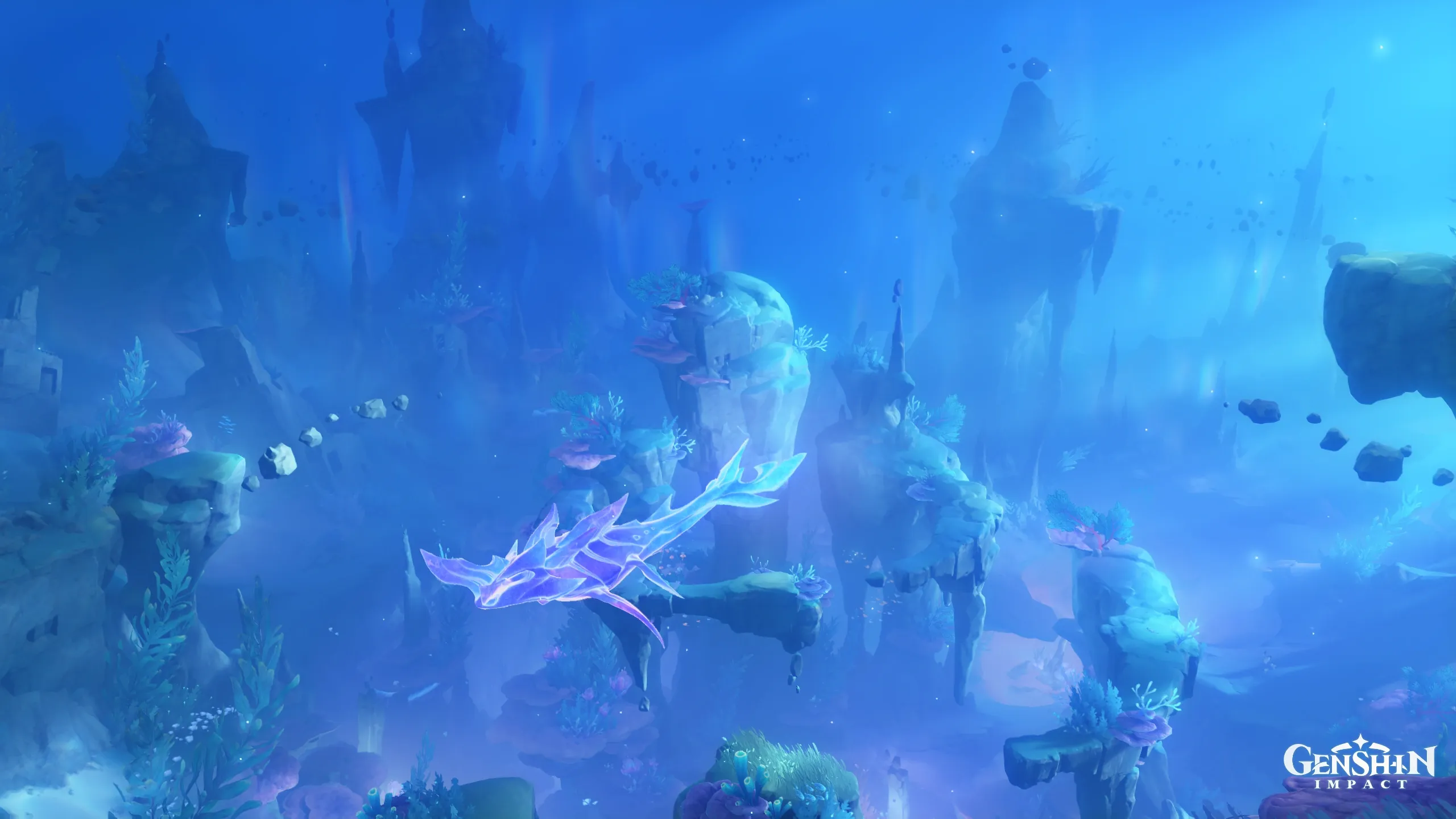
An underwater sub-region of Fontaine, released in patch 4.6, that holds the submerged ruins of Remuria, the civilisation that ruled what is now Fontaine before the Hydro Archon Egeria. It is reached from the Nostoi Region in south Fontaine and uncovered across the World Quest series Canticles of Harmony.
Overview
The Sea of Bygone Eras is a Fontaine sub-region, released in patch 4.6, that holds the submerged ruins of the pre-Egeria civilisation Remuria. It has its own map tab and exploration progress separate from the main map of Teyvat, and is reached not from the main Fontainan continental plate but from the Nostoi Region, a south-Fontaine island cluster that does not sit on the raised continental plate the rest of Fontaine occupies. Entry is through the Faded Castle, the sunken Remurian ruin of the Harmosts and scholars in Nostoi that "contains the entrance to the Sea of Bygone Eras, an even deeper region that holds the main ruins of Remuria." [1] [2]
The sub-region unlocks on completing Underwater Nocturne, the opening sub-quest of Canticles of Harmony: First Movement - In the Hall of the Sea King. It is the primary canvas for the Remurian arc: Remus, the Harmosts, the Grand Symphony Phobos, the Vishap-Prince Scylla, the finale with Boethius as Phobos's puppet, and Cassiodor's founding of the Marechaussee Hunters as the Golden Hunter after the fall. [1] [10]
Geography
The Sea of Bygone Eras has ten subareas, each tied to a civic or cosmological role in the Remurian era: [1]
- Alta Semita, an aqueduct that once carried Ichor from the Domus Aurea out into "the great lake in the far north," per NPC dialogue from Scylla. It visually resembles a giant harp, mirroring the Domus Aurea's instrument-form.
- Caesareum Palace, a training area for the legions of Remuria and storage for Scylla's chains. The Caesareum Palace Ancient Engravings #2 interactable supplies the account of the sealing at the Initium Iani.
- Capitolium, the inner city of Remuria's capital. Access requires entering the Initium Iani in the outer city of Machimos, then traversing the Passage of Ianus.
- Clivus Capitolinus, the hill at the heart of Capitolium that holds the Domus Aurea. The term also covers the cavern beneath the hill, which houses the Local Legend Cineas - Unreturned Envoy.
- Collegium Phonascorum, the educational centre of Remuria, where the Harmosts and music lecturers taught Remurians about Phobos's Symphony.
- Hortus Euergetis, an underwater garden whose name derives from the deceased Harmost Euergetia.
- Initium Iani, the entrance to the Passage of Ianus and the sole path between Machimos and Capitolium. Long ago, the Dragon-Prince Scylla was sealed here by the joint efforts of the Harmosts Boethius and Euergetia (per the Caesareum Palace Ancient Engravings #2 interactable and The Last Day of Remuria WQ).
- Machimos, the outer city of Remuria's capital. It once "had grand temples and arenas, towering walls decorated with glaze and gold, bronze and marble statues, and bustling markets," per The History of the Decline and Fall of Remuria.
- Passage of Ianus, the underwater corridor connecting Machimos to Capitolium. Its entrance is the Initium Iani, and a water current runs through its entire length.
- Portus Anticus, once the royal port of Remuria, since sunk into an underwater cavern. In its prime, its lofty belltower's sound could "pierce the barrier of ocean" to guide sailors home.
Two further points of interest sit inside the Capitolium core: [1]
- Domus Aurea, the royal palace of Remuria, fashioned from King Remus's ship the Fortuna. It is built as a giant instrument on which the Grand Symphony Phobos can be played, and is considered the heart of Phobos, "and is thus protected by its power" (per Gradus ad Capitolium).
- Sacellum Requietis, the throne room of the royal palace, where the God-King Remus once ruled and where the Traveler later silences the Grand Symphony.
History
The Sea of Bygone Eras is the post-collapse seabed of Remuria, the civilisation that ruled what is now Fontaine in the era between the fall of Sumeru's Gurabad and the rise of the Hydro Archon Egeria as Fontaine's god. The full record lives on the Remuria page; below is how that history is spread across the underwater map. [9] [3]
The god Remus arrived from Sumeru, a "singer of the oases" displaced when King Deshret conquered his homeland thousands of years ago. He discovered the ruins of a forgotten city in the High Seas older than the present-day ocean, met the angel Sybilla already worn down to a golden bee from her long duty guarding an Irminsul, and accepted her prophecy that he was destined to build a new nation. The Irminsul turned into a golden ship, the Fortuna, and Remuria was raised over the waters with Capitolium as its capital. The Faded Castle in Nostoi anchors that arrival: it housed the Harmosts and scholars who maintained the archives and researched music theory and fate, and it is the entry point that pilgrimage now leads through. [4] [2]
Remus shared governance with four Harmosts, Boethius, Cassiodor, Aurelius, and Euergetia, and built the Grand Symphony Phobos by combining his own powers with Sybilla's wisdom, Sybilla sacrificing her life to power its creation. Because she had no persona of her own, Phobos inherited the ascended Remurians' destructive desires rather than fulfilling Remus's design for a harmonious empire. Boethius was devoured by Phobos before Remuria's fall, so the Boethius who later acts against Remus's plans is Phobos's puppet rather than Boethius unmediated. [3] [7] [9]
Remus then composed a final symphony, the Requiem, Phobos's self-destruct order, and entrusted it to Scylla, the Vishap-Prince who had previously guarded Egeria's prison in the Primordial Sea. Scylla was to lead a feigned invasion against the capital so he could enter the Domus Aurea unsuspected and control the primordial energy the Symphony's collapse would release, returning every ascended Remurian to ordinary flesh-and-blood form. Phobos detected the plan, used the puppet Boethius (acting jointly with Euergetia) to seal Scylla at the Initium Iani before he could reach the Domus Aurea, and rejected Remus's final attempt to halt the war. Remuria sank in the resulting tsunami, the Golden Ichor was eventually corroded by the Primordial Sea, and Remus, Boethius, and Scylla were all swept under with the empire, leaving the Initium Iani and the chain storage in the Caesareum Palace as primary-text monuments to that sealing. [4] [5] [1]
The Remuria record states, "The survivors turned to 'barbarism and annihilation' until the Hydro Archon Egeria appeared and settled the conflicts between the remaining Remurians and the Fontainian tribes, taking over as Fontaine's God." That sentence fixes when Egeria took the throne: only after Remuria had already fallen. Her partition of Fontaine, turning her Oceanid followers into its first people, came earlier; when Remus reached her prison while Remuria prospered, she told him Fontaine's fate was already sealed by that "original sin." Both acts were Egeria's, not Focalors's. [15] So the Sea of Bygone Eras is not the residue of an Archon-era civilisation. It is older than the Hydro Archon's throne itself. [3]
How Remuria fits the wider cosmology
Remuria operated in a window where Egeria was imprisoned in the Primordial Sea and the original Hydro Dragon was already dead, with Scylla as Vishap-Prince filling the gap Egeria's hibernation created. So the Sea of Bygone Eras is not a Sovereign site (Remus is a god-king, not a Sovereign), not an Archon civilisation (the Hydro Archon's throne post-dates Remuria), and not a successor to the Hydro Dragon. Cassiodor recognises Neuvillette as the new Dragon of Water in The Last Day of Remuria: "A new Dragon of Water has already been born? Then again, it has been a long time since even the former Mistress of Many Waters passed..." That line, from a Remurian Harmost who lived while Egeria was still imprisoned, marks Neuvillette as the new Dragon of Water; it does not itself speak of the Hydro Authority. [6] [16] [10]
The only link to King Deshret here runs through Remus's own founding myth: he was "originally a 'singer of the oases' from Sumeru who fled after King Deshret conquered his homeland." The fallen city he later resettled in the High Seas was not a ruin of the Sumeru desert; it was an even older pre-Remuria Fontainan civilisation guarded by Sybilla. The Hadramaveth backdrop on the Sumeru side (the fall involving Liloupar and Gurabad, covered by Apocalypse Lost, and the Goddess of Flowers' cemetery at the Eternal Oasis of Hadramaveth, covered by The Eternal Dream, Ever Lush) only frames the political event that displaced Remus. It adds no direct content from the Sumeru desert inside the Sea of Bygone Eras. Apep (the Dendro Sovereign, per the Seven Sovereigns page) and Nahida are absent from the primary text about the Sea of Bygone Eras. Neither holds any position inside the Remurian order, and the agreement Apep and Deshret made before the kingdom (per the Nahida SQ Homecoming) belongs to the Sumeru Desert, not Fontaine. [4] [12] [13] [14]
Sybilla was an angel, Celestia's envoy to a pre-Remuria Fontainan civilisation, set to guard an Irminsul in an ancient city older than the High Seas itself, and gradually worn down to her golden-bee form over centuries of guard duty. Her wisdom became the moral core of Phobos, and in losing her own persona it also became Phobos's defect. That places one layer of the Sea of Bygone Eras older than the Heavenly Principles' arrival in Teyvat, since Angels pre-date that arrival per the Celestia page. [3] [9]
What Remuria left behind
Of the four Harmosts, only Cassiodor survived Remuria's destruction. Remus had severed him from the Grand Symphony as a failsafe so he would keep his free will, and he was outside Capitolium when the disaster struck. He then joined Egeria's people, took the new name Ouranides of Ouranopolis, and founded the Marechaussee Hunters together with the Lochknights to fight the Boethius-led Golden Troupe, the Remurian remnant that survived the fall and tried to revive Phobos. Hunting their Praetorian Golems earned him the byname the Golden Hunter. The present-day Marechaussee Phantom inherits its name and lineage from those original Hunters, and Clorinde inherits their swordsmanship through Petronilla. [6] [11]
Inside Canticles of Harmony: Third Movement, Cassiodor, having spent two millennia guiding successor generations and eventually possessing the cat Osse to meet the Traveler in Petrichor, sacrificed himself by possessing the same Legatus-Golem body as Phobos so the Traveler could destroy both. Every Remurian soul trapped in the Symphony, including Cassiodor's, finally moved on. The Domus Aurea's throne-room, the Sacellum Requietis, is the site of that closure. [6] [10]
Connected pages
The primary-text spine is Canticles of Harmony, the 4.6 five-movement chain whose First Movement (In the Hall of the Sea King → sub-quest Underwater Nocturne) opens the Sea of Bygone Eras map tab, and whose Second Movement (Prisoner in Shackles → The Last Day of Remuria) and Third Movement (Pharsalia's Rhapsody → Gradus ad Capitolium and Golden Aqueduct Reconstruction Parts I–II) traverse Capitolium, the Initium Iani, and the Sacellum Requietis. The full record for Remus, Sybilla, the Four Harmosts, Scylla, Phobos, and Egeria's appearance after Remuria is Remuria, and The Marechaussee Phantom is the organisation descended from Cassiodor's Hunters, through Neuvillette's re-forming of it after the Cataclysm. The parent region Fontaine holds the sub-region, entered from the Nostoi Region in south Fontaine.
On the Sumeru side, which connects only indirectly, King Deshret is the Lord of Deserts whose conquest of Remus's homeland in the oases displaced Remus to the High Seas, while Apocalypse Lost and The Eternal Dream, Ever Lush frame the lost civilisation of Hadramaveth, Liloupar, and Gurabad. Apep and Nahida are not parties to the Sea of Bygone Eras; the agreement Apep and Deshret made before the kingdom is a feature of the Sumeru Desert's primary text, not a Fontainan one.
Open questions
Sybilla guarded a Fontainan civilisation older than the High Seas itself, and the Sea of Bygone Eras post-dates that older civilisation but pre-dates Egeria's reign as Hydro Archon. Its name is not surfaced in the cited primary text. [4] Aurelius and Euergetia are similarly unresolved: the Hortus Euergetis is named for Euergetia and the Caesareum Palace Ancient Engravings #2 interactable attributes the sealing of Scylla at the Initium Iani to the joint efforts of Boethius and Euergetia, yet neither Harmost appears on-screen in the present-day Canticles of Harmony. Whether either survived the fall, was absorbed by Phobos, or was freed when the Traveler destroyed the Symphony is left implicit. [1] [3]
One last ambiguity is the word Fortuna. Remus's golden ship bore the name; the broader concept of Fortuna is the law of rise and fall that Sybilla pointed to as the cosmological constant Egeria's original sin could not escape; and Phobos's ultimate purpose was framed as controlling Fortuna itself. Whether these are the same Fortuna at different scales or different uses of one term drawn from Roman mythology is unresolved. [4]
The full primary-text spine is Canticles of Harmony; the civilisational record is Remuria; supplementary detail is in The History of the Decline and Fall of Remuria, the Golden Troupe and Marechaussee Hunter artefact sets, and La Chanson d'Erinnyes.
World Quests
- Canticles of Harmony · Patch 4.6