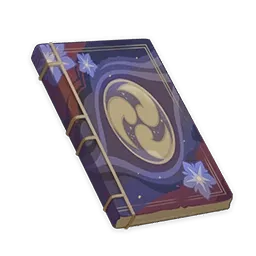
Treasured Tales of the Chouken Shinkageuchi is a 1-volume Inazuman Book Collection released in Version 2.2, sold at the Yae Publishing House in Inazuma City. Per its own framing the volume was "once a restricted text" and entered general circulation only after a separate book "known colloquially as 'Raiden Reincarnation'" generated enough demand for stories of this kind that it "wound up being published in a haphazard manner." It is short, a single volume also known as "Shinkageuchi," and it is the primary text for the founding of the Inazuman Shogunate in the Archon War era. [1] [2]
The Goshintou ceremony and the Shinuchi / Kageuchi distinction
The volume opens on swordsmithing. Per its verbatim framing, "when Narukami came to her people, she brought with her the knowledge of crafting swords," and after thousands of years mortal smiths could at last forge swords "that would please even Narukami herself." The Grand Shrine and the Shogunate together enacted the Goshintou ceremony, collecting "the greatest swords in the world" and offering them to the shrine.
Behind that public rite the book lays out the craftsman's distinction:
- Shinuchi ("true blade"): the greatest of a smith's works, "given a lovely name before being offered to the craftsman's lord or deity. These are not built for taking lives and are to remain pure."
- Kageuchi ("shadow blade"): the others, "given to retainers for them to use as weapons," often shedding blood and "thus stained with impurity and filth."
The title fuses these, Shin-kage-uchi, into a single coinage that doubles as the frame for the founding-of-Inazuma tale that follows. [1]
The First Shogun and her kagemusha
The book then walks the founding of Inazuma from the First Shogun's side. Per its verbatim disclosure: "From the day Narukami Gongen, the First Shogun, began her dominion over the land of Inazuma, she was accompanied by her younger twin sister. 'Shin' and 'Kage,' light and dark they were, mediating and holding court, ordering and giving battle." The younger twin, "named 'Ei,' and if her name were to be written plainly, it would likely be the word for 'shadow'", is the future Raiden Shogun the player meets in Inazuma. The older twin, the First Shogun proper, is later named Makoto.
The Archon War passage follows verbatim: "only The Seven emerged from the wrack and ruin of the war that rolled across the mortal world like a crimson storm." Though Ei ("the Shadow Shogun") was "divinely skilled in martial arts and unsurpassed with the blade," she believed herself "little more than a warrior with little understanding of mortal hearts." So "she chose to give up her bodily form, helping her sister to ascend to the 'heavenly citadel' and obtain dominion over Inazuma." Makoto then set up her Shogunate, and "remembering their bond, she recalled 'Ei's' divine will and reforged her body, thus returning her sister to her side once more as her *kagemusha."* [1] [5]
This is the source for the kagemusha ("shadow-warrior") vocabulary that the modern Raiden Shogun arrangement (two figures, one Archon) reuses centuries later: Ei in turn designs the puppet Shogun to be her own kagemusha and accepts that framing at the close of the Imperatrix Umbrosa Chapter. It is also one of the texts behind the idea of gods created by inheritance or succession, which the Gods page draws on for Archon-level succession. [3] [6]
What Ei says about this book
The book is not a neutral history. The Raiden Shogun's Voice-Over: More About Ei: III confirms two things: that Treasured Tales is fairly accurate about the events leading up to the war against Orobashi, which other in-game books have not covered, and that after that point the book idealizes her motivations and actions. The book's cover pattern also matches the Raiden Shogun: Enlightenment namecard, a small sign that miHoYo treats this volume as part of Ei's iconography.
So read the volume as reliable for the founding-era structure (the Shin/Kage twin framing, the sacrifice of bodily form and the kagemusha restoration, the Goshintou ceremony, the Shinuchi/Kageuchi distinction, the "only The Seven emerged" Archon-War survival) and as idealized for the later period of Inazuman rule, with Ei's own caveat as the guide to what to trust. [1]
Not a sword-school text
Despite the title, this is not a Shinkage-ryū sword-school text. The coinage fuses Shin, Kage, and uchi around the Goshintou ceremony's Shinuchi / Kageuchi blade distinction and the Shin/Kage twin metaphor for Makoto and Ei, and it has nothing to do with the real-world Japanese Shinkage-ryū school: no martial-arts lineage, no founders, and no school members appear. The Souran Isshin Art lineage in the World Quest Akitsu Kimodameshi (Yanagibashi Takuto, Tominaga Masanari, Kamai Kenji) is a separate Inazuman swordsmanship lineage with no connection to this text.
It is also not an Iwakura-family or Mikawa Flower Festival text; neither is named, and the Goshintou ceremony is the only formal rite the volume engages. Nor is it the full series. Only Vol. 1 exists as a purchasable entry, and the book's self-framing as "the first part of a traditional Inazuman novel" implies later volumes exist in-fiction without being separate entries.
For Ei after the war against Orobashi it is not reliable. By her own caveat those passages idealize her, so the Raiden Shogun character page and the Imperatrix Umbrosa Story Quest remain the anchors for her post-Cataclysm withdrawal, the puppet-Shogun design, and the disclosure that Makoto died at Khaenri'ah. The book is also not an anchor for the Cataclysm or Khaenri'ah at all: neither term appears, its Archon-War setting predates the Cataclysm, and the Cataclysm-era account of Makoto's death lives in the Imperatrix Umbrosa Story Quest, Act II.