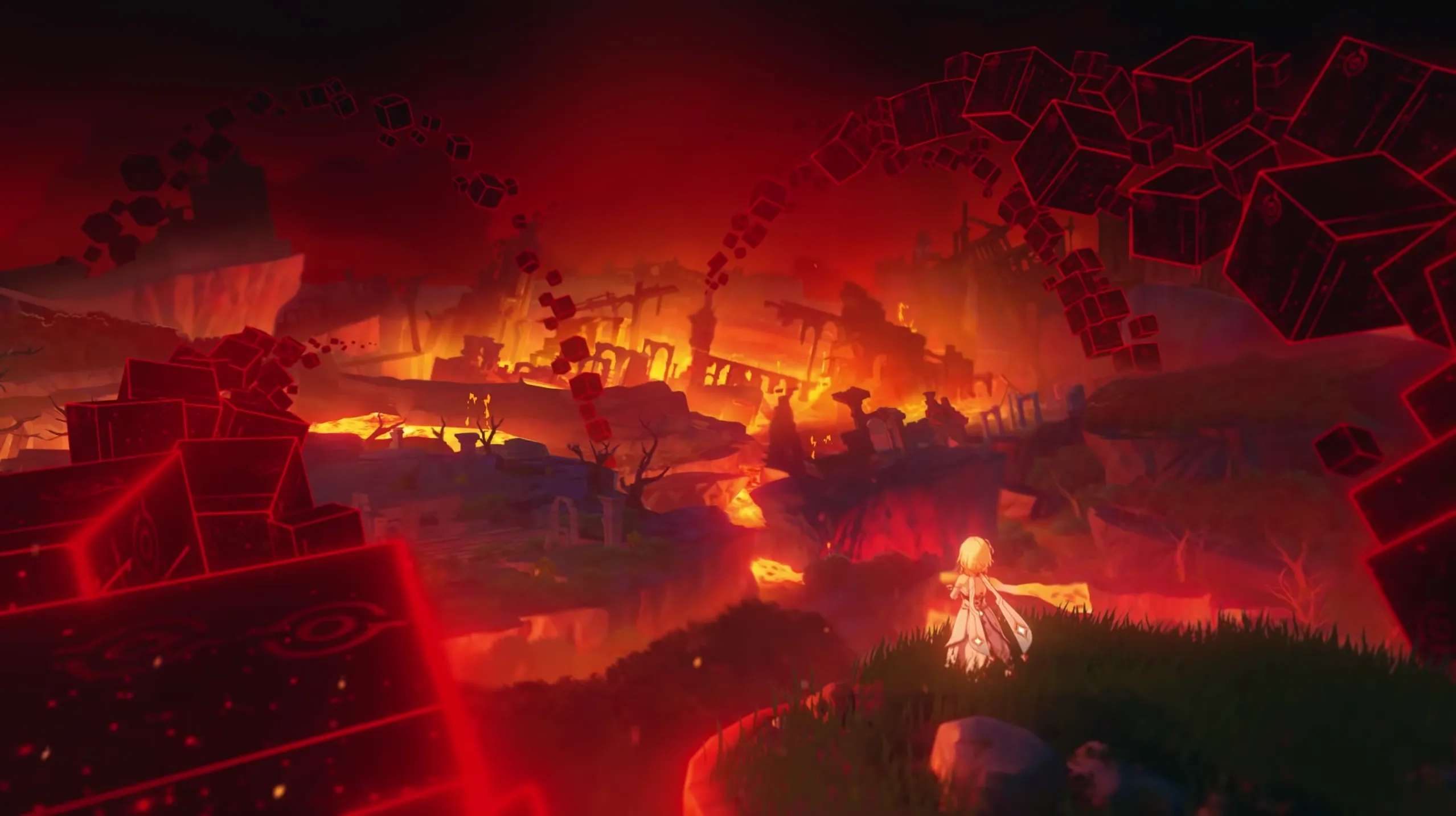
The Cataclysm was the world-scale disaster of 500 years ago. Khaenri'ah was destroyed, Abyssal monsters erupted across Teyvat, the Heavenly Principles and the Archons fell on the godless underground nation, and the curses that followed still define every lineage of Khaenri'ahn survivors. [1]
The game keeps the exact order of events deliberately unclear. The shape is stable, though. Khaenri'ah had become deeply involved with the Abyss, monsters carrying Abyssal power poured out of it, the gods and Heavenly Principles destroyed the nation, and the survivors were cursed. [1]
Why it happened
The Cataclysm has several overlapping layers of cause.
Layer | What canon supports |
|---|---|
Political / theological | Khaenri'ah was a godless civilization, "the pride of humankind," living without divine rule. [2] |
Technological / military | Khaenri'ah built Ruin Machines / Field Tillers as weapons against the divine order. [1] |
Abyssal / forbidden knowledge | Abyssal power and forbidden knowledge are alien and corruptive to Teyvat; Khaenri'ah grew more deeply involved with them. [1] |
Sinner trigger | The Five Sinners' exploitation of Abyssal power is now the sharpest known proximate cause of Ronova's curse on full-blooded Khaenri'ahns. [3] |
Put most carefully, Khaenri'ah's godless rebellion and forbidden arts created the long-term conflict, while the event in which Irmin and the Sinners took Abyssal power appears to be what immediately triggered enforcement.
What happened to Khaenri'ah
The Heavenly Principles and The Seven attacked Khaenri'ah, with the Dendro Archon Rukkhadevata tasked with protecting Irminsul rather than joining the main assault. The skies over Khaenri'ah turned red and filled with crimson cubes; the landmass was torn apart and flooded with lava. [1]
The curses followed. Ronova, Ruler of Death, cursed pure-blooded Khaenri'ahns with immortality. Eide separately says people whose ancestry belonged to the domains of other gods received the curse of the wilderness and became monsters, then identifies Caribert as a hilichurl. [1] Primary text does not establish a universal rule that royal guards became Shadowy Husks, or map every class of Abyss enemy to a bloodline. Dainsleif remained a witness and investigator; Chlothar and Caribert would later anchor the Abyss Order's founding. [4]
Regional impacts
Region | Cataclysm impact |
|---|---|
Rostam died on expedition; Arundolyn broke; Rosalyne became the Crimson Witch; the Cataclysm-era Abyssal "Humus"-classified dragon Durin (the historical one, distinct from the present-day playable Durin the Hexenzirkel created as a separate story version) attacked Mondstadt, fought Dvalin and Barbatos, and fell onto Dragonspine. [1] | |
The Chasm battle killed Bosacius, Boyang, and Millelith vanguard forces after they sealed Abyssal monsters underground. [1] | |
Makoto died; Kitsune Saiguu disappeared/was consumed; Chiyo was corrupted by a beast of sin; Reizenbou exiled herself; Takamine disappeared. [1] | |
Forbidden Knowledge contaminated Irminsul; Rukkhadevata sacrificed herself and was later erased from world-memory by Nahida; Old Vanarana and the Girdle of the Sands suffered long-term corruption. [1] | |
Elynas appeared and polluted land/sea; the Fontaine Armada hunted him; Egeria died at Tunigi Hollow; after Egeria, Fontaine moved toward the prophecy plan of Focalors and Furina. [1] | |
Abyss invasion exploited shallow Ley Lines; Mavuika and the tribes repelled it at great cost; Night Warden / Ancient Name / Ode of Resurrection structures became existential. [1] [7] | |
Nod-Krai, once called Nephilheim, was among the first attacked; the Lightkeepers and Frostmoon Scions entered a centuries-long Wild Hunt defense era, with Abyssal cavalry pouring out of the Moon Gate under the command of Rerir (one of the Five Sinners) until his Welkin Moon Act IV banishment back through the Gate (Luna II), after which command passed to Rotwang and Roland; the Tsaritsa and Pierro eventually built the Fatui as a project against Celestia. [1] [8] |
No two regions took the same kind of damage. The Cataclysm exposed what each region quietly relied on: Mondstadt's Four Winds and Knights, Liyue's defense by adepti and yaksha, Inazuma's yokai and Sacred Sakura, Sumeru's dependence on Irminsul, Fontaine's line running through the Oceanids, the Institute and Elynas, Natlan's Night Kingdom, and Nod-Krai's moon and Wild Hunt layer.
The four survivor lineages
The present story is largely the Cataclysm's aftermath, because four different survivor strategies are now active at once:
Lineage | Response |
|---|---|
Abyss Order | Founded by Chlothar and led by the Sibling, the organization descended from Khaenri'ah; it seeks to revive Khaenri'ah and activate the Loom of Fate before the Heavenly Principles awaken. [4] |
Fatui | The project of Pierro and the Tsaritsa against Celestia, using Harbingers, Delusions, and the collection of Gnoses to confront or restructure the divine order. |
Five Sinners | Rhinedottir, Vedrfolnir, Surtalogi, Hroptatyr, and Rerir: transcendent Khaenri'ahns who each took a one-sixth share of the world-shattering Abyssal power King Irmin had induced the Sibling to absorb, during a pre-Cataclysm operation Dainsleif convened (as its organizer, not himself a Sinner) to free his brother Vedrfolnir from Irmin's prison, per Welkin Moon Act IV "An Elegy for Faded Moonlight." Per Capitano (AQ V Act V "When All Becomes a Monument"), it was the Sinners' exploitation of that stolen authority that triggered Ronova's immortality curse on full-blooded Khaenri'ahns; none of the five returned to defend Khaenri'ah when disaster came. [3] [11] |
Cursed individuals/remnants | Dainsleif, Halfdan, Chlothar, the documented group of Khaenri'ahn hilichurls including Caribert, Kaeya's surviving Alberich line, and other remnants left by the curse. The exact ancestry and curse route of Mages, Heralds, Lectors, Shadowy Husks, and Black Serpents is not securely mapped. |
These lineages are not one faction. They disagree, compete, and often fight, but they all begin at the same wound.
The Cataclysm seeded more than those four willed responses. It also produced self-running Abyssal forces, Khaenri'ahn offshoots that answer to no one. The clearest case is the Wild Hunt in Nod-Krai, an Abyssal cavalry that has poured out of the Moon Gate for centuries. Rerir, one of the Five Sinners, commanded it for that span, but the Wild Hunt outlasted his banishment in Luna II, and Rotwang and Roland inherited the role per Frostmoon Scion oral tradition. It predates the Abyss Order as a political body, never answered to the order Chlothar founded, and is an Abyssal phenomenon rather than a willed army. [8]
The Khaenri'ahn engineered diaspora: Ruin Machines
The Wild Hunt is the Abyssal cavalry among the Khaenri'ahn remnants that, since the Cataclysm, have operated outside any deliberate organization. There is an engineered side too. The Khaenri'ahns built mechanical war machines and called them Field Tillers. The modern "Ruin Machine" name is a later case of mistaken identity, not the original designation. Per the Chaos Oculus material text, after Khaenri'ah fell the Field Tillers "wandered aimlessly across Teyvat for hundreds of years" and "became drawn to the ruins of other former civilizations, causing the people of the present era to mistake them as guardians of those ruins and dub them 'Ruin Machines.'" The engineering outlived its makers. The machines scattered across every original region of Teyvat, a remnant of Khaenri'ahn engineering left running with no one behind it. [12] [5]
That makes the machines the engineered counterpart to the documented group of Khaenri'ahn hilichurls. The two share a Khaenri'ahn origin and the same post-Cataclysm homelessness, and both carry an ambiguous link to the Abyss Order per Childe's AQ I IV disclosure ("these machines were not built by the Fatui, but have some connection to the Abyss Order"). They differ completely in kind, one mechanical and the other biological and cursed. The machines run on the Khaenri'ahn obsession with mimesis. Per the Chaos Bolt material text, Khaenri'ahn engineering set out to copy natural forms in a way that surpassed them, and so to "replace the continuously decaying and shattering order," the same ambition the godless civilisation shares with the Art of Khemia and the mechanical engineering of the Eclipse Dynasty, both covered on the Khaenri'ah page. [5] [3]
Primal Constructs, by contrast, are NOT Khaenri'ahn. The Sumeru desert's Primal Constructs are King Deshret's technology from before the Archon War, and the in-game Tutorial card marks them as distinct: "These ancient machines, which come from the desert, are quite distinct from the Ruin Machines." Fontaine's Clockwork Meka and ancient Natlan's Secret Source Automatons are likewise separate sub-families of the in-game Automatons super-family. The Cataclysm-era engineered diaspora is the Khaenri'ahn machines alone. For the full taxonomy and how they operate today (the ambiguous Abyss Order link, Sandrone's Marionette regiment, and the independent Ley-Line reactivation per Afratu's Dilemma WQ), see Ruin Machines. [5]
Sumeru post-Cataclysm recovery: the Irminsul burning before the Three Shades
Sumeru's particular Cataclysm wound was the Forbidden Knowledge contamination of Irminsul, along with Rukkhadevata's self-sacrifice and the long corruption of Old Vanarana and of the Akademiya's Akasha. Of all the regional aftermaths, it was the one whose final recovery went through an audience with the Shades. Per AQ Song of the Welkin Moon Act X "Truth Amongst the Pages of Purana," in Part 3, the quest of the same name, the current Dendro Archon Nahida (Buer) came with the Pyro Gnosis in hand before three Shades, labelled the Ruler of Death, the Ruler of Time and the Ruler of Life (Fandom names them Ronova, Istaroth and Naberius), and stated that Irminsul was beyond recovery. The Ruler of Death asked whether she was "certain" she wished to destroy the world's store of memory, which "represents both your roots and your finest accomplishments." [10] Fandom's quest summary says the three Shades granted her permission to burn it, though no line of the dialogue says so. [9] [10] It is the most concentrated case of three Shades acting together in the story since the Cataclysm, and it resolves the Forbidden Knowledge thread the AQ III Sumeru arc opened. The audience is also the last point at which the game places the Pyro Gnosis. Buer held it briefly there but did not keep it, and per Fandom's account of what became of the Pyro Archon's Gnosis, it disappeared without a trace after the burning. For the framework of the Shades that the audience put into action, see Four Shades.
The dormancy that followed
The Cataclysm is the last known large direct intervention by the Heavenly Principles. After Khaenri'ah's destruction, they appear dormant for 500 years. That dormancy is why the Sibling races to complete the Loom of Fate, why the Tsaritsa collects Gnoses, why Dainsleif keeps chasing Abyss Order operations, and why every Archon who survived the Cataclysm is now visibly estranged from Celestia.
Chapter VII Act IV offers an explanation for that sleep, told as a story. Rhinedottir tells the Tsaritsa that the Third Descender once bargained with the Heavenly Principles: his remains would be "split into seven pieces to consolidate the system of rule established by the Heavenly Principles" if they resurrected her and "promised to never lay a hand on his descendants," the people later known as Khaenri'ahns. He held them to it with "a curse, profound and complex, one that would only take effect if the promise was ever broken." It is the Tsaritsa, not Rhinedottir, who draws the conclusion: "So, when the Cataclysm occurred in Khaenri'ah, it must have triggered the Third Descender's curse... That's why the Heavenly Principles are asleep." Rhinedottir declines to confirm it, calling what she told "just a story" and saying she "certainly wasn't answering any particular question." The account is unconfirmed, and it concerns what the Cataclysm set off rather than what caused it. [13] [14]
It also explains why present-day Teyvat's factions are about more than politics. The Abyss Order, Fatui, Sinners, Archons, Sovereigns, and Traveler are all answering the same unresolved question: whether the Heavenly Principles' destruction of Khaenri'ah was necessary containment, unjust punishment, or both.
Deep dive
The full narrative essay lives at Khaenri'ah, the Cataclysm, and 500 years after, and the civilization at the center of the disaster has its own page at Khaenri'ah. The aftermath splits several ways: the Abyss Order that descended from the fallen nation, the Sibling's current response through the Loom of Fate, and Natlan's answer through death and the Ley Lines at Night Kingdom. The full 5/5 list of the Five Sinners and the event that created them, the rescue of Vedrfolnir in Welkin Moon Act IV, are on Surtalogi. Nephilheim, Nod-Krai's older name, and the Wild Hunt run through Nod-Krai, and the engineered machines that wandered Teyvat for centuries are covered at Ruin Machines.