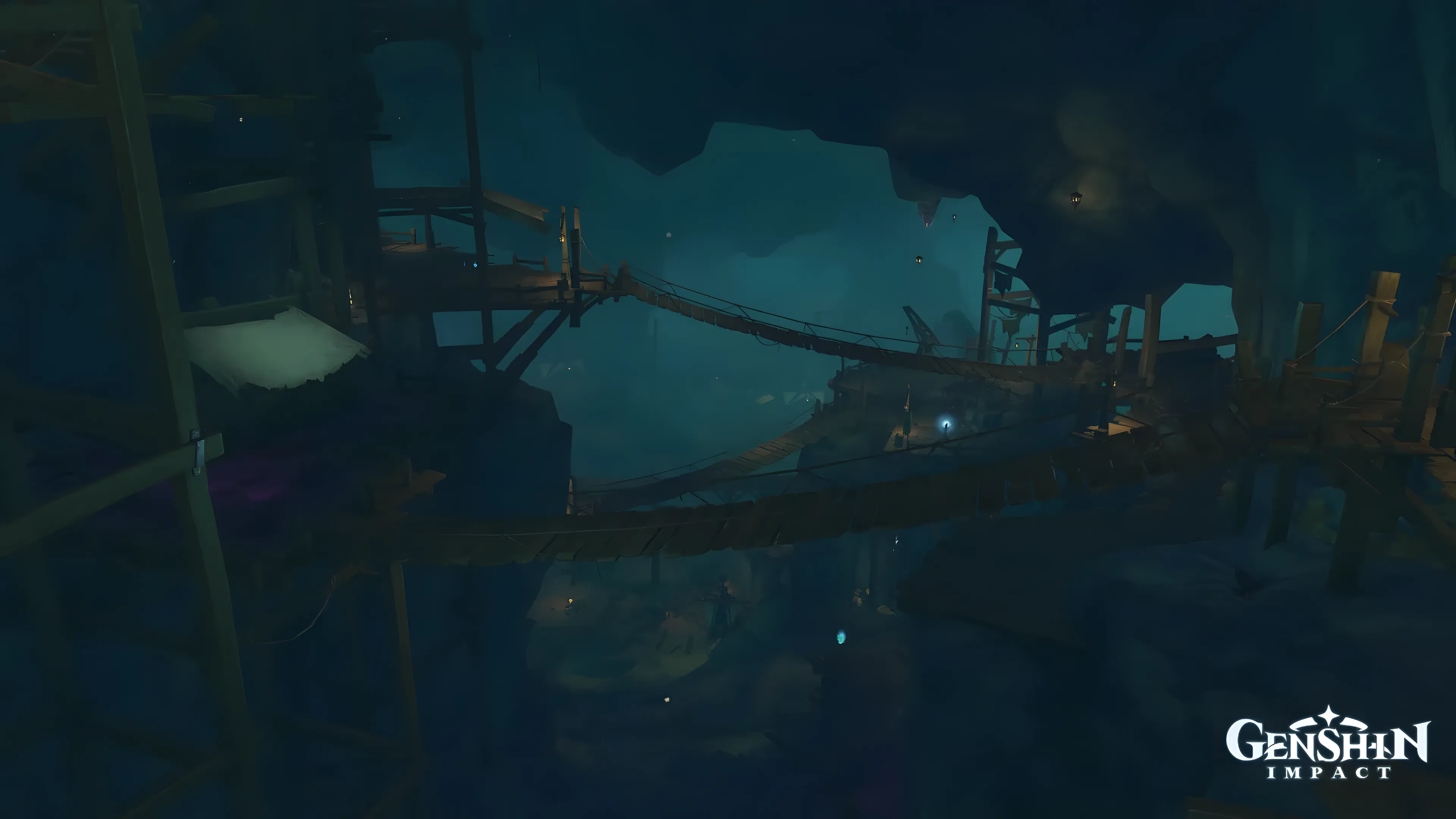
A western Liyue subregion, mentioned in lore from version 1.0 and physically released in patch 2.6. The Chasm layers three catastrophes in one place: a Heavenly Nail strike (the Spiritstone) that destroyed an ancient civilisation whose inverted ruins now hang from the cavern ceiling, a later sky-strike that opened the mining basin itself, and the Cataclysm, when an iron meteorite let Khaenri'ahn monsters loose and the Yaksha Bosacius and the Millelith sealed them in the depths called the Chasm's Bed.
Overview
The Chasm is the western subregion of Liyue, first mentioned by NPCs in version 1.0 and physically released in patch 2.6. Its name covers two distinct map levels: the surface area (the open-pit mining bowl beneath the Seven-Star Array, also called The Chasm: Area) and the much larger Underground Mines beneath it, which contain the Nameless Ruins, the Inverted City hanging upside-down from their ceiling, and the spacetime-distorted instance the Perilous Trail cast called the Chasm's Bed. [1] [2]
The Chasm carries residue from three catastrophes at three different cosmological orders. In deep antiquity a Heavenly Nail strike, the Spiritstone, whose description is "resembles the Skyfrost Nail" at Dragonspine, destroyed the ancient civilisation whose inverted ruins now hang fixed to the cavern ceiling. Dainsleif reads that civilisation as predating Khaenri'ah and the Abyss Order, even though its architecture resembles Khaenri'ah's. Roughly 6000 years ago a separate strike from the sky hit the surface: the Solar Chariot, per Liyue's History timeline, opened the Chasm itself as a mineable basin and displaced surviving tribes toward what would become Chenyu Vale. Then during the Cataclysm 500 years ago, an iron meteorite impacted the Chasm and Khaenri'ahn monsters poured out, drawing the Millelith, the insanity-stricken Yaksha Bosacius, and the brothers Boyang and Rongzhao with the Fantastic Compass into the seal that closed the Chasm's Bed. That seal held until Yelan, Boyang's descendant, cracked it during the present-day Ruin Serpent boss-fight that opens Perilous Trail. [6] [26] [16] [7]
Geography
Surface - The Chasm: Area
The surface sits in western Liyue, its open-pit mining bowl distinct in soil and vegetation from the rest of the region thanks to "special geological conditions, possibly as a result of the meteorite." It was the economic engine of Dunyu Ruins for thousands of years until the Cataclysm. Glazed Sand Crystals are a regional specialty used in porcelain, and unique fluorescent plants thrive in its soil. Seven further subareas on the surface round out the bowl: Cinnabar Cliff, Fuao Vale, Glaze Peak, Lumberpick Valley, The Chasm's Maw, The Surface, and Tiangong Gorge. [2] [1]
Underground Mines - The Chasm: Underground Mines
Beneath the Seven-Star Array opens the Underground Mines, which hold the Chasm's cosmologically significant sites. The subareas of the Underground Mines are: [3]
- Ad-Hoc Main Tunnel, the entrance, passageway to the Main Mining Area.
- The Chasm: Main Mining Area, the spacious main work-area west of the Ad-Hoc Tunnel where most ore is dug. A blocked tunnel at its end leads to the Stony Halls.
- Stony Halls, a sphere-shaped cave whose centre holds "a Spiritstone shard… the crystal has seemingly affected the surroundings to create a spiraling rock formation around itself." The pit below it leads down to the Nameless Ruins, and the Chasm's Bed instance is "right under the Spiritstone."
- The Glowing Narrows, The Serpent's Cave, and Underground Waterway, three further subareas (the Waterway is "south of [the] Main Tunnel").
- Nameless Ruins, the "subarea located in The Chasm: Underground Mines" whose ceiling holds "an upside-down ruin that contains a water pool" fixed up there "for unknown reasons." See History.
- Inverted City, the "point of interest located in Nameless Ruins" whose architecture "somewhat resembles that of Khaenri'ah." Initially barrier-blocked, then unlocked during AQ Chapter II Act IV Requiem of the Echoing Depths. See History.
- The Chasm's Bed, a "quest- and event-exclusive point of interest and instance," a distorted space "that has existed for a very long time before the cataclysm." See History.
Two further inner points of interest sit alongside these: the Spiritstone itself (western Glowing Narrows, "resembles the Skyfrost Nail"), and The Chasm Withered Tree (north of the Main Mining Area, which "looks like the ancient white tree from Dragonspine," a withered Irminsul of the same kind as Dragonspine's Frostbearing Tree, the dead-Irminsul effect the Heavenly Nail page records at every strike site). The Roots of the Valley of Life (east of the Main Mining Area) and the Chasm Exploration Team Camp round out the inner points of interest. [3] [19] [26]
The gadget needed to traverse the Underground Mines is the Lumenstone Adjuvant, acquired in the Chasm Spelunkers sub-quest of The Chasm Delvers and operational only within these tunnels: "Perhaps the stone relies on a unique ley line environment, however, and as such, only works within The Underground Mines of The Chasm." It illuminates the dark tunnels, recharges Lumenlamps and chests, and at higher ranks, once Jinwu has enhanced it, dispels the Oozing Concretions of corrupted Dark Mud. [15] [28]
History
Deep antiquity: the Inverted-City civilisation and the Spiritstone strike
The earliest Chasm inhabitants are the unnamed builders of the Nameless Ruins and the Inverted City within them. The Nameless Ruins page calls them "relics of an ancient civilization with ties to Khaenri'ah," and the Inverted City point-of-interest page clarifies that phrasing through Dainsleif's reading in primary text: "Dainsleif believes that the city was built by a civilization more ancient than Khaenri'ah or the Abyss Order; however, he remarks that the architecture resembles Khaenri'ah's. Since then, the Abyss Order took over the city." So resembling Khaenri'ahn architecture does not make the builders Khaenri'ahn. The builders of the Inverted City predate Khaenri'ah entirely, and the Abyss Order took the city over later. These layers must be kept strictly distinct. [4] [5] [24] [31]
Their end belongs to the same kind of event as the other Heavenly Nail strikes catalogued on the Heavenly Nail page. The primary-text anchor sits inside the Chasm's Bed page's Lore section: "As they fought, the surface of the Chasm was damaged, revealing a 'great and enigmatic underground palace in the bowels of the earth.' This underground palace is likely the inverted structures around the Nameless Ruins, remnants of an ancient civilization destroyed by Celestia using the Spiritstone." The Spiritstone "resembles the Skyfrost Nail" at Dragonspine that destroyed Sal Vindagnyr, and is the Chasm's entry in the six-Nail roster alongside Skyfrost, Tsurumi, Mt. Damavand, the Night Kingdom over Natlan, and Hyperborea. [6] [19] [26]
The upside-down pool at the top of the Inverted City is a relic of that same more-ancient civilisation: "Within the city is an upside-down pool, which weakens the effect of Dainsleif's curse when he is nearby. Dainsleif believes that the pool is also a relic of the more ancient civilization and is part of the city's structure." It is visible through a crack in a wall at the ??? point of interest in Fontaine, "though the altar below it is missing," the only stated case of the Inverted City's structures appearing outside the Chasm. [5]
~6000 years ago: the Solar Chariot, Lang-Gan, and the Chenyu-Vale exodus
A separate strike from the sky, in a much later cosmological age, opened the Chasm as we know it. Per the Liyue / History timeline anchor: "~6000 years ago, while Morax was young - The Solar Chariot falls to the west of what is now Dunyu Ruins, creating The Chasm. This prosperous mining area would sustain the Dunyu area for thousands of years, up until the cataclysm 500 years ago. The tribespeople in the area repair it and eventually it returns to the sky." The surface-area page adds a folkloric layer: "According to legend, the Chasm was originally the ancient civilization of Lang-Gan. The civilization was destroyed and the Chasm would be formed by the Solar Chariot during the War of Funerary Flame." Whether Lang-Gan is the same civilisation as the builders of the Inverted City or a separate culture on the surface is not stated in primary text, and both readings are open. Surviving Chasm tribes fled to Chenyu Vale at this displacement, seeding the ancestral line for Yelan and Lan Yan (the Chenyu Vale page covers the destination side). The migration ran out of the Chasm into Chenyu Vale, not the other way. [16] [2] [17]
Azhdaha's clash with Morax
The surface-area page additionally notes: "Legends also said that this was the area where Morax and Azhdaha clashed in battle." This ties Azhdaha, whom Fandom calls the Geo Dragon of the Seven Sovereigns, to the Chasm's deep cosmology, separate from the Spiritstone's strike and the Solar Chariot. Zhongli remembers the fight himself: "A thousand years ago, Azhdaha attacked The Chasm. I tried to obstruct him, fighting him tooth and nail down the length and breadth of the mine. Finally, I brought him down, and sealed him underground." The seal itself lies further north. The battle ran from the Chasm all the way to Nantianmen, and there Morax, with Mountain Shaper, Moon Carver and a third unknown adeptus, sealed Azhdaha in the Dragon-Queller. Azhdaha's prison and the seal on the Chasm's Bed are separate seals, holding different things and built with different instruments. [2] [21] [25] [33] [32]
Cataclysm 500 years ago: iron meteorite, Bosacius, and the Chasm's-Bed seal
The Chasm was one of the two places in Liyue where the Cataclysm struck hardest (the other being Dunyu Ruins, whose population abandoned the city for Liyue Harbor without leaving any record). Per the surface-area page: "During the cataclysm 500 years ago, an 'iron meteor' fell into The Chasm, which marked the beginning of the Abyss' invasion… An 'iron meteorite' impacted the Chasm and then monsters poured out of the Chasm and in response, Morax sent the Millelith to defend and evacuate the miners." [2] [23]
The insanity-stricken Yaksha Bosacius, eldest and leader of the Five Yakshas (Bosacius, Indarias, Bonanus, Menogias, Alatus), had "left his treasures in the region of Minlin… only to later succumb to his karmic debt and go mad," and had been missing from the Adepti's ranks for some interval prior to the Cataclysm. He returned to fight not from duty but because "having completely lost his sanity by then, Bosacius had only arrived at the battle because he had been attracted by the bloodshed," mistaking the Millelith around him for his Yaksha comrades. That confusion is the basis for Xiao's encounter with the illusion of Bosacius in Perilous Trail centuries later. Beside him fought the brothers Boyang and Rongzhao, both ancestors of Yelan, sent by the Liyue Qixing carrying the Fantastic Compass, a catalyst forged by the adeptus Sea Gazer with the power to manipulate space. The monsters weakened as they descended "perhaps due to the effects of the nail" (the Spiritstone above them), and the "great and enigmatic underground palace in the bowels of the earth," the ruins of the Inverted City, revealed itself as the Chasm's floor broke. They devised the sealing plan: lure the monsters into the spacetime-distorted depths and trap them with the Fantastic Compass, which required "significant energy from both a mortal and an adeptus to power it, and the trap would seal some of them away along with the monsters." Bosacius and Boyang volunteered to sacrifice themselves for the sake of Liyue. [7] [8] [6] [14] [13]
The seal closed. Per the Chasm's Bed page: "The Millelith had lost many of their comrades but emerged victorious against the monsters. The monsters had lost all mobility and disappeared as they were devoured by the space. And, so too, the surviving Millelith were also eventually devoured… leaving only Boyang and Bosacius… Eventually Bosacius sees illusions of his Yaksha comrades and remembers his name and purpose, and together with Boyang, they use the Fantastic Compass to complete the seal around the Chasm's Bed. Bosacius then perishes leaving Boyang the last one left until eventually he too perishes." Because Bosacius had forgotten his own name, "legends of the battle at The Chasm referred to him as the 'Nameless Yaksha.'" Rongzhao survived the surface battle but went insane from karmic debt, "only temporarily soothed by passing Wangshu Inn," Xiao's residence. That family curiosity is what later drives Yelan into the Perilous Trail party 500 years on. [6] [7] [8]
Recent past: Spiritstone corruption, the Fatui Mokosh Device, and the Qixing reopening
The seal held for ~500 years. In the recent past the Spiritstone was corrupted, possibly by the Abyss Order. Per the surface-area page: "It is later revealed during the Traveler's descent into the Chasm that the mysterious earthquakes and black ooze was a result of possibly the Abyss Order corrupting a nail similar to the Skyfrost Nail in Dragonspine." The quest itself names no culprit. Paimon sees "purple-blackish stuff" all over the crystal and afterwards asks, "Where did that dark mud and the strange monsters come from?" [20] The corrupted Spiritstone produced the mining accidents and black ooze that infested the mines, and the Qixing closed the entire subregion. [2] [26]
Before the Outlander's arrival in Liyue, the Fatui, "with Signora's help," entered the closed mines, "discovered that black ooze had begun to infest the mines… offered to deal with the ooze but failed as their device exploded and no further news was expected following Childe unleashing Osial on Liyue." The Outlander later learns the Fatui device's name during Wherefore Did the Spiritstone Descend?: the Mokosh Device, "An explosion has occurred. Cause unknown. The Mokosh Device, which should have theoretically been able to clear the Abyssal corruption from this place, has overloaded and been destroyed…" The surviving Fatui Action Log fragments (If Not Us, Then Who? hidden objective) are the only residue of the failed first attempt. After the Fatui withdrawal the Qixing began "to slowly reopen the mine, initially restricting access to the surface area. As a result, Treasure Hoarders began to sneak into the mines for wealth," which is the surface-area state when the Outlander first descends. [2] [20] [18]
Present day: the Outlander's descent
The Outlander's arc runs across three quests that carry the primary text.
The Chasm Delvers opens the Underground Mines. The Outlander joins the Chasm Exploration Team led by Zhiqiong, Jinwu helps the Outlander obtain the Lumenstone Adjuvant through Chasm Spelunkers, and the closing Wherefore Did the Spiritstone Descend? takes the Outlander to the corrupted Spiritstone, where striking the four mechanisms of corruption around it "causes the black ooze to recede and the earthquakes in the region to subside." The team stays on for now; in Zhiqiong's words, "we might stay here for a while yet, help the Ministry staff watch over the underground anomalies, and maintain the exploration facilities." Muning makes it an official arm of the Huishan Hall. [11] [20] [28]
AQ Chapter II Act IV Requiem of the Echoing Depths is the interlude act that takes the Traveler's party into the Chasm, requiring The Heavenly Stone's Debris (within Chasm Delvers) for entry into the Nameless Ruins. Yuehui, a miner, commissions the Outlander through Katheryne regarding strange hilichurl activity. The Outlander descends the pit in the Stony Halls and discovers the Inverted City, whose architecture reminds Paimon of the Defiled Statue, and Dainsleif appears from the portal of an Abyss Herald he was pursuing and joins the trio. The party finds an Inteyvat, the Khaenri'ah national flower, in a hilichurl camp; touching it triggers a vision of the Outlander's Sibling discussing a plan with an Abyss Herald to "amplify the water pool's special properties, remove the curse from the gathered hilichurls, and restore 'the homeland.'" The Sibling reads the hilichurls as cursed remnants of the ancient civilisation's builders, while Dainsleif reads the curse as irreversible and the amplification as only multiplying suffering. The Outlander sides with Dainsleif. At climax an Abyss Lector: Violet Lightning activates the amplifier atop the Inverted City, the Black Serpent Knight Halfdan sacrifices himself to stop the device long enough for the Outlander to defeat the Lector and destroy the four mechanisms powering it, Halfdan's soul briefly converses with Dainsleif before passing on, and Dainsleif "leaves to recuperate from the device's effects and to investigate the Abyss Order's Loom of Fate project." The Abyss Order's Loom of Fate should not be equated with the broader reading tied to the Heavenly Principles. [9] [10] [22] [30]
Perilous Trail (Interlude Chapter Act II, version 2.7) re-enters the Underground Mines and digs up the legend of Bosacius, Boyang, and the Fantastic Compass. Yelan fires at the Spiritstone during the Outlander's confrontation with the Ruin Serpent "Haftvad the Worm," "because it is highly effective against remnants of Khaenri'ahn civilization," and the impact damages the Cataclysm-era seal. The fall opens the Chasm's Bed. The party of six (Outlander, Paimon, Yelan, Arataki Itto, Kuki Shinobu, and Yanfei, later joined by Xiao who entered separately seeking the Nameless Yaksha) discovers what the space does: it distorts itself and time, suspends physical conditions, and reads minds to create illusions. There they meet the lingering illusion of Bosacius that the space conjured from his final memory. Xiao pays his respects, the party imagines the Fantastic Compass into existence using the space's own mind-reading mechanism, and the illusionary Compass gets them out before it dissipates "once exposed to normal spacetime." The Outlander's exit re-stabilises the seal, and the entrance to the Chasm's Bed becomes "permanently inaccessible" after the chain closes. [12] [6] [29]
Version 7.2: Liyue's Trial of Usurpation
In Chapter VII the Nails of Retribution activate and the Holy Soil phenomenon spreads across Teyvat. Stopping it takes a set of trials, each of which "requires someone to enter the Nail of Retribution and prove to the Heavenly Principles that their divine plan is still in effect." Liyue's is the first passed, during the leaders' meeting at Zapolyarny Palace in Act V, Hour of Ruin. The game's narration of the cutscene, recorded on Fandom's quest page, sets it here: "In the depths of The Chasm, Zhongli emerges from within the Nail of Retribution. In his palm, a Mora that symbolizes contracts takes shape. One of the Nail's runes disappears. It seems Liyue has passed its trial..." [34] The dialogue names no one. Xianyun reports only that "a mysterious adeptus deployed a magic array using a Mora coin as a catalyst, and entered inside the nail," proving "that the contract is still valid." [35] The narration does not name the Spiritstone either, but Fandom's Nail of Retribution page lists the Spiritstone as Liyue's Nail. [37]
Layers of catastrophe in one place
Like Tsurumi Island in Inazuma, the Chasm stacks residue from several catastrophes at different cosmological orders in one subregion. The Spiritstone belongs to the Heavenly Nail six-Nail roster alongside the Skyfrost Nail (Dragonspine), the unnamed Tsurumi Nail, the Mt. Damavand Nail (Sumeru), the Night Kingdom Nail above Natlan, and the Nail that destroyed Hyperborea. The corrupted nail the Outlander purifies in Chasm Delvers is the same Spiritstone. Fandom suggests the Abyss Order possibly corrupted it in the recent past; the quest names no culprit. [2] [20] The withered-Irminsul side-effect appears in the Chasm Withered Tree, of the same kind as Dragonspine's Frostbearing Tree. [26] [3]
The Cataclysm-era layer (the iron meteorite, the eruption of Khaenri'ahn monsters, and the seal Bosacius and the Millelith placed on the Chasm's Bed) sits on the Cataclysm page, and must be strictly distinguished from the Spiritstone's strike in deep antiquity that destroyed the builders of the Inverted City. The Cataclysm's iron meteorite is not the Spiritstone, its Khaenri'ahn monsters are not the cursed remnants of the Inverted City's civilisation, and the builders of the Inverted City predate Khaenri'ah and the Abyss Order entirely even though the Abyss Order took over their ruins. The Sibling's Requiem reading that the hilichurls are cursed remnants is one character's voice; it does not fold the builders of the Inverted City into the Khaenri'ahn lineage as doctrine. [23] [24]
Azhdaha stands apart. Fandom's Azhdaha page calls him the Geo Dragon of the Seven Sovereigns, and its Seven Sovereigns table lists him as the original Geo Dragon. Both now cite Zibai's line at the leaders' meeting in Chapter VII Act V, "the great Geo Dragon, Azhdaha," which names him a Geo Dragon rather than a Sovereign; an earlier revision rested on a note that the English "Dragon Sovereign" renders the same Chinese term, 龙王 ("dragon king"), as his own title. [36] [35] (Bathysmal Vishaps are not Sovereigns.) The surface-area page places his clash with Morax here, but his prison is the Dragon-Queller at Nantianmen, where that battle ended. Azhdaha's prison and the seal on the Chasm's Bed are separate seals, holding different things and built with different instruments. [25] [21] [27] [32]
Connected pages
The parent region Liyue is the harbor nation Morax founded about 3,700 years ago, governed in the present by the Liyue Qixing after the Archon's retirement. The Chasm sits at its western frontier, and both threads, Azhdaha's battle with Morax and the Cataclysm story of Bosacius and the Chasm's Bed, flow up into the broader history of Liyue. Tsurumi Island is the Inazuman counterpart in this pattern of layered hazards, built the same way: a Heavenly Nail strike destroyed an ancient civilisation, a later civilisation overlaid the older ruin, and a present-day exploration arc resurfaces the whole cosmology. The specifics differ, though, with Celestia worship from before the Thunderbird in place of the pre-Khaenri'ah builders of the Inverted City, and Kapatcir's grief-curse in place of the Abyssal eruption of the Cataclysm. Among nearby regions, Dragonspine is the site of Sal Vindagnyr and of the Skyfrost Nail the Spiritstone is said to resemble, and Chenyu Vale is where the surviving Chasm tribes fled ~6000y ago after the Solar Chariot displaced them.
The cosmology is anchored on Heavenly Nail (which places the Spiritstone in the six-Nail roster), The Cataclysm (the iron meteorite of 500y ago and the seal made with Bosacius, Boyang, and the Compass), Khaenri'ah (the rule that the Inverted City resembles Khaenri'ah but predates it), Seven Sovereigns (where Azhdaha's standing as Geo Sovereign is discussed), and Bathysmal Vishaps (the reminder that they are not Sovereigns, which guards against misreading the Ruin Serpent as a Bathysmal Vishap). The primary-text quests are The Chasm Delvers (the opening arc, which purifies the Spiritstone), Perilous Trail (the return to the Chasm's Bed that brings out the Bosacius / Boyang legend), and AQ Chapter II Act IV Requiem of the Echoing Depths (the act that unlocks the Inverted City, covering Halfdan's sacrifice, the naming of the Loom of Fate, and the Sibling's vision through the Inteyvat). For character and deep-dive context, Dainsleif is the companion in the Inverted City whose curse the pool weakens and whose investigation of the Loom of Fate bridges to later patches, Khaenri'ah, the Cataclysm, and 500 years after anchors the chronology of the iron meteorite, the Inteyvat, and the Loom of Fate, and How to tell Khaenri'ah's Crimson Moon and Eclipse dynasties apart protects the reading that the builders of the Inverted City predate Khaenri'ah.
Open questions
Is Lang-Gan the same civilisation as the builders of the Inverted City? The surface-area page gives a folkloric "ancient civilization of Lang-Gan… destroyed by the Solar Chariot during the War of Funerary Flame," while the Chasm's Bed page describes the Inverted City's civilisation as "remnants of an ancient civilization destroyed by Celestia using the Spiritstone." The two differ on instrument (Solar Chariot versus Spiritstone) and temporal order (the Solar Chariot fell ~6000y ago, while the Spiritstone's strike came before the Chasm was a mining basin, and so before that date). Whether they are two civilisations on the same site at different cosmological depths, or whether folklore's naming of Lang-Gan conflates the older Nail strike with the later fall of the Solar Chariot, is unresolved. [2] [6] [16]
Paimon's Requiem reaction is that the Inverted City reminds her of the Defiled Statue at Stormterror's Lair, and Dainsleif overrides her with his reading that the city is older than Khaenri'ah; whether that resemblance is cosmologically meaningful or coincidental architectural language is open. [9] [10] The fate of the builders of the Inverted City is the central ambiguity the act closes on. The reading that the Spiritstone destroyed the civilisation is an inference on the Chasm's Bed page, not first-person primary text. And whether any of the Requiem hilichurls are cursed remnants of the original civilisation (as the Sibling and Abyss Herald claim) or generic Khaenri'ahn hilichurls that the Abyss Order later layered on top is exactly what the Outlander and Dainsleif disagree on. [6] [9]
The Spiritstone's purified state after Chasm Delvers is also unstated: purification causes "the black ooze to recede and the earthquakes in the region to subside" and the Spiritstone resumes its role as a Heavenly Nail, but whether its deep-time function is also purified, or whether it still suppresses residual cosmological forces beneath the Chasm (as the Skyfrost Nail does at Dragonspine after In the Mountains), is not in primary text. [2] [20] The Enkanomiya idea of a time before the sun and moon (from the 2.4 WQ Erebos' Secret, the chain of Eboshi, the Bathysmal Vishaps, Watatsumi Omikami, and the Dainichi Mikoshi) is easy to confuse with the pre-Khaenri'ahn ruins of the Inverted City. Both are pre-Cataclysm and pre-Archon, but they are distinct things with no shared origin, and the two should not be cross-linked on that basis. [30]
World Quests
- The Chasm Delvers · Patch 2.6