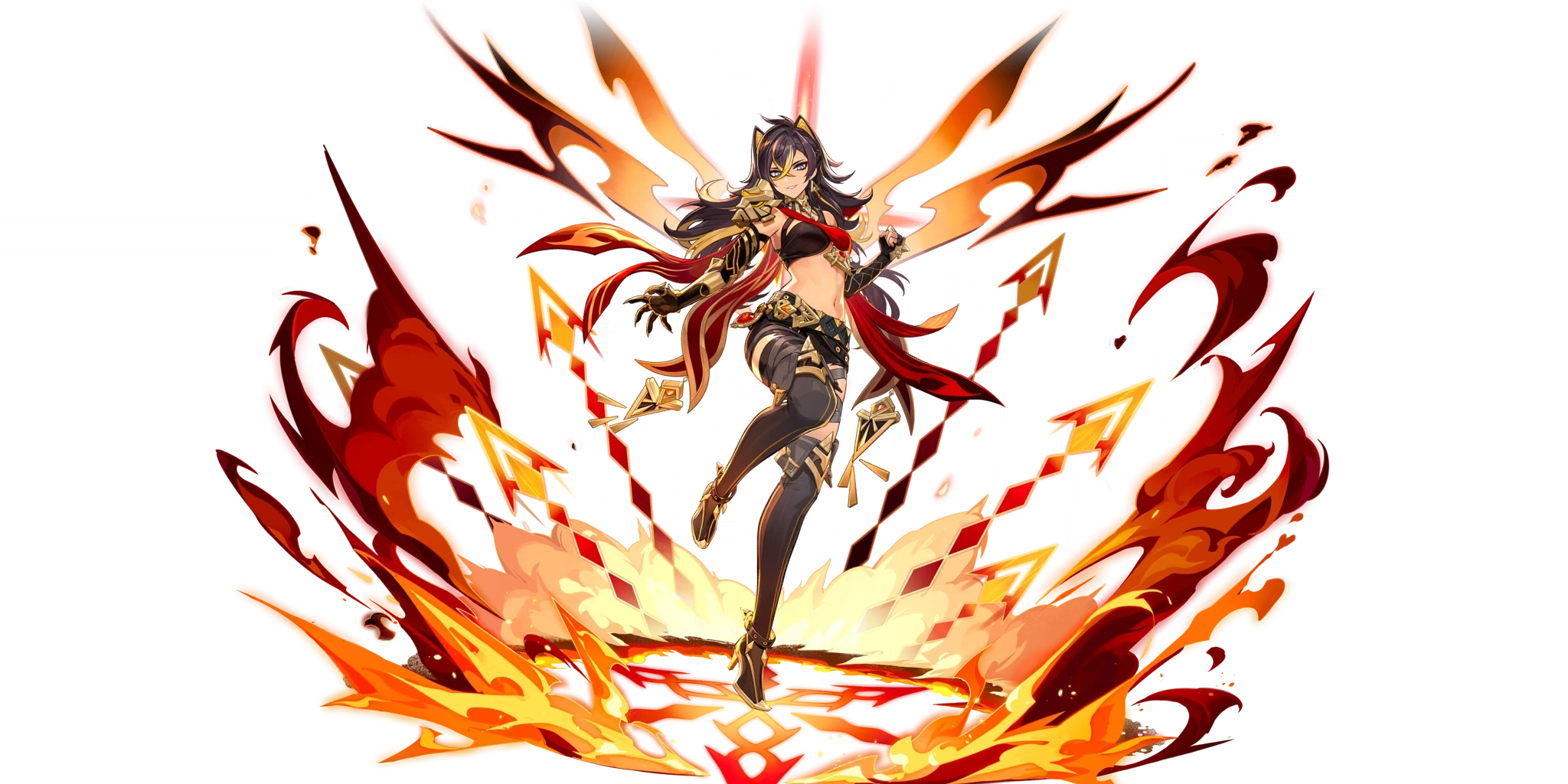


Dehya is the Flame-Mane, a senior Eremite mercenary of the Setaria-descendant tradition. Before the Sumeru Archon Quest her work centred on protecting Aaru Village and the wider desert through mercenary contracts, the kind of arrangement that kept desert-civilian life running in the spaces the Akademiya never reached. Her standing among the Eremites is the backbone of how that tradition cooperates with the desert's civilian sector.
Who she is
Dehya is a senior Eremite mercenary. The Eremites are Sumeru's Setaria-descendants, the people who handle the desert's contracts for tribal politics and civilian protection that the Akademiya leaves alone, and her own work has concentrated on the protective side: Aaru Village engagements, cross-village protection, and mediation between feuding tribal factions. Her epithet, "Flame-Mane," comes from combat. In sustained fighting her Pyro throws off a lion's-mane effect of flame. She is an allogene with a Pyro Vision, and her style is built on claymore and Pyro, with sustained output and a shielding, counter-attacking approach suited to protecting civilians rather than to offence on an army's scale.
History
The Eremites are Setaria-descendants, the surviving humans of King Deshret's pre-Cataclysm desert court who lived through the collapse caused by Forbidden Knowledge that destroyed Setaria itself. They are mercenaries and tribes rather than civilians and villages, handling the desert's mercenary contracts across a range of arrangements for tribal politics and protection. Their lineage is native to the Sumeru desert, traced to Deshret's court rather than to the line of Khaenri'ahn alchemy, and Dehya works within that tradition of Setaria's descendants.
A community reading holds that some Eremite weapons contain Spirits of Omen that may be the same kind of being as the Jinn, an idea built on Liloupar's "Spirit" framing in the World Quest "The Temple Where Sand Flows Like Tears" (Liloupar is herself a Jinn) and on a shared visual design with the Jinn that appear in Welkin Moon Archon Quest Act IX "As All Falls to Emptiness." The equivalence of the Spirits of Omen and the Jinn stays a community reading rather than confirmed canon. Dehya's own story does not touch those weapons in primary text, so the cross-reference belongs to the Eremites generally, not to her specifically.
Her pre-Archon-Quest arc concentrated on Aaru Village and the broader desert, where the Eremite mercenaries worked alongside the surviving civilians descended from Setaria and Dehya was senior and respected. The work was protective rather than extractive: she cooperated with civilians rather than preying on them, and her partnership with Candace and Aaru Village anchors that cooperation across several engagements. After the Archon Quest she stays an Eremite mercenary. She has not moved into work inside the Akademiya despite the reformed Akademiya's broader openness to the desert, and her identity stays with the mercenary tradition rather than anything administrative.
On screen
Dehya's on-screen Archon Quest role concentrates in Chapter III Act IV, King Deshret and the Three Magi, where the chapter's cooperation among desert civilians pulls in her mercenaries alongside Candace's Aaru Village commission. Her work with the Outlander there is professional, and the act's reckoning with the traditions of the Eremites and of Setaria's descendants runs through both her side and the wider civilian one. She has no dedicated Story Quest, so her arc otherwise runs through that act and the event material, where she recurs across arcs about Eremite mercenaries and quest chains about protecting desert civilians, warm and protective in the civilian work and formal and direct on the jobs.
In Chapter VII Act VI (Version 7.2) she stays offscreen, but Tighnari reports that "Dehya and her mercs are in the desert as we speak, dealing with the monsters that have emerged as a result of the Hallowing," and Nilou adds that "They've also been evacuating people from the desert and sending them here." [5]
Open questions
- The full landscape of Eremite tribal politics. Canon establishes the Eremites as descended from Setaria and as mercenaries and tribes, but documents the specific tribal politics only in part across the desert World Quests.
- Where Dehya ends up. Canon keeps her in the mercenary tradition; whether the reformed Akademiya's desert cooperation eventually folds her in is open.
- What was inherited from Setaria's collapse. Canon glosses over the period after Deshret's death when the lineage formed, leaving the specifics only partly documented.
Dehya's closest parallel is Candace, who holds the civilian-guardian side of the same desert; for the wider setting see Sumeru, and for another desert-rooted Akademiya outlier see Faruzan.