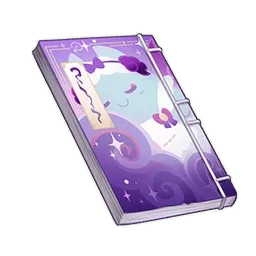
Glimpses of Mysterious Inazuma is a two-volume Inazuman Book Collection released in Version 5.4. It first appeared at the event venue of the Enchanted Tales of the Mikawa Festival, and after the event Kuroda sold it at the Yae Publishing House in Inazuma City. Both volumes carry the same item description: "A collection of Inazuman folk stories transcribed by a traveling writer from Fontaine. Its pages contain a wealth of myths and strange tales passed down orally by people all over Inazuma." That transcriber, "a traveling writer from Fontaine," is the framing voice of the collection. The interlocutor in Vol. 1's closing exchange is named only as Miss Usa, and the writer is never personally named. [1] [2]
Vol. 1 - The Mysterious Maiden of Genbou
A young samurai-official named Takehiko, "refined and elegant" and "trained… assiduously in both the cultural and martial arts," visits the home of the illness-stricken Emon no Kami - "Chief of the Gate Guard" - and falls in love with the Chief's only daughter Sayohime. They secretly pledge to marry once Sayohime comes of age, only for rebels to "stir up trouble" and Takehiko to march off at the Shogunate's orders. Both lovers exchange parting poems and Takehiko gifts Sayohime "a hand mirror of exquisite craftsmanship to be held by her during their wedding." Months later, false rumour of the Shogunate army's defeat reaches Sayohime; she dies "of a broken heart," but "perhaps because she perished with such intense longing in her heart, burial proved insufficient to lay Sayohime to rest" - instead, "she became corrupted by the Abyss, returned to the mortal realm as a demon." [1]
Takehiko, returning from the war, panics at her transformed apparition ("the tender hands that used to caress Takehiko's cheeks" now "bony appendages, darkened by death"), flees to a riverbank, then to Mt. Yougou, where "with magic learnt from the bake-danuki" he hides inside a stone among countless others. The hand mirror Sayohime drops shatters and reveals him; she "turned herself into a raging ball of flame, consuming both herself and the concealed Takehiko, till they were naught but ashes."
The volume's closing frame is the Fontanian transcriber and Miss Usa discussing the tale over tea. The Fontanian narrator stakes a Fontaine-coded operatic position - "the lovers we sing of in our operas are inseparable, even in death" - and cross-references Drest and Adsiltia's promise, the duel in Tancrede et Chariclea, and the farewell between Coppelius and Coppelia. Miss Usa replies that "in Inazuma, many people see Takehiko as a coward and a traitor to his beloved," and that the tale "was originally inspired by a novel from Liyue" in which "the protagonist never betrayed their lover, and the two were unable to meet for a long time because of the interference of evil-doers who transformed the girl into a monster and imprisoned her beneath a stone" - but she does not name the Liyue source, and neither the page nor the in-game text identifies it.
Vol. 2 - The Yumekui-Baku
An elderly couple "near Konda Village" - poor but "compassionate, and so earned the respect of their neighbors" - anchor the second volume. The old man frees a "plump little beast" (he assumes a young wild boar) from a hunting trap on the mountain. That night, a young woman "around seventeen or eighteen years old, braving the wind and snow" arrives at their door pleading shelter; the couple take her in, she stays on as adoptive daughter, and her overnight pastries - made "following a recipe passed down by my family" - sell "for a fittingly high price" among the town's wealthy merchants. Spying on her one night, the couple discover "a plump little beast, using its snubby nose to snatch floating dreams out of the air, then turning them into pastries." [1]
The reveal is self-correcting: "Firstly, I am a baku - well, technically speaking, a 'mo' - from Liyue, not a wild boar." The girl serves "my mistress - the one who oversees countless sweet dreams and nightmares," whom the text does not name, and is afraid the disclosure "might spell disaster in the near future." The old man's running gag - "Ah, I don't care if you're a human or a wild boar, you're still our darling daughter!" - runs against the baku's repeated correction ("Also, I am a baku, not a wild boar") until the volume settles into a happy-ending coda: "With their daughter's delicious pastries to sell, the old man and woman spent their twilight years in comfort and prosperity. And they all lived happily ever after."
Folk-tale setting and the Fontanian frame
The setting is Inazuman folk-tale: samurai, ashigaru, the Shogunate, Emon no Kami / "Chief of the Gate Guard" as a courtly title, Mt. Yougou as a sacred mountain, bake-danuki shape-stone magic in Vol. 1, and Konda Village as a named real-world Inazuma village in Vol. 2. That vocabulary maps onto genuine cultural and geographic facts of present-day Inazuma, but the volumes use it as setting paint within a folk-tale frame, not as a chronicle of the Shogunate or any specific named institution. [3]
The framing device, "a traveling writer from Fontaine," is the in-fiction conceit of the collection. The item description and Vol. 1's "Speaking from our Fontanian [sic] perspective" self-identification mark the transcriber as Fontanian-coded, and the closing operatic cross-references (Drest and Adsiltia, Tancrede et Chariclea, Coppelius and Coppelia) sit in the Fontaine operatic mode, not the Inazuman one. The collection performs its Fontaine-vs-Inazuma reading directly on the Genbou tragedy. The Fontanian narrator laments that "as a proud samurai of Inazuma, Takehiko should know the value of promises and oaths better than any of us," while Miss Usa counters that Takehiko's real failure was refusing to "offer her salvation" once she was an Abyssal demon. Both readings stand; neither is adjudicated. [4]
The book is published, sold, and obtained in Inazuma through the Yae Publishing House imprint via Kuroda. Its shelf-siblings on the same imprint are Flowers for Princess Fischl (V2.1; Mr. Nine's Mondstadt-coded Immernachtreich light novel) and Princess Mina of the Fallen Nation (V2.1; a pulp samurai light novel set in the in-fiction nation of Kogami). As both of those precedents show, distribution through the publishing house carries in-universe books, light novels, and folk-tale collections to readers without relocating the text's content or framing onto Teyvat-historical canon. [5] [6] [7]
So the volumes are folk-tales, not testimony. The Vol. 1 turn, "corrupted by the Abyss, returned to the mortal realm as a demon," is a folk-tale beat the genre expects, not a chronicle of any named Abyssal corruption event in Inazuma. Sayohime never appears in any Inazuman quest, character, or framework. Vol. 1's Liyue "novel" whose protagonist "never betrayed their lover" and whose lover was "transformed into a monster and imprisoned beneath a stone" goes unidentified: the in-game text does not say which Liyue tale this is, so neither does this page. The Vol. 2 "baku - well, technically speaking, a 'mo' - from Liyue" and the unnamed "mistress - the one who oversees countless sweet dreams and nightmares" stay uncertain as Liyue identifications; the baku's self-description and the patron's job description are recorded as the volume gives them, and no further guess about the patron is offered.
Nor is this a record of the festival or the village. The Enchanted Tales of the Mikawa Festival was only the V5.4 distribution channel, not the source of the tales it carried. The Vol. 2 elderly couple "near Konda Village" are folk-tale figures rather than quest NPCs, and the village name simply sets the "snowy day in winter" opening.