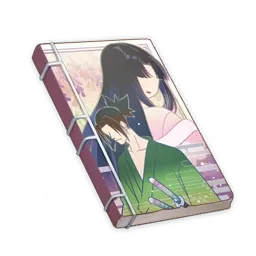
Princess Mina of the Fallen Nation is a six-volume Inazuma Book Collection released in Version 2.1, sold at the Yae Publishing House in Inazuma City for Vols 1-4 and 6, with Vol. 5 obtainable at the Yashiro Commission Headquarters. It shipped in the same popular-fiction-heavy wave as Flowers for Princess Fischl, Toki Alley Tales (Vols 4-6), New Chronicles of the Six Kitsune (Vol. 6), and Onibudou, as the Inazuma chapter settled into its post-AQ-II afterlife. The series bills itself in-universe as a "super-popular romantic adventure" (its own back-matter advertises Vol. 2 with that line), published under the Yae Publishing House imprint. [1] [2]
The arc
The frame is a fictional warring-states period set in the in-fiction nation of Kogami. "Thirteen years of peace were had before the era of warring states began," Vol. 1 opens, before the northern nations "hurling themselves into the flames of war" collapse. Out of the wreckage strides a wandering samurai - "a man dressed as a woman" in luxurious robes, accompanied by "a petite girl wearing a haori that was large to the point of incredulity" - through a foothill checkpoint where the ashigaru drop unconscious before the conversation can finish. Vol. 2 is the "princess who brings destruction" beat at a "nameless mountain shrine," where the samurai - void-like eyes now aflame - pronounces the title prophecy "an utterly stupid concept. You'll understand soon enough." [1]
Vol. 3 is the Avici beat at the desolated capital, and it lays out the exposition: the war has run "over a century now," sustained by Nakura's Hex, "a terrifying sorcery that sucked the life of all living things and the land itself dry, giving it unto powerful samurai and feeding the war effort," wielded by the Nakura Daimyo who were themselves created by "the Onmyouji who dwell in the Sky Tower at the center of the world." The volume closes on the samurai's exegesis: "O 'princess who brings destruction'… Has this world not already been destroyed?" Vol. 4 is the flashback beat in the wasteland of Kogami - a green samurai (the protagonist) meets a pale samurai across a sand dune and recounts how "the thirteen samurai banded together to defeat the Nakura Daimyo," only for Kogami "bereft of its ruler" to become "a paradise for those who would plunder it"; "in the end, only two escaped."
Vol. 5 is the Sky Tower confrontation: the pair argues atop the Tower while the oldest onmyouji finally states the doctrinal beat - "Nakura's Hex was originally created to preserve the vitality of a world that was slowly declining" - before the samurai cuts him off. Vol. 6 is the boundless-desert coda: the Sky Tower's plans complete, "vitality remaining in the world had all been stored up," the world is "most certainly done for," and the samurai walks on - "'Might as well destroy another world... if it exists.' And so the samurai embarked on a new journey." A bracketed editorial postscript turns the remainder of Vol. 6 into an in-fiction setting-appendix on "the various wicked overlords and monstrous creatures that did not appear in the main narrative." [1]
What the setting borrows, and what it is not
The setting is Inazuman pulp: samurai, ashigaru, haori, daimyo, mountain shrines, the Onmyouji of the Sky Tower. That vocabulary maps onto real things in present-day Inazuma (onmyoudou is the Inazuma-Liyue cross-regional mystic art Kamuna Harunosuke developed per the Shimenawa's Reminiscence artifact-set narrative), but the book uses it as backdrop, not as a chronicle of those institutions' actual history. The nation of Kogami, Nakura's Hex, the Nakura Daimyo, the Sky Tower, and the thirteen samurai of Vol. 4's flashback are in-fiction proper nouns true only between the covers of this novel. [3] [4]
A note on the other-language titles records that the Korean title (Mangguk-ui Minahime) is a parody of Code Geass: Akito the Exiled; the other localisations all simply translate the literal "Princess Mina of the Fallen Nation / Ruined Kingdom" sense (Japanese / Chinese 亡国の美奈姫 / 亡国的美奈姬 Boukoku no Mina-hime / Wángguó de Měinài Jī). The most-cited single line of the series is the Vol. 5 samurai retort "if you wrote this drivel nowadays, people would chuck it into the nation of Tokoyo, and that would be for the best." That is in-fiction self-deprecation. The Tokoyo here is the fictional nation internal to the novel where unwanted manuscripts go, not the present-day Inazuma Tokoyokoku of The Serpent and Drakes of Tokoyokoku (the Watatsumi-tied otherworld) or the broader 常世 (eternal-world / otherworld) sense in Shinto. [1]
The book is a light novel, not a historical record. The "Fallen Nation" is the in-fiction Kogami: not Khaenri'ah, not Remuria, not Sal Vindagnyr, not the Faded-Castle sunken-Remurian-palace of The Fall of the Faded Castle, and not any other Teyvat-canon Cataclysm-fallen polity. The cross-dressing samurai with "void-like eyes" is a pulp archetype within the novel's own frame, not the Wanderer, not Scaramouche, and not any other on-screen Inazuman character; the resemblance is genre convention, not identification. The thirteen samurai are not the Thirteen Sovereign Lords of Natlan or any other Teyvat-canon thirteen-count framework. As Hex & Hound establishes for the imprint, Yae Publishing House distribution gives an in-universe light novel its reach and does not relocate the in-fiction setting onto Teyvat-historical canon. The Vol. 5 line "originally created to preserve the vitality of a world that was slowly declining" echoes the "a world on the brink justifies drastic measures" beat the wiki tracks at Archon level elsewhere, but the echo is thematic resonance in a pulp novel, not testimony. [5]