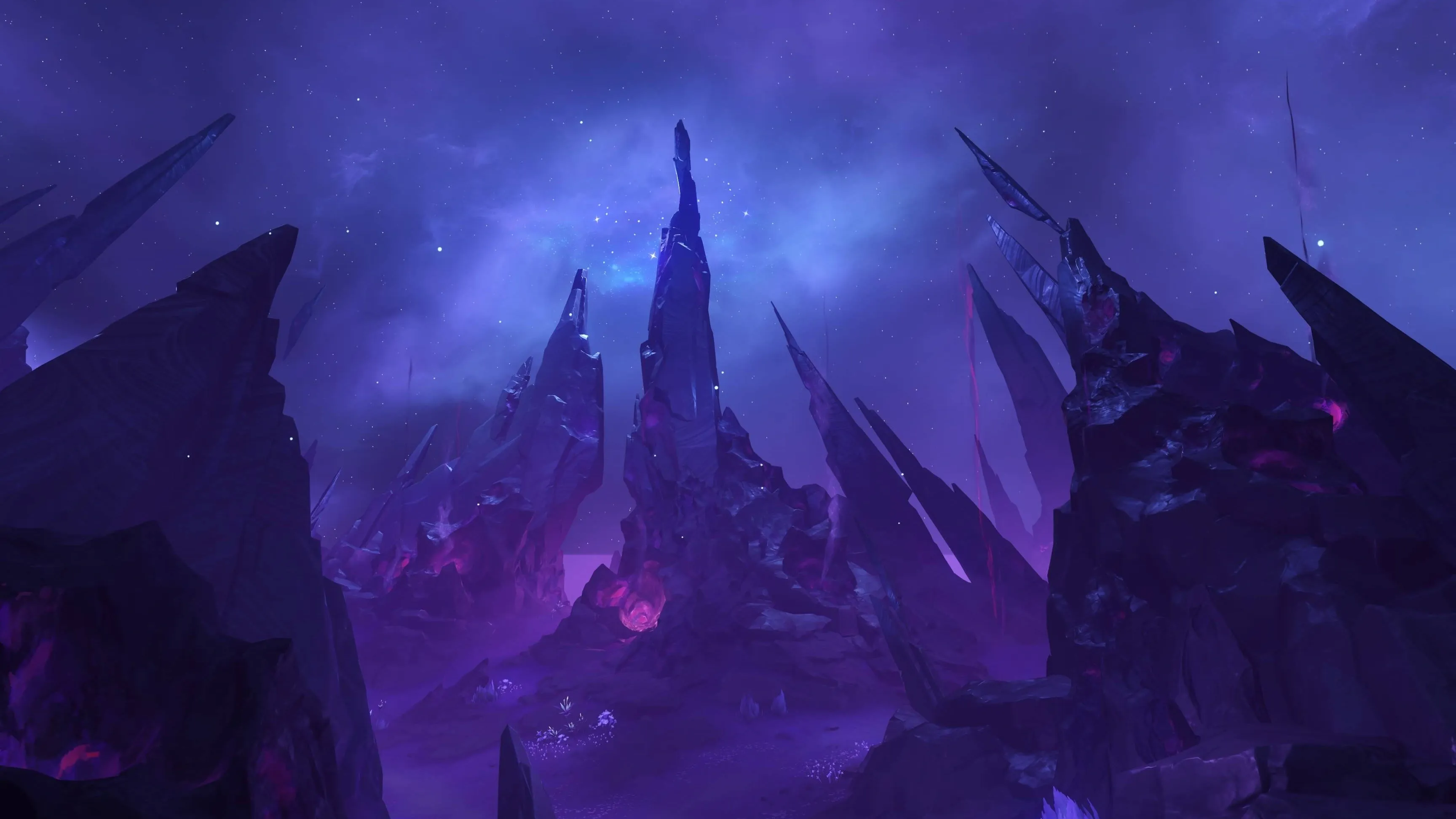
The Abyss is the dark side of Teyvat's cosmology, in roughly the same sense that the Heavenly Principles are the bright one. Where Celestia hands out Visions and enforces order from above, the Abyss leaks into the world from below: through cracks in Irminsul, through Khaenri'ahn ruins, through the eternal night under Enkanomiya. Hilichurls include documented groups of cursed humans, Ruin Guards are Khaenri'ahn relic machines, and Abyss Heralds are Abyss-aligned beings; these ties do not make them one ancestry or transformation class.
The Abyss has at least three distinct meanings the game uses interchangeably, and untangling them helps:
- The Abyss as a place, a literal realm with its own geography. The Traveler visits it briefly in cutscenes, and Dainsleif and the Traveler's sibling describe it. It has its own day-night cycle, its own creatures, and (per Skirk) its own deeper layers.
- The Abyss as a force, a corrupting energy that bleeds into Teyvat anywhere the Heavenly Principles' authority is weak. Khaenri'ah after the Cataclysm is the textbook case: a nation cut off from Celestial sanction, gradually consumed by the Abyss.
- The Abyss as a faction, the Abyss Order, a militant coalition of Khaenri'ahn survivors and Abyssal beings working against Celestia's rule. It was founded after the Cataclysm by Chlothar Alberich, a Khaenri'ahn noble who discovered an ancient sinner named Vedrfolnir in Sumeru's ruins and was changed by his power. Vedrfolnir is one of the Five Sinners of Khaenri'ah, pre-Cataclysm Khaenri'ahn humans who acquired transcendent Abyssal authority through Dainsleif's operation to rescue Vedrfolnir, each taking a one-sixth share of the world-shattering Abyssal power Irmin had induced the Sibling to absorb (the primary text is Welkin Moon Act IV "An Elegy for Faded Moonlight"). [3] [10] All five Sinners are now named as of Luna II: Rhinedottir, Vedrfolnir, Surtalogi, Hroptatyr, and Rerir. See the Five Sinners of Khaenri'ah page for the group, and the Surtalogi page for the biography of "The Foul" as Skirk's master. [12] The Traveler's sibling eventually joined, and is now known within the Order as the Prince (or Princess) of the Abyss. [1]
What we know
- The Abyss predates the current cosmology in some form. The Dragon Sovereigns, Apep of Sumeru above all, describe the present Teyvat as an imposition over an older world, and the Abyss is what remains of that older order. [2]
- Nibelung returned from the Sea of Stars with Abyssal power and Forbidden Knowledge before the War of Funerary Flame. Fandom counts him as the Second Descender, though no released line gives him that number. [8]
- Khaenri'ah is the wound that won't close. Full-blooded Khaenri'ahns received the curse of immortality; people whose ancestry belonged to the domains of other gods received the curse of the wilderness and became monsters, with Caribert as the direct hilichurl case. Released material does not assign the destruction or either curse personally to Asmoday, the Sustainer, and does not say every person in either cohort joined the Abyss. [6] [3]
- The Wild Hunt is an Abyssal phenomenon of Nod-Krai, distinct from the Abyss Order and older than it. It began as Khaenri'ah fell, when Rerir, one of the Five Sinners, tried to enter a moon gate to find his lost lover Tholindis and was torn into pieces scattered across Nod-Krai; those pieces brought its monsters into being. Chlothar founded the Order some time after the Cataclysm. [1] Rerir then led it against Nod-Krai while he searched for the fragments of his corpse and of the Three Moons; he was Khaenri'ahn but operated independently of the Order. He was banished through the Moon Gate at the end of Welkin Moon Act IV (Luna II), and the Wild Hunt did not dissolve. The Abyss made an imitation of the Mondstadt knight Roland to lead it in his absence, and when that form expired the Hunt was left leaderless, "with a simple, primal urge to destroy." Separately, the Wild Hunt in northern Nod-Krai was the work of Rotwang, the exiled Khaenri'ahn monk of the Eclipse Dynasty known as "The Professor," and his disciples. [9]
- The Abyss Order has an agenda beyond revenge. The Order's founder set out to use Abyssal power to reverse the Khaenri'ahn curse, and the sibling who leads it today is after something larger: a remaking of Teyvat they believe will free its people. The Abyss Order's own Loom of Fate is the device the Order built for that project. Its clearest example so far is the Sibling's operation inside the Night Kingdom. The Sibling negotiated with Yohualtecuhtin, Lord of the Night, for permission to weave New Khaenri'ah's Ley Lines there using the Loom of Fate, then stored the woven Ley Lines in an Atlas to be set down in a suitable area later. The whole operation runs on borrowed authority (Ronova's guidance, Yohualtecuhtin's realm-building, Xbalanque's strengthening) inside a realm that was already a rebuilt Ley Line system. It replaces one Ley-Line system with another; it does not touch the Heavenly Principles' machinery. [14] The Loom of Fate page keeps this constructed device apart from two related ideas it must not be confused with: a pre-Cataclysm Khaenri'ahn fate-engineering concept, and a speculative "Teyvat operating-system" reading of the Heavenly Principles. Whether the Sibling's belief that this will free Teyvat's people survives contact with what the Abyss actually is remains the central question of the main story.
- Skirk's training line is Abyssal. Her master, Surtalogi ("The Foul"), is one of Khaenri'ah's Five Sinners operating with stolen Abyssal authority. Seven-Shifting Serpent gives Skirk's power a Cryo presentation under Teyvat's laws; it does not connect either of them to Cryo-Sovereign Authority. [5]
How the Abyss corrupts
The Abyss isn't just an enemy faction. It's a force that reshapes everything it touches in three distinct ways:
- Forbidden Knowledge, raw Abyssal energy that causes physical degradation and madness on exposure. Akademiya scholars exposed to it in Sumeru manifested grotesque mutations. The Aranara call the same force Marana in their dream-world, another name for the same corrupting tide.
- The curse of the wilderness. Eide says people whose ancestry belonged to the domains of other gods were turned into monsters and then identifies Caribert as a hilichurl. The curse strips language, memory, and eventually personality in documented hilichurl cases, but primary text does not say long-term Abyssal exposure caused the curse or that most of Khaenri'ah's population took that form.
- Abyssal alignment. Heralds and Lectors wield Abyssal power and retain intelligence. Their exact pre-transformation ancestry, curse cohort, and whether transformation was a conscious choice are not securely stated.
How did the Sibling come by the Abyss's power?
Welkin Moon Act IV says King Irmin used the offworld Sibling as a vessel for world-shattering Abyssal power. That role does not assign the Sibling the Traveler's system observations or classify them as a Descender. [10]
Dainsleif convened the operation to rescue Vedrfolnir. He pulled together Rhinedottir, Surtalogi, Hroptatyr, and the Eclipse-Dynasty intelligence officer Rerir to free his older brother Vedrfolnir from Irmin's prison. The raid freed Vedrfolnir, but the five raiders also reached the vessel and each took a one-sixth share of the Abyssal power. They became the Five Sinners of Khaenri'ah, all five now named: transcendent beings with stolen Abyssal authority who then did not come back to defend Khaenri'ah when the Heavenly Principles struck at the Cataclysm. Dainsleif is the one organizer who was not a Sinner. He convened the rescue, and his 500-year investigation as the Bough Keeper rests on having organised the event that ultimately cost him his kingdom. [12] [13] Whether he was ever offered a share is unconfirmed; in his own account he "was betrayed": Vedrfolnir, "the very person I had come to rescue," "abandoned me and partook of the Abyss's power." [16]
The leftover one-sixth share stayed with the Sibling. One footnote calls it "trapped within the moon's reflection, unable to return." If that share is still attached to the Sibling, it would give them Abyssal authority on the level of a Sinner, coming from the Welkin Moon Act IV absorption rather than from any later recruitment by the Abyss Order, and it explains how they came to lead the Abyss Order as Prince or Princess of the Abyss. The Order's Loom of Fate project is therefore not the source of the Sibling's Abyssal authority. It is the device survivors built around an authority the Sibling carried out of the depths of Khaenri'ah, through the Cataclysm, and across the 500 years since.
The securely stated chain runs from Irmin concentrating Abyssal power through the Sibling to the Five Sinners taking one-sixth shares and the Sinners scattering. The residual share's holder remains disputed elsewhere on this page. That event does not by itself prove that every Herald, Lector, hilichurl, Wild Hunt unit, Marana outbreak, or Foul Legacy form descends from the same split.
In the event Homeward, He Who Caught the Wind, Alice relays Barbeloth's interpretation of the Abyss, which she considers the most accurate: "The essence of the Abyss lies in the hatred carried by all the fates that will not come to pass." She adds that it seeks not existence but "the destruction of all." That essence sits underneath the chain rather than beside it. The Abyss as a cosmic force is what wants Teyvat undone, while Nibelung's return, Irmin's ritual, and the Sinners' theft are the channels through which that want gained a hold on the present world. [11]
What we don't know
- What sits at the bottom. The Abyss has layers. We've seen the Traveler's sibling's domain; we've heard about Skirk's master's. Below that is unknown territory.
- Whether the Abyss Order will reconcile with the Traveler. The sibling has not declared the relationship over.
- Whether the Heavenly Principles can be opposed without invoking the Abyss. The Tsaritsa's project is the test case. So far, every public attempt to challenge Celestia has used Abyssal resources somewhere.
The casual version: the Abyss is the underworld, the resistance, and the deeper history all at once.
Deep dive
For the Cataclysm history behind the Abyss Order's Khaenri'ahn roots, what the Heavenly Principles did to the kingdom, and how the post-Cataclysm lineages diverged, see Khaenri'ah, the Cataclysm, and 500 years after.