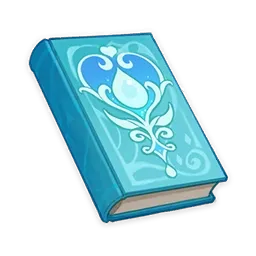
Heart of Clear Springs is a 4-volume Mondstadt Book Collection released in Version 1.0 and found in various locations across the region. Every volume opens with the same standing description - "A legendary tale passed down by Springvale hunters" - anchoring the book to the Windwail Highland subarea built around the moonlit spring at the base of its singular windmill. A copy also appears in the Total Rewards of the Version 4.1 Waterborne Poetry flagship event, whose Part III quest Heart of the Deep is the primary-text source for tying the series to Old Finch and Callirhoe. [1] [3]
Vols 1–2 - the wish and the friendship
The frame opens "under the cascading moonlight": a tearful boy makes a wordless wish at the spring, and the fairy ("born of water's essence, faceless descendants of the angels," recently arrived in the unoccupied pool) emerges, silently touches his forehead, and nods at his question "Can you make my wish come true?" She is "alone, without friends or family," and only as spring-water flows in from the cracks and the fractured moon shines on her pool does she "slowly regain the ability to think, and to mimic fragments of speech." Vol 2 grows the bond by dialogue and dream, and supplies the book's key link to somewhere beyond Mondstadt: as she gains speech "from the boy's memories and dreams," she tells him "tales of the faraway realm of Hydro. She spoke of her sapphire-blue homeland, she sang of the homesickness of exile, and she sighed for separation and belonging." The volume closes "Over time, they became friends who shared all." [1]
Vol 3 - the silenced promise
The book's central reversal turns on the fairy's slow recognition of mortality. "Mortal lives are strong but fleeting," she sees through his eyes, "and the boy must grow, and grow old." What humans call devotion she perceives only as "fleeting pleasure," and "with a kiss she stopped the boy from uttering the words. But the boy, in his innocence, mistook her rejection as her approval of his promise." Two non-overlapping vows close the volume: the fairy "vowed that she would someday bear to leave him," and the boy "vowed that he would remain by her spring forever." [1]
Vol 4 - "the raindrops … mix with the tears of the spring fairy"
The closing volume's standing description names it plainly: "a bitter ending finally faced by a boy who was no longer young and a spring fairy who had not grown old." The fairy sings him her quiet elegies until "the day came at last, when she left … Never again would the fractured moon become whole." He weeps once more into the pool, "but this time, the spring fairy did not come as promised," having chosen "to be the object of an innocent childhood dream" rather than let "her near-eternal life … break her lover's promise." The book closes on its legend: "whenever the rain pours down, the raindrops that fall into the pond mix with the tears of the spring fairy. To his dying day, the boy believed wholeheartedly in this groundless superstition." [1]
The Oceanid reading (from outside the book)
The book itself never names the fairy, never names her "faraway realm of Hydro," and never identifies her species. The in-book voice is fairytale, not testimony, and the "groundless superstition" coda is the volume's own honest admission of that. The out-of-book identification comes from Springvale's lore, which records that "the 'fairy' that resides in the spring is very much real and is an Oceanid from Fontaine" per the World Quest Wishful Drops - Life Flows On (I). Vol 2's "faraway realm of Hydro" and "sapphire-blue homeland" are the in-text fragments that hook into that out-of-text reading, and the same lore folds Diona's Character Story 5 (the founding miracle of a mother and her deathly ill son) into the same identification. [2]
A darker retelling of Finch and Callirhoe
The Trivia note calls the series "a fictional account based on the story of Old Finch and Callirhoe" per Waterborne Poetry Part III, and "unlike the boy in the story, however, Finch would eventually be reunited with Callirhoe." The book is a darker fictional inversion of the real arc of two NPCs, rooted in Mondstadt. [3] It is a 4-volume Mondstadt Book Collection, not a Liyue text, and has no connection to any cosmology of Sumeru's desert springs. The Hydro homeland of Vol 2 points to Fontaine, not at any other Hydro setting (Enkanomiya, Vourukasha Oasis, or the Primordial Sea). The Oceanid identification is canon from outside the book; the primary text itself stays in fairytale mode and refuses to name the fairy's species or origin.