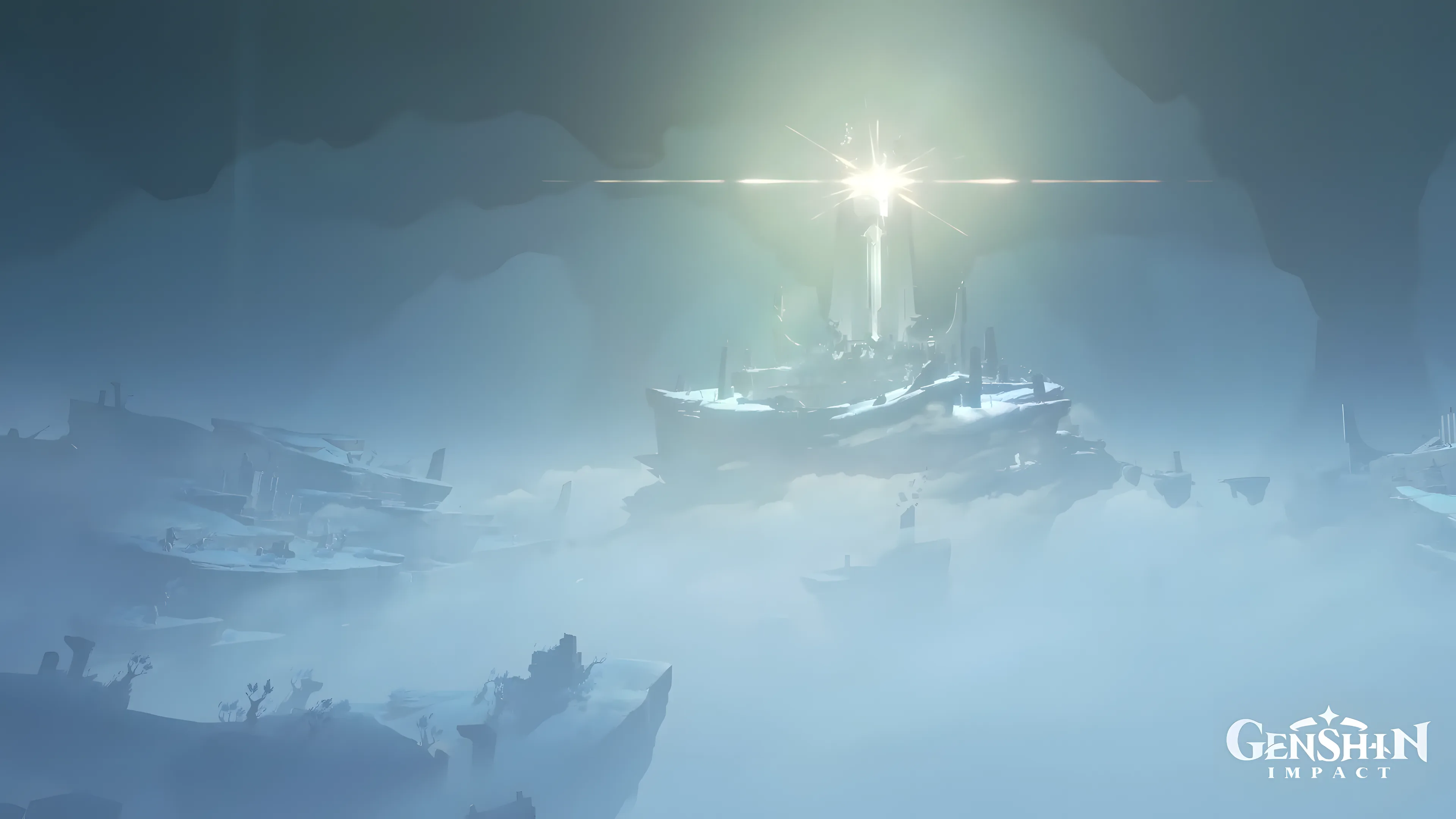
Enkanomiya (Japanese: 淵下宮, Palace Below the Depths) is a sealed undersea civilisation beneath Watatsumi Island in Inazuma, reached through a deep pool east of Sangonomiya Shrine. Long ago it sank into the sea when a war between the Heavenly Principles and the Second Who Came shattered the heavens, and its people survived in darkness until they built an artificial sun. The exiled god Orobashi eventually overthrew their puppet regime and led them up to the surface, and a present-day arc returns to the depths to deal with a creeping darkness and an old banned book.
Overview
Enkanomiya (Japanese: 淵下宮 Enkanomiya, "Palace Below the Depths") is a sealed undersea civilisation beneath Watatsumi Island in Inazuma, originally known by three older names: Byakuyakoku (白夜国, "White-Night Country"), Tokoyokoku (常世国, "Eternal-World Country"), and earliest of all Delphi Pytho (Δελφοί Πυθώ), the Greek-rooted name the civilisation carried while it was still a shard of a pre-disaster human polity that spanned the whole world. The current Japanese name was set only after the Inazuman Watatsumi culture grew up on top of it, and Enkanomiya is older than any other surviving Teyvatan place-name.[1]
The region was introduced in patch 2.1 through the WQ The Moon-Bathed Deep (the chain that breaks the five Goshou Rocks sealing the entrance) and physically released in patch 2.4 through From Dusk to Dawn in Byakuyakoku. The entry-point is the Suigetsu Pool east of Sangonomiya Shrine, water that "shines year in and year out with light akin to that of the moon." Crossing requires the Key of the Moon-Bathed Deep, "forged from Orobashi's blood" per the Heart of Watatsumi WQ, and only opens for "a person whose heart is as clear as water." Unlock criteria: AR 30 and WQ The Still Water's Flow.[1] [7] [6] The Still Water's Flow becomes available once The Moon-Bathed Deep is complete, and it opens the From Dusk to Dawn in Byakuyakoku series. The Moon-Bathed Deep itself needs AQ Chapter I Act III A New Star Approaches, with AQ Chapter II Act I Ritou Escape Plan needed only to reach its starting point north of Mouun Shrine, so the way in does not wait on the end of the Inazuma Archon Quest.[13] [14] [12] [29]
Like Dragonspine and The Chasm, Enkanomiya stacks several distinct layers of history in one place: the deep-antiquity war between the Heavenly Principles and the Second Who Came, the building of the artificial sun by Aberaku and Istaroth, the Sunchild puppet regime, Orobashi's arrival after his defeat in the Archon War and the exodus to Watatsumi, a Khaenri'ahn raid close in time to the Cataclysm that Antigonus repelled, and the reopening arc across patches 2.1, 2.4, and 2.5. These layers must be kept strictly distinct; the deep-antiquity sundering is not the Cataclysm 500 years ago.[1] [27]
Geography and access
The roster lists eight subareas:[1]
- The Narrows, the entry-belt of winding undersea passages.
- Evernight Temple, which anchors the Whitenight/Evernight cycling mechanic.
- The Serpent's Heart, originally called Delphi, or "land of snakes," built "with the power of Sunfire Phantasms" to "guard secrets, imprison criminals, and worship the great imaginary serpent, Ouroboros."
- Dainichi Mikoshi, the artificial-sun apparatus and its plaza, which "like Stormterror's Lair, does not have a battle theme" outside the Coral Defenders boss encounter.
- Vishap Research Lab, Orobashi's experiment site on the Bathysmal Vishaps, meant to forestall the "return of the Dragon of Water" prophecy in Before Sun and Moon.
- Yachimatahiko's Locus, Yachimatahime's Locus, and Kunado's Locus, three initially-hidden trial islands at Byakuyakoku's borders, "unlocked and shown on the map by starting the Erebos' Secret questline."
The signature environmental mechanic is the Whitenight/Evernight cycle. The artificial sun "can be toggled on and off to control Enkanomiya's day and night, respectively called Whitenight and Evernight." Toggle stations expose or hide mechanisms, walls, and Shield-Lights of Tokoyo barriers depending on cycle phase, while Places of Essence Worship let the Traveler carry one phase's power into the other. The toggle was only made possible "after his arrival," when "Orobashi used its powers to bolster the Dainichi Mikoshi's power, enabling Enkanomiya to have a day and night cycle that could be toggled manually," since the pre-Orobashi Dainichi Mikoshi ran as an un-toggleable Whitenight. The supporting roster includes Altar Patterns, Key Sigil Seals, Ghostfish (continuous-glide schools), Phase Gates, Sunfire Phantasms (Whitenight distortions), and Triangular Mechanisms. Local specialties are Sango Pearl and Sea Ganoderma.[2] [1]
History
Deep antiquity: Heavenly Principles, the Four Shades, the Seven Sovereigns, and the Second Who Came
The earliest layer sits at The Byakuyakoku Collection Vol. 2, Before Sun and Moon, the banned book that names this whole era. Its first entry, "When the Doves Held Branches," reads: "When the eternal throne of the heavens came, the world was made anew. Then the true lord, the Primordial One, came forth and did battle against the seven terrifying sovereigns, dragon-lords of the old world. The Primordial One created shining shades of itself, and the number of these shades was four." Forty years later, "The Seven Sovereigns were vanquished, and the seven nations submitted to the heavens. The Primordial One, the great sovereign, began the creation of heaven and earth for "our" sake." The book never uses the name Heavenly Principles; Fandom identifies its Primordial One with them. In "Four Hundred Years After the Held Branches," the writer's ancestors "made a covenant with the Primordial One, and so entered into a new age." Fandom's history of the region, drawing on the quest The Subterranean Trials of Drake and Serpent rather than the book, describes that age as a single unified civilisation that "spanned the whole world," with the people of Enkanomiya, then known as Delphi Pytho, part of it and not yet a sealed undersea pocket. The book names none of the Seven Sovereigns; Apep and Azhdaha are among those identified elsewhere, and the line of Bathysmal Vishaps the Enkanomiyans would later meet on the seabed is not a Sovereign line. The unified surface ended in "The Funerary Year": "The second throne of the heavens came, and war was rekindled, as it was in the world's creation. That day, the heavens collapsed and the earth was rent asunder. Our ancestors and their ancestral land fell into this place during that conflict." This sky-shattering event is distinct from the Cataclysm 500 years ago: far older, cosmological in scale, and on a much larger timescale than the regional collapse that ended Khaenri'ah.[1] [5] [23] [24] [27]
Years of Darkness: the Dragonheirs, Istaroth, and Aberaku no Mikoto
Falling into the ocean, the people of Delphi Pytho "met against the Dragonheirs of the Depths (now known as Bathysmal Vishaps) that ruled this place. They learned that the Dragonheirs loved the dark and shunned the light, so they used thousands of lanterns to ward them off. However, this was not particularly effective, and so they prayed and lamented, but the Heavenly Principles and its Four Shades did not hear their pleas." The Dragonheirs are seabed-dwellers from before the Heavenly Principles, a lineage distinct from the Sovereigns.[1] [21] They are described as "pure, primordial elemental creatures, wild spirits who never bent the knee to any god or worldly power."[8]
The breakthrough came in the Third Year of Darkness, the Year of Blindness. "Only Istaroth, one of the four shining Shades and the 'Ruler of Time,' heard their lamentations, helping them by giving enough wisdom to Aberaku no Mikoto so that he could create the Dainichi Mikoshi, which was then known as the Helios." Aberaku called the apparatus "Helios, the divine chariot of the sun," and pre-Inazuman naming preserved an additional title, "Hyperion (or Byakuya no Hikari)," the source of the WQ name Hyperion's Dirge. The Four Shades page places Istaroth among the four Shades, alongside Naberius, Ronova, and Asmoday, and Enkanomiya is the only known case of a single Shade answering a regional cry for help.[1] [2] [9] [22]
Years of Sun and Moon: the Sunchild puppet regime and Aberaku's martyrdom
"The year the Helios was completed was the First Year of Sun and Moon. With the light of the Dainichi Mikoshi, they were able to survive and drive away the Dragonheirs." The great houses of present-day Watatsumi, including the Yuna Clan to which Mouun the Shrine Maiden traces, anchor their genealogies to this period. For the Second Year of Sun and Moon the book records: "Our ancestors sought the returning way, for surely the war on the surface had ended by then. But the Primordial One, the first throne, had laid down a ban, preventing our ancestors from finding the path home. In that case, the Primordial One must have defeated the Second Who Came." The defeat is the scribe's inference from the ban, not something the book witnesses.[5] [1]
The Sunchild puppet regime then formed: "a cabal of corrupt nobles manipulated the people of Byakuyakoku into worshipping the Dainichi Mikoshi as a god, while installing a puppet ruler, known as the Sunchild." "Aberaku realized the truth and opposed the corrupt nobles, so the cabal simply convinced the Sunchild that Aberaku wanted to kill him and take his place, then had him accuse Aberaku of high treason and imprisoned him under permanent house arrest." In the Tenth Year of Sun and Moon Aberaku died in prison, and his "clothes and body were enshrined in various places," a posthumous deification staged by the same cabal that killed him. The dispersal "had the effect of splitting apart his soul into fragments, rendering him unable to rest for many years," the premise of Hyperion's Dirge and of the WQ Lotus Eater, set in the cabal's aftermath. The reformer Spartacus also opposed the Sunchildren but "failed and was imprisoned," a second martyr on a parallel track.[1] [2] [9]
Three Realms and triangle worship
"At some point" during the Years of Sun and Moon, "the people of Enkanomiya built the Towers of the Three Realms at the borders of Byakuyakoku. Because Byakuyakoku was on the border between three different realms - the Human Realm, the Light Realm, and the Void Realm, they built these towers to stabilize the tendencies of Byakuyakoku…hidden using secret arts, and can only be summoned by shrine maidens such as Eboshi and the Vassals of Watatsumi." An alternate reading via the Abyss Lector Enjou in The Subterranean Trials of Drake and Serpent names the three realms as Vishap Realm, Void Realm, and Human Realm, framing the Towers as "three watchposts" at the corners of a triangle "to guard against the Vishaps." Both readings sit in primary text without being reconciled, and the ambiguity should be preserved.[1] [5] [25]
The Towers' "ancient names have been long forgotten, but the islands on which they stand are now called Yachimatahiko's Locus, Yachimatahime's Locus, and Kunado's Locus," Inazuman names laid over a past the Enkanomiyans no longer carry the language for. Triangle motifs run through the architecture as the visual signature of this cosmology, most prominently in the Dainichi Mikoshi itself, "made of three tall pillars that form a triangle-shaped interior," and in the Triangular Mechanisms scattered through the subregion. Access to the trial islands is gated behind the World Quest Erebos' Secret, the lead-in before patch 2.5.[1] [31]
Arrival of Orobashi and the Watatsumi exodus
The Sunchild regime continued "until the arrival of Orobashi." After being "defeated in the Archon War and fleeing the continent of Teyvat," the future Watatsumi Omikami, the god Orobashi, took refuge in a cave somewhere in Byakuyakoku. "A young child of Enkanomiya found Orobashi in a cave and asked it to become their god. Taking pity on them, Orobashi overthrew the Sunchildren and defeated the Dragonheirs, sealing them away," which overturned the Sunchildren's claim to rule at one stroke.[1] [20]
Once installed as patron, Orobashi "used the corals growing off its body to create a path back to the surface world, creating Watatsumi Island. The people it saved dubbed this new land 'Sangonomiya' and in turn began referring to Byakuyakoku as 'Enkanomiya.' They also began worshipping this god as their 'Orobashi no Mikoto' and 'Watatsumi Omikami.'" The name Enkanomiya therefore dates strictly from after Orobashi: the inhabitants only began calling their own undersea homeland "Palace Below the Depths" once they had a Sangonomiya up above to look down from. Watatsumi Island is itself a coral construction from Orobashi's body, and the sealing of the Dragonheirs is what later requires the Goshou Rocks surface apparatus. When the coral path was made is reported two ways: Fandom's Orobashi page places it 2,000 years ago, long before the Cataclysm, while its Watatsumi Island page says the island "was created by Orobashi after the Archon War," so whether it came during or after the war is unsettled.[15] [16] After his arrival the Dainichi Mikoshi was bolstered rather than dismantled, "enabling Enkanomiya to have a day and night cycle that could be toggled manually," and the Sunfire/Ghostfire Phantasms taxonomy, previously lumped together as "Eidolons" per Vol. 5, was only named and separated "after the arrival of Orobashi."[1] [20] [21] [7] [2] [5]
Before Sun and Moon and the Khaenri'ahn raid
Orobashi's most fateful discovery in Byakuyakoku was the banned book. "Upon taking in the Enkanomiyan people, Orobashi came upon the book *Before Sun and Moon, which recorded a history of the world that Celestia wanted concealed. He learnt of a prophecy that foretells the rebirth of the Dragon of Water, one of the Seven Sovereigns, in human form. Orobashi placed a ban upon the book and began personally leading experiments on the Dragonheirs to better understand their abilities, as well as prevent the return of the Dragon of Water."* The Dragon of Water is the Hydro Sovereign reborn in human form, which in Fontaine is Neuvillette. The Vol. 4 prophecy is therefore the anchor, on the Inazuma side, for the Fontaine arc of the Hydro Sovereign.[1] [5] [24] That arc pays off in Masquerade of the Guilty, the fifth act of Archon Quest Chapter IV, where Focalors returns the elemental authority to Neuvillette, "her dragon sovereign counterpart."[18]
On the Enkanomiya side, the story of Before Sun and Moon ends with the Khaenri'ahn raid. "On the last day of Enkanomiya before the people relocated above the sea, envoys from Khaenri'ah alongside a Ruin Guard came to seize the book (Before Sun and Moon). Antigonus fought them and prevented the loss of the book, but was also critically injured as a result." The raid sits close to the Cataclysm but is not strictly identical to the 500-year Cataclysm window, and the ambiguity should be preserved. The same Khaenri'ahn forces that fielded Ruin Machines at Dragonspine sent this party of envoys and a Ruin Guard on a targeted mission to seize one specific banned book, and the raid anchors the WQ Antigonus, set after his death.[1] [10] [26] [27]
Antei, the Jibashiri who saved the book
The defender is Antei (安貞), also known as Antigone or Antigonus, a member of the Jibashiri. In the World Quest he explains the order: "The Jibashiri started out as heroes who fought against the Bathysmal Vishaps. It was only later that they became law enforcement — the judges of the nether." Accused of stealing Before Sun and Moon, he was locked in the hanging prison with Ooshima and Oogura, all three innocent. Ooshima remembers him as an apprentice Jibashiri: "Fierce temper, and super strong to boot. He escaped by grabbing the tiny bumps in the cliff and climbing right out of here." Before going, Antei promised to leave bird pictures to mark his route while he proved their innocence.[11] [10]
The thieves were the Khaenri'ahn diplomatic group he had served as a bodyguard. He defeated them all, but they also sent a Field Tiller at him: "Finally, I was able to tear its core out, but I was wounded seriously in the process." He soon died of his injuries, and as he tells it, "The disabled machine crashed on top of the lost book." In the quest the Traveler, searching for the book on Ema's behalf, follows the bird pictures to his afterimage, one of the Shades of Tokoyo, then reactivates and destroys the buried Ruin Guard with its core and recovers the book. Told he is innocent, Antei understands that he is "a shadow, left behind after my death," and fades after reciting broken lines: "What divine law have I broken... Why do the unfortunate rely on the gods? Do my deeds have meaning, now that my earnest deeds have earned me a sinful name?" The quest's title likely nods to Sophocles' tragedy Antigone, which turns on justice, law and sin.[11] [10]
Present-day reopening: The Moon-Bathed Deep, the Watatsumi Goryou Matsuri, and Tsuyuko
The post-Orobashi present-day arc opens at the surface ritual that contains Enkanomiya's after-effects. "Every few thousand years, Enkanomiya begins to bleach the soil of Watatsumi Island, which would endanger the island…as well as release the Dragonheir of the Depths…to the surface if not dealt with properly." The counter-ritual is the Watatsumi Goryou Matsuri (海祇御霊祭, Watatsumi Spirit Ritual), using "a Jade Coral Branch broken off from the depths of Enkanomiya" to force the absorbing spirits back into the ocean. The five seals of the Goshou Rocks (Eye, Tooth, Fin, Tail, Heart) mirror Narukami's Sacred Sakura Cleansing Ritual and Mt. Qingce's Chi seal: one sealing pattern, applied in three regions.[1] [4]
The V2.1 reopening is anchored at Tsuyuko's request to "remove the five seals to obtain the Key of the Moon-Bathed Deep," with Kokomi authorising entry to retrieve the Bloodbranch Coral for the ritual. The descent, which opens with the World Quest The Still Water's Flow and runs through the series From Dusk to Dawn in Byakuyakoku, exposes the Outlander to the ancient Bathysmal Vishaps still living in the depths, "along with numerous hilichurls and traces of the Abyss Order, who were ordered by 'Enjou' to search for the book *Before Sun and Moon. This was done in order to prove that the gods and Celestia came from outside Teyvat."* The Abyss Order's motive is to disclose the cosmology, not to acquire power. Tsuyuko's re-reading, from her training at the Sumeru Akademiya, that salinity leaches nutrients and the Jade Coral Branch replenishes them, sits alongside the legend rather than displacing it.[1] [4] [13] [14] [28]
V2.5 Three Realms Gateway Offering: Tsumi, Enjou, and the everlasting darkness
The V2.5 event Three Realms Gateway Offering is the arc that follows the Bloodbranch Coral. "Sometime after handing the Bloodbranch Coral over, the Traveler learns from Kokomi that the ritual underwent some complications. Upon investigating, they find an everlasting darkness surrounding Enkanomiya, and a strange shrine maiden named Tsumi who initially helps the Traveler." Gating is AR 30, AQ Chapter II Act II Stillness, the Sublimation of Shadow, and WQ Erebos' Secret. The chain runs The Eve, Part I, Part II, Part III, and Aftermath, then unlocks The Bunkoku Enigma. The exploration mechanic is the Bokuso Box gadget, a Corrosion-Resistance meter upgraded via Light Realm Sigils at the Statue of the Vassals (of Watatsumi). The Chinese and Japanese event names use the historical Shinto term Michiae-no-Matsuri (道饗祭, "Road Feast Festival"), a real-world rite "to protect Kyoto…by performing a ritual…at each of the four corners of the capital."[3] [31]
The story's resolution shifts how Tsumi is understood. Fandom's Enkanomiya page sums it up: "The Traveler finds out that Enjou was causing the darkness, and was maliciously conspiring with Tsumi, who may be one of the 'Vishap-people': vishaps that evolved to imitate humans to infiltrate human society. The Traveler repels the darkness and convinces Tsumi not to destroy the Dainichi Mikoshi, although Tsumi warns that the vishaps will be back. Returning to Sangonomiya Shrine, Kokomi denies the existence of Vishap-people, saying that Tsumi is likely the last Vassal of Watatsumi, human/snake hybrid familiars of Orobashi. Now that she knows how the Bloodbranch Coral works, Kokomi decides to find a different method of stopping the soil bleaching, in order to no longer disturb the vishaps." Kokomi's own words are narrower. She never names Tsumi: she calls "Vishap-people and Reptilians" "pure fiction," tells the story of "the very last of the vassals," and ends by saying she "may need to think of a new way to counteract the Holy Soil phenomenon." [34] The Vassals of Watatsumi page notes that Vassals have vertical reptilian pupils and a deep connection to the Mikoshi. Kokomi's account of the last Vassal is consistent with Tsumi's pendant and raised-by-vishaps backstory, while Enjou's competing Vishap-people / Reptilians reading is rebuked as "pure fiction." The new way she mentions is left unspecified, and the V2.5 arc closes without showing the Bloodbranch Coral mechanism retired.[1] [3] [25] [32]
Outside Inazuma, Enkanomiya is not well-known. Per the Wriothesley anecdote Quite the Win, the Fontaine Duke "asked where the Traveler meant" and "wanted to know more of it from Neuvillette," turning to the Iudex in Fontaine who is tied to the Dragon of Water's rebirth, which closes a loop the V2.1 Vol. 4 prophecy opened.[1]
Culture
The Enkanomiyans "revered snakes, even before Orobashi became their patron." The Serpent's Heart was "originally called Delphi, or 'land of snakes,'" and "since the earliest times," they had worshipped Ouroboros, the "great imaginary serpent" or "Cosmic Serpent." After Orobashi arrived, the snake-cult enlarged rather than collapsed: "the Enkanomiyans came to worship them both, depicting Ouroboros as a 'scaleless serpent' and Orobashi as a 'coral-adorned serpent.'" The account of triangle worship comes via Enjou's Subterranean Trials of Drake and Serpent exposition: "the Enkanomiyans also had a tradition of 'triangle worship.' They believed that Enkanomiya was the intersection of three realms, the Vishap Realm, Void Realm, and Human Realm. Their borders are marked out by three corners, at which they established three watchposts (now trial sites) to guard against the Vishaps." As noted above, Enjou's Vishap/Void/Human roster sits alongside Vol. 3's Human/Light/Void roster without being reconciled.[1] [5]
The Inazuman layer of names came after Orobashi. "As they integrated with the nation of Inazuma above, many Enkanomiyan things gained Inazuman names, such as the artificial sun, Helios ('Dainichi Mikoshi'), and the people of Enkanomiya themselves (e.g., Abrax as 'Aberaku no Mikoto'). Over time, the ancient Enkanomiyan language became lost." The only surviving primary-text traces of the original layer are the Greek-rooted names (Delphi, Pytho, Helios, Hyperion, Abrax) and a handful of artifact descriptions. The Watatsumi-side people "have continued the practice of certain Enkonomiyan traditions, such as fortune-telling using Deep Sea Spiritherbs" per the WQ Divine Plant of the Depths.[1]
Etymology and inspiration
The name-evolution per The Byakuyakoku Collection Vol. 3 is staged, running from "Aphotic Earth" to "Tokoyokoku" to "Byakuyakoku," with the 淵下宮 Enkanomiya / Palace Below the Depths form set only after the Inazuman renaming that followed Orobashi. Byakuya (白夜) refers to "a natural phenomenon in which the sun remains visible during nighttime," a midnight-sun, and "this implies that the area was named Byakuyakoku after the creation of the Dainichi Mikoshi," a reading the Vol. 3 sequencing supports. Tokoyokoku (常世国) draws on the Japanese folkloric Tokoyo-no-Kuni, the Eternal-World or Land of the Dead, anchoring Enkanomiya's Years of Darkness, before the Helios, to the land beyond the sea tradition.[1] [5]
Delphi Pytho is the Greek-rooted earliest name. "Delphi" derives from Δελφοί and "ultimately shares the same root as the word for 'womb,' δελφύς." "Pytho," the older name, "shares an origin with both the priestess of Apollo, Πυθία, and the mythical serpent slain by Apollo, Python," anchoring the snake-worship the Serpent's Heart still carries. The Pythia–Python doublet hints that Enkanomiya draws on a specifically Delphic tradition rather than generic snake-worship. Its broader inspiration "may be based on the lost city of Atlantis or the lost continent of Mu…described as technologically advanced civilizations which sank underwater in a single night after experiencing severe earthquakes," a clear echo of Enkanomiya's own sinking when the Heavenly Principles warred with the Second Who Came.[1]
Where Enkanomiya connects
Enkanomiya sits beneath Watatsumi Island within the parent region Inazuma. Its above-water sister is Watatsumi Island, the coral surface island the Enkanomiyans fled to, home of the Sangonomiya clan, the Watatsumi Goryou Matsuri, and the Goshou Rocks re-entry apparatus. The peoples and institutions live at Bathysmal Vishaps (the Dragonheirs of the Depths, with the hedge that they are not Sovereigns) and The Vassals of Watatsumi (Orobashi's familiars and the idea that Tsumi was the last of them).
The cosmological lore-concept pages run through Heavenly Principles (the war between the Heavenly Principles and the Second Who Came), Four Shades (Istaroth), Seven Sovereigns (Dragon of Water as Hydro Sovereign reborn as Neuvillette), Khaenri'ah and The Cataclysm (how close the raid Antigonus repelled sits to the Cataclysm), and The Abyss Order (Enjou). For the dragons' side of their conflict with the Heavenly Principles, see Nahida's Story Quest: in Act II Homecoming of the Sapientia Oromasdis Chapter, Apep tells Nahida that the dragons sought forbidden knowledge to overcome the Heavenly Principles.[17] The primary-text spine threads The Immovable God and the Eternal Euthymia (Ritou Escape Plan, the unlock prerequisite), Orobashi's Legacy, Erebos' Secret (the V2.5-event prerequisite), and Three Realms Gateway Offering: Aftermath. On the Khaenri'ahn side, Dainsleif and his fellow Khaenri'ahns frame the raid party of Antigonus's era, while Dragonspine and The Chasm are sister cases of the same layered history in Mondstadt and Liyue.
Open questions
Before Sun and Moon names the Heavenly Principles' opponent only as "the Second Who Came," an enumeration title rather than a proper name. The book never names him. Fandom's Orobashi page dates Enkanomiya's sinking to "the war of funerary flame against Nibelung", which reads the Second Who Came as Nibelung; that identification is Fandom's, not the book's, and even the Enkanomiyan reading that the Second was defeated is inference.[1] [5] [15] The Three Realms themselves are named two different ways, Human/Light/Void in Byakuyakoku Collection Vol. 3 and Vishap/Void/Human in Enjou's exposition, with no resolution as to whether the gap is translation drift, a pre- versus post-Inazuman renaming, or two readings of the same boundary.[1] [5]
Tsumi's nature is left open too. Sangonomiya Kokomi's account of the last Vassal of Watatsumi fits her, though Kokomi never names her, and she rebukes Enjou's Vishap-people legend as "pure fiction," Enjou credits her as a Vishap-person, and Tsumi's own self-presentation wavers before she returns to the vishaps.[1] [25] The Khaenri'ahn raid that Antigonus repelled is anchored only "on the last day of Enkanomiya before the people relocated above the sea," a relative anchor tied to the exodus rather than the dated 500-year Cataclysm; the presence of a Ruin Guard pulls toward identifying it with the Cataclysm without closing the loop.[1] [10] [27] And the V2.5 Aftermath ends with Kokomi saying she "may need to think of a new way to counteract the Holy Soil phenomenon"; no new way has surfaced as of Version 7.2.[1] [32] [34] When the phenomenon threatens all of Teyvat in Chapter VII Act V, Kokomi tells the leaders of the nations that "We've dealt with the same phenomenon before on Watatsumi Island," and the remedy she describes is the old one: "When we've faced this crisis in the past, we hold a ritual called the Watatsumi Goryou Matsuri, which awakens the Sangacorexes using the Watatsumi Omikami's life force." Ei doubts it can be scaled up, since "The Serpent is dead, and few Sangacorexes remain." No line says whether these Sangacorexes are the "second familiars" Tsumi called the Sangacorallia in Version 2.5.[35] [36] [34]
World Quests
- Erebos' Secret · Patch 2.4
- Three Realms Gateway Offering: Aftermath · Patch 2.5