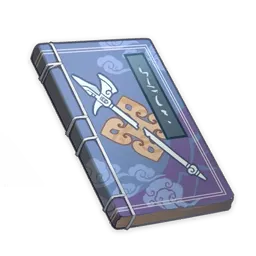
Legend of the Shattered Halberd is a 6-volume Liyue Book Collection released in Version 1.0. Vols 1, 4, 5 are sold by Jifang at Wanwen Bookhouse in Liyue Harbor for 3,000 Mora each; Vol. 2 sits on a table at Stone Gate; Vol. 3 is offered by Tea Master Liu Su on the "Can you tell another story?" branch of his rotation. Vol. 6 is obtained during Xingqiu's Story Quest "Bookworm Swordsman" - the volume Chang the Ninth of Qingce Village refuses to pawn through his mining collapse, and the one Xingqiu has spent three years hunting. The set completes the Mortal Travails: Series I achievement The Divine Halberd Mocks the Heavens. [1] [2] [6]
A Liyue-distributed book, not a Liyue-authored one
Vol. 1 frames the series as "an all-new graphic novel on the epic journey in search of the God King's Halberd." The editor's commentary closing Vol. 6 names the imprint: "Legend of the Shattered Halberd was a successful first attempt by Inazuma's Yae Publishing House to incorporate elements of Liyue culture in one of their novels." The setting is Liyue-coded ("Great and Glorious General," "Imperial Grand Minister," "Minister of Imperial Banquets") but the publisher and the in-universe author Mr. Nine are Inazuman. The closest parallel in the corpus is Hex & Hound, a Mondstadt aristocrat-era fairytale that Yae Publishing House also distributes across regions, and the pattern of the Yae imprint carrying books between regions is the detail this book adds. [4] [8]
Plot and in-novel cosmology
Mir, disinherited son of Mi Tingren (framed former Minister of Imperial Banquets), is drawn westward by Weiyang, a female officer cross-dressing as the male "Great and Glorious General Weiyang," in truth the Secretary of Ceremonies dispatched to retrieve the Nine Ominous Swords: cursed blades forged by the swordsmith Feng from an "iron meteorite" that was in fact the shattered Divine Halberd. Weiyang's body is possessed by the nameless daughter of the Celestial Emperor, who has forgotten her name ("knowledge of a deity's true name allows a human being to exercise absolute control over them") and wields telekinetic polearm-manipulation strictly "for sentencing the guilty." Mir surrenders an eyeball to her and travels alongside, killing through cursed-sword-wielders whose intellect the blades have drained. Vol. 4 reveals Mir's father is in truth Khan the Asura from Jotunheim and that the mad late Celestial Emperor is called the Contra Mundi.
The novel's cosmology is internally consistent fiction. The Axis Mundi once connected nine realms (humans in Zhongzhou, gods in Shenxiao, the Daoist 神霄 "God's Sky," the highest of the nine Daoist heavens that the Chinese title 神霄折戟录 points to) until a war among the gods sealed the passage. The first Divine Halberd, Irmin, pierced the Axis Mundi to bind the nine worlds. Named sword-shards include the Sword of Mist, the fire-realm "Katakugosha," and Mir's inherited Laevatain, "the greatest cursed sword of all, that had once burned the entire world to cinders." The Norse (Irmin, Laevatain, Jotunheim) and Hindu-Buddhist (Asura) names are in-novel proper nouns; the Irmin / Irminsul resonance is author-level etymology, not a claim about Teyvat's world tree. [1]
Vol. 6 - the editorial break and the Prinzessin der Verurteilung
The editor's commentary admits Vol. 6 "reads like a different story entirely," attributing the tonal break to Mr. Nine rushing to meet schedule. The volume climaxes with the maiden confronting the resurrected mad God King: "Oh my daughter… did I not bring you into existence that you might one day pierce me with a halberd?" The narration then names her: "Fearing the madness that would ensue following his death, the God King made one final Divine Halberd, and named it the Prinzessin der Verurteilung. In this moment, it - nay, she - could finally unleash her true self." The editor closes with a Blackwood Box Set collector's-edition announcement and promises "more tales of the Prinzessin der Verurteilung in the future."
The German coinage Prinzessin der Verurteilung is the same one Fischl uses: Fischl von Luftschloss Narfidort, Prinzessin der Verurteilung der Immernachtreich. Both surface in the 1.0 release window. Fischl's Immernachtreich is Amy's own invention, while the Shattered Halberd editor frames its Prinzessin as Mr. Nine's character about to spin off. Neither names the other as source; the coinage circulates across both as a shared 1.0 chuunibyou flourish. [7]
Boundaries of the fiction
It is not Liyue-authored. Distribution in Liyue is not origin in Liyue; the imprint is Yae Publishing House, and the in-universe author is Mr. Nine.
It is not a paired set with Legend of the Lone Sword. Title-overlap on "Legend" is the whole of it: Lone Sword is a 4-volume Liyue-internal martial-arts novel with a "world without elemental energy or alchemy" disclaimer, while Shattered Halberd is a 6-volume Inazuman-imported graphic novel with cross-realm cosmology. Different region of origin, volume count, genre, and disclaimer. [9]
It is not Teyvat-cosmology testimony. Axis Mundi, Zhongzhou, Shenxiao, Irmin, Laevatain, Jotunheim, Asura, and Contra Mundi are in-novel proper nouns; the Irmin → Irminsul resonance is real-world etymology, not Teyvat canon.
Nor is it the source of Fischl's persona. Both Prinzessin der Verurteilung surfaces are 1.0, and no primary text names one as source of the other.
What it amounts to is an Inazuman light novel about a one-eyed swordsman, a possessed female court officer, and the nine shards of a god-killing halberd, marketed by Yae Publishing House into a cross-region phenomenon and hunted by Xingqiu for three years.