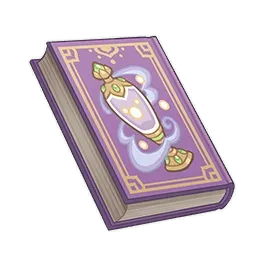
The Shepherd and the Magic Bottle is a 1-volume Quest Item book held in the House of Daena, the Akademiya's central library in Sumeru City, and one of three Sumeru Quest-Item primary texts there, alongside An Ode to Khvarena (the liturgical hymn of the Order of Skeptics) and The Lay of Al-Ahmar (the legend cycle of King Deshret). [4] Released at Version 3.0 in Sumeru, it is the prequel to the V3.0 2-volume Book Collection The Tale of Shiruyeh and Shirin. Both works share the same two core characters, a Jinni in a magic silver bottle and a human shepherd-boy she names "Raven," and the same frame of a desert journey after the Cataclysm, carried by Sumpter Beasts. [3] [9]
Al-Ahmar's silver bottles and the City of the Moon Maiden
The text opens in folktale cadence: "Legend has it that King Al-Ahmar, while still alive, had collected numerous Jinn and demons from across the world, placing them within magic bottles... Al-Ahmar, mighty yet bewildered, seized them from the silver night winds and quicksands of the desert, the mystical swirls of the ocean, and the tinkling springs in the rainforest, and kept them in silver bottles." [1] Where The Lay of Al-Ahmar gives the "master of the one thousand and one Jinn" epithet from King Deshret's side, the Shepherd tells it from the side of the Jinn. The mechanism of imprisonment in silver bottles (Al-Ahmar "made us magic bottles of silver and stamped his mark on us, and so we became his servants") is this text's distinctive contribution to the myth cycle of King Deshret, and the only primary text that narrates it from inside the bottle. [8] [5]
The opening then names Ay-Khanoum: "the majestic Ay-Khanoum - the 'City of Amphitheaters,' or 'City of the Moon Maiden' - to commemorate them. It is said to have been the city of the spirits, the paradise for migrants from the moon, gifted to them by Al-Ahmar. In return, the spirits constructed the huge doorway to his mausoleum." [1] The Shepherd lists Ay-Khanoum alongside three other lost desert civilizations ("Saleh, the city of the valiant Thamudians, Tulaytullah, the land of the wise Tighnarians, and Orghana, the city of the Twenty-Nine Deys") as cities "buried beneath heavy sands and swirling currents." This is the primary-text catalogue of named desert polities that vanished before the Cataclysm, and the only source that pairs the name City of the Moon Maiden with the better-attested translation City of Amphitheaters.
The Gravelsong Dunes frame: shepherd, Jinni, three questions
"Fifteen years after Port Ormos was built, a young shepherd found a silver bottle in the Gravelsong Dunes," glossed in Note 1 as "the desert area that the Eremites often refer to as 'Dar al-Azif.' This does not refer to a fixed place, since the dunes themselves flow like the wind." [1] [6] The boy breaks the seal beneath the moonlight, and a Jinni "arose from within the bottle in the form of a dancer, as flexible and languid as a cat and as bright and beautiful as a water lily." She greets him with the naming that the V3.0 sequel inherits as the frame for its title character: "Yes, ravens... Birds that live fast and die fast, a noisy lot and no mistake... only when they die do they wake up." [1]
The Jinni sets three conditions on the boy's three questions: "(1) do not defame my lord Al-Ahmar... (2) harbor you no arrogance. Short-lived mortals should know where they stand. (3) do not pry into the affairs of heaven and earth." [1] That structure mirrors the three prophecies and three admonitions Liloufar delivers to her daughter Shirin in Tale of Shiruyeh and Shirin Vol. 2; both texts use a Jinni's set of three as a narrative device. [9]
"A descendant of Liloufar": the identity hedge
To the boy's first question, the Jinni replies: "I'm a creation of the sky, yet also a creature of this world. I'm an exile of the ages, a faithful servant to my great lord. I'm an elemental spirit who will not bow to flesh and blood, an eternal prisoner content with the illusion of comfort... As a descendant of Liloufar, I can be big or small. I can rise or hide. My kindred may be found in the waves, in the night wind, or in the pale light of the dead moon." [1]
The "descendant of Liloufar" clause is ambiguous between two readings the sequel later sharpens. The Tale of Shiruyeh and Shirin establishes that Liloupar (the Jinn-Mother whose name the Dirge of Bilqis World Quest chain puts to use) is "the one Al-Ahmar imprisoned in the magic bottle," which leaves open whether the Shepherd's narrator is Liloupar herself speaking obliquely about her own lineage, or one of her many descendants speaking literally. [2] [9] The Shepherd's text does not resolve the identification, and the House of Daena archive keeps the ambiguity marked unconfirmed.
The three-era arc: Cataclysm as folktale
The boy's third question ("What's it like to live in a bottle?") draws out a three-era arc. In the first era, the Jinni "lived in a carefree palace, singing with nightingales and talking with roses... if anyone ever broke the seal and let me out into the outside world, I would curse and kill them." In the second, "sandstorms and demons ran riot. Nightingales sang till their voice grew raspy and their blood dried up. Roses withered and turned into tangles of thorns... I would fight against its injustice." In the third, "everything was reduced to dust. The grand play of the City of the Moon Maiden came to an end, and what remained were the ruined theater and the wrecked masks of the gods... I would turn into an evil seeking revenge - I would destroy the world, or else destroy myself." [1]
The Shepherd never names "the Cataclysm" or "the Black Tide" in primary text. The three-era arc reads as the Jinni's encoding, from inside the bottle, of the same wound to the Sumeru desert before, during, and after the Cataclysm that The Lay of Al-Ahmar tells as legend from the king's side (the fall sequence in which the 1001 pillars collapse) and that An Ode to Khvarena tells in the liturgy of the Order of Skeptics ("if the dark tide reappears and the black abyss returns"). [8] [7] [10]
Then the reversal: "the dead moon cast a glow over the quicksand dunes, and over me... and I suddenly realized how lovely the world is... It all makes me wonder what it will be like... when the 'raven' becomes the 'groom.'" [1] The book closes by opening its frame ("tell me a story, little raven. Let me see the world. And so, the spirit of the moon maiden's city once again embarked on her journey around the world") onto the desert journey on Sumpter Beasts that the sequel narrates from inside. [1]
What the Shepherd carries
For a single-volume book, it does a lot. It is the only primary text that narrates Al-Ahmar's "stamped his mark" binding from inside the bottle, the complement from the Jinn's side to the "master of the one thousand and one Jinn" line from King Deshret's side in The Lay of Al-Ahmar. [8] It supplies the Ay-Khanoum / "City of the Moon Maiden" name, paired with the catalogue of lost civilizations (Saleh, Tulaytullah, and Orghana), which gives the urban history of the Sumeru desert before the Cataclysm that the Akademiya's archival tradition inherits. And it sets the narrator frame of the Jinni and Raven that the V3.0 sequel Tale of Shiruyeh and Shirin picks up: tales told along a desert journey carried by Sumpter Beasts, a structure the Jinn-Mother's lineage carries across the V3.0 corpus of Sumeru desert texts. [9]
The Tale of Shiruyeh and Shirin inherits the frame of the Jinni and Raven; The Lay of Al-Ahmar is the co-witness from King Deshret's side; An Ode to Khvarena is the liturgical co-witness from the Order of Skeptics on the same wound from the Cataclysm era. The history of the desert civilizations before the Cataclysm runs through Sumeru and the Seven Archons page (King Deshret = Al-Ahmar), the Akademiya supplies the archival mechanism, and the Cataclysm page holds the wound Sumeru took 500 years ago, which the three-era arc encodes in folktale cadence.