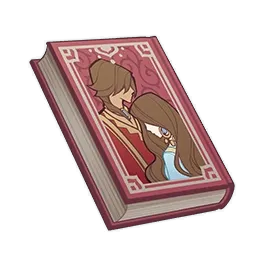
The Tale of Shiruyeh and Shirin is a two-volume Sumeru Book Collection released in Version 3.0, obtained from bookshelves in the House of Daena library in Sumeru City. Both volumes share the same in-game Description: "A Jinni tells a tale on the night wind, a story about itself and a shepherd. It's a story of unknown origin and is full of absurdities." The series is a sequel to the Quest Item book The Shepherd and the Magic Bottle, carrying forward the same two characters: the Jinni in the magic bottle and the human boy she has one-sidedly named "Raven." The tale is told across a desert journey by Sumpter Beast under the moonlight. [1] [2] [4]
Vol. 1 - Kisra, the ninety-nine cities, and Ormazd's one-night death
The Jinni opens not with the title characters but with their parents' generation, leaning on the meaning of a name: "in the lost language, 'Shiruyeh' means 'unweaned lion cub'. His father Parvezravan gave this name to his newborn son, oblivious that he, the vassal king who referred to himself as the 'Spirit of Unceasing Victory,' would be torn apart by his own beloved 'lion cub'." In Raven's own tribe, by contrast, "'Shiruyeh' is a disgraceful name branded only onto the foreheads of exiled chiefs and spoken only in curses and mockery." [1]
Kisra Parvezravan is "an orphan who was raised in the nest of the giant bird Ghoghnus and given the name 'Kisra,' or 'one who has been bestowed a good name.'" The vassal king Ormazd Shah adopted him; in Ormazd's name, "the bronze and mortar towers of ninety-nine cities were destroyed or abandoned. By his hand, the leaders of ninety-nine nomadic tribes were defeated. And by his hand, ninety-nine sages with knowledge of the order of the stars were bound in golden chains, then led back to the towering royal city of Gurabad to be imprisoned." [1]
The volume sets this rampage inside a wider collapse: "At that time, the promised land of 'Valivija' was engulfed by wild, gilded sands, and one of the three living gods had fallen." That line about "one of the three living gods" echoes the three gods who once held Sumeru together, Greater Lord Rukkhadevata, King Deshret, and Nabu Malikata, though the book never names them outright. [5] [6] The fall is resolved in folktale shorthand: "my lord Al-Ahmar and the Sage-King of the Greenwood gathered their subjects. Once the oasis paradise was reconstructed, the age of the vassal kings, the age of division, finally came to a close." Al-Ahmar is King Deshret, and the Sage-King of the Greenwood is Greater Lord Rukkhadevata. [5] [7]
Ormazd bestows the name "Parvez" upon Kisra and offers his daughter Shirin's hand in marriage. The volume closes with the inciting catastrophe: "one cursed day, Ormazd and all 300 of his offspring suddenly died in one night in the city of Gurabad. Following such an unthinkable event, the throne naturally fell to Kisra, who added 'Ravan' to his title and became the most powerful vassal king among mortals." The Jinni hedges at once ("Some people say that the tragedy that befell the city of Gurabad was the handiwork of the hero Kisra") and then theatrically defers the question of who engineered the fall to Vol. 2. [1]
Vol. 2 - Liloufar's three prophecies and Shiruyeh's Plague
Vol. 2 walks the prophecy frame. Liloufar ("the Daughter of the Water Lily" and "the foremother of the spirits") delivers three prophecies to her daughter Shirin (Shirin will fall in love with a great hero whose offspring surpass their father; many of Shirin's relatives will enjoy a sweet end; Shirin alone will possess her father's kingdom) and three admonitions: Shirin's joy will bring tears to her father's eyes; Ormazd and his wife should no longer feast at the same table as their daughter after she weds; their daughter's heir will be an ill omen on the king's land. [1]
The Jinni narrates the prophecies fulfilling themselves at folktale cadence. Shirin's marriage to Kisra Parvezravan turns sour: "a vivid hatred coalesced from this passionless, dull, rotten life - the same hatred that those imprisoned in the silver bottle carry." On the night of "the infamous grand banquet," "a few lowly slaves - mages of the Mazandaran Oasis, or perhaps some illiterate Fellahin servants - dripped scorpion venom into musk honey and offered it to the vassal king Ormazd and his 300 heirs." Shirin had been excluded from the party by Ormazd himself; Kisra, the Jinni claims, was her "reluctant co-conspirator"; the second prophecy is fulfilled. [1]
Years later, Shiruyeh, Shirin's son, is "banished by his father from the towering city of Gurabad," made to "hide his face and flee on a fast steed" in a brass mask. Shirin disguises herself as "a divine princess of the temple to the moon goddess", meets the masked Shiruyeh at the temple, and delivers a "false, illusory prophecy" spurring him to murder his father: "the peerless vassal king 'Parvezravan' would be stabbed to death in his bed by his own masked, unfilial son." After Shiruyeh ascends the throne, "he was long tormented by inescapable nightmares until finally, on a frenzied night of wandering, he fell into a deep black chasm in the earth and disappeared. Later, a great plague emerged from that chasm and swallowed up half of the souls in the city of Gurabad." The scattered survivors called it Shiruyeh's Plague, "the divine retribution invited by the absurdly short-lived despot himself." [1]
The volume closes with the third prophecy's fulfilment (Shirin and her heir "won true freedom in a kingdom ravaged by vengeance, and they became evil apparitions, death knells to the conceited") and the Jinni's coda: "Some people say that Shirin was later subdued by my lord Al-Ahmar, who detained her in a magic silver bottle. Others say that she still roams the desert, tormenting overconfident adventurers and tirelessly searching for the beloved child that she lost to that dark world." The moon then rises high and "the distant, ancient time when the desert had not yet become a desert" approaches: "It was time for the divine princess to hold the sacrifice." [1]
The unreliable-narrator frame
There are four clear points where the Jinni's tale diverges from the actual fall of Gurabad, the history revealed by the Dirge of Bilqis World Quest chain and the Desert Pavilion Chronicle artifact set, which correct the book's account. [3]
- The architect of Gurabad's fall is Liloupar (Liloufar), not Shirin, "as revenge against Ormazd for failing to abolish slavery and becoming an ordinary tyrant." The Jinni-narrator omits her own role.
- Kisra Parvezravan is Liloupar's secret son, left in the wilderness for an unwitting Ormazd to adopt. The Ghoghnus-nest framing is the Jinni's folktale euphemism for her own concealment of maternity.
- The banquet poisoning was not Shirin's vengeance. Per the Dirge of Bilqis Part 5 III Dune-Entombed Fecundity: "The princess sees the consequences of her innocuous error, her sanity giving way to madness... Her invincible husband is shaken by the tragedy, his greedy heart blinded by ecstasy... All the sorrow, joy, and madness are finally turned into food for the Jinn-Mother to devour." Shirin did not intend the poisoning; the realization drove her insane; Parvezravan was innocent of the deed though already power-hungry; and Liloupar herself claims the incident was part of her punishment for Gurabad. [3]
- Liloupar, not Shirin, is the one Al-Ahmar imprisoned in the magic silver bottle. The Jinni-narrator transposes her own imprisonment onto her daughter. The imprisonment in the silver bottle belongs to the lamp djinn Liloupar, who surfaces in the Dirge of Bilqis World Quest chain. [3]
The book also omits Shiruyeh's role as Khorramdin, leader of the Brass Mask Rebellion, the popular uprising in which Liloupar (again, not Shirin) convinced the commoners to join the rebels.
So the book is the Jinni's own retelling of the era she helped destroy, a folk-tale that turns her own role inside out, told from a Sumpter Beast crossing the desert to an inattentive boy. The player meets the tale at Sumeru's launch in Version 3.0, then receives the correction a few patches later through the Dirge of Bilqis chain and the Desert Pavilion Chronicle artifact set. It is Sumeru's clearest case of a biased narrator written into the source itself: the Jinni tells the story of Gurabad's fall while being, in truth, the one responsible for it.
The real-world sources
The story-within-a-story shape, with each volume ending on a cliffhanger, recalls One Thousand and One Nights, in which Scheherazade breaks off her stories every night. Liloupar's self-fulfilling prophecies about Shirin and Shiruyeh, and Parvezravan's futile attempts to dodge them, are "loosely inspired by" King Astyages and his grandson Cyrus the Great as told in Herodotus' Histories. Shiruyeh's recruitment of commoners into his revolt may also draw on Cyrus rallying the Persians against the Medes, alongside the more overt Babak Khorramdin Revolt that the book's omitted "Khorramdin" and "Brass Mask Rebellion" framing points to. The names Shirin, Shiruyeh, and Parvez(ravan) come from the Persian Khosrow and Shirin lineage: the Sasanian shah Khosrow II's queen Shirin, and the historical Shiruyeh who killed his father. "Valivija" reads as a likely compound of Persian vali ("guardian") and Sanskrit bīja ("seeds"), so, "guardian seeds." [1]
The Jinn-Mother whose role the book inverts is the figure at the centre of the Dirge of Bilqis. The wider pre-Cataclysm Sumeru desert it sits in runs through the Sumeru region and the story of the Sage-King of the Greenwood behind the Akademiya's founding, and the line about "one of the three living gods" falling echoes the world-scale disaster of the Cataclysm.