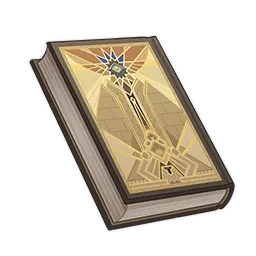
The Lay of Al-Ahmar is a one-volume Quest Item book held in the House of Daena, the Akademiya's central library in Sumeru City and the largest library in Teyvat. It is one of three Sumeru Quest Item primary texts kept there, alongside An Ode to Khvarena (the Order of Skeptics' liturgical hymn) and The Shepherd and the Magic Bottle (the Liloupar-related fragment). [5] Al-Ahmar, Arabic for "the Red One," is one of King Deshret's names. He is also called Amun in the Deshret Script, and Mourning King among the desert peoples. The name may derive from the Red King of the Jinn, Al-Ahmar, the same Arabic-mythological figure the Lay's own "one thousand and one Jinn" motif draws on. [2] [3] The work arrived in Sumeru at Version 3.0, alongside Scroll of Streaming Song, The Folio of Foliage, The Tale of Shiruyeh and Shirin, An Ode to Soul-Light (since renamed An Ode to Khvarena), and The Shepherd and the Magic Bottle. [6] [11]
The Lay is the most-quoted source behind King Deshret's story, anchoring more of his arc than any single artifact set, weapon story, or world quest. [2] The text itself is short, a single sustained legend passage that opens on the desert dwellers' framing. Its reach across the rest of Sumeru's lore is unusually large for a one-volume book.
The opening - epithets, Jinn, son-of-the-sky
The Lay opens with its framing line and the epithet pair the rest of Sumeru's texts reuse: "According to the desert dwellers, the world was once ruled by a king named Al-Ahmar, a king of warriors, horticulturists, and sages. He controlled the winds whistling through the desert, the dunes turned bright silver by moonlight, and the one thousand and one Jinn who hid within the night and the calls of owls." [1] Two threads run from this opening.
The "king of warriors, horticulturists, and sages" triplet is the line that opens King Deshret's profile, taken directly from this text. [2] The "master of the one thousand and one Jinn" clause is the source for Deshret's relationship to the Jinn. They passed to him as servants only after Nabu Malikata's death, per the Defender of the Enchanting Dream / Desert Pavilion Chronicle artifact text, yet the Lay's desert-dweller legend grants them to him from the outset.
The text continues with the origin clause: "They say that Al-Ahmar was a son of [the sky]. That is why [he ruled the] world and received the fervent faith of [the world] from the three great tribes, and was even adored by the elusive Jinn." [1] This is the only source for Deshret's "son of the sky" origin. The line that opens his Archon-War history, "Information on King Deshret's origins is vague. According to legend, Deshret was a son of the sky," draws directly on it. [2] The clause stays legend rather than confirmed cosmology, hedged as "according to legend," and the Lay's own opening "according to the desert dwellers" sets the same tone.
The "three great tribes" clause is the source for the desert tribes who predate Deshret's civilization, the same vassal-king lineage the Seven Pillars of King Deshret deep-dive traces. [12]
The Mourning King - the boundless paradise
The Lay's second movement is the source for Deshret's Mourning King epithet: "Whenever he looked up to [the] sky and recalled the boundless paradise high above, and the [merciless] reign of thousands of years past, Al-Ahmar could not help but lower his noble head and sigh helplessly. In such moments, even the songs of the nightingale and the aroma of roses could not pull him from his sorrow." [1] His profile traces the epithet's origin straight to this passage: "He was also known as the Mourning King because of his deep sorrow and nostalgia for the past. It was said that he would look up at the sky and remember the boundless paradise high above and the merciless reign of thousands of years past." [2]
The "boundless paradise high above" prefigures the Lay's later "forbidden knowledge and an elixir with which he might abandon his mortal form" motive: "The Lay of Al-Ahmar suggests that resurrection and life eternal was the reason why Deshret pursued his paradise, as opposed to ignoring and moving on from the past, or owning it." [2] The "merciless reign of thousands of years past" clause stays open between three plausible referents, the pre-Seelie cosmic order, the era of the Seelie and the Moon Sisters, or an earlier order of the Heavenly Principles, and the Lay does not resolve which.
The retainer-betrayal, the maze, the forbidden knowledge
The Lay's third movement is the source for Deshret's seclusion, his maze-building, and his hunt for forbidden knowledge: "king heeded his retainers' lies. Thus did Al-Ahmar use a hundred years and a hundred years further to build a huge maze for his kingdom, before trapping himself deep within it in search of forbidden knowledge and an elixir with which he might abandon his mortal form." [1] The account of his multi-century seclusion rests on the same text: "The Lay of Al-Ahmar states that Deshret secluded himself deep within his territory to research forbidden knowledge for countless years, seeking a way to transcend his mortal form." [2]
The "hundred years and a hundred years further" maze-building duration is a stylized doubling in the legend, a literary flourish rather than a measured span. The "retainers' lies" clause is the Lay's only glimpse of internal political failure before the fall, and it points ahead to the vassal-kings and priests of the Seven Pillars of King Deshret that the Desert Pavilion Chronicle artifact set and the Memories of Gurabad World Quest develop separately. [12] The "forbidden knowledge" clause ties Deshret to forbidden knowledge itself, described as the "first" of "two more known surges of forbidden knowledge" since Nibelung introduced it to Teyvat. The second surge is the one the Khaenri'ahns pursued 500 years ago, at the Cataclysm. [4] [9] [10]
The 1001-pillars collapse and the survivors' silence
The Lay closes on the fall-of-the-royal-city sequence: "They say that when that night came, the desert quaked, and the walls of Al-Ahmar's royal city collapsed. One thousand and one pillars [fell], and the [crown] that once stood proudly atop them, gazing down at the lifeless dunes, now reluctantly fell into its [tearful] embrace. Count[less] people, sage or fool, hero or coward - all of them vanished within the sandstorm that night. The lucky survivors fell into eternal silence. It's said that they were made blind and mute as punishment for their sin of benefitting from forbidden knowledge. The sages say that trying to keep knowledge for [oneself] is ignorance, and that the punishment..." [1]
The "one thousand and one pillars" rhymes with the opening's "one thousand and one Jinn", the legend's way of closing the frame it opened. The "survivors made blind and mute as punishment for their sin of benefitting from forbidden knowledge" clause is the Lay's only word on what became of the survivors, and it points ahead to the Eremites and Aaru Village who descend from them, traced separately in King Deshret's own history. [2] The sage's closing moral, "trying to keep knowledge for [oneself] is ignorance, and that the punishment...", truncates mid-sentence in the preserved text. It reads as the Lay's lesson: knowledge belongs to the many, the same conviction the Akademiya and its House of Daena archive carry forward. [8]
Did Deshret scatter his mind? The in-universe hedge
The Lay also claims that Deshret separated his mind from his body and scattered it through his kingdom's structures. The record states it plainly: "The Scarlet Sand Slate and The Lay of Al-Ahmar both state that King Deshret ultimately managed to separate his mind from his body, which was left in his mausoleum," then hedges in a footnote: "The Lay of Al-Ahmar additionally claims that Deshret distributed his mind into the structures of his kingdom, and that he went on to connect his mind to his citizens' minds in one way or another. Given the nature of the book, this is not backed up anywhere else." [2] That hedge is preserved here. The separation of mind from body is also attested by the Scarlet Sand Slate; the claim that his mind was scattered through the kingdom is the Lay's alone, and it stays unconfirmed rather than folded into Deshret's confirmed history.
What the Lay anchors
Five claims rest on the Lay as their source. It is where Deshret's profile draws the "king of warriors, horticulturists, and sages" and "master of the one thousand and one Jinn" epithet pair. [2] It supplies the "son of the sky" and "three great tribes" origin for the Deshret civilization that predates the Three Eternal Companion-Gods, kept at the level of "according to legend" and "according to the desert dwellers." [7] It is the origin of the Mourning King epithet, the "boundless paradise high above and the merciless reign of thousands of years past" remembrance his profile traces straight to it. [2] It grounds the centuries of maze-building, the pursuit of forbidden knowledge and an elixir, and the abandonment of mortal form that place Deshret in the first of forbidden knowledge's two known surges, the Cataclysm being the second. [4] And it carries the collapse of the 1001 pillars, the sandstorm, and the survivors made blind and mute, the fall sequence the Akademiya's later scholarship inherits through the House of Daena. [8]
The Lay does not equate Deshret with any of the Seven Sovereigns. The Dendro Sovereign seat is Apep's, per the Apep and Dendro Sovereign deep-dive, and Deshret is a separate god. It does not name Khaenri'ah outright; the bridge between Deshret and Khaenri'ah runs through forbidden knowledge's "two surges," not through the Lay itself. Nor does it name the Three Eternal Companion-Gods, Nabu Malikata, or Greater Lord Rukkhadevata: the Mourning King's grief stays inside the "boundless paradise high above" legend without ever naming the companions he lost. [14] [13]
The wider Deshret story the Lay feeds into runs through the Seven Archons page (the Three Eternal Companion-Gods and the rejected Gnosis) and the Apep and Dendro Sovereign deep-dive, which keeps the line between a Sovereign and a Companion-God clear. The vassal-kings and retainers behind the "retainers' lies" clause are worked out in the Seven Pillars of King Deshret deep-dive. The Sumeru wound the forbidden-knowledge clause foreshadows sits at the Cataclysm, with its bridge to the second surge of forbidden knowledge at Khaenri'ah. The archive that has kept the Lay across the ages is the Akademiya's House of Daena, in the very desert it describes.