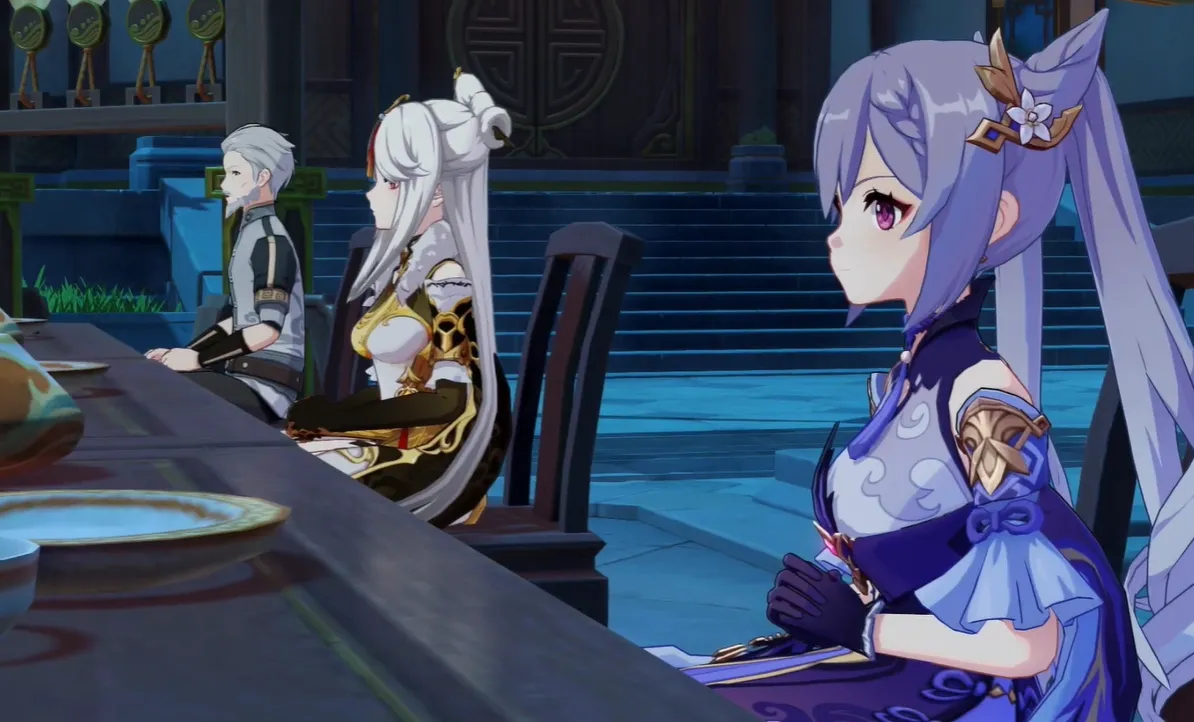
The Liyue Qixing (Chinese: 璃月七星, Liyue Qīxīng, "Seven Stars of Liyue") is the seven-merchant council that governs civilian Liyue. [1] After AQ Chapter I, it inherited Liyue's working executive authority from the Geo Archon Morax. The seven seats are equal in rank, each named for one of the seven stars of the Chinese Big Dipper (北斗 Běidǒu) constellation, with the labour divided by portfolio: laws, urban management, transportation, salt, glazed ceramics, foreign relations, intelligence, and the rest.
Morax as an Archon is covered on Zhongli, Liyue as a region on Liyue, and the pattern of Archons stepping back across Teyvat that began with Morax on the Seven Archons page.
Formation: post-Archon-War civilian consolidation
The Qixing formed ~2,000 years ago, after the Archon War. [1] Morax (Rex Lapis) had won the Archon War and consolidated Liyue under the Geo seat, but the reconstruction after the war needed commercial and artisanal capacity that the Geo Archon's authority alone could not supply. Liyue's most prosperous merchant and artisan families consolidated as a council to provide it, operating under Morax's strategic oversight.
Ganyu, a half-qilin who fought alongside Morax during the Archon War, joined as the Qixing's General Secretary when the council was founded, and has held the role continuously for ~2,000 years. [5] The General Secretary seat is the operational backbone of the council. Ganyu produces the calculations, data, and policy drafting behind the Qixing's day-to-day decisions, and she is attached to no single Qixing member but supports the whole organisation. [1]
Post-Morax inheritance: the Rite of Descension and after
The defining moment of the modern Qixing is the Rite of Descension at the start of AQ Chapter I, Rex Lapis's apparent death over Liyue Harbor. [2] The Qixing learned through a secret message that the Archon had relinquished the seat rather than died, and announced his passing through a controlled trial framework rather than as a public emergency. They inherited all of Morax's previous duties wholesale and began re-evaluating old laws and establishing new ones for civilian-only Liyue. [1] [3]
The transition went smoothly because the Qixing already had ~2,000 years of governance experience. Their commercial and civilian role since the Archon War had given them practiced infrastructure: the Yuehai Pavilion secretariat, the Eight Trades subordinate offices, the Wangshu Inn intelligence network, working relationships with the Adepti through Ganyu, and a culture of governing through divided portfolios. When the Geo Archon seat was formally vacated by AQ Chapter I Act III "A New Star Approaches," civilian governance did not wobble, because the Qixing were already running it.
In Version 7.2 the council leads Liyue through the Hallowing. Ningguang speaks for Liyue at the leaders' meeting in Snezhnaya in Chapter VII Act V and goes with the nations' representatives to Celestia in Act VI. When Venti praises a human for stepping up to "fill the boots of a god," she answers: "My personal contribution to the administration of Liyue is but one piece in a large puzzle. We rely on a group effort, from planning to execution." [8] [9] The World Quest Firm as the Bedrock shows that effort at home. After the meeting, its description says, "the Millelith, the Qixing, and the adepti joined forces to bring the initial chaos under control," and Liyue then "turned to dispatch manpower and supplies to more distant front lines." Keqing moves the discussion on to foreign aid, and Ningguang adds: "Although the Adepti have helped us temporarily weather this crisis, the peril facing Teyvat as a whole looms ever larger. There's much work for us mortals to do." [10]
The seven seats
The Qixing seats are named for the seven stars of the Big Dipper constellation. Each holds a portfolio; each seat is equal in rank. [1]
Seat | Star (Ursa Major) | Holder | Portfolio |
|---|---|---|---|
Tianshu (天枢) | Dubhe / α UMa | Policymaking + succession governance | |
Tianxuan (天璇) | Merak / β UMa | unnamed in canon | unknown |
Tianji (天玑) | Phecda / γ UMa | unnamed in canon | unknown |
Tianquan (天权) | Megrez / δ UMa | Ningguang | Laws (ancient + amended) + foreign relations |
Yuheng (玉衡) | Alioth / ε UMa | Keqing | Urban development + infrastructure + real estate |
Kaiyang (开阳) | Mizar / ζ UMa | unnamed in canon | unknown |
Yaoguang (瑶光) | Alkaid / η UMa | unnamed in canon | unknown |
Only three of seven seats are publicly held by named characters (Tianshu, Tianquan, Yuheng); Tianxuan and Tianji are completely unnamed; Kaiyang has an unnamed holder; Yaoguang remains entirely unrevealed. The Yaoguang seat name itself is sometimes extrapolated from the real-world star name rather than verbatim in-game text, but the consistent star-naming convention makes the inference safe.
Tianshu: Uncle Tian and the Seven-Star Selection
The Tianshu seat holds the policymaking portfolio and is the most senior role coordinating policy on the council. The current holder, Uncle Tian, has held the seat for many years, consolidating his position partly by pitting his political enemies against each other. [1] The Tianshu identity was first disclosed in the Ganyu SQ "Sinae Unicornis Chapter" (1.2, S45 shipment). [5]
The Tianshu succession process, the Seven-Star Selection, is detailed in the Yelan SQ "Umbrabilis Orchis Chapter" (2.7, S45 shipment). [6] Candidates submit a manifesto for Liyue's development; the appointed successor is bound by their manifesto and may not modify it absent a cataclysmic event. Yelan was a candidate in the selection process and declined the seat in favour of her existing intelligence role.
Tianquan: Ningguang
The Tianquan seat holds the portfolio for laws and foreign relations. The current Tianquan, Ningguang, maintains the book of ancient laws inherited from Morax and authors all subsequent amendments. [1] Each amendment keeps the laws aligned with Liyue's current needs; the law-book is designed to be amended, not preserved unchanged. [7]
Ningguang is the only Qixing member who maintains a high public profile, unlike the low-key working style of the rest of the council, and that has made her the member the public most personally identifies with the Qixing. She employs three personal secretaries (Baiwen, Baishi, Baixiao) as her closest confidantes for research and strategy, and operates the Jade Chamber as her sequestered decision-making space.
Yuheng: Keqing
The Yuheng seat holds the urban-management portfolio: urban development, infrastructure, real estate, water-supply quality, sanitation regulation. [1] The current Yuheng, Keqing, spends more time in the field than any other Qixing member, working frequently outside Yuehai Pavilion at the south wharf, the Chasm, and Liyue's uninhabited wilderness. Her work ethic and perfectionism are why her personal assistants typically last no more than three months.
Keqing's stance also sets her apart on the council. She has openly held that Liyue can and should be governed without Adeptal or Archonic guidance, which places her firmly on the "civilian-governance era" side of any debate over how to read Liyue after Morax.
Operational network: secretariat, fronts, and intelligence
The Qixing's executive capacity reaches well beyond the seven seats themselves.
- Yuehai Pavilion atop Yujing Terrace is the Qixing's meeting site and the working headquarters for day-to-day operations. [1]
- The General Secretariat under Ganyu handles calculations, data, policy drafting, and ordinance authoring. Huixin and other junior secretaries support it and, like Ganyu, are not attached to any single Qixing member.
- The Wangshu Inn was founded and is secretly run by the Qixing as a covert operation. It provides material support to Xiao in his ongoing Yaksha duty and is the Qixing's intelligence-gathering point for persons of interest entering Liyue. [4] All its employees (Verr Goldet, Huai'an, Yuhua, Zhen Qiang, Smiley Yanxiao) are Qixing agents.
- The Crux Fleet under Beidou works closely with the Qixing, particularly with the Tianquan, though The Crux is an independent organisation. Beidou is Ningguang's chosen operational counterpart for sensitive off-record assignments.
- Yelan is an intelligence agent who works closely with Ningguang under cover of a role at the Ministry of Civil Affairs, handling foreign agents entering Liyue, including Fatui infiltrators and the Northern Intelligence Network's attempted Liyue presence.
The Eight Trades: Qixing-subordinate industrial offices
The Eight Trades are the eight offices that operate Liyue's major industries under Qixing jurisdiction. Only four are publicly identified in the game: [1]
Office | Industry | Notable members |
|---|---|---|
Communications Office (和记厅 Héjì-tīng) | Transportation | Master Qin "Thunder Hand" (bodyguard) + Yanfei's friends |
Huishan Hall (惠山堂) | (possibly Mining) | Uncle Dai (Foreman) |
Shenglu Hall (盛露堂) | Glazed Ceramics | Miss Ruoyu (Representative); Wanyu (Researcher) |
Yinyuan Hall (银盐堂) | Salt | Wanyan |
The remaining four offices are unnamed in the game. The Eight Trades mirror the seven seats: the Qixing govern as a council, while the work itself is parcelled out to specialised offices they nominally oversee.
Common misreadings
- Yun Hui was a figure connected to the Qixing whose title is unknown (named on Blackcliff Series and Prototype Series weapon lore). The game does not say whether he held a seat. Treat him as a case study of a former member rather than as evidence of a particular seat.
- The "Tian"-prefixed seat-naming pattern is the in-game convention, but only Tianshu, Tianquan, and Yuheng are clearly verbatim in primary text; Tianxuan and Tianji are extrapolated from the Big Dipper naming convention (Note 1 in the Fandom roster table). They are likely correct but not as firmly grounded in primary text as the named three.
- The Qixing is not anti-Adepti. The Wangshu Inn operation supporting Xiao (a Yaksha and Adeptus) is evidence that the Qixing, as a body, actively partners with the Adepti where it suits Liyue's interests. Keqing's "humans don't need gods" stance is her personal position, not the Qixing's official one. The Qixing's actual stance on Adepti is case-by-case, governed by Liyue's interests as the council defines them.
- The Qixing did not depose Morax. Morax retired the Geo Archon seat voluntarily (per AQ I Act III "The Fond Farewell"); the Qixing's inheritance of his governance duties was the planned consequence of his retirement, not the cause of it.
How the Qixing connect to other institutions
The Seven Archons context is the clearest. Morax's retirement is the first case in the post-Cataclysm pattern of surviving Archons stepping back from the Heavenly Principles' implied order. The Qixing's readiness to inherit Liyue's governance is what made that retirement possible: without the council, Liyue would have needed a replacement Archon rather than a council to inherit.
The Eleven Fatui Harbingers are the Qixing's standing counterparty in Liyue. The crisis in which Childe released Osial (AQ Chapter I Act III) put both institutions on alert, and the infiltration plot by Pantalone, the Regrator, disclosed in the Yelan SQ (2.7), is the slow-burning background conflict between them. [6]
On the Cataclysm, the Qixing matter for their sheer continuity. They predate it by roughly 1,500 years and came through it intact, one of the few pre-Cataclysm civilian institutions that stayed functional through the period 500 years ago without restructuring.
The Mondstadt counterpart, a body protecting civilians that inherited governance after the local Archon stepped back, is the Knights of Favonius. Liyue's continuity with Morax's era runs through Zhongli and Ganyu.