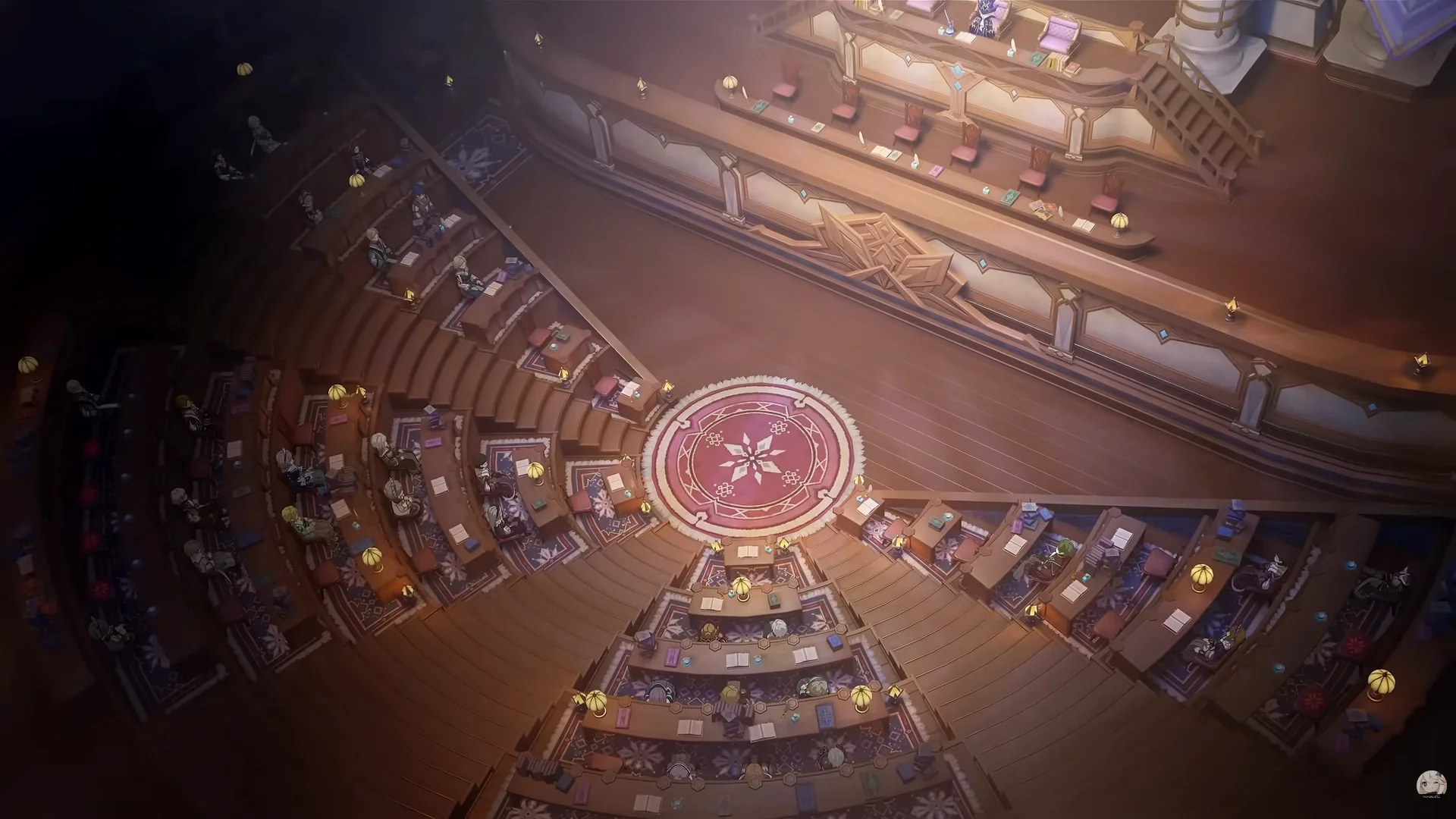
The Snezhnograd Veche, or simply the Veche, is the council where Snezhnaya's policy is argued and put to a vote. Alyosha points out its hall on the Traveler's first walk through the capital: "over there is the Snezhnograd Veche, where all the big shots meet regularly to make policy decisions." The hall's map description says that "citizen representatives from various groups deliberate on newly issued laws" there, and that the Veche "is now presided over by 'The Rooster,' one of the Fatui Harbingers." That is Pulcinella, who is also the Mayor of Snezhnograd. [7] [2] [1]
A veche was a popular assembly in medieval Russia. The Chinese name, 皇都评议会, translates as "Assembly of the Imperial Capital." [1]
Founded by the Tsaritsa
A Brief History of the Pale Starborn, a history of the fae thought to be written by fae elders, dates the Veche to the early years of the Tsaritsa's reign. Her troops occupied the lands of several fae clans whose princes she charged with "negligence and condoning rebellion"; their titles were revoked and "their positions taken over by non-hereditary officials," and the remaining princes were told to hand over their authority in exchange for honorary titles. Then: "In the sixth year of the 799th Cycle, the Tsaritsa established the Snezhnograd Veche to handle the administrative issues caused by the absence of the various princes. The human, Ioanna Ivanovna, was appointed its first chairperson." [3] [26]
The artifact text Glory to Your Legacy describes Pulcinella's start in politics. When the Domovoy fae applied to join the Fatui, he was told to report to Mayor Ioanna Ivanovna, who "also served as Speaker of the Snezhnograd Veche." "To outsiders, compelling a fae to bow his head and become the pupil of a human was Her Majesty's warning to the old order." Her high opinion of him made him "a likely successor to her position." Fandom identifies her with I. Ivanovna N., a member of the Hexenzirkel, the circle of witches. [4] [5]
Chapter VII Act V says both things in dialogue. When the Tsaritsa names "Ioanna Ivanovna" as someone who might help against the Hallowing, Pierro explains who she was: "Pulcinella's predecessor — the first chair of the Snezhnograd Veche. She was also a member of the Hexenzirkel... 'J' was her codename." The friendship she built between Snezhnaya and the Hexenzirkel "persists to this day." Alice of the Hexenzirkel, visiting the palace, remembers how "Ioanna once complained to me about how she had to work herself to the bone every day in the Veche, because there was simply so much urgent work to be done." Alice also looked in on the chamber, and found that "although the Veche continues to argue as ever, most of the issues under debate there seem less pressing than once was the case." [27] [28]
Who sits there
Pulcinella runs the chamber. Alyosha calls him "the chair of the Snezhnograd Veche and a key figure in the voting process," with "the backing of many powerful and influential people." Sandrone calls him "the linchpin of the Veche," adding, "Everything involves him, so nothing can bypass him." In one of her voice-overs she says he "often feels more like... its overseer." [6] [7] [17] [24]
The other members speak for interest groups. "Having a voice in the Veche is the only way to steer policies in your favor," Sandrone explains. "So, every person in that room represents a particular interest group. Pantalone, for instance, represents the financial sector, and Tartaglia represents the Fatui soldiers." She speaks for the engineers and researchers under her command. Childe became "Councilor Tartaglia" after Capitano's last letter reassigned his key people to him. [7] In Act V the Veche also shares in hosting the nations' leaders. Childe explains that "although the Bureau of Ceremonies handles most of the day-to-day work, they still need some oversight from the Veche and the Fatui." "I got roped in by old man Rooster, since I hold posts in both," he adds. [27]
Families hold seats too. In Vesna's character story, Pulcinella tells her that "Of all the seats on the Snezhnograd Veche, only a scant few are reserved for your family, even fewer than those allotted to the merchant class." Others met in its hall include Golitsyn, a "Second-rank noble and Active Privy Councillor"; Euphrosiniya Trubetskaya, head of her house and a Veche Councillor; and Eteri, a Vila of House Strivozha who carries the same title. At the Act I session a finance scholar speaks for Pantalone, a Druzhna officer takes notes for her absent commander Vesna, and an Energy Commission representative offers its statistics. [16] [18] [19] [21] [8]
A session
Outsiders can sit in. Sandrone says the factional strife "plays out for all to see in that one little room," and the Traveler watches a session beside Vodyanitsa, with a reporter from the street-stall paper Bring Out the Kvass! tagging along. [7] [8]
The Act I session follows a set order. Discussion of extending Project Stuzha is saved for the end. Pulcinella presents energy statistics and opens the floor to the representatives. Childe protests that Fatui families in remote areas get 15% less Kristall than the average civilian family in Snezhnograd, and Pantalone pushes back. When Childe proposes Fatui data collection under Druzhna supervision, Pulcinella tells him to "Follow the usual procedure" so it can come back "as a new motion," and the members then agree to use Energy Commission statistics checked against the Northland Bank's own report. After discussion "from energy to healthcare, technology, and industry," the final vote is tallied: "Those in favor of continuing Project Stuzha total sixty-one percent, securing a clear majority." The project stays in force "until the next Veche period," and Pulcinella closes with the Veche's formula: "We debate only for the greater glory and solidarity of our nation. May the aurora shine ever on and the tundra always stand firm." [8] [22] [25]
Pressure on the vote
Alyosha says extensions need "to pass by majority vote," but that opponents "end up caving in to political pressure from 'The Rooster.'" Childe admits he has not voted against the project "because the Tsaritsa would never let me get away with it." Odette suspects "many others in the Veche who must feel trapped and forced to vote against their conscience." [6] [7]
Pressure came from the other side as well. The Rokot operative Lelek, Vodyanitsa says, "believes that votes in the Veche are all that matter" and will use "threats, coercion, or bribery" to change them. The factory owner Chugunov flips after a threatening letter, then complains, "Project Stuzha cannot be so easily shaken. Not with The Rooster in charge." Lelek's organization, Rokot, ends its notice to members with a version of the Veche's own closing words: "We act only for the greater glory and solidarity of our nation." [8] [9] [10]
Councillors complain from inside, too. Euphrosiniya says she has "put forward no fewer than five proposals to improve heating in Zolnyy," only for the Speaker to dismiss each one. The Druzhna officer Akvilina, a privy councillor herself, calls the Veche "rotten, utterly corrupt." Sandrone's view is kinder: "As contentious as things can get within the Veche, there's no selfishness or malice behind it." [19] [20] [7]
After the vote
Project Stuzha was put on hold at the end of Act II, and the decision came from outside the chamber. In Act III Childe says that "ever since The Jester decided to put Project Stuzha on hold, the atmosphere in the Veche has improved a lot," though members still bicker "about things they'll never be able to agree on." Pulcinella tells the Tsaritsa that publishing the figures at the Veche and holding open discussions kept disputes "within a manageable range." [11]
When rumors of the Seals of Life spread in Act III, a crowd gathers at the Veche's hall: "The Veche owes us an explanation! If the councilors won't talk, we'll go to Her Majesty!" A bystander notes that the Veche usually rushes to deny rumors like this, and this time stayed silent. Councilor Belozersky fails to calm the crowd until Pantalone sends him back: "much work remains in the Veche." Once the seals have been returned, "the Veche announced that the Seals of Life had fulfilled their purpose." [12] [13]
In a Version 7.1 World Quest, the Tsaritsa's secretary Chayka explains why a questionnaire will not do: it would alert officials at every level, and "Her Majesty would most likely just end up with another report from the Snezhnograd Veche instead of who she truly wants to hear from." [15]
The Harbingers' vote was not a Veche vote
The unanimous vote of Act IV belongs to a different body. To unseal Hroptatyr's notebook, Pierro summons the active Harbingers to the Armory Palace archives for what Sandrone calls "an internal meeting of the Fatui Harbingers." It follows a rule set when the notebook was sealed: "Any decision that entails a national-level risk must be voted on in person by all active Harbingers. The motion must pass unanimously before it can be executed." Pulcinella, Childe, Arlecchino, Pantalone and Sandrone vote in favor, and Pierro, who raised the motion, does not vote. The Veche does not appear in that act's dialogue. [14] [23]
Open questions
The hall's description calls its deliberations "a tradition preserved since the early days of Snezhnaya's founding," while the chronicle dates the Veche itself to the Tsaritsa's sixth year; whether some older assembly came first is not said. How seats are allotted beyond the hints about families and the merchant class is unknown. One of Sandrone's voice-overs refers to votes "cast in the Evaluation Council," and it is implied but not stated that this means the Veche. [2] [3] [17]